




A foreign applicant can qualify for startup or small entity status in India and pay about 80% lower patent fees. Since a foreign entity cannot get DPIIT recognition or Udyam registration, it self-declares against the Startup India or MSME medium-enterprise thresholds and files Form 28 with each fee-bearing document.
This guide covers the position under the Indian Patents Act 1970 and the Patents Rules 2003 as they stand in June 2026, for a foreign founder or in-house team deciding whether their company can claim the lower official fee category when filing a patent in India, and how to keep the benefit afterwards.
| Quick answer |
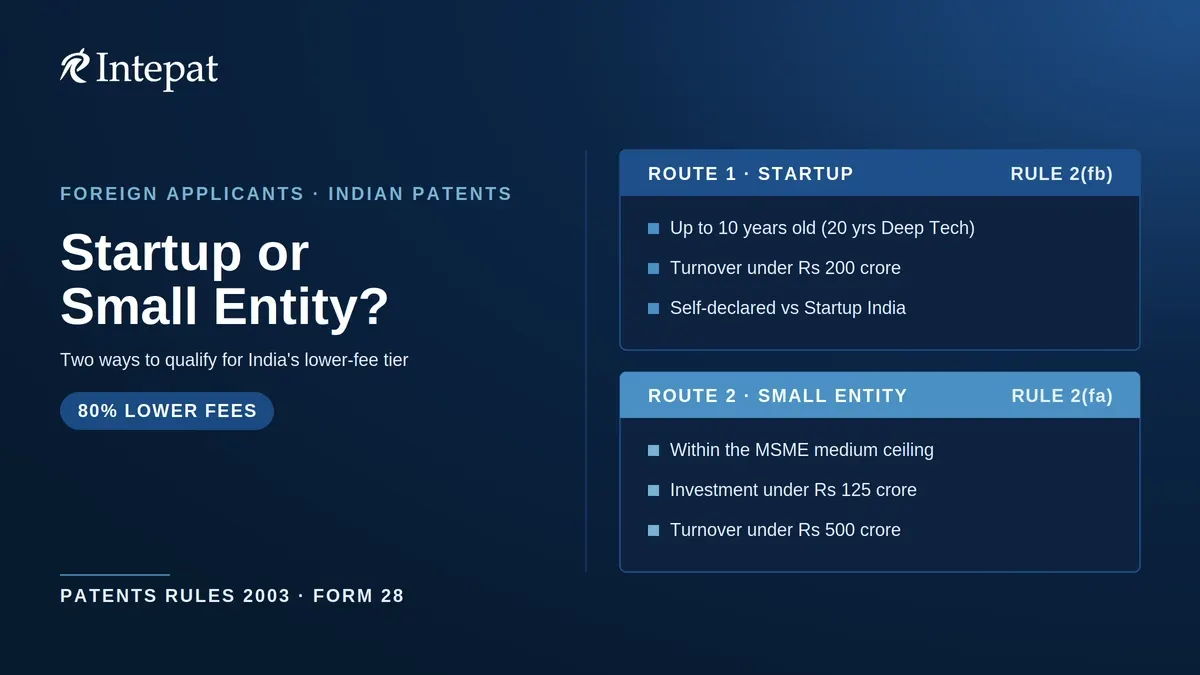
| Startup route (Rule 2(fb)): incorporated up to 10 years ago, turnover under Rs 200 crore in every year since incorporation, self-declared against the Startup India turnover and incorporation-period criteria. The newer Deep Tech limits (20 years, Rs 300 crore) should be confirmed before they are relied on. Small entity route (Rule 2(fa)): within the MSME medium-enterprise ceiling, investment up to Rs 125 crore and turnover up to Rs 500 crore, revised with effect from 1 April 2025. Fee effect: startups and small entities pay the natural-person rate, one-fifth of the large-entity fee. Filing costs Rs 1,600 instead of Rs 8,000; examination costs Rs 4,000 instead of Rs 20,000. How to claim it: file Form 28 (no official fee) with every document that carries a fee, with evidence of status. Convert foreign-currency figures at Reserve Bank of India reference rates. Bonus: both startups and small entities can request expedited examination on Form 18A under Rule 24C. |
Can a foreign company qualify as a startup or small entity in India?
Yes. The Patents Rules 2003 define both “small entity” and “startup” to include foreign entities, so a non-Indian applicant is not shut out of the lower fee tier. Rule 2(fa) and Rule 2(fb) each contain a separate route for foreign entities, and the Manual of Patent Office Practice and Procedure sets out the declaration they file in place of the Indian recognition documents.
Which route to check first depends on size: the startup route if the company is young and within the Startup India limits, the small entity route if it is older or larger, since that route follows the much higher MSME medium-enterprise ceiling.
The practical obstacle is proof, not eligibility. An Indian startup proves status with a DPIIT certificate and an Indian enterprise with an Udyam registration; a foreign company cannot obtain either, since both require incorporation or registration in India. The Rules answer this by letting a foreign entity self-declare that it meets the same thresholds and submit that declaration on Form 28.
The concession is open only to an applicant that meets the criteria: a large foreign corporation exceeding both thresholds files as an ordinary applicant at the full rate, with no foreign discount, only equal access to the status an Indian applicant of the same size would hold. Filing in India, including the address for service required for non-residents, is covered in our patent filing guide.
Startup status for a foreign applicant: the Rule 2(fb) self-declaration route
Rule 2(fb) defines a startup in two parts. For an Indian entity, it is one recognised as a startup by the competent authority under the Startup India initiative. For a foreign entity, it is one “fulfilling the criteria for turnover and period of incorporation/registration as per Startup India Initiative and submitting declaration to that effect.”
A foreign applicant does not need DPIIT recognition. It needs to meet the turnover and incorporation-period criteria the Startup India scheme sets, and to declare that it does. The two operative criteria, as the scheme currently stands, are:
- Period: the entity has not completed 10 years from its date of incorporation or registration. A Deep Tech startup has 20 years.
- Turnover: turnover has not exceeded Rs 200 crore in any financial year since incorporation. For a Deep Tech startup the ceiling is Rs 300 crore.
These figures are current as of June 2026. The DPIIT notification of 4 February 2026 (G.S.R. 108(E)) raised them, replacing the earlier Rs 100 crore ceiling and adding the Deep Tech category. Because Rule 2(fb) points to the Startup India criteria as they stand from time to time, the prevailing figures apply, not those in force when an older guide was written; you can confirm them on the official Startup India recognition page. Turnover in another currency converts at the Reserve Bank of India reference rate, as the Explanation to Rule 2(fb) requires.
Deep Tech status is a DPIIT determination made on the evidence furnished, not a free self-assessment. A foreign applicant should confirm that its evidence supports that category, and that the Patent Office accepts a self-declaration for it, before relying on the 20-year period and Rs 300 crore ceiling. The ordinary 10-year and Rs 200 crore limits are the safer default.
A separate scheme, the Scheme for Facilitating Start-Ups Intellectual Property Protection (SIPP), is often confused with the fee concession. SIPP funds the fees of empanelled facilitators, and its eligibility turns on DPIIT recognition. A foreign startup cannot obtain that recognition, so it cannot use SIPP, though it can still claim the statutory fee concession through the Rule 2(fb) declaration. The two are independent.
Small entity status for a foreign applicant: the MSME medium-enterprise threshold
“Small entity” under the Patents Rules is wider than the name suggests. Rule 2(fa) sets the ceiling at the limit for a medium enterprise under Section 7(1) of the Micro, Small and Medium Enterprises Development Act 2006, not the small-enterprise limit, so a business far too large to be a startup can still qualify.
The medium-enterprise ceiling was revised from 1 April 2025 by Notification S.O. 1364(E): investment in plant and machinery or equipment up to Rs 125 crore and turnover up to Rs 500 crore, up from Rs 50 crore and Rs 250 crore. Both apply; breaching either ceiling puts the enterprise outside the category.
For a foreign entity, the Manual of Patent Office Practice and Procedure provides the route: the applicant declares that its investment in plant and machinery or equipment is within the limit prescribed under the MSME Act. Because the MSME classification is a composite test, the safer course is to show that both investment and turnover sit within the medium-enterprise limits. The declaration goes on Form 28 with supporting evidence, typically the entity’s audited financial statements, with foreign-currency figures converted at the Reserve Bank of India reference rate.
What the status saves: the 80% fee concession and expedited examination
The concession is built into the First Schedule to the Patents Rules. Startups, small entities, natural persons, and educational institutions sit in the lower fee column; every other applicant sits in the higher one, and on the core filing and examination fees the lower rate is one-fifth of it, an 80% reduction, with the gap wider still on some steps. The fees below are for electronic filing, verified as of June 2026. Physical filing carries a higher schedule (Rs 1,750 to file instead of Rs 1,600), so the lower rates assume e-filing.
| Step | Form | Startup / small entity | Other applicant |
| On filing an application | Form 1 | Rs 1,600 | Rs 8,000 |
| Request for examination | Form 18 | Rs 4,000 | Rs 20,000 |
| Expedited examination | Form 18A | Rs 8,000 | Rs 60,000 |
| Claiming the status | Form 28 | No fee | Not applicable |
These are official government fees only; professional fees are separate, and our patent cost guide breaks the figures down across the lifecycle, where the saving repeats at every fee-bearing step. See our guides to the request for examination and the provisional patent application, the cheapest entry point, filed at the same Rs 1,600 rate.
Status also affects how quickly the application is examined. Under Rule 24C, a startup or small entity can request expedited examination on Form 18A, which moves the application into a priority queue, and in current practice the first examination report then issues far sooner than on the ordinary route. A foreign company that is not a startup or small entity cannot use that ground, but may still qualify under another Rule 24C route, in practice by having designated India as the International Searching Authority, or elected it as the International Preliminary Examining Authority, in the corresponding PCT application. Rule 24C also covers an arrangement between the Indian Patent Office and a foreign patent office, but India’s only such arrangement, the Patent Prosecution Highway pilot with Japan, was discontinued in 2022, leaving the ISA or IPEA route as the practical one today. Our guides on expedited patent examination and designating India as the ISA set out each path.
Filing Form 28: the evidence a foreign entity submits
Form 28 is the form for claiming small entity or startup status, and it carries no official fee. The form is short; what matters is the evidence attached and the discipline of filing it at the right moments.
Two rules decide whether the concession holds:
- Form 28 must accompany every document for which a fee is specified, not only the first application. The Rules state that “every document for which a fee has been specified shall be accompanied by Form 28.” Miss it on the request for examination, and that step can be charged at the full rate.
- The declaration must be backed by evidence in accordance with Rule 2(fa) or 2(fb): for a foreign small entity, investment and turnover within the medium-enterprise limits, supported by financials; for a foreign startup, the incorporation date and turnover. The Manual calls for a duly authenticated copy of the evidence.
No single Rule prescribes a fixed evidence list, but the documents below are generally useful, verified as of June 2026.
| Status claimed | Documents generally useful |
| Foreign startup | Certificate of incorporation or registration; financial statements; turnover figures for each financial year since incorporation; authorised-signatory declaration; RBI currency-conversion note |
| Foreign small entity | Audited financial statements; investment (plant, machinery or equipment) schedule; turnover statement; auditor or accountant certificate where available; authorised-signatory declaration; RBI currency-conversion note |
| Both | Form 28 with each fee-bearing form; Form 26 power of attorney for the Indian patent agent; applicant details and Indian address for service |
A foreign applicant that does not reside or carry on business in India files through a registered Indian patent agent with an Indian address for service, whether entry is direct or through the PCT national phase. The agent files Form 28 alongside the other forms at each fee-bearing step.
Keeping the status valid: lapses, transfers, and the mistakes to avoid
Growing out of the category does not claw back what you have already saved. If a startup completes its recognition period, or a startup or small entity later crosses the turnover threshold, the Rules say “no such difference in the scale of fees shall be payable” on an application already filed. Rule 24C gives the same protection to an expedited request: it shall not be questioned merely because the applicant has since ceased to be a startup or small entity.
A transfer is different. If the application is assigned to someone who is not a natural person, startup, small entity, or educational institution, for example a large acquirer, the new applicant pays the difference between the concessional fees already charged and the full rate, with the request for transfer. Diligence on an inbound filing should price this in.
Three errors recur. Relying on the superseded Rs 100 crore startup turnover ceiling can wrongly exclude an applicant that is now eligible up to Rs 200 crore. Treating the SIPP facilitator scheme as available to a foreign entity, when it requires DPIIT recognition the entity cannot obtain. And filing Form 28 once at the outset, then omitting it on a later fee-bearing step. Each is avoidable, and cheaper to prevent than to correct after the Patent Office raises the fee.
Frequently asked questions
Yes. Rule 2(fb) of the Patents Rules 2003 lets a foreign entity qualify by meeting the Startup India turnover and incorporation-period criteria and filing a declaration to that effect on Form 28. DPIIT recognition is the Indian proof route; it is neither available to nor required of a foreign applicant.
As of June 2026, the entity must be within 10 years of incorporation (20 years for a Deep Tech startup) and have turnover not exceeding Rs 200 crore in any financial year (Rs 300 crore for Deep Tech). These figures were set by the DPIIT notification of 4 February 2026, replacing the earlier Rs 100 crore ceiling.
A small entity under Rule 2(fa) is one within the medium-enterprise limit of the MSME Act. From 1 April 2025 that means investment in plant and machinery or equipment up to Rs 125 crore and turnover up to Rs 500 crore. Both ceilings must be satisfied for the status to hold.
The status places the applicant in the lower First Schedule column, one-fifth of the large-entity fee, an 80% reduction. Filing costs Rs 1,600 instead of Rs 8,000, and a request for examination costs Rs 4,000 instead of Rs 20,000, for electronic filing. The saving repeats at each fee-bearing step.
Yes. The Patents Rules require Form 28 to accompany every document for which a fee is specified, not just the first application. Omitting it on a later step, such as the request for examination, can cause that step to be charged at the full applicant rate.
No. The SIPP facilitator scheme requires DPIIT recognition, which a foreign entity cannot obtain. A foreign startup can still claim the statutory 80% fee concession through the Rule 2(fb) self-declaration on Form 28. The SIPP facilitator funding is a separate benefit and is unavailable to it.
Yes. A foreign applicant entering the Indian national phase can claim small entity or startup status if it meets the applicable criteria, by filing Form 28 with supporting evidence alongside the relevant fee-bearing document. The status attaches to the national phase application as it would to any other application.
If the application is transferred to an applicant that is not a natural person, startup, small entity, or educational institution, the new applicant must pay the difference between the concessional fees already paid and the ordinary applicant fees, along with the request for transfer. Fees already paid are not clawed back.
This article explains the law on startup and small entity status for patent applicants in India as at June 2026 and is for general information only. It is not legal advice. Government fees, forms, and the underlying Startup India and MSME thresholds change; confirm current figures with the Indian Patent Office before you file. For advice on your specific invention, consult a registered patent agent. An incorrect or omitted status declaration can cost the concession on a given step, so do not rely on these figures for a specific filing without confirming the current position.