




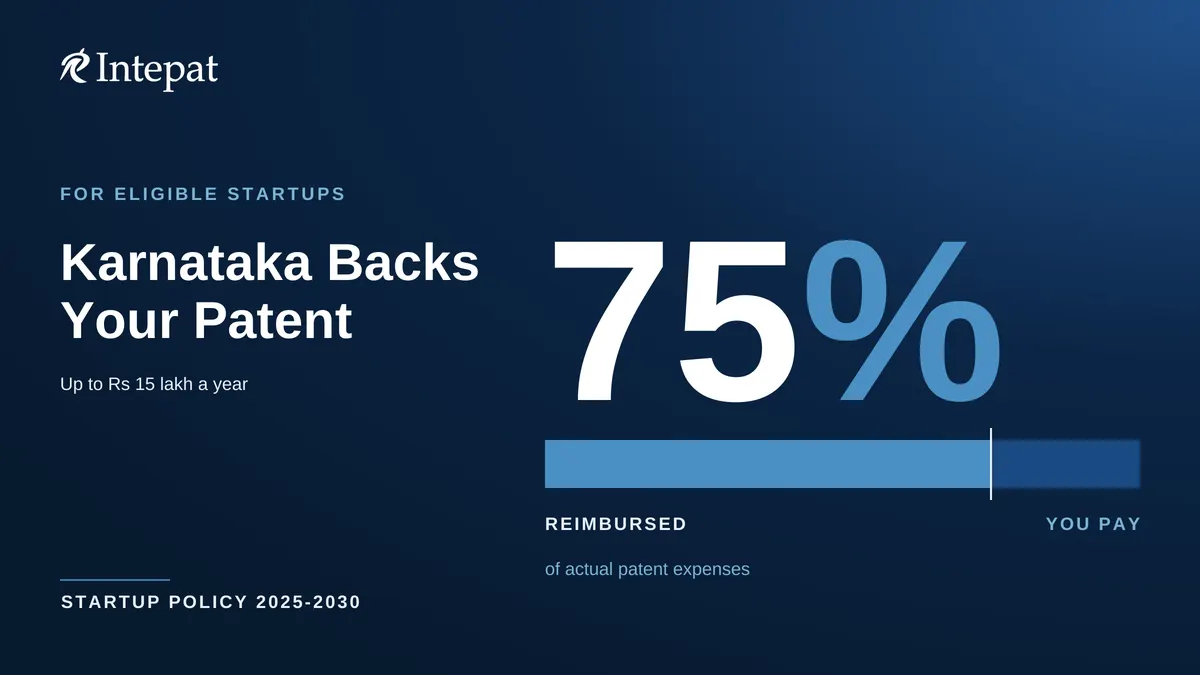
Karnataka reimburses 75 percent of what an eligible startup spends on a patent, up to Rs 15 lakh a year and five claims a year, under the Karnataka Startup Policy 2025-2030. The Karnataka patent subsidy covers Indian and foreign filings, offers two claim routes, and excludes provisional application costs.
This is the Startup Policy route, the one open to startups in Karnataka generally; other Karnataka policies carry their own sector incentives. The policy took effect through a Government Order of 14 November 2025 and runs for five years from that date, or until a new policy is announced. Its operational guidelines, issued under the same file in April 2026, carry the claim mechanics, the prescribed forms and the official worked illustration.
Quick answer: An eligible startup registered with KITS can recover 75 percent of its patent expenses, capped at Rs 15 lakh a year, and at most five claims a year. There are two routes: claim after filing, and a part of the government fee is released at once; or claim after grant, and 75 percent of total expenditure is paid after committee approval. Claims must be made within one year of filing, and provisional application costs are excluded.
What the Karnataka patent subsidy pays
Karnataka pays 75 percent of a startup’s actual patent expenses, subject to a maximum of Rs 15 lakh in each year of the policy period. The instruments permit a maximum of five claims a year, and the guidelines also speak of five unique patent applications a year. Both Indian and foreign filings qualify.
Rs 15 lakh is an annual ceiling on money. The second number is counted two ways in the instruments themselves: the policy clause and the guidelines table both permit a maximum of five claims per year, while the guidelines’ terms and conditions say that five unique patent applications are considered in a year by a single startup. The guidelines reconcile the two. A second claim under the same patent application is not treated as a separate or independent claim under the policy, which fixes the application as the unit being counted, so the effective annual limit is five applications and a repeat claim on one of them does not consume a slot. A startup may claim twice on the same application during the policy period.
| The subsidy at a glance | |
| Rate | 75 percent of actual expenses |
| Annual cap | Rs 15 lakh per year during the policy period |
| Claims counted | A maximum of five claims a year; the guidelines also state five unique patent applications a year per startup, and a second claim on the same application is not a separate claim |
| Filings covered | Indian and foreign |
| Claim after filing | 60 percent of 75 percent of the applicable government fee released on proof of payment; balance after document verification and committee approval; available twice on the same application during the policy period |
| Claim after grant | Patent must already be granted; 75 percent of total expenditure, government and non-government fees included; paid after committee approval |
| Claim window | Within one year from the date of filing the patent |
| Not covered | Provisional application expenses; patents with a change of assignee; fees not already paid |
| Claimant bar | A startup that has already availed this benefit under any other policy scheme of the Karnataka government or the Government of India cannot claim again under this or any other policy of the department |
| Who may claim | Startup registered with KITS, holding a valid Karnataka Startup registration number, and operating in Karnataka |
| Sanction | Approval Committee, subject to budgetary provision and availability of funds |
Verified as of October 2026.
Who qualifies as a startup under the 2025-2030 policy
The policy takes its startup definition from the central notification of 4 February 2026: incorporated or registered in India, within ten years of incorporation or registration, and turnover in any financial year since incorporation not exceeding Rs 200 crore. A recognised deep tech startup gets twenty years and Rs 300 crore.
The eligible forms are wider than founders often assume. They run to a private limited company, a registered partnership firm, a limited liability partnership, a Multi-State Cooperative Society and a Cooperative Society registered under a State or Union Territory Act. An entity formed by splitting up or reconstructing an existing business is excluded. A startup also stops receiving benefits under the policy once ten years have passed from incorporation or its turnover in any previous year crosses Rs 200 crore.
The Karnataka connection is not incorporation in the State. The definition asks for incorporation or registration in India; what ties the subsidy to Karnataka is registration with the Karnataka Startup Cell under KITS, a valid Karnataka Startup registration number, and operating in Karnataka. If you have read that the turnover limit is Rs 100 crore, or that the company must be incorporated in Karnataka, you are reading the 2022-2027 policy, which the State replaced in November 2025. Neither the policy’s patent clause nor the patent provisions of the operational guidelines make incubation a condition of this subsidy, which the earlier scheme did.
How the subsidy is paid: two routes
The guidelines give two routes. On the post-filing route, 60 percent of 75 percent of the applicable government fee is reimbursed at once on proof of payment, with the balance released after document verification and committee approval. On the post-grant route, a granted patent attracts 75 percent of total expenditure, paid after committee approval.
The State’s own illustration shows how the first route works. On government fees of Rs 4,00,000 and non-government fees of Rs 4,00,000, total spending of Rs 8,00,000, the eligible incentive is 75 percent of the total, or Rs 6,00,000. The immediate release is worked out on the government fee alone: 75 percent of Rs 4,00,000 is Rs 3,00,000, and 60 percent of that is Rs 1,80,000, paid on submission of the fee invoice. The remaining Rs 4,20,000 follows document verification and approval. The guidelines say in terms that this exists to let a startup recover part of the government fee without waiting for committee approvals, reducing the initial cash outflow.
That is the practical difference between the routes. The post-filing route gets cash moving earlier but computes the immediate part on the government fee, which for a startup on the concessional fee scale is a small fraction of what a patent actually costs. The post-grant route waits for the grant and then pays on the whole eligible spend. One caution on the State’s own pages: the incentives page carries these two headings the other way round against their own text, so read the operational guidelines, not the web table, when deciding which route you are applying under.
What the subsidy will not cover
Four exclusions matter before you budget. Expenses on a provisional application are not reimbursed. A patent that has gone through a change of assignee is not considered. The fees must already have been paid. And a startup that has already taken this benefit under another Karnataka or central scheme is disqualified from taking it again.
That last one sits in the guidelines’ general conditions rather than in the patent clause, and it is the one most likely to be missed. A startup that has already availed this benefit under any other policy scheme of the Karnataka government or the Government of India is not eligible to claim again under this policy or any other policy of the department. It bars the claimant rather than the invoice, so settle which scheme you are using before you claim under either. The paid-fees condition has a simpler effect: the subsidy reimburses spending rather than funding it in advance.
The provisional exclusion is the one that shapes filing strategy. Filing a provisional application first is often the right commercial call, because it secures a date while the invention is still developing and allows 12 months to file the complete specification. The exclusion does not make that a bad decision; it means the cost of the provisional stage sits outside the claim, while later expenses fall to be assessed under the operative rules. A startup that files provisionally should keep the two stages separately invoiced so that the claim file does not mix excluded costs with the rest.
The change-of-assignee exclusion catches a common startup pattern: an application filed in a founder’s name and later assigned to the company. Where the subsidy matters to the cash plan, file in the name of the entity that will own the patent.
When you must claim, and what to file with it
A claim must be made within one year from the date of filing the patent. The prescribed documents are bank account statements highlighting the transactions, invoices and receipts, and a notarised affidavit executed on stamp paper in the form set out at Annexure 10.2 of the operational guidelines, which also prescribe a detailed statement of expenditure for patent registration.
Applications for fiscal incentives are submitted online through the State’s registration portal, and startup registration itself runs through the Karnataka Startup portal. Use the prescribed affidavit and expenditure statement rather than drafting your own, and assemble the evidence as the work happens rather than in the eleventh month, because the window is measured from filing and sanction depends on committee approval and available funds.
Two points in the instrument are worth a written question to KITS before you plan around them. The window runs from “the date of filing the patent” without saying whether that is the provisional or the complete specification, while provisional expenses are separately excluded; counting from the earliest filing is the precautionary course rather than a stated government position. And a one-year window measured from filing sits awkwardly with a route that requires the patent to have been granted, since grant ordinarily takes longer than a year.
Why the Rs 2 lakh figure you may have read is out of date
Rs 2 lakh per Indian patent awarded, and Rs 10 lakh for foreign patents on a single subject matter, were the figures under the Karnataka Startup Policy 2022-2027, paid 75 percent after filing and 25 percent after grant, and limited to incubated startups. A Government Order of 14 November 2025 replaced that policy.
Those older figures remain easy to find. As at October 2026 the State’s legacy incentives page at startup.karnataka.gov.in still published the 2022-2027 terms, and several summaries of patent reimbursement schemes in other States carry them too. Karnataka’s patent reimbursement was restructured, not merely repriced: the old scheme paid against an awarded patent with a per-patent ceiling, while the current one pays against expenses within an annual cap and a count of applications.
What the current instruments do not state is how a patent filed while the 2022-2027 scheme was in force should be treated if the claim is made now. No transitional or saving provision appears in the Government Order or in the operational guidelines. The guidelines do provide that incentives filed by a startup within the validity period of the policy are eligible for reimbursement, which speaks to when the claim is filed rather than to when the patent was filed. If you filed before 14 November 2025 and have not yet claimed, ask the Startup Cell which policy governs your claim before you prepare the file, because the answer changes both the cap and the evidence you need.
What the central schemes add
The State subsidy and the central concessions are separate pots. A startup recognised under the Startup India initiative pays the lower fee scale at the Indian Patent Office under the Patents Rules, which is a discount at the counter rather than money back. The Ministry of MSME’s Innovative Scheme reimburses separately, after registration, on its own caps and conditions.
On official patent fees, the lower scale is substantial: the base electronic application fee is Rs 1,600 for a natural person, startup, small entity or educational institution against Rs 8,000 for other applicants, covering up to 30 pages and 10 claims, with a request for examination at Rs 4,000 against Rs 20,000 and a request for expedited examination at Rs 8,000 against Rs 60,000, which is an electronic filing only. A startup, a small entity or an educational institution files Form 28 with each fee-bearing document to claim the scale, where a natural person does not, and adding a co-applicant who does not qualify moves the whole application to the higher one. Being a startup is itself a ground for expedited examination.
The central reimbursement repays the cost of a domestic patent up to Rs 1 lakh and a foreign patent up to Rs 5 lakh, claimed once the patent is registered; the patent benefits for an MSME guide sets out the eligibility and the claim route. Its guidelines require a self-declaration that funding is not being claimed from any Central or State government source, and make the support one-time, so treat the two schemes as competing claims on the same patent rather than a combined entitlement. One central route has run its term: the facilitator scheme for startups, SIPP, ran for three years to 31 March 2026, and no extension, renewal or successor had been notified on the Patent Office, Startup India or DPIIT pages when they were checked on 17 October 2026. The Patent Office listing still carries the scheme with its start date and duration, so confirm its position before counting on a facilitator.
There is also help in Karnataka outside the subsidy. The Patent Information Centre run by the Karnataka State Council for Science and Technology on the Indian Institute of Science campus publishes prior art search reports, assistance with filing, IP cells in colleges and awareness programmes. A search before drafting narrows what an agent has to work around later.
Frequently Asked Questions
No. The guidelines state that expenses related to provisional patents are not reimbursed. Filing provisionally can still be the right commercial decision, because it secures a date, but the cost of that stage falls outside the claim. Keep provisional and complete specification costs separately invoiced, and later expenses are assessed under the operative rules.
The policy adopts the central startup definition from the notification of 4 February 2026, so the same tests of age, turnover and entity form apply. What the policy requires of you is registration with the Karnataka Startup Cell under KITS, a valid Karnataka Startup registration number, and operating in Karnataka.
The current policy does not price foreign filings separately. It reimburses 75 percent of actual expenses for domestic and international filings alike, inside the same Rs 15 lakh annual cap and the same five-claim limit. The Rs 10 lakh figure, for foreign patents on a single subject matter, belonged to the superseded 2022-2027 policy.
No transitional provision appears in the 2025-2030 policy, the Government Order of 14 November 2025 or the operational guidelines. Ask the Karnataka Startup Cell in writing which policy governs a patent filed before that date, because the cap, the payment routes and the evidence all differ between the two schemes.
Bank account statements highlighting the relevant transactions, invoices and receipts, and a notarised affidavit on stamp paper in the form prescribed at Annexure 10.2 of the operational guidelines, which also prescribe a detailed statement of expenditure for patent registration. Applications for fiscal incentives go in through the State’s online portal.
Both sides bar it. Karnataka’s guidelines disqualify a startup that has already availed this benefit under any other policy scheme of the Karnataka government or the Government of India, and bar a further claim under any other policy of the department. The MSME scheme separately requires a declaration against other government funding.
This article explains the law on the Karnataka patent subsidy in India as at October 2026 and is for general information only. It is not legal advice. Government fees, forms, and procedures change; confirm current figures with the Indian Patent Office before you file. For advice on your specific invention, consult a registered patent agent. Scheme terms, eligibility and available funds are matters for the Karnataka Startup Cell, which should be asked to confirm the position for your claim.