




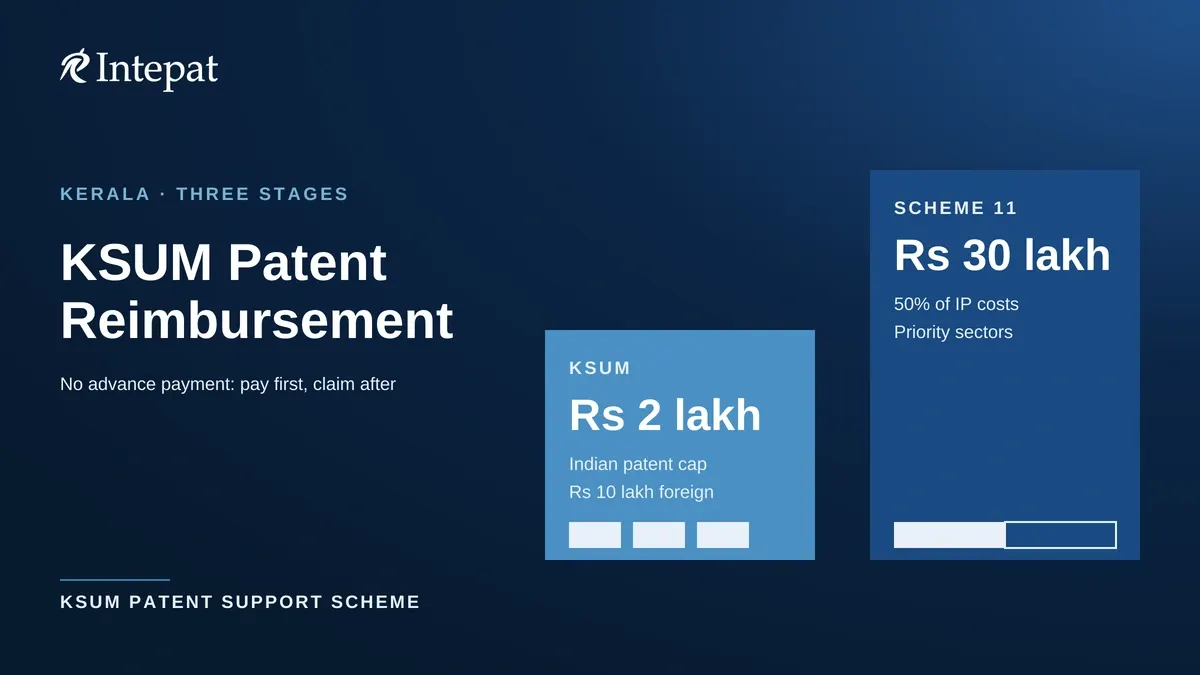
KSUM patent reimbursement, run by Kerala Startup Mission, is published with ceilings of Rs 2 lakh for Indian patents and Rs 10 lakh for foreign patents, consultation costs included. Its materials describe payment in three stages, at filing, prosecution and award, but word the unit of each ceiling differently. Confirm the cap and current intake before you budget.
This guide to the Kerala patent subsidy is for startups registered in Kerala. The page KSUM used to publish the scheme on returned an error on 19 October 2026, so it relies on KSUM’s separate Patent Support pages, which carry no dates, and on KSUM’s Early Stage Funding page, which still marks the scheme Coming Soon. Kerala also has a larger route for enterprises in its priority sectors, Scheme 11 under the Kerala Industrial Policy 2023, which repays 50 percent of IP costs up to Rs 30 lakh; it is covered below.
Quick answer: A private limited company or LLP registered in Kerala, within ten years of incorporation, holding a KSUM Unique ID (the ID KSUM issues) and DPIIT recognition and/or Udyog Aadhaar, can seek up to Rs 2 lakh for an Indian patent and up to Rs 10 lakh for foreign patents. KSUM’s pages word what the cap is measured against more than one way, exclude renewals, and disagree on whether the scheme is open. Enterprises in Kerala’s 22 priority sectors may apply separately under Scheme 11 for 50 percent of IP costs incurred since 1 April 2023, up to Rs 30 lakh per applicant across all IP types, subject to available funds; read the overlap section before claiming under both.
Before you file, budget the patent at full cost and treat any reimbursement as upside. Pay the professional by bank transfer so the statement shows the payment, keep originals with seal and signature, and ask KSUM the questions listed below before you file a claim.
What KSUM patent reimbursement pays
KSUM publishes a ceiling of Rs 2 lakh for Indian patents and Rs 10 lakh for foreign patents, consultation fees included. The pages measure each ceiling differently (per patent, per invention or per startup), so treat it as an upper limit and confirm how KSUM applies it before you plan around it.
Three wordings are in circulation, and the Patent Support home page carries all of them. Its text speaks of Rs 2 lakh “per Indian patent awarded” and of Rs 10 lakh for awarded foreign patents “on a single subject matter”, while its list of limits reads “Max. Upto Rs.2 Lakhs for Indian Patents /startup” and “Max.Upto Rs.10 Lakhs for International Patents/startup”. A per-patent ceiling, a per-invention ceiling and a per-startup ceiling lead to very different budgets for a company with several filings, and no page says which governs. Do not assume the ceiling renews each year, or that every patent carries its own full amount.
No percentage is stated, so the ceiling rather than a share of the bill sets the limit. The eligibility page lists the covered work as provisional filings, patent search, drafting, filing, preparation of claims, fast tracking fees, prosecution and grant. It also says the patent consultant or attorney must be registered and identified by IPR India, and that their registration number must be given. The pages do not explain that registration or how to check it, so choose the professional and ask KSUM before you file.
| KSUM patent reimbursement at a glance | |
| Indian patent | Up to Rs 2 lakh; the unit of the cap (per patent, per invention or per startup) is worded differently across KSUM pages |
| Foreign patents | Up to Rs 10 lakh; same unit question |
| Covered work | Provisional filing, search, drafting, filing, claims, prosecution, grant and consultation fees; expedited-examination fees disputed |
| Paid | In three stages: filing, prosecution and award; no advance payment |
| Who | Private limited company or LLP registered in Kerala, within 10 years of incorporation, with a KSUM Unique ID and DPIIT recognition and/or Udyog Aadhaar (the pages word this inconsistently); students through the Innovation and Entrepreneurship Development Centre (IEDC) of their institution |
| Not covered | Renewals (though one KSUM page says maintenance is covered), prosecution before an appellate authority that has rejected the claims, trademarks, copyrights and other IP |
| Filing date | Only patent applications filed after 9 November 2015 |
Verified as of October 2026 against KSUM pages read on 19 October 2026, which are undated and conflict on intake and on maintenance.
Who can claim it
KSUM wants a private limited company or LLP registered in Kerala, within ten years of incorporation, with a KSUM Unique ID and DPIIT recognition and/or Udyog Aadhaar. The schemes “are not applicable to Innovators”, which reads as excluding individual inventors. Students apply through their IEDC. Only patents filed after 9 November 2015 count.
The registration wording differs between KSUM pages. The eligibility page says a startup must have a KSUM Unique ID and “Startup India DPIIT and/ or Udyog Aadhar”. The scheme page, before it went offline, said “a DIPP and Udyog Aadhar”, using the older names. Do not assume that both registrations are required, and do not assume that either one alone is enough: ask KSUM which documents it accepts today. These are KSUM’s criteria for this track, and they should not be read as the national definition of a startup.
The company test excludes more founders than the headline suggests. A partnership firm or a sole proprietorship is outside it, and, as noted, the page says “The schemes are not applicable to Innovators”. A patent filed before the company existed is not automatically excluded: KSUM’s checklist provides for patent costs to be reimbursed to a startup that is pursuing the filed idea, with the original inventor’s no-objection letter where there has been an assignment or a transfer of technology. Settle ownership and consent before you claim, and record any assignment to the company in writing. The checklist asks for original invoices and bank statements, and the pages do not say whether costs a founder paid personally before incorporation qualify, so ask KSUM.
Students are the one exception to the company rule, and may apply through their institution’s IEDC while still studying. KSUM’s undated IEDC site lists other student benefits, but their present operation is unconfirmed, so ask the IEDC.
How a claim works
KSUM’s pages describe reimbursement in three stages, at filing, prosecution and award (which appears to mean grant of the patent), and say no advance payment is considered. You pay the professional and official costs first, then claim against original invoices, receipts and bank evidence. Intake, stage amounts and release timing are not confirmed.
The How to Apply page publishes separate checklists for startups and students. Both ask for an original hard-copy invoice and receipt carrying an authorised seal and signature, and for original bank statements verified by a bank manager. They ask for a copy of the provisional patent certificate where there is one, and for the patent certificate once the patent is granted. Students add a recommendation letter from the IEDC and a letter from the college. The page describes originals being couriered or handed in at a KSUM office, so confirm whether a current online route exists.
Two commitments sit inside the checklist. The startup undertakes that it has not claimed, and will not claim, patent reimbursement cost from any other organisations or government bodies, and agrees to pay KSUM twice the amount reimbursed if that proves untrue. It also declares that it will report on the progress of patent sanctioning every six months.
Timing is not settled either. The Patent Support home page says files are processed in five days once all documents arrive in hard copy and that approvals and disbursements normally take 20 days, with the duration extendable for shortage of funds. The offline scheme page used a different monthly cut-off. None of these statements is dated, so none is a guaranteed date for payment. The same home page says KSUM would forward the proposal to MSME DIC Thrissur under the MSME patent reimbursement scheme. If that route works it would be a second source of money, but it is unverified, and the central scheme asks for a declaration that no other Central or State funding is claimed for the same patent, so it may not be a second source for that patent.
What it will not pay for
KSUM’s pages exclude patent renewals and prosecution before an appellate authority that has already rejected the claims. They support patents only, not trademarks or copyrights. Whether expedited-examination fees count is unclear: the activity list includes fast tracking fees, while the home page exempts Form 18A, the form used to request expedited examination.
The renewal exclusion is the one most likely to catch a founder out. Renewal fees are what keep a granted patent in force, so the support is for getting a patent rather than keeping it, although the Early Stage Funding page describes the scheme as covering maintenance. On expedited examination, the Patent Office fee and KSUM’s treatment of it are separate questions: do not assume either page is the operative one, and ask KSUM in writing before you request expedited examination on the strength of this scheme. Treat the cost of appellate prosecution as uncovered unless KSUM confirms otherwise.
Where KSUM’s own pages disagree
KSUM’s materials do not agree on whether the scheme is open. The old scheme page now returns an error, the Early Stage Funding page says Coming Soon, and the How to Apply page says applications are open on all days. All three are undated, so confirm intake with KSUM before you budget on the scheme.
The disagreement reaches the terms as well. The Early Stage Funding card describes reimbursement of filing, prosecution “and maintenance” of domestic and international patents, and lists the foreign tier as “US Patent upto Rs 10 Lakhs”. The Patent Support pages speak of international patents and exclude renewals. The Startup India summary of Kerala’s policy repeats the US wording. No notice explaining the differences was found.
As at October 2026, no order fixing the scheme’s full current terms was found. Kerala’s 2017 Technology Innovation and Entrepreneurship Policy commits to aligning the scheme with the national scheme and to enhancing it, without stating figures. Before you count on the money, write to KSUM and ask these things: whether applications are open, how the cap applies to a portfolio, whether maintenance and expedited-examination fees are covered, and what each stage pays and when. If your patent was filed before the company existed, add a fifth: whether costs paid personally by a founder qualify.
Scheme 11: up to Rs 30 lakh for enterprises in Kerala’s priority sectors
Under Scheme 11 of the Sustainable Industry Incentive Scheme 2023, enterprises in the State’s priority sectors can be reimbursed up to 50 percent of intellectual property costs, capped at Rs 30 lakh per applicant, for expenses incurred on or after 1 April 2023. Claims are made online and decided at district level.
The scheme covers patents, industrial designs, trademarks, copyrights and geographical indications, nationally and internationally. It is open to new and existing micro, small, medium, large and mega enterprises in the priority sectors, of any constitution, including a proprietorship, provided the applicant has an operational head office in Kerala. A Udyam or IEM registration is required where available, together with a PAN and a GST number. The Industrial Policy 2023 names 22 priority sectors, which this guide does not list; they appear in its Chapter IV from printed page 31, so check your sector first. They include technology sectors such as artificial intelligence and robotics, so the scheme is not only for factories. The scheme text lists a proprietorship and also requires an independent legal entity, so ask the District Industries Centre how it treats a sole proprietor. Industries on the State’s Negative List are excluded, and Scheme 11 defines that list to include government-controlled industries and public sector undertakings. The Government Order’s general guidelines also exclude trading and units started by Government-controlled agencies, and ask for claims only after commercial operation has begun; the Scheme 11 text does not repeat those two rules, so ask the District Industries Centre whether they apply to an IP claim.
Money is paid after the expenditure. The named cost heads are search or subscription charges, documentation, filing charges and document publishing cost; the text does not mention examination, renewal or hearing fees, so ask before assuming them. Bring a chartered accountant’s statement, the fee receipt and an attorney invoice showing what it includes and excludes, registration certificates, original proof of payment and a short report stating the purpose of the filing.
The application and its processing fee must be submitted on the online portal (K-RIIS) within one year of filing or grant, with up to six more months at the sanctioning authority’s discretion, and nothing later is entertained; the text does not say whether filing and grant each start their own window. The fee is 0.5 percent plus GST, with a minimum of Rs 1,000 plus GST, for example Rs 15,000 plus GST on a claim of Rs 30 lakh. The Assistant District Industries Officer recommends the claim and a district committee chaired by the General Manager of the District Industries Centre sanctions it.
After sanction you receive a sanction letter and have 30 days to sign the stamp-paper agreement or file an appeal to the Managing Director of KSIDC (appeal form with a Rs 10 court fee stamp). If you do neither, the sanction cancels automatically without notice and you must apply again and pay the fee again; if genuine reasons stop you signing in time, write to the sanctioning authority within the 30 days; it may grant an extension case by case. Payment is held while an appeal is pending. Only after the agreement does KSIDC pay, depending on the availability of funds.
The conditions run for years. The applicant must operate the unit for five years from filing or grant, and must not transfer, sell or sublet the unit or the assets claimed in that time without the sanctioning authority’s consent. An applicant paid for grant-stage expenses must hold the IP for at least five years from grant and carry the granted IP in the books as a separate intangible asset.
Each year, until the agreement period ends, the unit must send balance sheets, a local body licence, electricity bills and performance particulars in the prescribed proforma before 31 December of the next financial year. Misrepresentation, a breach of the agreement or an unauthorised transfer or change of activity can lead to refund in full with 14 percent annual interest from the date of receipt, after a registered demand notice. Failing to operate for the stated period leads to recovery pro rata to the period not operated, also with 14 percent interest. The policy states no fixed end date and describes itself as evolving. The Government Order approving the scheme was a 2023-24 plan sanction valid to 31 March 2024, so confirm with your District Industries Centre that funds are available now.
Claiming KSUM and Scheme 11 on one patent
Scheme 11 does not bar a claim by a unit that already received IPR assistance elsewhere, but it reduces the amount by what was availed. It does not say whether one expense can be funded twice, or mention KSUM. KSUM’s checklist asks for an undertaking not to claim the same cost elsewhere. Ask both.
Read against each other, the texts do not say how they interact. Scheme 11 subtracts assistance already received from its own entitlement. KSUM’s undertaking, as it appears on its checklist, is a promise not to claim from any other organisations or government bodies the cost that KSUM reimburses, with recovery of twice the amount if that proves untrue. A startup that is also an eligible enterprise could therefore find that a claim made under one scheme conflicts with the undertaking given under the other.
Do not assume that splitting costs between the schemes by invoice resolves the point, and do not rely on either scheme’s text alone. If you expect to qualify under both, raise it with KSUM before you sign the undertaking and with the District Industries Centre before you apply.
How it sits with central support
Central support includes a lower Patent Office fee scale, the Ministry of MSME’s Innovative Scheme and the SIPP scheme for startups. The Innovative Scheme repays costs for granted patents through an IP Facilitation Centre, and it asks for a self-declaration that no Central or State Government funding is being claimed for the same patent, so it competes with KSUM.
On official patent fees the lower scale applies where every applicant is an individual, startup, small entity or educational institution. The basic electronic application fee is Rs 1,600 against Rs 8,000 (extra charges apply beyond 30 sheets, 10 claims and for further priorities), the request for examination Rs 4,000 against Rs 20,000, and a request for expedited examination Rs 8,000 against Rs 60,000. Being a startup is a ground for expedited examination, but the request must be accompanied by a request for publication unless the application has already been published or publication has been requested, so the specification goes public early.
The central reimbursement pays 100 percent of actual cost, up to Rs 1 lakh for an Indian patent and Rs 5 lakh for a foreign one, to a Udyam-registered enterprise through an IP Facilitation Centre. Its guidelines describe the support as one-time and require the self-declaration noted above; the patent benefits for an MSME guide sets out the route. Compare the published structures of each scheme rather than their headline ceilings, because the unit, the stages and the declarations differ. SIPP ran its published term to 31 March 2026, and no extension had been notified on the pages checked in October 2026.
For foreign filings, the PCT route for Indian startups explains the national phase steps that follow an international application, and summaries of patent reimbursement schemes in other States show how patent reimbursement in Kerala compares with other States.
Frequently asked questions
KSUM publishes ceilings of Rs 2 lakh for Indian patents and Rs 10 lakh for foreign patents, with consultation fees included and no percentage stated. Its pages word the unit of the ceiling as per patent, per invention or per startup, so confirm how the cap applies to your portfolio and whether the scheme is open before you budget.
KSUM’s published criteria call for a private limited company or LLP registered in Kerala, within ten years of incorporation, with a KSUM Unique ID and DPIIT recognition and/or Udyog Aadhaar. The schemes are “not applicable to Innovators”, which reads as excluding individual inventors. Students apply through their IEDC, and only patents filed after 9 November 2015 count.
KSUM’s pages exclude patent renewals and prosecution before an appellate authority that has rejected the claims. The Early Stage Funding page describes maintenance as covered, so the pages conflict. Expedited examination is also unsettled: the activity list includes fast tracking fees, but the home page exempts Form 18A. Ask KSUM in writing.
It is not automatically excluded. KSUM’s checklist provides for patent costs to be reimbursed to a startup pursuing a patent filed before the company was formed or registered, and asks for the original inventor’s no-objection letter where there was an assignment or technology transfer. Check the ownership and consent evidence first.
Scheme 11 reduces its assistance by what a claimant has already received elsewhere, while KSUM’s checklist asks for an undertaking not to claim from other bodies the cost KSUM reimburses. The texts do not say how the two interact for the same expenditure, so ask KSUM and your District Industries Centre before you claim under both.
You have 30 days from the sanction letter to sign the stamp-paper agreement or appeal to the Managing Director of KSIDC. If you do neither, the sanction cancels automatically and you must apply and pay the processing fee again. Payment follows the agreement, subject to funds.
Not confirmed. The old scheme page returned an error on 19 October 2026, the Early Stage Funding page says Coming Soon, and the How to Apply page says applications are open on all days. None of these is dated. Write to KSUM to confirm intake before you file a claim or plan your budget around it.
This article explains the KSUM patent reimbursement scheme in India as at October 2026 and is for general information only. It is not legal advice. Government fees, forms, and procedures change; confirm current figures with the Indian Patent Office before you file. For advice on your specific invention, consult a registered patent agent. Scheme terms, eligibility and available funds are matters for Kerala Startup Mission and, for the industrial route, the District Industries Centre and KSIDC, which should be asked to confirm the position for your claim.
Sources
- Patent Support, Eligibility page: entity, KSUM Unique ID, DPIIT and/or Udyog Aadhaar wording, covered activities, exclusions, consultant requirement (undated), read 19 October 2026. Kerala Startup Mission. https://sites.google.com/startupmission.in/patent/eligibility
- Patent Support, Home page: ceilings, stages, no advance payment, Form 18A exemption, processing and disbursement statements, forwarding to MSME DIC Thrissur (undated), read 19 October 2026. Kerala Startup Mission. https://sites.google.com/startupmission.in/patent/home
- Patent Support, How to Apply page: startup and student checklists, pre-incorporation and assignment provisions, undertaking, progress declaration (undated), read 19 October 2026. Kerala Startup Mission. https://sites.google.com/startupmission.in/patent/how-to-apply
- Patent Reimbursement (Patent Support Scheme), scheme page read on 17 and 18 October 2026 and not available on 19 October 2026 (error). Kerala Startup Mission. https://startupmission.kerala.gov.in/schemes/patent-support
- Early Stage Funding page, Patent Reimbursement card (“Coming Soon”; “US Patent upto Rs 10 Lakhs”), read 17 to 19 October 2026. Kerala Startup Mission. https://startupmission.kerala.gov.in/schemes/early-stage-funding
- Technology Innovation and Entrepreneurship Policy (Sub Policy 7, 2017), sections 3.1 and 11.1 item 3. Government of Kerala, copy hosted by Startup India. https://www.startupindia.gov.in/content/dam/invest-india/Templates/public/Kerala%20Startup%20PolIcy%202017.pdf
- Kerala state policy summary, fiscal benefits. Startup India. https://www.startupindia.gov.in/content/sih/en/startup-scheme/state-startup-policies/Kerala-state-policy.html
- IEDC Kerala Startup Mission, Schemes (undated). Kerala Startup Mission. https://sites.google.com/startupmission.in/iedc/schemes
- Scheme 11, Incentive for Intellectual Property Creation, Annexure H of the Sustainable Industry Incentive Scheme 2023, sections A to K. Government of Kerala, Industries Department. https://kriis.kerala.gov.in/images/Scheme%2011.Intellectual%20Property%20Creation.pdf
- Kerala Industrial Policy 2023, incentive table item 11, priority sectors and Chapter VI (Policy Tenure, printed page 63). Government of Kerala, KSIDC copy. https://ksidc.org/static/pdfs/industrial-policy.pdf
- G.O.(Rt) No. 1120/2023/ID dated 2 November 2023, Industries (J) Department: administrative sanction for the Sustainable Industry Incentive Scheme, with Annexure H. Government of Kerala. https://document.kerala.gov.in/documents/governmentorders/govtorder0411202311%3A25%3A29.pdf
- The First Schedule, Patents Rules 2003, entries 1, 28 and 29. Office of the CGPDTM. https://www.ipindia.gov.in/writereaddata/Portal/ev/schedules/Schedule_1.pdf
- Patents Rules 2003, rule 24C, including sub-rules (1)(b) and (3). Intellectual Property India. https://ipindia.gov.in/acts/patent-rules-2003/rule-24c
- MSME Innovative Scheme Guidelines, section 4.3 (100 percent reimbursement, ceilings, self-declaration for the same patent, Udyam requirement). Office of the Development Commissioner, Ministry of MSME. https://dcmsme.gov.in/CLCS_TUS_Scheme/MSME%20Innovative%20Scheme%20Guidelines.pdf
- Scheme for Facilitating Start-Ups Intellectual Property Protection (SIPP), approved scheme document and scheme page. Intellectual Property India. https://www.ipindia.gov.in/writereaddata/Portal/News/885_1_approved_SIPP_scheme.pdf ; https://ipindia.gov.in/page-content/startups-intellectual-property-protection-sipp