




Before refusing a patent application in India, the Controller must put every proposed ground of refusal to the applicant, ordinarily in the patent hearing notice, and allow an answer. On 1 October 2026 the Delhi High Court set aside a refusal for lack of inventive step in claims 1 to 17, after the notice confined that objection to claim 18.
The decision is Glisten LLC v. The Assistant Controller of Patents & Designs, C.A.(COMM.IPD-PAT) 21/2026, decided by Justice Purushaindra Kumar Kaurav of the Delhi High Court in an appeal under Section 117A of the Patents Act, 1970, on an application filed at the Delhi Patent Office. It is a single-judge decision, directly relevant to any applicant in India who receives a Section 14 hearing notice after replying to a First Examination Report (FER), and it joins a line of Delhi High Court decisions on what that notice must carry.
Quick answer: The Controller may refuse only on a ground first put to the applicant, with a real chance to answer it, and the same applies to documents relied on. For a Section 3(d) objection that a claim is a new form of a known substance, the Delhi High Court requires the notice to identify that substance. The Controller is still not bound to grant, so compare every hearing notice with the FER.
Where does the hearing notice sit in Indian patent examination?
The hearing notice is the Controller’s statement of what still stands after the applicant’s reply to the FER. Where the examiner’s report is adverse or requires amendment, Section 14 requires the Controller to communicate the gist of the objections and, if the applicant so requires within the prescribed period, to give an opportunity of being heard.
The sequence is set out in Glisten itself: “The FER opens the examination, and the applicant’s reply answers it. The hearing notice under Section 14 is the Controller’s statement of what, after considering the reply, still stands against the application. It narrows the dispute to the objections that remain” (para 28). For the stages before the notice, see our guide to the patent examination procedure in India and our explainer on responding to a First Examination Report.
Where the applicant contests objections communicated under Section 14, the Rule 28 procedure may apply (Rule 28A). The time limits and conditions that govern the hearing stage are these:
| Step | Rule | Period or condition |
| Hearing request | Rule 28(2) and (3) | A request within one month of the gist of objections obliges the Controller to fix a hearing; a request should in any case be made earlier than ten days before the final date of the Section 21(1) period, though the Controller may allow a later one; the Controller may also fix a hearing where it considers it desirable |
| Putting the application in order | Rule 24B(5) and (6) | Six months from the FER; may be further extended by three months on a Form 4 request with fee, made “before expiry of the period specified herein” (wording substituted in 2024 for “specified under sub-rule (5)”) |
| Notice of hearing | Rule 28(4); Rule 129 | Ten days’ notice, or shorter notice the Controller considers reasonable; Rule 129 requires ten days notice ordinarily |
| Attendance | Rule 28(4) and (5) | Notify the Controller whether you will attend; if you do not attend or decline a hearing, the Controller may proceed without one |
| Written submissions | Rule 28(7) | Within fifteen days from the date of the hearing |
| Extending a time limit | Rule 138 | The Controller may extend the time or condone delay by up to six months on a Form 4 request made within that six months; discretionary |
The opportunity of a hearing is not optional once refusal is in view. In Fresenius Kabi Ipsum SRL v. The Asst. Controller of Patents and Designs (C.A.(COMM.IPD-PAT) 7/2025, 31 August 2026), Justice Jyoti Singh held that a hearing on a pre-grant opposition under Section 25(1) did not replace the applicant’s Section 14 hearing, agreeing with the appellant that its denial was “not merely a procedural violation, but violation of a substantive right” (para 51). The court read Section 14 with Rule 129, which requires the Controller, before exercising a discretionary power likely to affect an applicant adversely, to give a hearing after ten days notice ordinarily (para 50). The Manual of Patent Office Practice and Procedure (version 3.0, 2019) records the same practice: “No patent is refused without giving an opportunity of being heard under Section 14 of the Act” (para 09.04(12)).
What happened in Glisten LLC v. Assistant Controller?
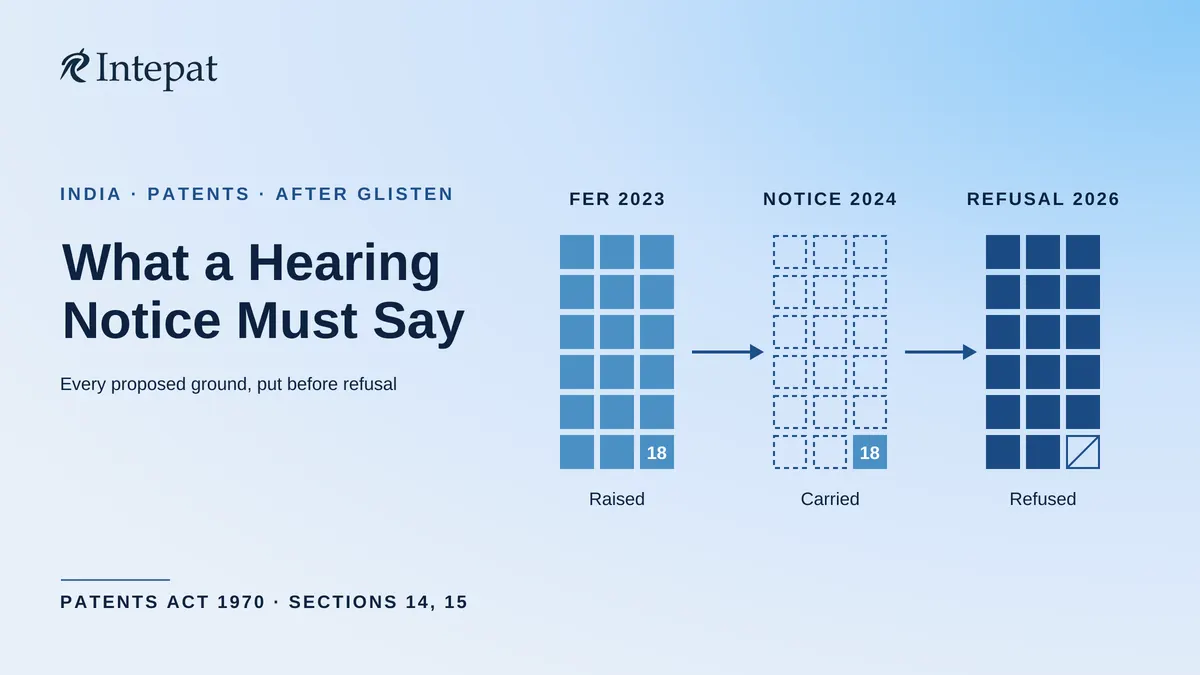
The FER objected that claims 1 to 18 were obvious over D1 and D2. After Glisten replied, the hearing notice raised inventive step only against claim 18, and only because the specification lacked working examples for it. After Glisten gave up claim 18, the Controller refused the application for obviousness of claims 1 to 17 over D1 and D2.
The chronology, all from the judgment, runs as follows. Glisten filed Indian Patent Application No. 202017005875, “Gemstone Coating and Methods of Making and Using the Same”, on 11 February 2020, and requested examination on 8 June 2021 (para 3). The FER of 24 April 2023 said claims 1 to 18 appeared obvious in view of D1 and D2 combined with common general knowledge (para 4). Glisten replied on 18 January 2024, within the extended period, distinguishing the cited documents (para 5). The hearing notice of 14 June 2024 stated that claim 18 “lacks inventive step” for want of support in the complete specification in terms of working examples (paras 6 and 7).
The court read that notice closely. It found the notice did not state that claims 1 to 17 were obvious over D1 and D2, did not identify the features of those claims said to be disclosed in the cited documents, and did not indicate how a skilled person would combine D1 and D2 to arrive at them (para 7). Glisten attended the hearing, filed written submissions with amended claims, and gave up claim 18 (para 8).
The refusal order of 23 January 2026 then analysed claims 1 to 17 against D1 combined with D2, and rejected Glisten’s wear test data because “no unexpected technical effect, synergistic effect, or surprising improvement is demonstrated” (paras 9 and 30). The same order recorded that “all the other requirements raised in the hearing notice u/s 14 are met” (para 9, quoting para 13 of the order). The refusal therefore rested on a ground the notice had not carried.
What did the Delhi High Court hold?
The court held that the procedure did not meet Section 14 and the principles of natural justice, and set the refusal aside on that ground alone (para 33). It did not decide whether claims 1 to 17 involve an inventive step; that question was expressly left open for the Controller (paras 15 and 36).
Four propositions carry the judgment. First, the power of refusal under Section 15 “is wide, but it is not free standing”; it is exercised at the end of the Section 14 process, so the Controller’s satisfaction “must, therefore, be formed on objections which have been communicated to the applicant and on which the applicant has had a fair chance to be heard”, and “Section 80 points the same way, since it requires a hearing before the Controller exercises any discretion adversely to an applicant” (para 19). Second, an applicant “is entitled to take the hearing notice at face value and to prepare for the hearing on the objections listed in it” (para 28); on the facts, Glisten “could reasonably understand that its reply to the FER had answered the objection of obviousness” for claims 1 to 17 (para 29). Third, general written submissions do not cure missing notice: “An applicant who defends its claims in general terms, without knowing what objection it has to meet, is not in the same position as one who answers a specific objection” (para 31). Fourth, prejudice was visible on the face of the order, because the wear test data was rejected for a deficiency “never put to the appellant” (para 32).
The court rested the rule on audi alteram partem (the right to be heard before an adverse decision). It relied on Supreme Court authority that notice “should be clear and precise so as to give the other party adequate information of the case he has to meet” (para 21, quoting Biecco Lawrie Ltd. v. State of West Bengal, (2009) 10 SCC 32) and that it must “apprise the party determinatively of the case he has to meet” (para 22, quoting Canara Bank v. V.K. Awasthy, (2005) 6 SCC 321). The full text is on the Delhi High Court website.
What must a patent hearing notice contain?
The Delhi High Court decisions require every ground and every document the Controller relies on to be put to the applicant before an adverse order, ordinarily in the FER or the hearing notice. For a Section 3(d) new-form objection, the notice must also identify the known substance and how the claim is a new form of it.
Glisten is a case of a missing ground rather than a thin one. Paragraph 7 records that the notice did not say claims 1 to 17 were obvious over D1 and D2, did not identify the features said to be disclosed, and did not explain how D1 and D2 would be combined. The court did not decide how much detail an inventive step objection must carry when the notice does raise it, but those are the points an applicant needs to argue against obviousness; our guide to inventive step in Indian patents explains why each matters.
The Section 3(d) cases set a particulars requirement. Section 3(d) excludes, among other things, a new form of a known substance that does not enhance its known efficacy, and the mere use of a known process, machine or apparatus unless that process results in a new product or employs at least one new reactant (discussed in our analysis of evergreening and Section 3(d)).
In DS Biopharma Ltd v. The Controller of Patents and Designs (C.A.(COMM.IPD-PAT) 6/2021, 30 August 2022), Justice Prathiba M. Singh held that the known substance “has to be identified. It cannot be left to the Applicant to deduce as to what is the known substance and thereafter give efficacy data qua that known substance” (para 14). The manner in which the claimed compounds are new forms “ought to be mentioned by the Patent Office, even if not in detail but at least in a brief manner” (para 14).
In Taiho Pharmaceutical Co. Ltd. v. The Controller of Patents (C.A.(COMM.IPD-PAT) 6/2022, 15 May 2025), Justice Amit Bansal required the Controller to identify the known substance with known efficacy, explain how the claim is a new form of it, and compare efficacy objectively, holding that “the aforesaid aspects have to be identified by the Controller in the hearing notice” (paras 13 and 14). A notice citing D1, a Markush structure (a generic formula covering many compounds), without naming a specific compound, did not meet that standard (para 15). In Nippon Steel Corporation v. The Controller General of Patents, Designs & Trademarks (C.A.(COMM.IPD-PAT) 323/2022, 29 August 2024), a refusal under Section 3(d) on a coke oven repair method failed where the notice raised only a generic Section 3 objection and the order never identified the known process, machine or apparatus (paras 4, 5, 8.5 and 8.9).
The documents, and any materially new technical basis, relied on must also be put. In Otsuka Pharmaceutical Co. Ltd. v. The Controller of Patents (C.A.(COMM.IPD-PAT) 2/2022, 22 September 2022), the notice relied on D1 and D4, and the refusal relied on D2 and D3 as well, which Justice Jyoti Singh held was “in the teeth of the doctrine of audi alterem [sic] partem” (para 13). In Phillip Morris Products S.A. v. Assistant Controller of Patents and Designs (C.A.(COMM.IPD-PAT) 29/2025, 9 September 2026), reliance on three reports first cited in the refusal order was one of the grounds on which the order was set aside, and the defence that they “were not prior arts” was rejected (paras 33 and 51); the court also faulted a changed technical case on what D1 disclosed, which was “not forthcoming either in the FER or the hearing notice” (para 36). Phillip Morris records that the Calcutta High Court took a similar view in ITC Limited v. The Controller of Patents Designs and Trademark (para 33).
| Decision | What the notice or order lacked | Relief on appeal |
| Otsuka (22 September 2022) | Refusal relied on D2 and D3; notice cited D1 and D4 | Remand; replies on D2 and D3 if relied on; decision within four months |
| DS Biopharma (30 August 2022) | Section 3(d) first raised in notice; known substance not identified | Response within eight weeks on substances named in the order, with efficacy data if the applicant chose; fresh hearing; inventive step may also be considered; endeavour to decide within six months |
| Perkinelmer (4 January 2023) | Section 3(f) first raised at the hearing | Fresh notice raising all objections within two weeks; hearing within four months |
| Nippon Steel (29 August 2024) | Notice raised a generic Section 3 objection; refusal under Section 3(d) named no known process, machine or apparatus | Fresh hearing; notice to “clearly delineate the objection(s)”; decision within four months of the hearing ending |
| Taiho (15 May 2025) | Notice cited a Markush D1 without a specific known substance | Fresh hearing notice and hearing; efficacy data may also inform inventive step |
| Proprietect (29 July 2025) | Section 10(5) first raised in the refusal order | Fresh hearing notice and hearing; decision preferably within six months |
| Fresenius Kabi (31 August 2026) | No Section 14 hearing at all after a pre-grant opposition hearing | Remand; Sections 14, 15, 25 and Rule 129 to be followed; decision within six months |
| Phillip Morris (9 September 2026) | Three reports first cited in the refusal order | Remand; decision within five months, after a hearing |
| Glisten (1 October 2026) | Inventive step for claims 1 to 17 not carried into the notice | Application revived for fresh consideration; no time limit set |
Can the Controller still raise a new objection?
Yes, with notice. Glisten holds that if the Controller intends to revive an objection the notice did not carry forward, or to raise a fresh one, the applicant must be told and given a real opportunity to answer before an adverse order. The bar falls on refusing without that opportunity, not on the objection itself.
The court accepted the Patent Office’s argument “only to a limited extent”: “The Controller is not bound to grant a patent merely because a particular objection does not find mention in the hearing notice. However, if the Controller proposes to refuse the application on a ground, that ground must first be put to the applicant” (para 20). The two halves work together. The applicant may prepare on the notice as written (para 28), and on facts like Glisten’s could reasonably understand that its FER reply had answered a dropped objection (para 29); what the applicant cannot assume is that the dropped objection will not be raised again with notice.
The Patent Office’s own instructions point the same way. Circular No. 4/2011 of 21 September 2011, as quoted in Perkinelmer Health Sciences Inc. v. Controller of Patents (C.A.(COMM.IPD-PAT) 311/2022, 4 January 2023), provides that outstanding or further objections reported after the applicant’s response “shall be communicated along with the notice of hearing, giving reasonable time to the Applicant”, and that “no further objections can be raised at the time of hearing” (para 6, clauses k and l). Justice Sanjeev Narula read this to mean that the Controller or Examiner “is not permitted to raise new grounds of objection at the time of hearing” (para 6).
One statement in the line is worded more broadly. In Proprietect L.P. v. The Controller of Patents (C.A.(COMM.IPD-PAT) 168/2022, 29 July 2025), Justice Tejas Karia said that “raising new grounds in the Hearing Notice or, as in this case, in the final Order is not permissible as it does not provide a reasonable opportunity to the applicant to be heard” (para 19). On its facts the new Section 10(5) ground appeared first in the refusal order (para 17), and DS Biopharma, where Section 3(d) appeared first in the notice, turned on the missing particulars as well as the timing (para 19). Glisten quotes Proprietect and then states the position as one of notice and a real opportunity (paras 26 and 28).
These are single-judge decisions of the same court. Glisten concerned the revival of an objection already raised in the FER (paras 4, 6 and 7), so it does not settle every fresh-ground case. Where a notice adds a ground the FER never raised, the safer course is to answer it on the merits without prejudice to the procedural objection, record that it is raised for the first time, and ask for time if the notice period does not allow a proper answer.
What does a successful appeal actually give you?
An appeal won on a natural justice ground has, in these cases, returned the application to the Patent Office rather than securing a grant. The court sets the refusal aside, restores the application and usually leaves the merits open, so the applicant must still meet the objections, this time with notice of them.
In Glisten the application was “revived and restored to the file of the respondent for fresh consideration, to be taken to its logical conclusion”, with all rights and contentions left open and the observations confined to natural justice (paras 34 to 36). The order sets no time limit and does not direct a fresh hearing notice or a different officer. Other benches have been more specific, as the table above shows: Perkinelmer directed a fresh notice “raising all objections” within two weeks (para 8), and DS Biopharma let the applicant file efficacy data against the substances the refusal had identified (para 22).
Depending on the remand directions, fresh examination may also cover other objections, after proper notice and an opportunity to respond. In DS Biopharma the Controller was “also permitted to consider” inventive step (para 22), Taiho reopened inventive step alongside Section 3(d) (para 18), and Nippon Steel added questions on use claims, Section 3(n) and novelty and inventive step “in addition to any outstanding objections” (para 8.13). Where the court set a time limit for the fresh decision, it ranged from four to six months.
The appeal route itself has a deadline. Section 117A(4) requires an appeal within three months from the date of the Controller’s decision, or within such further time as the High Court may allow under its rules. You can track the application’s position afterwards using our guide to Indian patent status meanings.
How should you check a hearing notice before the hearing?
Compare the hearing notice with the FER objection by objection, claim by claim and document by document, and note every change before preparing for the hearing. Each narrowing, addition or missing particular decides what you argue, what you put on record, and whether a later refusal is open to challenge.
A working check runs in five steps:
- List each FER objection, the claims it hit and the documents cited, then mark whether the notice keeps, narrows, drops or adds to it; for an added ground, plan a full answer on the merits, without prejudice to the procedural objection, and record that it is new.
- For each objection the notice keeps, confirm the particulars: the documents relied on, the features said to be disclosed, and for Section 3(d) the applicable limb and the specific known substance, process, machine or apparatus relied on; where one is missing, the safer course is to ask the Controller in writing before the hearing to identify it.
- Prepare on the objections the notice lists, which Glisten entitles you to do (para 28); keeping your FER reply on dropped objections briefly on record in the written submissions costs little, given that the Controller is not bound to grant (para 20).
- If a new ground, document, or material technical or factual basis for refusal surfaces at the hearing, record it in the hearing and in your written submissions, due within fifteen days of the hearing under Rule 28(7), and ask that it be communicated in writing with time to respond.
- If the order then refuses on a ground, document or material basis never put to you, check whether the order itself shows prejudice, as the rejected wear test data did in Glisten (para 32), and whether it is a speaking order that deals with your submissions (Manual para 09.04(11); Otsuka para 13), before deciding on an appeal.
Where you need more time to prepare a hearing, Rule 129A allows an adjournment request with reasonable cause and the prescribed fee at least three days before the hearing; the Controller may adjourn, if he thinks fit and on such terms as he directs, and no party gets more than two adjournments of up to thirty days each.
Frequently Asked Questions
It is the Controller’s communication under Section 14 of the Patents Act, 1970, issued after the applicant has replied to the First Examination Report, listing the objections that still stand for a hearing. Glisten LLC describes it as narrowing the dispute to the objections that remain after the reply, which the applicant may take at face value.
Not without first putting that ground to the applicant and giving a real opportunity to answer it. In Glisten LLC the Delhi High Court set aside a refusal that rested entirely on an inventive step objection the notice had not carried. The Controller remains free to raise the objection properly, so the applicant gets notice, not a grant.
Glisten is a single-judge decision of the Delhi High Court, and other High Courts are not automatically bound by it. Its reasoning may be relied on elsewhere, alongside the relevant High Court’s own precedent, since Section 14 and natural justice apply across India. Phillip Morris records a similar Calcutta High Court view in ITC Limited.
A ground first appearing in the hearing notice should not be ignored. Answer it on the merits, without prejudice to the procedural objection, and ask for enough time. Proprietect contains broader language against new grounds in hearing notices; Glisten emphasises notice and a real opportunity to answer, so record that the ground is new.
General submissions do not. Glisten LLC held that written submissions defending the claims in general terms cannot take the place of notice of a specific objection (para 31), and Perkinelmer held the same of post-hearing submissions. The cure the courts have directed is a fresh opportunity to answer, such as Perkinelmer’s fresh notice raising all objections (para 8).
For a new-form objection, DS Biopharma and Taiho require the specific known substance and how the claim is a new form of it; Taiho also requires the efficacy comparison to be identified so the applicant can respond. For the known process, machine or apparatus limb, Nippon Steel set aside a refusal that never specified that prior subject matter.
Rule 28(7) requires written submissions and relevant documents, if any, within fifteen days from the date of the hearing. Rule 138 lets the Controller extend that time or condone delay by up to six months on a Form 4 request made within that six months; the extension is discretionary, and filing the request does not itself grant it.
Where the refusal fails on a natural justice ground, the application usually returns to the Patent Office for fresh consideration, with the merits left open. Some judgments direct a fresh hearing notice and a time limit; Glisten LLC restored the application without either. The Controller may revisit other objections, so the applicant must still meet them.
This article explains the law on patent hearing notices in India as at October 2026 and is for general information only. It is not legal advice. Government fees, forms, and procedures change; confirm current figures with the Indian Patent Office before you file. For advice on your specific invention, consult a registered patent agent.
Sources
- Glisten LLC v. The Assistant Controller of Patents & Designs, C.A.(COMM.IPD-PAT) 21/2026, High Court of Delhi, judgment of 1 October 2026, paras 1 to 37. Glisten judgment; Glisten text
- Taiho Pharmaceutical Co. Ltd. v. The Controller of Patents, C.A.(COMM.IPD-PAT) 6/2022, High Court of Delhi, judgment of 15 May 2025, paras 2.3 to 2.5 and 13 to 21. Taiho judgment; Taiho text
- DS Biopharma Limited v. The Controller of Patents and Designs and Anr., C.A.(COMM.IPD-PAT) 6/2021, High Court of Delhi, judgment of 30 August 2022, paras 5, 6, 14 and 18 to 24. DS Biopharma judgment; DS Biopharma text
- Proprietect L P v. The Controller of Patents, C.A.(COMM.IPD-PAT) 168/2022, High Court of Delhi, judgment of 29 July 2025, paras 17 to 19, 25 and 26. Proprietect judgment; Proprietect text
- Perkinelmer Health Sciences Inc. and Ors. v. Controller of Patents, C.A.(COMM.IPD-PAT) 311/2022, High Court of Delhi, judgment of 4 January 2023, paras 3 and 6 to 8, quoting Circular No. 4/2011 dated 21 September 2011. Perkinelmer text
- Otsuka Pharmaceutical Co. Ltd. v. The Controller of Patents, C.A.(COMM.IPD-PAT) 2/2022, High Court of Delhi, judgment of 22 September 2022, paras 10 to 13 and 21 to 22. Otsuka text
- Nippon Steel Corporation v. The Controller General of Patents, Designs & Trademarks, C.A.(COMM.IPD-PAT) 323/2022, High Court of Delhi, judgment of 29 August 2024, paras 4, 5, 8.8, 8.9 and 8.13. Nippon Steel text
- Phillip Morris Products S.A. v. Assistant Controller of Patents and Designs, C.A.(COMM.IPD-PAT) 29/2025, High Court of Delhi, judgment of 9 September 2026, paras 32, 33, 36, 51 and 52. Phillip Morris text
- Fresenius Kabi Ipsum SRL v. The Asst. Controller of Patents and Designs, C.A.(COMM.IPD-PAT) 7/2025, High Court of Delhi, judgment of 31 August 2026, paras 50, 51 and 59. Fresenius Kabi text
- The Patents Act, 1970, sections 14, 15, 80 and 117A. IP India. Section 14; Section 117A
- The Patents Rules, 2003, rules 24B, 28, 28A, 129, 129A and 138, as amended by the Patents (Amendment) Rules, 2024 (G.S.R. 211(E)). IP India. Rule 24B; Rule 28; Rule 129; Rule 129A; Rule 138
- Manual of Patent Office Practice and Procedure, version 3.0 (26 November 2019), Office of the Controller General of Patents, Designs and Trade Marks, paras 09.04(11) and 09.04(12). Manual PDF