




Patent filing in Bangalore is ordinarily done online on the IP India portal, and applications from Karnataka are handled by the Patent Office in Chennai. The government fee to file is Rs 1,600 for individuals, startups, small entities and educational institutions, and Rs 8,000 for other applicants, before examination and renewal fees are added.
A patent granted under India’s Patents Act, 1970 covers the whole country, whichever office processed it, so the law a Bangalore inventor deals with is the national law. What is local is the office that holds your file, the State’s own startup incentives, and the scale of filing around you: Karnataka now produces more patent applications by Indian applicants than every State except Tamil Nadu.
Quick answer: There is no Patent Office in Bangalore; Karnataka applications ordinarily sit with the Chennai office and are filed online. E-filing starts at Rs 1,600 (individuals, startups, small entities, educational institutions) or Rs 8,000 (others) for up to 30 pages and 10 claims, and for applications filed from 15 March 2024 the request for examination is due within 31 months of the priority or filing date, whichever is earlier. KITS-registered startups can claim 75 percent of eligible patent filing costs, up to Rs 15 lakh a year. Verified as of October 2026.
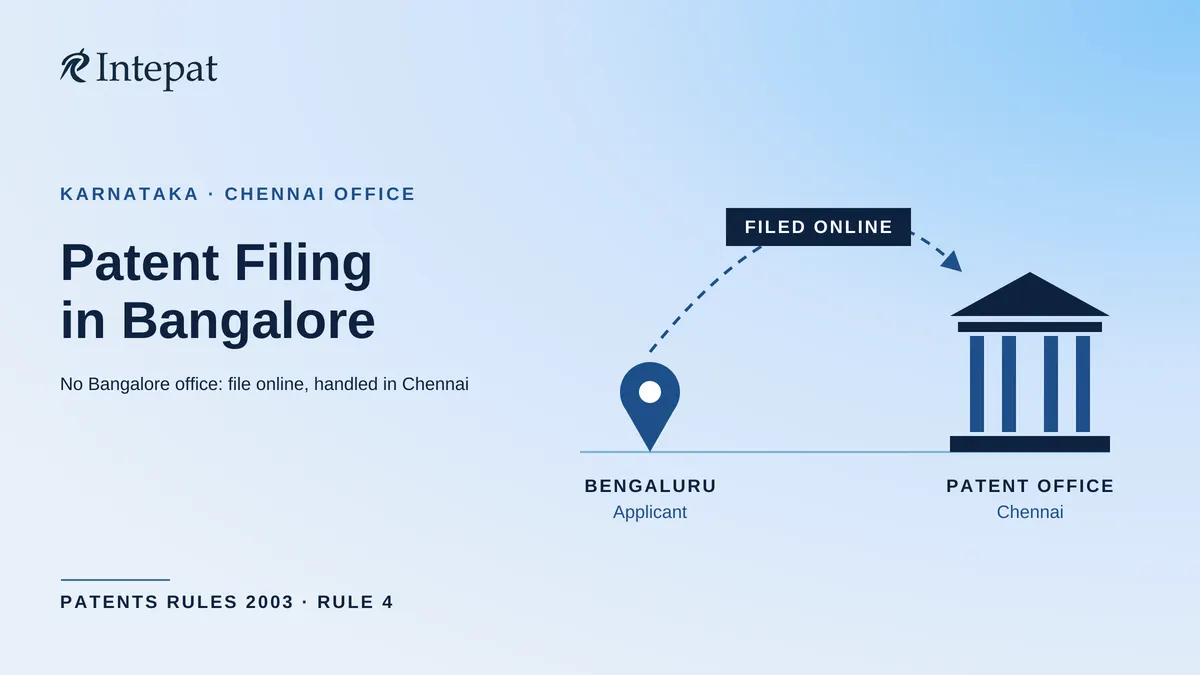
How Patent Filing in Bangalore Works
There is no Patent Office in Bangalore. Applicants who live, carry on business, or made the invention in Karnataka (for a joint application, the first-named applicant) ordinarily fall within the territorial jurisdiction of the Patent Office, Chennai, which also covers Tamil Nadu, Kerala, Andhra Pradesh, Telangana, Puducherry and Lakshadweep.
The location matters less than it sounds. The Patent Office describes its four branches at Kolkata, Delhi, Mumbai and Chennai as working “as a virtual single office”, and filing and prosecution run through the online portal. In current practice a Bangalore applicant deals with the Chennai office without travelling there, and the patent e-filing guide shows each portal screen.
The steps themselves are the national ones: a patentability search, a provisional or complete specification, the application form, publication, a request for examination, a reply to the examination report, and grant. Our patent filing procedure in India explains each stage in order. This article covers what changes in patent registration in Bangalore, where the applicant’s location brings in a different office and different State incentives.
One rule regularly catches Bangalore companies with overseas parents or customers. A person resident in India needs the Controller’s written permit before applying for a patent abroad, unless an Indian application for the same invention was filed at least six weeks earlier and no secrecy direction is in force. The office granted 9,826 such permits in 2024-25, and our guide to the foreign filing licence sets out the request.
What Karnataka’s 8,371 Filings Show
Karnataka ranked second among Indian States for patent applications by Indian applicants in 2024-25, with 8,371 against Tamil Nadu’s 15,440, according to the Patent Office’s Annual Report 2024-25. Ordinary applications from the State rose from 6,025 to 8,319 in a single year.
That growth sits inside a national rise. Total patent applications reached 110,375 in 2024-25, and Indian applicants filed 68,201 of them, or 61.79 percent. Presidency University, Bangalore filed 625 applications, ninth among academic institutions in the country.
Computer science and electronics drew more applications than any other field nationally, at 29,494. A patentability search should cover Indian patent publications alongside worldwide patent and non-patent literature. Karnataka’s rising numbers make the Indian layer worth checking, though they do not show how much of it bears on any particular invention, and a search confined to US and European patent publications leaves that layer out.
Government Fees for a Bangalore Patent Application
The government fee to file a patent application online is Rs 1,600 for a natural person, startup, small entity or educational institution, and Rs 8,000 for any other applicant. That covers up to 30 pages, 10 claims and one priority. The fee schedule is national, so a Chennai filing costs the same as one in Delhi.
| Step | Form | Individual, startup, small entity, educational institution (Rs) | Other applicants (Rs) |
| Patent application | Form 1 | 1,600 | 8,000 |
| Each claim above 10 | Form 1 | 320 | 1,600 |
| Each page above 30 | Form 1 | 160 | 800 |
| Early publication | Form 9 | 2,500 | 12,500 |
| Request for examination | Form 18 | 4,000 | 20,000 |
| Expedited examination | Form 18A | 8,000 | 60,000 |
| Renewal, years 3 to 6, per year | None | 800 | 4,000 |
| Renewal, years 7 to 10, per year | None | 2,400 | 12,000 |
E-filing fees from the First Schedule to the Patents Rules, 2003; physical filing carries higher fees. Where a complete specification follows a provisional, the extra-page and extra-claim fees are paid when the complete specification is filed. Verified as of October 2026.
Take a Bangalore hardware startup filing a complete specification of 34 pages with 14 claims. It pays Rs 1,600, plus Rs 640 for four extra pages, plus Rs 1,280 for four extra claims: Rs 3,520 to file. Examination then costs Rs 4,000 on the normal route or Rs 8,000 on the expedited route, and the patent fees calculator works out other combinations.
The fee scale follows the applicant named on the application, and the applicant should be the person or company entitled to the invention. If any co-applicant falls outside the four lower-fee categories, the application pays the higher scale. A startup, small entity or educational institution files Form 28 with each fee-bearing document, and if the application later moves to an owner outside these categories, the new applicant pays the fee difference with the transfer request.
How Long It Takes, and When Expedited Examination Helps
There is no guaranteed end-to-end grant date. The request for examination is due within 31 months of the priority or filing date, whichever is earlier. In 2024-25 the Patent Office reported examining 15,726 applications, while 90,971 requests for examination were filed that year.
Those are one year’s flows, not a measure of today’s backlog or of any single application’s wait. The office has added capacity: four hundred and seven new examiners joined in January 2025, and the annual report expected them to begin full examination work in the second half of 2025-26. Plan around the queue rather than against it.
Recognised startups and small entities can move ahead of that queue. Expedited examination (Form 18A) is open to them and to several other categories, including applications where every applicant is an individual and at least one is a woman (a woman director or inventor does not qualify a company), government bodies, and applicants who named India as the International Searching Authority, or elected it as the International Preliminary Examining Authority, in the corresponding PCT application. The 2024-25 annual report states that in the majority of expedited cases, grant or final disposal came within an average of one year from the request. The office received 7,154 such requests that year, 1,026 of them from startups.
An expedited request goes with a request for early publication unless the application is already published or early publication has already been requested. For a Bangalore startup heading into a fundraise, a licensing deal or an enforcement dispute, the extra cost is often worth paying: Rs 4,000 more than normal examination, or Rs 6,500 more where a Rs 2,500 early publication request must go with it. A startup whose recognition period lapses, or whose turnover later crosses the notified limit, keeps the expedited request, because the rule says the request is not to be questioned merely on that ground; our guide to expedited patent examination covers eligibility in full.
Karnataka’s Patent Reimbursement for Startups
Karnataka reimburses 75 percent of a startup’s actual patent filing expenses, up to Rs 15 lakh a year, under the Karnataka Startup Policy 2025-2030, which the State approved by a Government Order dated 14 November 2025. Up to five claims a year are allowed, covering domestic and international filings.
The claimant must meet the policy’s startup definition and be registered as a startup with the Karnataka Innovation and Technology Society (KITS). The policy treats an entity as a startup if it is a private limited company, registered partnership firm or LLP incorporated or registered in Karnataka, is under 10 years old, has not exceeded Rs 100 crore turnover in any year since incorporation, and is working on innovation; entities formed by splitting or reconstructing an existing business are excluded. Neither the policy nor the State’s incentives page makes incubation a condition of this subsidy.
The reimbursement comes in two parts. Sixty percent of the 75 percent is paid promptly against the official government filing fees once proof of filing is validated. The remaining 40 percent covers expenses such as consultancy fees, searches and documentation, and is paid after the supporting documents are verified.
The State’s Startup Policy Incentives 2025-30 page adds conditions. Expenses on provisional applications are not reimbursed, patents with a change of assignee are excluded, the fees must already have been paid, and the claim must be made within one year of filing the patent. Claims need bank statements, invoices and a notarised affidavit. Payment is subject to Approval Committee approval and available funds, and the page also describes a claim route open only once the patent is granted, so check which route applies in the operational guidelines.
Two of those conditions shape the filing plan. Provisional-stage costs fall outside the scheme, and the page does not say whether the one-year claim window runs from the provisional or the complete filing. Count it from your first filing unless KITS confirms otherwise in writing, and keep every invoice and fee receipt. For a patent filed under the earlier 2022-27 policy, confirm with Startup Karnataka which policy’s terms apply before claiming.
For how Karnataka patent reimbursement compares with other States, our comparison of patent reimbursement schemes for startups covers Kerala, Telangana and the central MSME scheme.
Where Bangalore Inventors Can Get Help Before Filing
Bangalore inventors have a public patent information centre close at hand. The Karnataka State Council for Science and Technology has run a Patent Information Centre at the Indian Institute of Science since 2005. The centre runs patent searches and IPR awareness programmes.
A Technology Innovation Support Centre set up there in association with CIPAM, DPIIT gives the centre a paid database it uses to generate prior-art search reports.
What changed in 2026 is free professional help. Under the Scheme for Facilitating Startups Intellectual Property Protection (SIPP), empanelled patent facilitators claimed reimbursement for their work, and the modified scheme ran for three years from 1 April 2023. No later extension was located in the official materials we checked on 16 October 2026, so budget for professional fees unless you have confirmed facilitator funding or another support arrangement. The lower official fees, expedited examination and Karnataka’s reimbursement are separate benefits.
A university IP cell or the KSCST centre is a sound first stop for a search and for learning what is patentable. Drafting the claims is a different job. The claims decide what you can later enforce, and they are where a registered patent agent earns the fee.
If you are protecting the brand as well as the technology, our guide to trademark registration in Bangalore covers the Registry side.
Five Deadlines to Diary on Filing Day
Five deadlines follow from filing day, though not all are counted from it: the first four govern the road to grant, and the fifth keeps the patent alive. Missing the complete specification, the examination request or the deadline for putting the application in order ends the application.
The complete specification deadline is fixed by the Act. Other periods can be extended only on a Form 4 request with a fee, and no extension is automatic, so docket the original date and treat it as hard.
- Complete specification within 12 months of a provisional application; otherwise the application is deemed abandoned. A provisional secures the date only for what it properly describes, so prepare it with care.
- Statement and undertaking on corresponding foreign applications (Form 3) within six months of the Indian filing date, with updates on later foreign filings due within three months of the first examination report; up to three months’ extension or condonation is available on request.
- Request for examination within 31 months of the priority or filing date, whichever is earlier; applications filed before 15 March 2024 keep the older 48-month period.
- Put the application in order for grant within six months of the first examination report (FER). Up to three more months are available on a request filed before the period ends, and IP India’s patent FAQ recognises up to six further months on a Form 4 request with the prescribed fee.
- Renewal fees from the third year of the patent, each due before the year it covers begins. If grant comes more than two years after filing, the fees that fell due in the meantime are payable within three months of the patent being recorded in the register, extendable to nine months.
For a Bangalore startup, the priority is a properly prepared filing before any public disclosure. Choose a provisional or complete specification according to how ready the invention is, confirm who is entitled to apply, arrange DPIIT recognition and KITS registration in parallel, and assess expedited examination once the complete application is ready.
Frequently Asked Questions
No. Applications from Karnataka ordinarily fall within the jurisdiction of the Patent Office in Chennai, one of four branches that work as a virtual single office. Filing, payment and correspondence run through the IP India portal, so in current practice a Bangalore applicant deals with the Chennai office online and does not need to travel there.
The government fee is Rs 1,600 to file and Rs 4,000 to request examination for individuals, startups, small entities and educational institutions. Other applicants pay Rs 8,000 and Rs 20,000. Extra pages and claims cost more, and professional fees for search, drafting and prosecution are separate. Fees verified as of October 2026.
Yes. A recognised startup can request expedited examination on Form 18A for Rs 8,000, instead of Rs 4,000 for normal examination. The Patent Office’s 2024-25 report states that in the majority of expedited cases, grant or final disposal came within an average of one year from the request. Expedited examination speeds the process; it does not guarantee grant.
Yes. Under the Karnataka Startup Policy 2025-2030, a startup registered with KITS can claim 75 percent of actual patent filing expenses, up to Rs 15 lakh and five claims a year, for domestic and international filings. Provisional-stage costs are excluded, and claims must be made within one year of filing the patent. Check the current operational guidelines first.
No. A patent granted in India covers the whole country, whichever office processed it. Protection abroad needs separate filings, country by country or through the PCT route, and a resident of India needs the Controller’s permit before filing abroad first, unless an Indian application was filed at least six weeks earlier and no secrecy direction applies.
This article explains patent filing in India for Bangalore applicants as at October 2026 and is for general information only. It is not legal advice. Official fees, forms and State schemes change; confirm current figures with the Indian Patent Office and Startup Karnataka before you file, and consult a registered patent agent about your invention.