




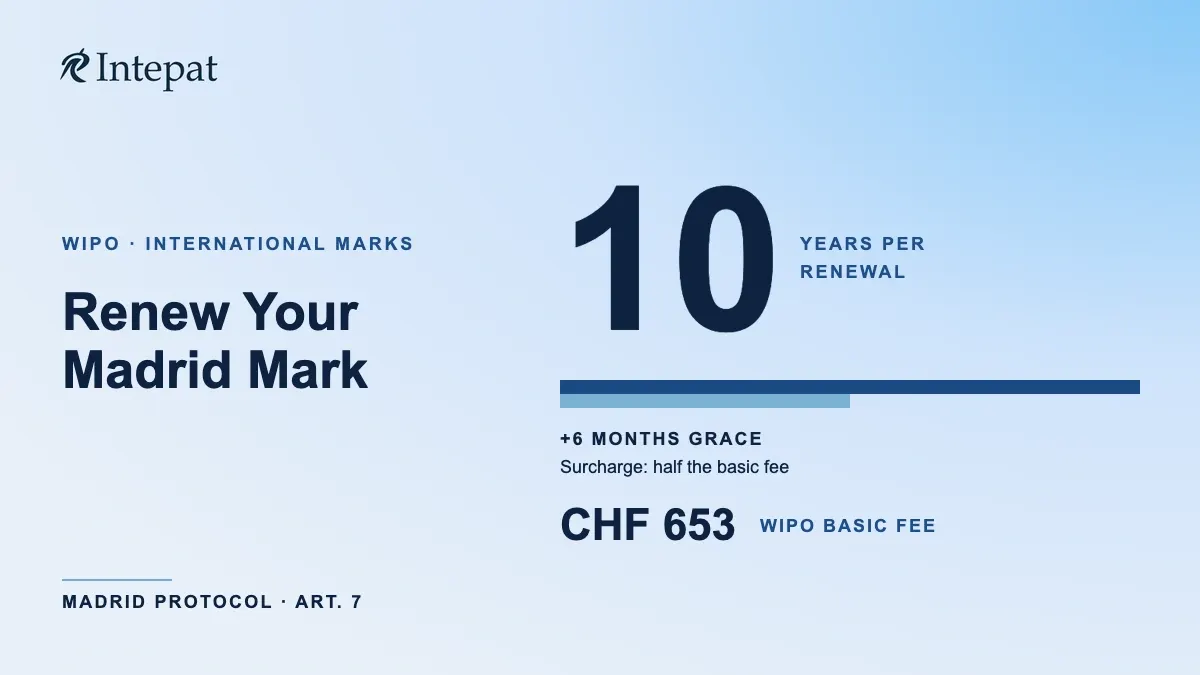
A Madrid Protocol international registration lasts ten years and is renewed by paying WIPO by the expiry date: a CHF 653 basic fee plus fees for your classes and countries. A six-month grace period follows, with a surcharge of half the basic fee. After that, a renewal not fully paid is not recorded, save on proof of force majeure or under WIPO’s narrow 70% rule for underpayments.
This guide covers Madrid Protocol renewal for owners who filed their international registration through the Trade Marks Registry in India, and for foreign owners whose registration designates India (names it as a country to be covered). WIPO, the World Intellectual Property Organization, runs the Madrid System and collects the fees, in Swiss francs (CHF). Fees and rules are verified as of November 2026.
Quick answer: Pay WIPO’s renewal fees by the date the ten-year term ends. You choose which designated countries to renew, but you cannot change the mark or add goods. Paying within six months after the due date adds WIPO’s CHF 326.50 surcharge; you pay the fees in force on the due date, and the renewal still counts from the due date; miss that too, and protection ends in the countries not renewed. Your Indian basic mark is renewed separately at the Registry.
When an international registration must be renewed
An international registration runs for ten years from its registration date and can be renewed for further periods of ten years, each counted from the end of the one before. Renewal falls due when the current term ends, and India’s Trade Marks Act states the same ten-year term and six-month grace period.
Six months before expiry, WIPO sends the holder (the registered owner) and any representative an unofficial reminder of the exact expiry date. Do not rely on it. The Regulations say that not receiving the reminder is no excuse for missing a renewal deadline. An Indian national registration is different: there the Registry must send an expiry notice to the address the Rules require before it can remove a mark, and courts have let owners renew where the Registry could not show that notice was sent, as our guide to a trademark removed without renewal notice explains.
A renewal payment WIPO receives more than six months before the due date is treated as received six months before it. In practice, the six months before expiry is the renewal window and the six months after it is the grace period. The fees that apply are those in force on the day of payment, or on that deemed date if you pay very early; a payment made in the grace period takes the fees in force on the due date. So price an on-time renewal at the fees in force when you pay, or six months before the due date if you pay earlier than that; in the grace period, use the fees in force on the due date.
What Madrid Protocol renewal costs
WIPO renewal fees are a basic fee, a supplementary fee for each class beyond three, a complementary fee for each designated country that has not set its own fee, and the individual fee of each country that has (where the holder’s country and the designated country are both also bound by the older Madrid Agreement, the complementary fee is payable instead of that country’s individual fee; India is bound only by the Protocol, so its fee is unaffected). They are paid to WIPO in Swiss francs and cover ten years. WIPO’s own renewal fees have no reduced rate for startups or small businesses, and nor does India’s individual fee.
| WIPO renewal fee item | Amount (CHF) |
|---|---|
| Basic fee | 653 |
| Supplementary fee, for each class beyond three | 100 |
| Complementary fee, for each country with no individual fee | 100 |
| Individual fee, for each country that has fixed one | Set by that country |
| India’s individual fee, per class (only where India is designated) | 83 (93 for renewals due before 28 June 2026) |
| Surcharge for paying in the six-month grace period | 326.50 (50% of the basic fee) |
These amounts come from WIPO’s Schedule of Fees and WIPO’s notice on India’s individual fee, verified as of November 2026. A one-class registration renewed for three countries that take the complementary fee costs CHF 653 plus three times CHF 100, so CHF 953, or CHF 1,279.50 in the grace period. The supplementary fee is not payable where every country being renewed charges an individual fee; some countries set theirs per class. Our guide to the Madrid fee calculator shows how to price a country list.
India’s fee is due only where India is a designated country, which means registrations filed through an office of origin other than India’s; a registration filed through the Indian Registry cannot designate India. Where India’s statement granting protection for only some goods or services is recorded, its fee is counted only on those. No complementary or individual fee is due for a country where a final refusal or an invalidation covering all the goods and services has been recorded in the International Register. A finally refused country can still be renewed if you ask for it, with a statement, and pay its fee; an invalidated country cannot be renewed at all. A country where a refusal is still provisional, or an opposition is pending, is not exempt: pay its fee to keep it, or drop it with a statement.
How to renew, country by country
To renew an international registration, you pay WIPO the renewal fees, in Swiss francs, by the due date. No form from the Indian Registry is involved, and India’s Rules provide no Registry fee for renewing an international registration. WIPO accepts payment by debit to a WIPO current account, by bank transfer to one of its specified accounts, or by credit card through its online payment interface.
Have the holder’s name as recorded, the registration number, the exact expiry date and the list of countries still in effect to hand. Renewal cannot change the registration: you cannot add goods or services, alter the mark, or add a country through renewal. A new country is added by a separate subsequent designation, and new goods need a new application. You can, however, renew for some countries and not others, and dropping a country does not count as changing the registration.
To drop a country, the payment must carry the holder’s statement that the renewal should not be recorded for that country. Leaving out a country’s fee without that statement risks WIPO treating the payment as short. WIPO does not renew a country for which an invalidation or a renunciation has been recorded, and it does not renew goods or services in a country that are covered by a partial invalidation or a recorded limitation. Once the renewal is recorded, WIPO notifies the offices concerned and sends the holder a certificate.
The six-month grace period, late payment and lapse
Missing the due date does not end the registration at once, though if renewal is never completed, the lapse takes effect from the original expiry date. The renewal fees can still be paid within six months after the due date, together with the surcharge of half the basic fee, and the renewal is then recorded with the original due date.
Underpayment is the trap. If WIPO receives less than the full amount, it tells the holder and any representative how much is missing. If the shortfall is still unpaid when the grace period ends, WIPO does not record the renewal and refunds what was paid. There is one narrower rescue: where WIPO’s notice of the shortfall went out in the last three months of the grace period and at least 70% of the fees had been received, WIPO records the renewal, but cancels it if the balance is not paid within three months of that notice.
If nothing is paid by the end of the grace period, or too little and the 70% rescue does not apply, WIPO notifies the holder, any representative and each designated country’s office that the registration has not been renewed. Protection then ends in those countries, with effect from the expiry date. If the registration was renewed for other countries, an omitted country can be designated again by subsequent designation, with a later date; if it lapsed entirely, only a new filing, with a new date, remains. WIPO’s continued-processing procedure does not cover the renewal deadline; the only excuse is force majeure, such as war, natural disaster or a failure of postal or electronic services beyond your control, shown to WIPO’s satisfaction, with the evidence and the payment reaching WIPO as soon as reasonably possible and no later than six months after the deadline. This is stricter than Indian renewal, where the Registrar may, at his discretion, restore a removed mark up to one year after expiry.
Countries added later share the same renewal date
Every designation in an international registration renews on the same date, however late it was added. A country added by subsequent designation in year seven is renewed with the rest at year ten, and its first fees covered only the years up to that date.
That shared date simplifies the calendar, but it affects the cost of adding countries late in a term. Our guide to adding countries by subsequent designation explains how the fees for a late addition are worked out, and when it can be worth asking for a designation to take effect after the renewal.
Your basic mark is renewed separately
Renewing the international registration does not renew the Indian application or registration it was based on (the basic mark), and renewing the Indian registration does not renew the international one. The Indian mark is renewed at the Registry on Form TM-R, for Rs 9,000 per class by e-filing or Rs 10,000 on paper, the same for every owner. Its ten-year term ordinarily counts from the date of the Indian application (a convention-priority mark counts from the earlier foreign filing date), and renewal can be filed up to one year before it expires; a mark registered within six months before, or after, its renewal date can be renewed within six months of registration.
If the Indian date is missed, the mark can still be renewed within six months with a surcharge of Rs 4,500 per class by e-filing, on top of the renewal fee. After six months and within one year from expiry, if the mark has been removed, an application to restore and renew it can be made, and the Registrar may grant it at his discretion, for Rs 9,000 per class by e-filing (Rs 10,000 on paper) plus the renewal fee; the Schedule’s restoration entry is also worded to cover renewal with surcharge, so confirm the amount the filing system asks for. Our guide to renewing a trademark in India covers the domestic side in full.
For the first five years from the international registration date, the international protection depends on the basic mark. If the basic mark lapses in that period, protection ends in every designated country for the goods or services affected, so renew it on time or within its six-month surcharge window rather than relying on restoration. If WIPO cancels the international registration on that ground, the holder can, within three months of the cancellation, file a national or regional application for the same mark in any country the registration covered, for goods or services covered there; if it meets that country’s requirements and fees, it keeps the international registration’s date (or, for a country added later, that designation’s date) and any priority. After five years the international registration generally stands on its own, unless an opposition, appeal or cancellation action against the basic mark that began within those five years later succeeds, or the basic mark is withdrawn or surrendered while such an action is pending. The same rule applies to a foreign holder’s home basic mark, so letting it lapse in the first five years ends protection in India too.
FAQ
You can pay at any time, but a payment WIPO receives more than six months before the due date is treated as received six months before it. The practical window is the six months before the expiry date, followed by a six-month grace period with a surcharge. A grace-period payment takes the fees in force on the due date.
That does not help you. WIPO sends an unofficial reminder six months before expiry, but the Regulations say that not receiving it is no excuse for missing a renewal deadline. Diarise the expiry date yourself, and keep your email address and your representative’s details up to date in the International Register.
No. Renewal cannot change the international registration as it stands, so the mark and the list of goods and services stay as they are. You can drop countries at renewal, with a statement saying so. To add a country, file a subsequent designation; to cover new goods or services, file a new application.
If full fees have not reached WIPO, the renewal is not recorded and protection ends, unless the 70% rescue applies. Continued processing does not apply to renewal; the only excuse is force majeure, with evidence and payment as soon as reasonably possible and within six months. Otherwise, if other countries were renewed, re-designate the omitted country; if nothing was renewed, file anew. Either way, protection takes a later date.
WIPO tells you the missing amount. If it is unpaid when the grace period ends, the renewal is not recorded and your payment is refunded. If that notice came in the grace period’s last three months and at least 70% was paid, WIPO records the renewal but cancels it unless the balance arrives within three months.
No. They are separate registrations with separate renewals. The international registration is renewed by paying WIPO; the Indian registration is renewed at the Registry on Form TM-R. During the first five years of the international registration, letting the Indian registration lapse without renewal also ends the international protection for the goods or services affected.
This article explains the renewal of international registrations under the Madrid Protocol for owners filing from India, and for foreign owners designating India, as at November 2026. It is for general information only and is not legal advice. WIPO fees, individual fees and office practice change; confirm current figures with WIPO before you pay. For advice on your registration, consult a trademark attorney.
Sources
- The Trade Marks Act, 1999 (Act 47 of 1999), India Code consolidation as on 1 June 2026: https://www.indiacode.nic.in/bitstream/123456789/1993/1/a199947.pdf
- The Trade Marks Rules, 2017, G.S.R. 199(E), Ministry of Commerce and Industry, 6 March 2017, with the First Schedule fees as shown on IP India’s forms and official fees page (as at November 2026): https://ipindia.gov.in/pages/trade-marks/learn/forms-and-official-fees
- WIPO publication 207: Madrid Protocol, Regulations (as in force on 1 November 2026), Administrative Instructions and Schedule of Fees: https://www.wipo.int/edocs/pubdocs/en/wipo-pub-207-2026-en-protocol-relating-to-the-madrid-agreement-concerning-the-international-registration-of-marks-regulations-administrative-instructions-schedule-of-fees.pdf
- WIPO, Madrid System Information Notice No. 27/2026, change in the amounts of the individual fee, India: https://www.wipo.int/documents/d/madrid-system/information-notices-en-2026-madrid_2026_27_in_indfee_e.pdf