




If you had a trademark removed without renewal notice, you may get it back. Where the register holds the address the Rules require (now an address for service in India), the Registry may remove a mark for non-renewal only after sending an expiry notice to it, and in two 2026 judgments the Delhi High Court let owners renew where the notice was not shown to have been sent.
This guide covers registered marks under India’s Trade Marks Act 1999 and the Trade Marks Rules 2017, and the older 2002 Rules where the expiry notice fell due before March 2017. It explains what the Registry must do before removing a mark, which filing windows may still be open to you, what the two judgments decided, and when the missing-notice argument does not work.
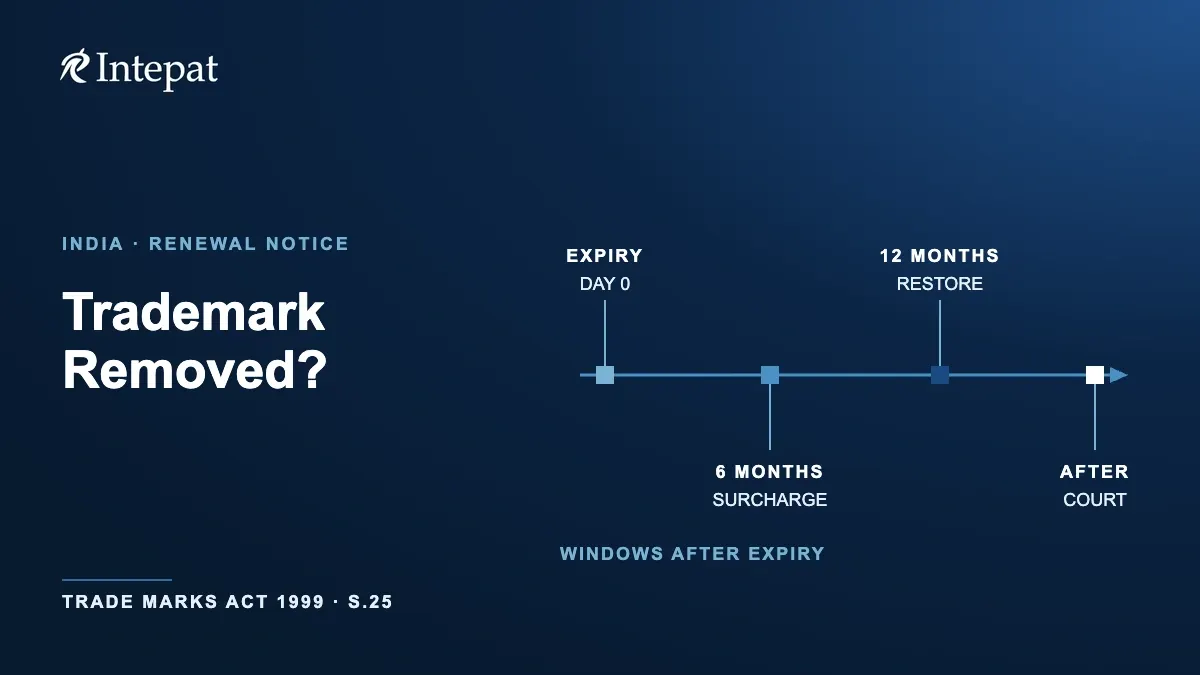
Quick answer: If no renewal has been filed, the Registry must send the registered owner an expiry notice before it can remove the mark, to the address the Rules require. For notices due under the current Rules that is the address for service in India (the postal and email address the Registry writes to), and if none was given, the Registrar is not obliged to send the notice. Within six months of expiry you can renew with a surcharge; between six and twelve months you can apply to restore and renew, which the Registrar grants at discretion. After a year, a writ petition (a direct challenge in the High Court), the route used in two 2026 Delhi cases, may be available if the notice was never sent.
What the Registry must do before it removes your trademark
The Registry cannot simply let a registration lapse and strike it off. Before expiry it must send the registered owner a notice stating the expiry date and the conditions for renewal, and it may remove the mark only if those conditions are still unmet once the time allowed has run.
A registration lasts ten years and can be renewed for further ten-year terms, each counted from the expiry of the last. You can apply to renew at any time in the year before expiry. If no renewal has been filed, the current Rules require the Registrar to send a notice on Form RG-3 to your address for service, not more than six months before expiry, telling you the expiry date and the conditions for renewal.
The Act then says that if, at the end of the prescribed time, those conditions “have not been duly complied with the Registrar may remove the trade mark from the register.” Notice comes first and removal after, and that sequence is what the courts enforced in the two 2026 cases below. A removal is also advertised in the Trade Marks Journal.
If your expiry notice fell due before the 2017 Rules took effect on 6 March 2017, the older 2002 Rules set the notice duty. Under the 2002 Rules the notice, called Form O-3, was due one to three months before expiry and went to the owner’s principal place of business in India on the register, or to the address for service where there was none. For expiries between about early April and early June 2017, that window straddles the changeover, so which rule applied is open to argument; take advice on those dates. The HMP case below was decided under that older rule.
One practical warning if a notice does reach you. The printed notice form in the 2017 Rules still tells the owner to renew on a form from the repealed 2002 Rules, and to do so on or before the expiry date. Renewal, surcharge and restoration all go on Form TM-R, and the expiry date is only the deadline for ordinary renewal: the later windows below still apply after it.
Trademark removed without renewal notice: first check the statutory windows
If your mark expired less than a year ago, you may not need a court at all. The Act allows renewal with a surcharge for six months after expiry, and restoration and renewal of a removed mark up to one year after expiry; the Rules require both to be filed on Form TM-R.
| Where you are | What you file on Form TM-R | Government fee per class (e-filing) |
|---|---|---|
| Up to one year before expiry | Renewal | Rs 9,000 |
| Up to six months after expiry | Renewal with surcharge | Rs 13,500 (Rs 4,500 surcharge plus Rs 9,000 renewal fee) |
| More than six months, up to one year after expiry, once removed | Restoration and renewal | Rs 18,000 (Rs 9,000 plus Rs 9,000 renewal fee) |
| More than one year after expiry | Ordinary windows closed (late-registered marks excepted, see below) | Court-directed filing, if any |
Fees are from the First Schedule to the Trade Marks Rules 2017, as shown on IP India’s forms and official fees page, verified as of November 2026. Physical filing costs more at each stage, and unlike the application fee, none of these fees has a reduced rate for individuals, startups or small enterprises. The schedule entry for restoration is also worded to cover renewal with surcharge, so confirm the amount the filing system asks for before paying. For routine timing and costs, see our guide to renewing a trademark in India and the full Registry fee schedule.
Trademark restoration is not automatic. The Registrar restores a removed mark only if satisfied that it is just to do so, may attach conditions or limitations, and must consider the interests of anyone else affected. Form TM-R has no space for reasons, so if the notice was never sent, attach a short statement saying so, with your evidence; the Delhi High Court has treated a missing notice as making the removal itself unlawful.
One more window applies if your registration came through late. Where a mark was registered within six months before its first renewal fell due, or after that date, the Rules allow renewal within six months of the actual registration date. Count from that date, not the expiry date, before deciding a window has closed.
What the Delhi High Court decided in the HMP case
In Punam Chand Kedia v. Registrar of Trade Marks, decided on 23 September 2026, the Registry said it had sent the expiry notice in 2015. Asked to prove dispatch, it produced a printout of dispatch details that showed nothing to suggest the notice was ever sent to the owner, so the court let him file a fresh renewal.
The mark HMP was registered in Class 9 and renewed until December 2015. The owner learned in June 2025 that it was likely to be removed, filed Form TM-R with the fee, and the Registry rejected the filing on 9 June 2025. Its stated reason was that the notice had been served on his earlier attorney in September 2015 and the time for renewal had expired.
In February 2026 the court gave the Registry two weeks to place on record proof that the 2015 letter was dispatched and received. The court found no reliable evidence that the notice was sent, allowed the petition, permitted the owner to file a fresh Form TM-R within two weeks with the prescribed fee, and directed the Registry to accept and process it under the Rules. Judgment came a little over fifteen months after the Registry’s rejection.
The case turned on evidence, not on whether a notice sat in the Registry’s file. The court did not decide whether a notice sent to the former attorney would have been enough; the 2002 rule it quoted directed the notice to the owner’s principal place of business in India. What failed was proof that the notice was ever dispatched to the owner. Under the current Rules, service on an authorised agent counts as service on the owner.
What the ODEON case says about long delays
In Arun Kumar Gupta v. Registrar of Trademarks, decided on 17 July 2026, the owner had missed the renewals due in December 2008 and December 2018. The Registry’s counsel could not deny the owner’s case that no notice had been sent, and the court rejected the Registry’s argument that the owner had come to court too late.
The mark ODEON was registered in Class 11 in 1987 and renewed until December 2008. The original proprietor died in 1992, and his son applied in 2001 to have the mark recorded in his name. Neither renewal had been obtained when the court considered the petition. The son petitioned the Registry for renewal in February 2019 and sent reminders over the following years before finding the mark shown as removed.
The court held the notice to be a mandatory condition of removal and said the owner could not be blamed for failing to renew without it. It rejected the delay objection mainly because he had never received the notice, citing an earlier case that had granted relief after several years, and noted that he had kept pursuing the Registry. The Registry was directed to restore the mark, the owner was given six weeks to file for renewal with the fees, and the Registry was to renew within three months if the filing was in order.
The principle is not new. The court treated it as settled, relying on earlier Delhi High Court rulings including Union of India v. Malhotra Book Depot (2013), and noting Bombay High Court decisions to the same effect. Delay did not defeat this owner, but an owner who sits on a known removal for years weakens the case.
When the missing-notice argument will not help
The argument depends on the Registry having had a proper address to write to. For notices due under the 2017 Rules, if you had not given an address for service in India in the required form, the Rules say the Registrar was under no obligation to send any notice, and later orders cannot be questioned for lack of one.
The required form is a postal address in India and a valid email address. The Registry may serve documents by post or by email, and a notice counts as served when the letter would arrive in the ordinary course of post or when the email is sent. If the Registry can show a properly addressed letter was posted, or an email went to the address you gave, the notice is likely to count even if nobody read it. Under the Rules, service on your authorised agent counts as service on you, so tell the Registry promptly when you change agents.
That is where these claims can weaken in practice. Owners move offices, change agents or let an old email lapse without updating the register, and the notice then goes exactly where the record said. Updating your address for service is a filing on Form TM-P, and appointing a new agent is done on Form TM-M; our guide to post-registration changes covers the process.
What to gather before you approach the Registry or the court
If you are still within one year of expiry, file Form TM-R first: the restoration window closes at twelve months and does not wait for paperwork. For the court route, build the full record first: status history, the address and agent on record when the notice was due, Registry letters, and what you did next.
- The current record and status history from the Registry portal; our guide to checking trademark status explains where to find it.
- The Trade Marks Journal entry advertising the removal, if there is one.
- Certified copies of the register entry, requested on Form TM-M, and a request to inspect or copy any notice the Registry says it sent.
- Your address for service and agent history, including any change requests you filed.
- Your own correspondence with the Registry, with dates: renewal requests, petitions and reminders.
- The renewal fee and a completed Form TM-R, because both 2026 orders gave owners only weeks to file.
Neither judgment says how many lapsed ten-year terms must be paid for, so confirm the fees with the Registry before the deadline the court sets. Timing matters for a second reason. For one year after removal, a removed mark still counts as being on the register against a new application for another mark, unless the Registrar or the High Court is satisfied that it had no genuine trade use in the two years before removal, or that no deception or confusion is likely. That second one-year clock runs from the date of removal, not expiry, and covers applications filed by others during that year. A trademark attorney can tell you quickly whether your facts support a restoration request or a petition.
How to stop this happening at your next renewal
Do not rely on the Registry’s notice at all. Diarise every expiry date, file Form TM-R in the twelve months before expiry, and keep the address for service and email on the register current so that any notice the Registry sends reaches someone who will act on it.
The 2026 judgments help owners the Registry failed, but each one took a writ petition in the High Court to win back a right that an on-time Form TM-R would have kept for Rs 9,000 per class at today’s e-filing fee. If you hold several marks, a managed renewal service tracks the dates for you. If your mark is already removed, check the table above first: within a year of expiry, applying promptly through an open Registry window may avoid court proceedings altogether.
FAQ
Not necessarily. Non-renewal is one route to removal, but a registration can also be taken off the register by an order on a rectification application or for non-use. Check the status history and the Trade Marks Journal entry first, because the restoration windows and the missing-notice argument in this guide apply only to removal for non-renewal.
Usually not through the Registry alone. The Act’s restoration window ends one year after expiry; the exception is a mark registered late, which can still be renewed on Form TM-R within six months of the actual registration date. Otherwise, the route used in the 2026 Delhi cases was a writ petition in the High Court, which succeeded because the expiry notice was not shown to have been sent.
Not on its own. Under the current Rules, a properly addressed letter that was posted, or an email sent to the address on the register, counts as served even if nobody read it. Both 2026 owners won because the notice was not shown to have been sent: in ODEON the Registry could not deny that none was sent, and in HMP its dispatch records did not prove it.
Neither 2026 judgment decides this. The HMP order refers to the prescribed fee and the ODEON order to the prescribed fees, without saying how many lapsed terms are covered. Confirm the amount with the Registry, or ask the court to record it, before the short filing deadline, so a fee dispute does not cost you the window.
If it was removed for non-renewal, for one year after removal it still counts as being on the register against an application another person files during that year, unless the Registrar or the High Court finds it had no genuine trade use in the two years before removal, or that no deception or confusion is likely. Applications filed after that year do not get this treatment.
No. The reduced fees for individuals, startups and small enterprises cover the application and a request to expedite it, not renewal. Renewal, the surcharge and restoration each carry a single fee for every owner: Rs 9,000 per class to renew by e-filing, with the surcharge or restoration fee added on top where a later window applies.
This article explains the law on renewal, removal and restoration of trademarks in India as at November 2026 and is for general information only. It is not legal advice. Government fees, forms and procedures change; confirm current figures with the Trade Marks Registry before you file. For advice on your specific mark, consult a trademark attorney.
Sources
- The Trade Marks Act, 1999 (Act 47 of 1999), India Code consolidation as on 1 June 2026: https://www.indiacode.nic.in/bitstream/123456789/1993/1/a199947.pdf
- The Trade Marks Rules, 2017, G.S.R. 199(E), Ministry of Commerce and Industry, 6 March 2017, with the First Schedule fees as shown on IP India’s forms and official fees page (as at November 2026): https://ipindia.gov.in/pages/trade-marks/learn/forms-and-official-fees
- Punam Chand Kedia v. The Registrar of Trade Marks, W.P.(C)-IPD 44/2025, High Court of Delhi, judgment of 23 September 2026 (CNR DLHC010484962025), including the Trade Marks Rules 2002, Rule 64(1), as quoted at paragraph 9.
- Arun Kumar Gupta v. Registrar of Trademarks, W.P.(C)-IPD 28/2026, High Court of Delhi, judgment of 17 July 2026: https://delhihighcourt.nic.in/app/showFileJudgment/JIS17072026WO282026_232957.pdf