




Somewhere in Bangalore, a business files a trademark application roughly every 15 minutes. This guide explains trademark registration in Bangalore using outcome data from 306,002 applications filed by Bangalore-based proprietors, covering the process, government fees, realistic timelines, and the deadlines that can determine whether an application proceeds or fails.
Trademark protection in India is national under the Trade Marks Act, 1999, and applications are generally filed online through the IP India portal. What differs locally is the Registry jurisdiction, the level of competition within relevant classes, and the real outcomes experienced by Bangalore applicants. This article draws that local picture directly from the Indian Trade Marks Register.
| Quick answer: |
| E-filing Form TM-A on the IP India portal is the standard route; applications from Karnataka sit with the Chennai office of the Trade Marks Registry, and no physical visit is needed. The government fee is INR 4,500 per class for individuals, startups and small enterprises, and INR 9,000 per class for everyone else (verified as of August 2026). |
How Trademark Registration in Bangalore Works
Trademark registration in Bangalore is ordinarily completed online through the IP India portal. Under Rule 4, jurisdiction is determined by the applicant’s principal place of business, so applications from Karnataka fall within the Chennai Trade Marks Registry. Physical visits are generally unnecessary, and hearings may be conducted by video conference under Rule 115.
Applications are filed in Form TM-A for word marks, logos, or other marks, with separate applications required where separate protection is sought. Under Section 18, any person claiming to be the proprietor of a trademark, whether already in use or proposed to be used, may apply for the relevant goods or services across the 45 international classes. For device or logo marks, the Registry may first assign figurative-element codes under the Vienna Classification before examination; a “Vienna Codification” status is therefore a routine processing stage, not an objection.
The Registry then examines the application and searches for earlier conflicting marks. It may accept the application or issue an examination report raising objections under Rule 33. Once accepted, the mark is advertised in the Trade Marks Journal, after which any person may file an opposition within four months under Section 21. If no opposition is filed, or any opposition is successfully overcome, the mark proceeds to registration and the certificate is issued.
Whether users search for trademark registration in Bangalore or trademark registration in Bengaluru, the legal process is the same. The distinction becomes relevant mainly when analysing register data, where variations in city names and addresses can affect search results and, as the dataset below shows, the apparent local filing picture.
What 306,002 Bangalore Filings Reveal
Bangalore-based proprietors account for 306,002 trademark applications on the Indian register. Annual filings rose from 11,284 in 2017 to 31,166 in 2025, while 2026 is running at about 97 applications per day, equivalent to an annualised pace of roughly 35,400 filings.
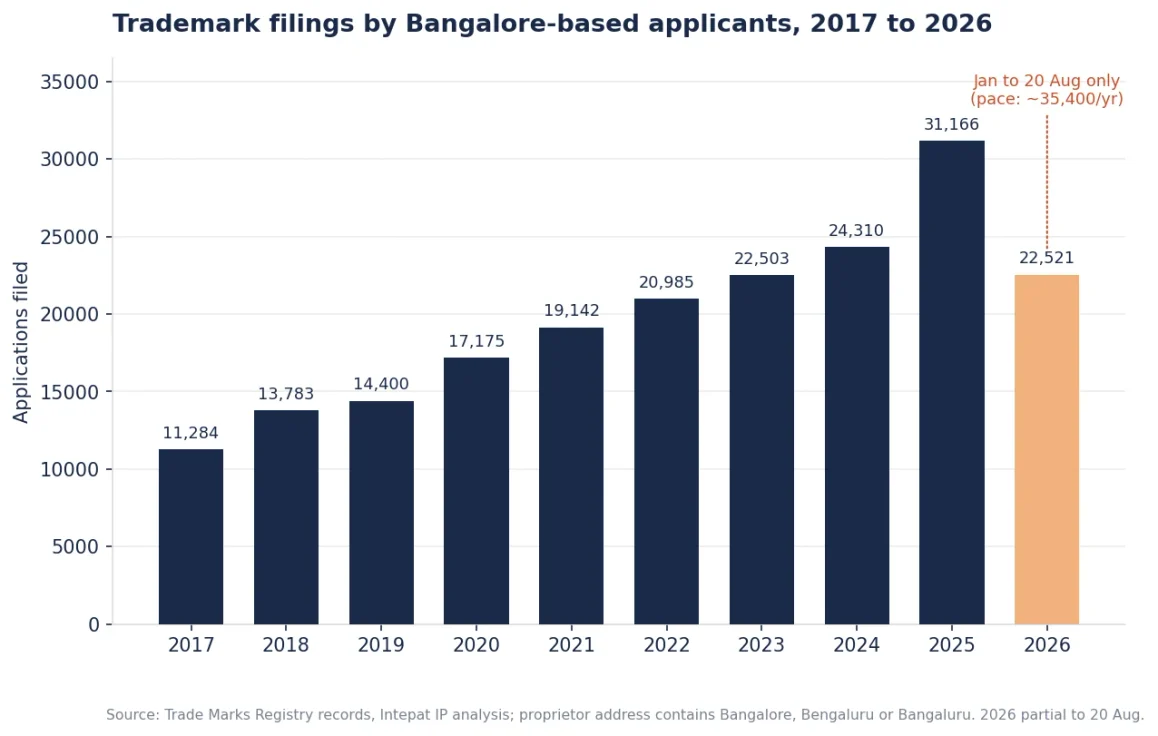
The growth has been consistent rather than driven by isolated spikes: filings increased in every year of the series, including during the pandemic. For context, the Trade Marks Registry received more than 5.5 lakh applications nationally in 2024–25, placing Bangalore’s filing activity within an already high-volume national system.
That activity reflects the city’s commercial base. According to the Bengaluru Innovation Report 2025, Bengaluru is home to 53 unicorns and about 2.5 million software professionals, while startups in the city have raised approximately US$79 billion since 2010. A growing business ecosystem also means a growing number of brands competing for distinctive names, logos and market identity.
A note on methodology is important. The dataset was compiled on 20 August 2026 from Trade Marks Registry records by matching proprietor addresses containing Bangalore, Bengaluru or the common misspelling Bangaluru. Status figures represent the Registry’s current status codes, not the complete prosecution history of each application. Multi-class applications recorded as Class 99, representing 2.3% of the relevant subset, were not redistributed across their constituent classes. The annual filing analysis covers 197,269 applications filed from January 2017 onwards. The refusal rate is based on 17,752 refused applications within the 244,517-application “Bangalore” spelling subset; accordingly, the per-100 outcome analysis combines subset and corpus rates, as disclosed here.
The practical implication is straightforward: as filing volumes rise, the pool of earlier marks that may affect a new application also grows. A pre-filing trademark search is therefore not merely a procedural precaution; at current filing volumes, it is an important part of assessing whether a proposed mark is commercially safe to adopt and legally viable to register..
What Happens to Bangalore Applications After Filing
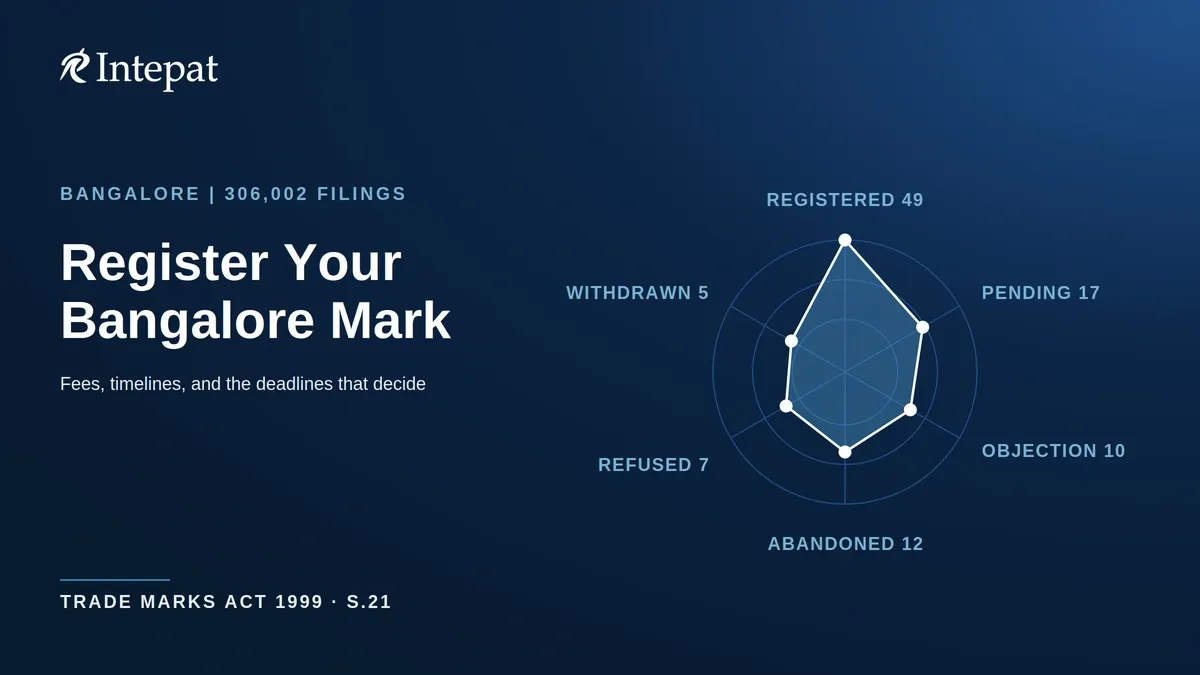
Take 100 typical Bangalore trademark applications as they stand on the register today. About 49 are registered, 17 are still pending, 10 are facing an objection or opposition, 7 are refused, 5 are withdrawn or removed, and 12 are marked abandoned.
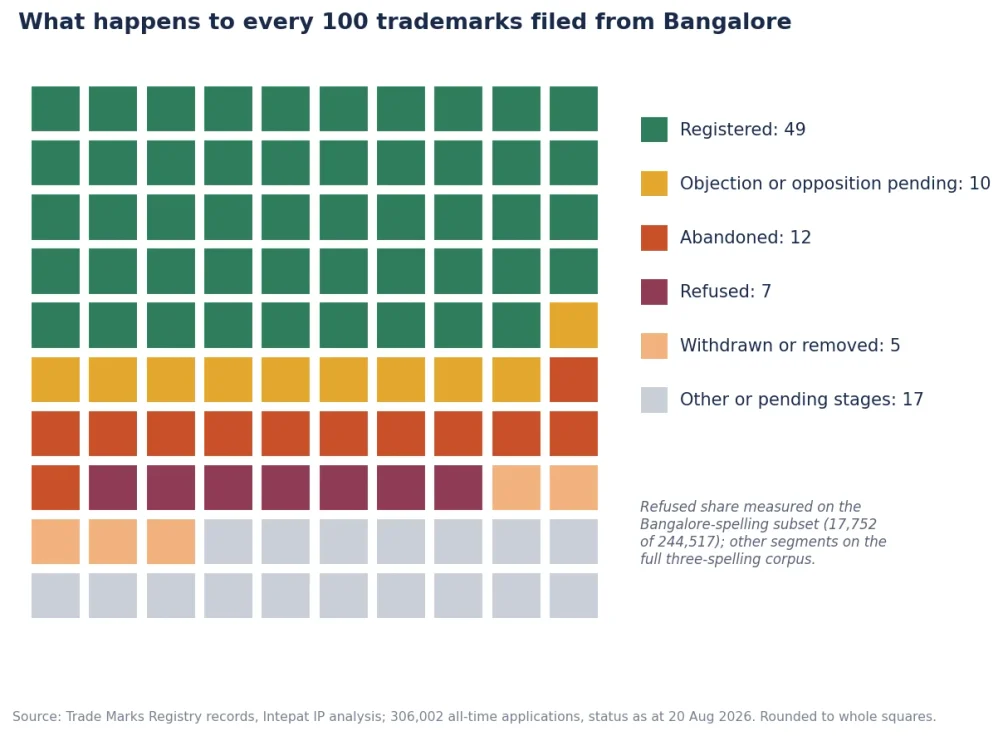
That last number is the one I would pay attention to as a practitioner. Refusal is a genuine risk: 17,752 applications in the Bangalore-spelling subset are recorded as refused, roughly 7 in every 100. But abandonment is even more common, at about 12 in every 100. The register does not tell us why each of the 37,844 abandoned applications reached that status, so it would be wrong to assume that every one resulted from the same missed deadline. What we can say is that trademark procedure contains several stages where failure to respond or take the required action within time can result in abandonment.
It is also important not to treat every adverse-looking status as the same thing. A withdrawn application is one the applicant has chosen not to pursue. A removed mark is different: it reached registration and was subsequently taken off the register, including through non-renewal under Section 25(3) or proceedings based on non-use under Section 47. For that reason, these figures are better read as a snapshot of current register status than as a simple “success versus failure” rate.
The 10 in 100 facing an objection or opposition should not automatically be viewed as applications heading for refusal. Examination objections are common, and many can be overcome with a properly prepared response. Oppositions likewise have their own procedure and merits. The real practical point is that once the Registry issues a notice, examination report or procedural direction, the applicant needs to act within the prescribed time.
That is the part of trademark prosecution clients sometimes underestimate. A strong mark can still run into difficulty if correspondence is missed or deadlines are not monitored. My advice to a first-time filer is simple: treat docketing as part of the filing itself. Record every deadline from day one, monitor the application after filing, and respond promptly whenever the Registry requires action. The sections that follow explain those stages, the time limits attached to them, and the costs you should expect along the way.
Government Fees for Trademark Registration
The government fee for filing a trademark application in Bangalore is the same as anywhere else in India. For online filing of Form TM-A, an individual, recognised startup or small enterprise pays INR 4,500 per mark per class. All other applicants pay INR 9,000 per mark per class. These figures are based on the First Schedule to the Trade Marks Rules and are verified as of August 2026.
| What you are paying for | E-filing fee (INR) | Form |
|---|---|---|
| Application, per class: individual, startup or small enterprise | 4,500 | TM-A |
| Application, per class: all other applicants | 9,000 | TM-A |
| Expedited processing, per class: individual, startup or small enterprise | 20,000 | TM-M |
| Expedited processing, per class: other applicants | 40,000 | TM-M |
| Notice of opposition or counterstatement, per class | 2,700 | TM-O |
| Renewal, per class | 9,000 | TM-R |
| Renewal with surcharge, within six months after expiry | 4,500 plus renewal fee | TM-R |
The point clients most often miss is that the fee is calculated per mark and per class. If you file a word mark and a logo in three classes, that is six separate class filings for fee purposes. The concession also applies at the application stage; renewal is currently INR 9,000 per class irrespective of whether the proprietor originally qualified as an individual, startup or small enterprise.
For example, a Bangalore skincare startup filing one word mark in Classes 3, 5 and 35 would pay INR 13,500 in government filing fees. A company that does not qualify for the concession would pay INR 27,000 for the same three-class application. If both the word mark and logo are filed separately, those figures double.
One practical point is worth checking before filing. The reduced fee is available only where the applicant actually falls within the prescribed category and can support that claim with the appropriate documentation. A startup must satisfy the recognition requirements under the Rules, while a “small enterprise” is the specific statutory category referred to there; it should not be assumed that every entity commonly described as an MSME automatically qualifies for the concession. Where a client intends to claim the lower fee, we normally verify the supporting status before filing rather than deal with a deficiency later.
Physical filing remains possible, but the corresponding application fees are higher at INR 5,000 and INR 10,000 respectively. Professional fees for clearance searches, preparing the application, responding to objections, attending hearings or handling oppositions are separate from these government charges.
How Long Trademark Registration Takes in Practice
There is no fixed statutory timeline for completing trademark registration in India, so I would be cautious of anyone promising registration within a specific number of months. What the law does prescribe are deadlines at individual stages: one month to respond to an examination report, four months for filing an opposition after advertisement, and two months to file a counterstatement once an opposition is served. The overall timeline depends on how many of those stages your application encounters.
A straightforward application with no objection or opposition moves through examination, advertisement in the Trade Marks Journal, the four-month opposition period, and registration. An objection, hearing or opposition can extend that considerably. In practice, it is better to track the application by stage rather than work backwards from a promised registration date.
There is an expedited route. Under Rule 34, an applicant may request expedited processing through Form TM-M, following which examination is ordinarily to be completed within three months. The government fee is INR 20,000 per class for individuals, startups and small enterprises and INR 40,000 per class for other applicants. Given the cost, we generally see it as useful where registration timing has a commercial consequence, such as an upcoming funding round, marketplace requirement or enforcement action.
The period while the application is pending is not necessarily lost time. If the mark is ultimately registered, the registration takes effect from the filing date under Section 23. The applicant may continue using the mark with the ™ symbol, and a trademark watch can help identify later conflicting applications when they are advertised, giving the proprietor an opportunity to oppose them within the four-month statutory window.
The Most Crowded Classes in Bangalore
The most crowded trademark class in Bangalore is not software. It is Class 5, covering pharmaceuticals and related goods, with 29,703 applications, followed by Class 35 for advertising and business services at 24,677. The software-heavy Classes 9 and 42 come third and fourth. Together, the top five classes account for about 42% of all Bangalore filings.
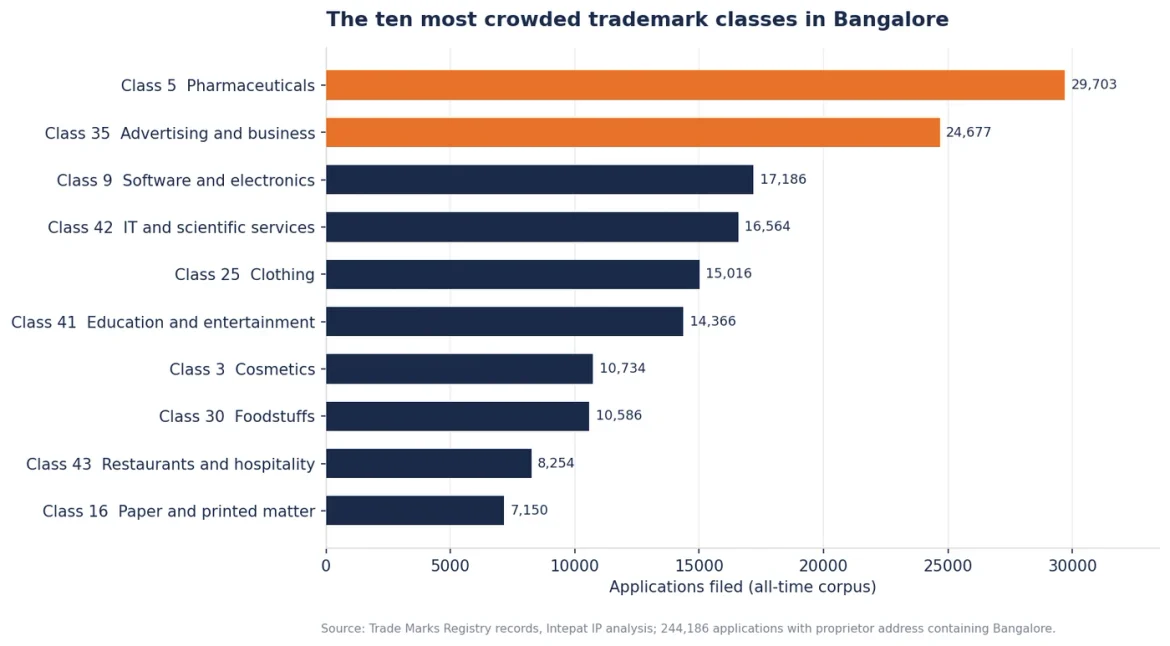
Class 5 being at the top may surprise anyone who thinks of Bangalore mainly as a technology hub. But the trademark register reflects a much broader economy. Pharmaceutical, nutraceutical, healthcare and personal-care businesses often develop multiple products and sub-brands, which naturally generates more trademark filings. Classes 25 (clothing), 41 (education), 3 (cosmetics), 30 (food products) and 43 (restaurants and hospitality) also feature prominently in the top ten.
From a practitioner’s perspective, filing volume matters because it affects clearance risk. During examination, the Registry searches for earlier identical or deceptively similar marks covering the same or similar goods or services. A crowded class therefore means more earlier marks to review and, generally, a greater chance of encountering a citation or commercial conflict. For applicants in Classes 5, 35, 9, 42 and 25, careful trademark class selection and a proper pre-filing search are particularly important.
The data also challenges the assumption that Bangalore’s trademark activity is dominated by services. Goods classes, Classes 1 to 34, account for about 61% of filings, compared with 36% for service classes, with the balance recorded under Class 99 for multi-class applications. For product businesses, this is a reminder that trademark protection often needs to be planned as a portfolio across the core product, related products and commercial services rather than as a single application.
A useful Bangalore example is the dispute between Nandhini Deluxe, a restaurant business, and the Karnataka Cooperative Milk Producers Federation, proprietor of the NANDINI dairy brand. The dispute reached the Supreme Court, which in 2018 permitted the restaurant’s registrations subject to exclusions relating to milk and milk products. The case is a good reminder that a trademark registration does not automatically give its owner exclusive rights over every conceivable good or service falling within the same class. What matters is the actual scope of the specification, the nature of the competing goods or services, and the likelihood of confusion. For applicants, the practical lesson is simple: choose the right classes, but draft the specification just as carefully.
Five Trademark Deadlines to Calendar on Filing Day
The Bangalore data shows a significant number of applications ending in abandonment. In practice, that usually makes deadline management just as important as the strength of the mark itself. The Rules prescribe several time limits during prosecution, but these five deserve to be placed on the docket from the outset because missing them can result in abandonment.
- One month to cure filing deficiencies. If the Registry identifies a defect in the application, the applicant generally has one month from the Registrar’s notice to correct it. Failure to do so results in the application being treated as abandoned under Rule 31.
- One month to respond to the examination report. An examination report must be answered within one month of receipt. If no response is filed, the Registrar may treat the application as abandoned under Rule 33(4).
- Do not miss the hearing. Where objections remain unresolved and a hearing is appointed, failure to respond and appear at the hearing can lead the Registrar to treat the application as abandoned under Rule 33(7).
- Two months to file the counterstatement. If an advertised application is opposed, the applicant has two months from receipt of the notice of opposition to file the counterstatement. Miss this deadline and the application is deemed abandoned under Section 21(2).
- Two months to file evidence in support of the application. After receiving the opponent’s evidence, or an intimation that the opponent does not intend to file evidence, the applicant has two months to file its own evidence or intimate that it relies on the counterstatement. Failure to take either step results in deemed abandonment under Rule 46(2).
There is another important deadline after registration. A trademark registration remains valid for ten years and can be renewed indefinitely under Section 25. If renewal is missed, it may still be completed within six months with the prescribed surcharge. Restoration is available only during the following six-month period, up to one year from expiry, and remains subject to the Registrar’s discretion.
The practical point is simple: the law imposes several firm clocks on the applicant, but no corresponding statutory deadline by which the Registry must complete registration. That is why good trademark prosecution and maintenance is largely about disciplined docketing, prompt instructions and timely responses, long before any dispute reaches a courtroom.
Documents You Need
For most Bangalore applicants, the documentation is straightforward. An individual filing in their own name generally needs basic identity and address details and a representation of the mark. There is no requirement to prove an existing business simply to file, because Section 18 permits an application even where the mark is proposed to be used. A company or LLP applies in its own legal name, with its principal place of business stated in the application.
A few additional documents become important depending on the filing. If you claim that the mark was already in use before the application date, Rule 25(2) requires an affidavit supporting that prior-use claim together with relevant evidence. If you claim the reduced government fee, you should have the appropriate startup-recognition or small-enterprise documentation supporting eligibility under Rule 2. Where the application is filed through a trademark agent or attorney, a signed authorisation is also required. We have set out the supporting documents and practical filing requirements in more detail in our guide to documents required for trademark registration in India.
What This Means Before You File
Before filing, there are three things worth getting right: clear the mark properly, choose the correct applicant category, and docket every deadline from day one. With nearly half of Bangalore’s filings concentrated in just five classes, applicants in those classes face a particularly crowded register. That makes a proper pre-filing search much more valuable than a simple identical-mark check.
The search should also cover phonetic, spelling and transliteration variants, especially for marks derived from Kannada, Sanskrit or other Indian-language words. Even this dataset required searches for Bangalore, Bengaluru and Bangaluru to capture the city consistently. Trademark searches need the same practical flexibility because a conflicting mark may not be spelled exactly the way you expect.
Applicant status also affects cost. The government filing fee is INR 4,500 per class for an individual, recognised startup or qualifying small enterprise, compared with INR 9,000 per class for other applicants. Across several classes, that difference becomes significant. But cost is only one part of the filing strategy. The register currently shows 37,844 Bangalore applications as abandoned, compared with roughly 7 in 100 recorded as refused. Whatever the underlying reason in each case, the lesson from practice is clear: once an application is filed, every Registry notice and statutory deadline needs to be monitored and acted upon.
For a detailed walkthrough, see our trademark registration guide for India. We also have separate guides on Form TM-A, trademark registration fees, the registration process, and filing strategies for startups and MSMEs.
Frequently Asked Questions
Generally, no. In ordinary e-filing practice, filing and examination responses are handled electronically, and Rule 115 permits hearings by video conference, deemed to take place at the appropriate office. Chennai administers Karnataka files under Rule 4, and a Bangalore applicant can typically reach the registration certificate without attending in person.
TM is commonly used in the marketplace to signal a claimed but unregistered mark, and businesses typically start using it once the application is filed. The R in a circle is different: Section 107 of the Act penalises falsely representing a mark as registered before it actually is, so switch symbols only after registration.
A startup recognised under the Startup India initiative pays INR 4,500 per class per mark for e-filing Form TM-A, the same concessional rate as individuals and small enterprises (First Schedule, Entry 1, verified as of August 2026). Attach the recognition certificate when filing; without it the Registry treats the applicant as standard and the fee is INR 9,000.
Legally, no; the mark’s protection is national and the appropriate office is the same. Practically, be consistent. This dataset needed three separate spellings, Bangalore, Bengaluru and Bangaluru, to capture the city’s applicants, and inconsistent addresses across your filings make your own portfolio harder to search, watch and renew as it grows.
Most software businesses need Class 9 for the software product itself and Class 42 for software-as-a-service and development services, with Class 35 added where the brand covers marketplace or advertising activity. Those are three of Bangalore’s five most crowded classes, so run the clearance search before committing to a name, not after.
There is no statutory overall period, and actual durations vary substantially with objections and opposition, so treat any single promised figure with caution. The one benchmark the Rules themselves set is expedited processing: examination ordinarily within three months of the request (Rule 34), at INR 20,000 to 40,000 per class (verified as of August 2026).
The Registrar may treat the application as abandoned under Rule 33(4), and the filing fee is not refunded. The available remedial options then depend on the procedural circumstances, and a fresh application may be required; a fresh filing also means a fresh filing date, losing the benefit of the original one.
No. Registration under the Trade Marks Act 1999 confers rights across the whole of India, regardless of which Registry office processed it. Protection outside India needs separate filings, either country by country or through the Madrid Protocol route using your Indian application or registration as the base.
This article explains the law on trademark registration in India as at August 2026 and is for general information only. It is not legal advice. Government fees, forms, and procedures change; confirm current figures with the Trade Marks Registry before you file. For advice on your specific mark, consult a trademark attorney.
Sources
- The Trade Marks Act, 1999 (Act 47 of 1999), Sections 18, 21, 23, 25, 47 and 107. Government of India.
- The Trade Marks Rules, 2017, Rules 2, 4, 25, 31, 33, 34, 46 and 115, and the First Schedule (Entries 1, 2, 3, 4 and 17). Government of India.
- Trade Marks Registry, Office Locations and Jurisdiction, Intellectual Property India.
- Office of the CGPDTM, Annual Report 2024-25.
- Nandhini Deluxe v Karnataka Co-operative Milk Producers Federation Ltd, Civil Appeal Nos. 2937-2942 of 2018, Supreme Court of India, decided 26 July 2018.
- Trade Marks Registry records, internal analysis by Intepat IP: 306,002 applications with proprietor address containing Bangalore, Bengaluru or Bangaluru, and a refused-status count of 17,752 within the 244,517-application Bangalore-spelling subset.
- Bengaluru Innovation Report 2025, Karnataka Digital Economy Mission, 3one4 Capital and Startup Karnataka.