




A patent grant within 1 year in India is possible, and can be targeted through the expedited route under Rule 24C, but it is a target rather than an entitlement. It needs early publication, an accepted Form 18A request, and a prompt reply to the examination report. No patent may be granted before six months have expired from publication.
This guide covers Indian practice only. The twelve-month target is measured from the Indian filing date, while each statutory period runs from its own trigger. Periods, fees and forms are stated as at July 2026.
| The short version |
| ● A twelve-month grant is a target, not an entitlement. Nothing caps the interval between filing Form 18A and the file reaching an examiner. ● No patent can be granted until six months have passed from the actual date of publication. Early publication starts that clock and the opposition window together. ● Applicant identity controls eligibility. A female founder or inventor does not make a company applicant eligible. ● Official fee delta over the ordinary route: about Rs 6,500 for a startup or small entity and about Rs 52,500 for others, measured against a comparator that does not request early publication. ● Government fees are not the whole budget. Drafting, excess pages and claims, prosecution, hearings, extensions and any biodiversity step sit on top. |
What It Takes to Get an Indian Patent Granted in 12 Months
Five things have to hold together, each governed by a different provision. Two of them sit outside the applicant’s control: when the file reaches an examiner, and whether anyone opposes.
File the complete specification at the outset. Where an application is accompanied by a provisional specification, the complete specification must follow within twelve months or the application is treated as abandoned. That is an outer limit, not a waiting period: it may be filed the same day, or at any point inside the twelve months. A provisional patent application does not make a twelve-month grant impossible, but examination cannot begin until the complete specification is on record, so every month a provisional stands alone is a month lost from the examination timeline.
File Form 9 with the application. The Patent Office does not examine an unpublished application, and publication otherwise falls at eighteen months from filing or priority, whichever is earlier. A request on Form 9 brings it forward, ordinarily within one month of the request. On the expedited route early publication is not optional: a Form 18A request must be accompanied by a publication request unless the application has already been published or a Form 9 is already on record.
Request expedited examination on Form 18A. The ordinary route is not barred from producing a fast grant; it too prescribes periods that run once an examiner holds the file. What neither route prescribes is a maximum period before the file reaches an examiner. The expedited route provides three things the ordinary route does not: a separate reference queue, shorter maximum periods on the office after reference, and a deadline for the Controller to dispose of the application. Mechanics are in the guide to expedited patent examination in India.
Calculate the reply margin before the report arrives. Once the first statement of objections issues, commonly called the examination report, the applicant has six months to put the application in order. The Controller then has three months to dispose of the application, running from the last reply or from the end of that six months, whichever is earlier. How much of the six months is available depends on how long the file waited for reference.
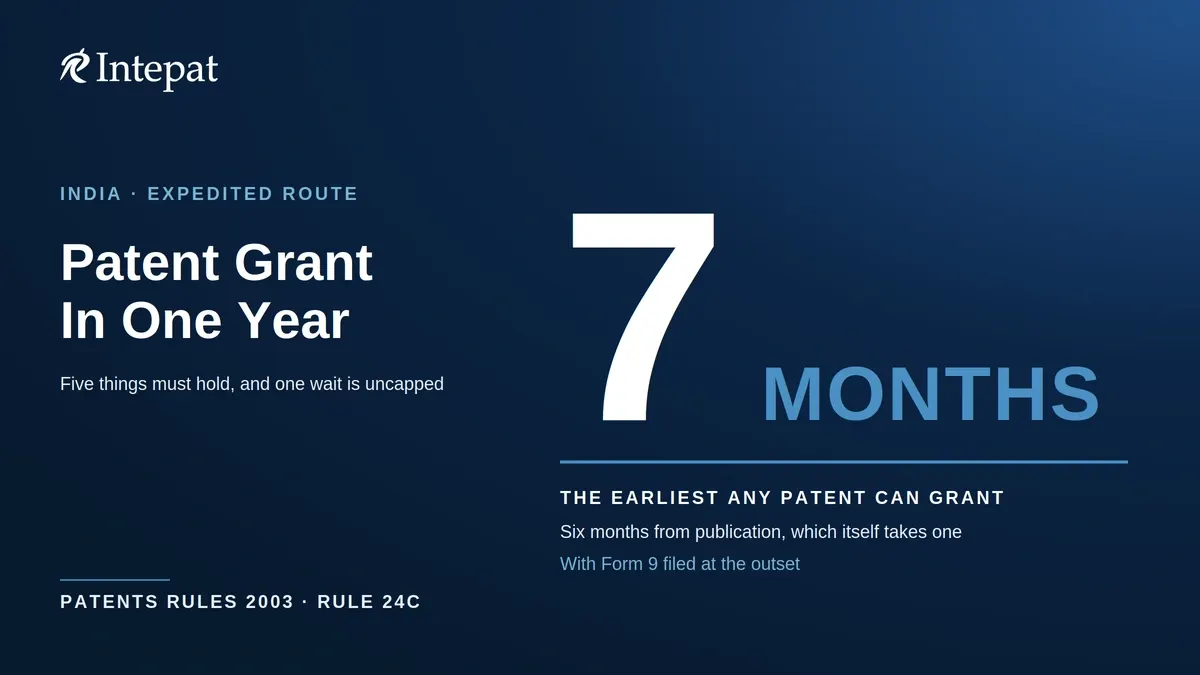
Diarise the six-month publication bar. No patent may be granted before six months have expired from the date of publication. The period runs alongside examination rather than after it, so it adds nothing to a well-run file, but it fixes the earliest possible grant date: the later of completion of prosecution and expiry of six months from the actual publication date. Where Form 9 is filed with the application, that bar lifts at about month seven.
Our answer, as a practice matter. Where the applicant qualifies on one of the listed grounds, the specification is complete at filing, and the first statement of objections can be answered within about two months, twelve months is a reasonable target and we plan filings around it. Where the applicant is a company outside the concessional grounds, where the specification is still in development, or where a competitor is positioned to oppose, it is not, and the instruction should be to file well rather than fast.
Who Can Request Expedited Examination in India
The grounds are exhaustive. A request is filed on Form 18A, by authenticated electronic transmission only, within the same window as an ordinary examination request: thirty-one months from priority or filing, whichever is earlier, for applications filed on or after 15 March 2024, and forty-eight months for applications filed before that date. Nothing in the route rewards a late request, so file Form 18A on the filing date.
| Ground | Clause |
| India named as the competent International Searching Authority, or elected as International Preliminary Examining Authority, in the corresponding international application | (a) |
| The applicant is a startup | (b) |
| The applicant is a small entity | (c) |
| The applicant is a natural person, or all joint applicants are natural persons, and the applicant or at least one of them is female | (d) |
| The applicant is a department of the Government | (e) |
| The applicant is an institution established by a Central, Provincial or State Act, owned or controlled by the Government | (f) |
| The applicant is a Government company | (g) |
| The applicant is an institution wholly or substantially financed by the Government | (h) |
| The application is in a sector notified by the Central Government | (i) |
| The applicant is eligible under an arrangement between the Indian Patent Office and a foreign patent office | (j) |
Clause (d) is the one most often misread. It does not provide that one female applicant qualifies the application: it requires the applicant to be a natural person, or, where there are joint applicants, all of them to be natural persons. A company applying jointly with a female inventor does not qualify, and will ordinarily need the startup or small entity ground.
Clause (j) needs an operative arrangement. The India and Japan Patent Prosecution Highway pilot terminated on 20 November 2022, both offices ceasing to accept requests after 21 November, so check whether an arrangement is in force before relying on it. A request that misses the requirements is not rejected outright: it is processed as an ordinary examination request, keeping the date it was filed.
The startup and small entity protections are specific rather than general. A request is not reopened merely because the applicant later loses that status through lapse of recognition, or because turnover crosses the notified threshold, and the same protection covers fees already paid. It goes no further. Transfer the application to someone outside the concessional categories and the new applicant pays the difference in fee scale.
The Expedited Patent Timeline in India, Month by Month
What the Rules require, and where they require nothing:
| Step | Period | Runs from | Rule |
| Publication after a Form 9 request | Ordinarily one month | Date of the request | Rule 24, proviso |
| Reference of the file to an examiner | No maximum prescribed. Requests are taken in the order received | Receipt of the Form 18A request | Rule 24C(5) |
| Examiner’s report to the Controller | Ordinarily one month, not exceeding two months | Date of reference by the Controller | Rule 24C(6) |
| Controller disposes of the examiner’s report | One month | Date of receipt of the report | Rule 24C(7) |
| First statement of objections issued | Within fifteen days | Date of disposal of the examiner’s report | Rule 24C(8) |
| Application put in order for grant | Six months | Date the first statement of objections is issued | Rule 24C(10) |
| Controller disposes of the application | Three months | Last reply received, or the last date to put the application in order, whichever is earlier | Rule 24C(12) |
| Earliest possible grant | Not before six months have expired | Actual date of publication | Rule 55(1A) |
Verified as of July 2026.
The second row governs everything below it. Requests are taken in the order received, with no maximum period for doing so, and each period after that runs from its own trigger rather than from the moment of reference.
Run every office step to its maximum and the first statement of objections issues three months and fifteen days after the file reaches an examiner. Disposal is then due three months after the last reply, or three months after the last date to put the application in order, whichever is earlier. The second falls at twelve and a half months, so it never binds a twelve-month target. The reply date does. Working back, the reply must be on file nine months after reference, which leaves five and a half months to answer the examination report.
Measured from the Indian filing date, that margin shrinks by however long reference took.
| Reference to an examiner | Response window left to reach twelve months from filing |
| Month one | About four and a half months |
| Month three | About two and a half months |
| Month five and a half or later | None. Twelve months from filing is out of reach |
There is no universal response period, because nothing caps the wait for reference. Every period above is an outer limit, so a faster office widens the margin.
An illustration. A recognised startup files a complete specification on 1 March with Forms 1, 9, 18A and 28. Publication follows around 1 April. If the file reaches an examiner in early May, the first statement of objections must issue by about mid-August, and the six-month publication bar lifts on 1 October. To reach a grant by the end of February the reply must be on file by about the end of November, roughly three and a half months to answer it. Every date is derived from the periods above, not from any actual file.
Set the two routes side by side and the difference after reference is only about six weeks: the examiner has two months instead of three, and the statement of objections issues in fifteen days instead of one month. Two further differences sit outside that figure. On the expedited track the Controller’s month to deal with the examiner’s report is stated flatly, where on the ordinary route it is only what should ordinarily happen, and the ordinary route carries no disposal deadline at all. The queue and that deadline matter more than the six weeks.
Intepat case-file observation. On our own files the gap between the request for examination and the first report runs to twelve to twenty-four months on the ordinary route, against one to three months expedited. These are impressions from prosecution files rather than a statistical sample, no period of the kind is prescribed, and both figures move with Patent Office workload and technology field.
What Expedited Patent Examination Costs in India
For a startup or small entity the fast track adds about Rs 6,500 in official fees over an ordinary application that does not request early publication. For an applicant outside the concessional categories it adds about Rs 52,500. The concessional column below covers a natural person, startup, small entity or educational institution.
| Entry and form | Concessional, e-filing | Others, e-filing | Concessional, physical | Others, physical |
| Entry 1, Form 1, application with specification | Rs 1,600 | Rs 8,000 | Rs 1,750 | Rs 8,800 |
| Entry 13, Form 9, request for publication | Rs 2,500 | Rs 12,500 | Rs 2,750 | Rs 13,750 |
| Entry 28(i), Form 18, ordinary examination | Rs 4,000 | Rs 20,000 | Rs 4,400 | Rs 22,000 |
| Entry 29, Form 18A, expedited examination | Rs 8,000 | Rs 60,000 | Not allowed | Not allowed |
| Entry 30, Form 18A, converting a Form 18 request | Rs 4,000 | Rs 40,000 | Not allowed | Not allowed |
| Entry 4(iii), Form 4, extension on the ordinary route, per month | Rs 1,000 | Rs 4,000 | Rs 1,100 | Rs 4,400 |
| Entry 4(iv), Form 4, extension on the expedited route, per month | Rs 2,000 | Rs 10,000 | Rs 2,200 | Rs 11,000 |
| Entry 4(v), Form 4, general extension of time, per month | Rs 10,000 | Rs 50,000 | Rs 11,000 | Rs 55,000 |
| Form 28, declaration of applicant category | No fee | No fee | No fee | No fee |
Official fees under the First Schedule as substituted by G.S.R. 211(E) of 15 March 2024. Verified as of July 2026.
Both headline figures are the Form 9 fee plus the difference between Form 18 and Form 18A. Where the comparator would have published early anyway, the premium is only the examination difference, Rs 4,000 or Rs 40,000. Converting an existing Form 18 request costs half a fresh one, and neither can be filed on paper.
Where any joint applicant falls outside the concessional categories, the whole application pays on the others scale, so a startup does not keep the concessional fee merely by being one of several applicants.
These are official fees for the filing and examination stages only, and exclude drafting, per-sheet and per-claim additions, prosecution, hearings, opposition work, extensions and any biodiversity step. Budget against the whole of that, not the Form 18A line. The patent fees payable in India and the patent fees calculator cover the rest.
Forms and Evidence Required on the Fast Track
Only one form is specific to the route. The rest follow the ordinary patent filing procedure.
| Form | Purpose | When it applies |
| Form 1 | Application with complete specification | Both routes |
| Form 3 | Statement and undertaking on corresponding foreign applications | Both routes |
| Form 5 | Declaration as to inventorship | Both routes |
| Form 26 | Authorisation where a patent agent acts | Both routes |
| Form 9 | Request for publication | With Form 18A, unless already published or a Form 9 is on record |
| Form 18A | Request for expedited examination | Expedited route only |
| Form 28 | Declaration of applicant category | Category-specific, not route-specific: on every fee-bearing document filed by a startup, small entity or educational institution |
Evidence supporting the ground goes in with Form 18A. An Indian startup relies on its DPIIT recognition under the Startup India initiative; a foreign entity claiming startup status files a declaration meeting that initiative’s criteria. A small entity holds current registration evidence, the threshold being the investment limit for a medium enterprise under the MSMED Act 2006. A government body relies on its instrument of establishment. That limit moves, having been revised with effect from 1 April 2025, so confirm it before the category is declared: a wrong declaration carries a fee consequence.
What Stops a One-Year Patent Grant
A pre-grant opposition. This is the risk to assess before Form 9 is filed. Any person may represent by way of opposition to the Controller against the grant, in writing, at any point after publication and before grant. On filing, the Controller’s three-month disposal deadline falls away, though the rest of the procedure does not. The opposition procedure prescribes its own periods, which differ depending on whether a prima facie case is made out, the representation is refused without a hearing, or it is decided after one. Once notice issues, the applicant has two months to file a statement and evidence, and the application and the representation are decided together, ordinarily within one month of the proceedings closing. That two-month window is not one the Controller can rescue afterwards.
Note that the two effects do not arrive together. The disposal deadline falls away on filing of the representation. The second consequence requires more: once the Controller finds a prima facie case and issues notice, the application is examined on the expedited track whether or not it started there.
Early publication opens that window months earlier than it would otherwise open, and the six-month bar means the application remains open to opposition for that whole period before it can be granted. Acceleration therefore increases exposure, so the pre-grant opposition risk should be assessed before Form 9 is filed, not after.
A specification that is still moving. After filing, amendment is possible only by way of disclaimer, correction or explanation, only to put in something that is actually the case, only where nothing new is introduced that was not in substance disclosed already, and only within the scope of a claim as filed. New embodiments cannot be added to a filed application at all. They become fresh applications with a later priority date, granted parent or not.
A biodiversity step. If the invention draws on a biological resource from India, or on traditional knowledge associated with one, a separate clearance has to be in place before grant, and what it involves depends on who the applicant is. A non-resident, a foreign national or a foreign-controlled company needs the National Biodiversity Authority’s prior approval before grant. An Indian citizen, or an Indian company not under foreign control, registers with the Authority instead, again before grant. A further approval is needed when the invention is commercialised, but that one does not hold up grant.
The separate Form 3 deadline. The updated statement and undertaking on corresponding foreign applications is due within three months of issuance of the first statement of objections, running alongside the response deadline. The Controller can condone delay or extend that by up to three months on Form 4, so it is not incurable, but the relief carries a fee. The statement and undertaking on Form 3 sets out the disclosure scope.
Extensions. A further three months to put the application in order is available on Form 4, requested before the six months expire, at Rs 2,000 a month for concessional applicants and Rs 10,000 for others. A separate general power allows extension or condonation of up to six months, again on Form 4 and requested before the period expires, at five times that rate. Either route cuts the remaining margin materially, though an early report can absorb a short overrun. Neither the six months nor the three-month extension can be rescued afterwards through the Controller’s general power to correct irregularities.
Two edge cases. The Controller can cap the number of expedited requests taken in a year, by notice in the official journal. And while a secrecy direction is in force publication is deferred, so whether the target survives depends on when it lifts.
When Paying for Speed Makes Business Sense
At roughly Rs 6,500 for a startup, official cost rarely decides this. The test is whether a granted patent does something for the business that a pending application cannot.
On our prosecution files that is usually so where diligence in a funding round treats a granted patent differently from a pending one; where a licensing negotiation turns on a granted claim set, though examination is expressly not a warranty of validity; where enforcement is in prospect, since publication gives rights but no infringement suit lies until grant; and where a tender or subsidy is drafted around a granted patent.
Three situations point the other way. Where the specification is still in development, acceleration achieves nothing, because new embodiments cannot be added to the filed application in any event.
Where divisionals are in prospect, the grant date is a hard deadline, because a divisional may be filed only while the parent is pending. A divisional does not have to wait for a unity objection, but in our experience the decision still follows the examiner’s treatment of unity, and accelerating the parent compresses the time to take it. And where a competitor is positioned to oppose, accelerating publication opens the opposition window earlier for no compensating gain.
Where the answer is yes, file the complete specification with Forms 18A, 9 and 28 together, calendar the downstream periods from reference rather than from the request, and scope the response before the report arrives. The applicant controls the specification, the filing date, the category declaration and the speed of reply. Reference timing, examiner allocation, hearings, opposition and any secrecy direction are not.
Frequently Asked Questions
It is possible and can be targeted through the expedited route under Rule 24C, but it is not an entitlement. Fixed periods apply to each examination step once the file is referred to an examiner, and nothing caps the wait before reference. No patent can be granted until six months after publication.
Not until six months have expired from the actual date of publication. The period runs alongside examination rather than after it, so it adds nothing to a well-run file. Where Form 9 goes in with the application and publication follows about a month later, the bar lifts around month seven.
The grounds are exhaustive: startups, small entities, applicants who are all natural persons with at least one female applicant, government departments and companies, government-financed institutions, notified sectors, applicants who named India as their international searching authority, and applicants covered by an arrangement with a foreign patent office.
Form 18A costs Rs 8,000 for a natural person, startup, small entity or educational institution, and Rs 60,000 for other applicants. It cannot be filed on paper. Early publication on Form 9 costs Rs 2,500 or Rs 12,500 on the same split between concessional and other applicants.
Effectively yes. An expedited examination request has to be accompanied by a request for publication on Form 9, unless the application has already been published or a Form 9 request is already on file. This is why Form 9 and Form 18A are normally filed together.
Yes. An existing Form 18 request can be converted to Form 18A on payment of the conversion fee and filing the documents an expedited request requires. Conversion costs Rs 4,000 for concessional applicants and Rs 40,000 for others, half the cost of a fresh request.
Only if the complete specification follows quickly. The complete specification may be filed on the same day as the provisional or at any point within twelve months, but examination cannot begin until it is on record, so every month the provisional stands alone is a month lost.
Filing removes the Controller’s three-month disposal deadline and starts the separate opposition procedure, which prescribes its own periods for the prima facie decision, the applicant’s reply and the final order. Once the Controller finds a prima facie case and issues notice, the application is examined on the expedited track.
This article states the position under Indian patent law as at July 2026 and is provided for general information. The examination periods bind the Patent Office as a matter of law, but each runs from its own trigger, and none of them starts until the application reaches an examiner, for which no maximum is prescribed. Actual timelines depend on Patent Office workload, technology field, and the conduct of the individual file. Nothing here is a guarantee of a grant within any stated period, and it is not a substitute for advice on a specific application. Fees are official fees only, verified against the First Schedule as substituted by G.S.R. 211(E) dated 15 March 2024, and are subject to amendment.