




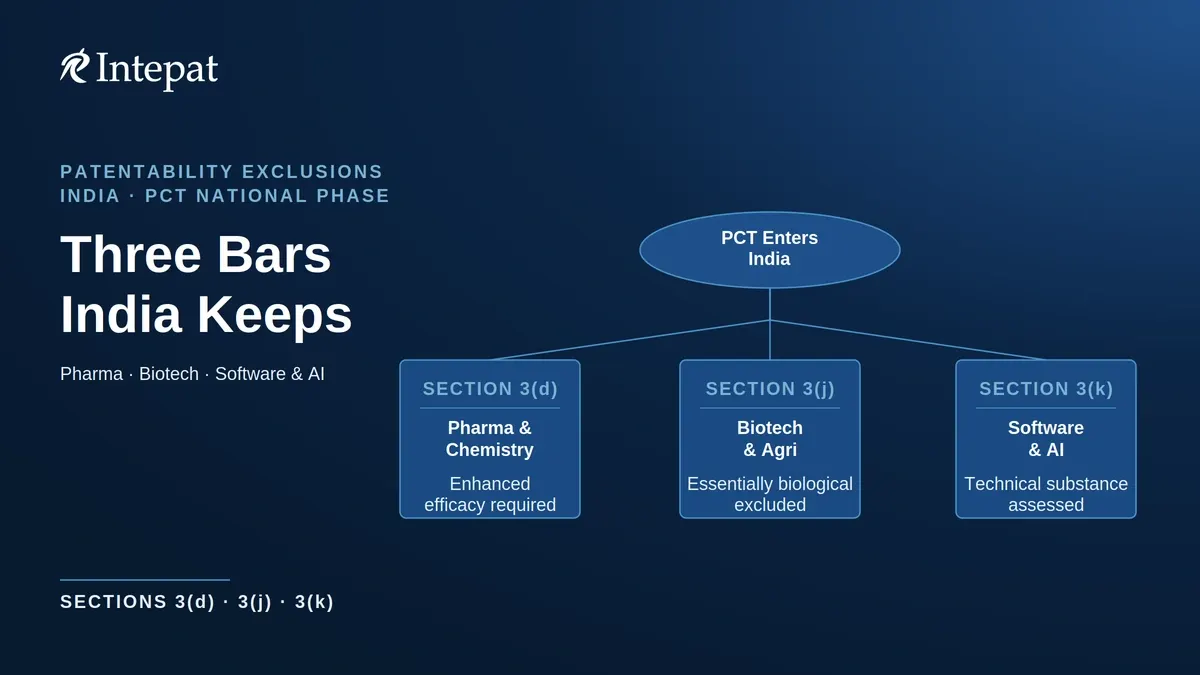
This article addresses the three exclusions most directly relevant to pharmaceutical, biotechnology and computer-related inventions entering India via the PCT route. It does not cover every exclusion under Section 3 or every limb of Section 3(d).
A US patent, a European patent granted by the EPO, or a Japanese patent does not determine patentability in India. Once a PCT application enters the Indian national phase, the Indian Patent Office examines it under the Patents Act 1970, including the exclusions in Section 3. The International Search Report identifies relevant prior art. The Written Opinion of the ISA provides a preliminary, non-binding view on patentability. Neither document prevents the Indian examiner from raising an objection under Section 3.
| Key takeaways |
| ● India’s Section 3 bars apply independently. A foreign grant does not displace them. ● Section 3(d) applies to a new form of a known substance. For a medicine, the applicant must establish enhanced therapeutic efficacy. For other substances, efficacy is assessed by relevant function or purpose. ● Section 3(j) bars patents on plants, animals, and essentially biological processes. Micro-organisms are not excluded under Section 3(j), but naturally occurring micro-organisms are independently barred under Section 3(c). ● Section 3(k) bars computer programs per se. The examiner assesses the claim as a whole under the CRI Guidelines 2025 to determine whether the claimed subject matter constitutes patentable technical subject matter. ● The International Preliminary Examination Report (IPER) from the IPEA (International Preliminary Examining Authority) is non-binding on India and does not decide compliance with Section 3. ● The FER response window is six months from the first statement of objections, extendable by three months on Form 4 with fee (verified as of July 2026). |
Why a foreign grant does not settle patentability in India
The Patent Cooperation Treaty creates a unified filing channel, not a unified patentability standard. When a PCT application designates India and the applicant enters the national phase, Section 7(1A) of the Patents Act 1970 deems that international application to be an application under the Act. Section 10(4A) treats the title, description, drawings, abstract and claims filed internationally as the complete specification. Section 138(4) further confirms that the international filing has the effect of filing an application for patent under section 7. This statutory framework brings every PCT national-phase application under the full discipline of Indian patent law.
Section 12 of the Act requires the Controller to refer every application to an examiner who must report on whether there is any lawful ground of objection to the grant of the patent under the Act. That mandate is unconditional. It covers PCT national-phase applications as fully as it covers applications filed directly in India.
The consequence is direct: the examination that happened in the home jurisdiction does not bind the Indian examiner. An application covering a polymorph of a known drug, a method of producing a plant variety, or a software-implemented process faces the same Section 3 scrutiny whether it enters India through the PCT route or directly under the Paris Convention. A favourable Written Opinion, or a granted patent from the EPO or USPTO, does not create a presumption of patentability in India: the Act gives the Indian examiner no obligation to follow either.
PCT search and examination documents: what they do and what they do not decide
The international search is conducted by the competent International Searching Authority (ISA) selected for the application. The ISA produces documents with distinct functions:
| Document | What it does | Does it decide Section 3 in India? |
| International Search Report (ISR) | Identifies relevant prior-art documents | No |
| Written Opinion of the ISA | Gives a preliminary, non-binding view on novelty, inventive step and industrial applicability under the PCT framework | No |
| Chapter II report (IPER) | Gives a further preliminary, non-binding patentability opinion under the PCT’s Article 33 criteria | No |
| Indian FER | States objections raised under Indian law, including Section 3 | This is the Indian examination document to which the applicant must respond |
The Manual of Patent Office Practice and Procedure is explicit: the opinions from ISA and IPEA are non-binding on the member countries. The procedural requirements for India national-phase entry are set out in the WIPO PCT Applicant’s Guide, National Chapter India.
This cuts both ways. A negative Written Opinion does not make an Indian grant impossible, and a favourable Written Opinion does not prevent a Section 3 objection: the Written Opinion applies the PCT’s own preliminary examination criteria, while India remains free to apply its own substantive exclusions under the Patents Act.
For the Chapter II demand and IPER strategy, a favourable IPER (International Preliminary Examination Report) from the IPEA (International Preliminary Examining Authority) does not decide compliance with Section 3. The report applies the PCT’s Article 33 criteria; India remains free to apply its own substantive exclusions. A favourable Chapter II report leaves Section 3 entirely open.
The planning implication: treat the ISR, Written Opinion and IPER as inputs into a separate India-specific patentability assessment, not as a proxy for it. The three exclusions this article addresses can each arise in Indian examination of inbound PCT applications and each requires an independent pre-entry strategy.
Section 3(d): the efficacy bar for pharma and chemistry
Section 3(d) of the Patents Act 1970 contains three limbs: it bars the mere discovery of a new form of a known substance without enhanced efficacy; the mere discovery of a new property or new use for a known substance; and the mere use of a known process, machine or apparatus unless the process produces a new product or employs at least one new reactant. This section focuses on the first limb, the one most directly relevant to derivative and polymorph claims at the PCT national phase. The Explanation lists the specific derivative categories covered: salts, esters, ethers, polymorphs, metabolites, pure forms, particle sizes, isomers, mixtures of isomers, complexes, combinations, and other derivatives, all treated as the same substance as the parent unless they differ significantly in properties with regard to efficacy.
Section 3(d) is meant especially to deal with chemical substances, and more particularly pharmaceutical products, as the Supreme Court observed in Novartis AG v Union of India (Civil Appeal Nos. 2706-2716 of 2013, (2013) 6 SCC 1). The Court held that Section 3(d) sets a second tier of qualifying standards for chemical substances and pharmaceutical products to check repetitive patenting on spurious grounds, while leaving the door open for true and genuine inventions. Section 3(d) does not prohibit every incremental pharmaceutical invention; the applicant must satisfy the specific statutory threshold applicable to the relevant limb of the provision.
For pharmaceutical inventions, the Court held that efficacy means therapeutic efficacy: physico-chemical properties such as better flow, thermodynamic stability, or lower hygroscopicity do not satisfy the test, and enhanced bioavailability alone may not meet the bar unless it demonstrably translates into enhanced therapeutic effect. For non-pharmaceutical substances, efficacy is assessed by the relevant function or purpose of the substance.
For counsel preparing a national-phase application covering a pharmaceutical derivative, the specification must address efficacy directly. The Patent Office Manual directs applicants to state clearly in the description how the claimed form differs significantly in efficacy from the known substance, and the examiner investigates this case by case. On post-filing evidence, the Delhi High Court held in Daewoong Pharmaceutical Co. Ltd. v Controller General of Patents (C.A.(COMM.IPD-PAT) 23/2022) that additional efficacy data may be admitted at the appellate stage where the original rejection was not based on a substantive finding that enhanced efficacy was absent, but the admission was case-specific and not an unrestricted right. The broader principle, confirmed in Shaafi Naturcure LLP v Assistant Controller of Patents and Designs (C.A.(COMM.IPD-PAT) 109/2022, 22 June 2026), is that later-filed evidence is not a substitute for the original disclosure: it may be considered to confirm a technical effect already expressly or implicitly supported by the specification, but not ordinarily to establish that effect for the first time. Any proposal to amend the specification itself must satisfy all four requirements of Section 59 before grant: (1) by way of disclaimer, correction or explanation; (2) for incorporation of actual fact; (3) must not introduce matter not in substance disclosed in the original specification; and (4) must not result in any amended claim falling outside the scope of a claim as originally filed.
Section 3(j): plants, animals, and biotech at the national phase
Section 3(j) bars patents on plants and animals in whole or any part, other than micro-organisms, including seeds, varieties, and species, and essentially biological processes for the production or propagation of plants and animals.
Micro-organisms are not excluded under Section 3(j). A separate bar arises under Section 3(c), which excludes the mere discovery of any living thing or non-living substance occurring in nature. A claim directed merely to the discovery of a naturally occurring micro-organism is therefore excluded under Section 3(c). A modified micro-organism, or another micro-organism-related invention that is not merely such a discovery, must be assessed under the remaining requirements of the Act. The Manual confirms that genetically modified microorganisms may be patentable subject to other requirements of patentability. Two biological-material obligations under Section 10(4) apply where relevant: where biological material cannot be adequately described and is not publicly available, it must be deposited at an international depository authority under the Budapest Treaty; and the specification must disclose the source and geographical origin of biological material used in the invention.
Plant varieties are excluded from patentability under Section 3(j). Protection, where available, must be pursued separately under the Protection of Plant Varieties and Farmers’s Rights Act and is not automatically transferred from the patent application; the two are distinct regimes with their own eligibility criteria and procedures.
Claims at risk under Section 3(j) often appear in applications drafted under statutory frameworks that treat certain biological processes as patentable. In India, the Act does not define “essentially biological.” Each process claim must be assessed against the statutory exclusion and the applicable judicial and Patent Office authorities. Counsel reviewing an application before India entry should examine every claim touching a plant, animal, seed, variety, or biological production process and assess whether it survives Section 3(j) as drafted. Any amendment must identify the specific excluded feature, retain only matter supported by the international application as filed, and be assessed under all applicable provisions of Sections 2, 3, 10 and 59.
Section 3(k): software and AI patents at the national phase
Section 3(k) bars mathematical methods, business methods, computer programs per se, and algorithms from patentability. The per se qualifier is important: the legislative intent, as recorded in the Manual, was not to reject inventions that include a computer program as an ancillary element, but to bar computer programs as such. The examiner must consider the substance of the claim as a whole, not merely its label or format. A claim does not become patentable merely because it is drafted as a system, device, or computer-readable medium claim; conversely, claim format alone is not determinative of exclusion.
The detailed examination framework for computer-related inventions is set out in the CRI Guidelines 2025, which provide the Patent Office’s examination framework under Section 3(k). The statutory exclusion remains Section 3(k) itself. The Guidelines direct the examiner to assess the claim as a whole, identify its essential technical features, and determine whether the claimed subject matter produces a technical effect beyond a merely incidental effect. The specific assessment and its application to different claim types are set out in the examination framework of the CRI Guidelines 2025, which should be consulted directly.
For applications entering the India national phase with AI, machine learning, or software-implemented claims, the specification as filed needs to support a technical-character argument. If it describes the invention only in terms of algorithmic logic or data manipulation, without addressing the technical problem, technical means, or technical output, the Section 3(k) objection will be harder to overcome at the FER stage through argument alone. The software patents in India article covers the CRI Guidelines framework in more detail. Counsel should not read a favourable Written Opinion on a software claim as resolving the Section 3(k) question.
Responding to a Section 3 objection: what the FER window allows
A Section 3 objection may be raised in the first statement of objections issued during examination (the First Examination Report, or FER). When the Controller issues the first statement of objections, the applicant has six months to put the application in order for grant. That period is extendable by three months on a Form 4 request with fee, made before the six-month period expires (verified as of July 2026).
For responding to the FER, the tools available depend on the exclusion:
For Section 3(d): the applicant may file a written argument supported by research data establishing that the claimed form differs significantly in therapeutic or functional efficacy from the known substance. Subsequent research data may be considered where it confirms a technical effect already grounded in the specification, in accordance with the principles in Daewoong and Shaafi. Depending on the original disclosure and claim scope, a supported narrowing amendment may be considered as a prosecution strategy, subject to Sections 57 and 59.
For Section 3(j): the applicant may file arguments showing the claim does not fall within the excluded category, for example by addressing the character of the process as claimed, or by amending claims where the disclosure supports a narrower formulation outside the excluded subject matter.
For Section 3(k): the applicant may file arguments showing the claim, read as a whole, addresses a technical problem through technical means and produces a specific technical effect, supported by the specification. Any amendment must identify supported essential technical features and the resulting technical effect; recasting the same algorithm in a different claim format is insufficient.
Any amendment must satisfy all four requirements of Section 59: (1) by way of disclaimer, correction or explanation; (2) for incorporation of actual fact; (3) not introducing matter not in substance disclosed in the original specification; and (4) no amended claim may fall outside the scope of a claim as originally filed. Where the international specification did not anticipate the Indian examination strategy, amendment options narrow, reinforcing the value of pre-entry review.
What to do before filing: pre-entry risk mapping
A pre-entry claim and disclosure review for the India national phase should assess each claim against the three exclusions addressed in this article:
Section 3(d) requires particular attention where the claim is directed to a new form or derivative of a known substance, including a salt, ester, polymorph, isomer, metabolite, complex, combination or another derivative falling within the statutory Explanation to Section 3(d). Counsel should confirm the specification addresses therapeutic or functional efficacy, not merely physical properties.
Section 3(j) is a concern for any application in agri-biotech, plant biology, or animal science. Every claim should be tested against the essentially biological process bar and the plant/animal exclusion, including under Section 3(c) for micro-organism claims.
Section 3(k) is a concern for any application where one or more claims are software-implemented, AI-driven, or algorithmic. The specification should be reviewed for technical-character and technical-effect language before entry.
Rule 20 of the Patents Rules 2003 treats communicated Article 19 amendments and Article 34(2)(b) amendments as part of the corresponding international application entering India, subject to translation and procedural requirements: where such amendments were made internationally, a translation must be filed at national-phase entry, and failure to file results in the amended claims being disregarded. Section 138(6) of the Patents Act further provides that amendments proposed before the international authorities may, if the applicant so desires, be taken as amendments before the Indian Patent Office. Any further amendment during Indian national-phase proceedings must be requested under Section 57 and Rule 81, ordinarily in Form 13, and must satisfy all requirements of Section 59. Pre-entry review is therefore the point at which Section 3-specific strategy should be locked in, before the application is examined.
The negative PCT Written Opinion and FER strategy article addresses the broader FER response strategy; the pre-entry window is where Section 3-specific planning belongs.
Current examination guidelines are published by the Indian Patent Office.
Frequently Asked Questions
No. The Written Opinion of the ISA gives a preliminary, non-binding view on novelty, inventive step and industrial applicability under the PCT framework. The ISR separately identifies relevant prior-art documents. Neither document evaluates compliance with India’s domestic patentability exclusions under Section 3, and neither binds the Indian examiner. A favourable Written Opinion or a clean ISR does not prevent a Section 3 objection.
The applicant must establish, through appropriate research data, that the claimed derivative produces enhanced therapeutic efficacy over the known substance. Physical property improvements such as stability, solubility, or hygroscopicity do not satisfy the test. Enhanced bioavailability alone does not satisfy the test unless it demonstrably correlates with enhanced therapeutic outcome. The nature of the required evidence depends on the claimed invention and the asserted therapeutic improvement.
Micro-organisms are not excluded under Section 3(j). However, a claim directed merely to the discovery of a naturally occurring micro-organism is excluded under Section 3(c). A modified micro-organism that is not merely such a discovery may be patentable, subject to Section 3(c) and all other requirements of the Act. Plants and animals, seeds, varieties, and essentially biological processes remain excluded under Section 3(j) regardless of modification.
A computer program per se is not patentable under Section 3(k). The examiner assesses the substance of the claim as a whole, not merely its format or label. A computer-implemented invention may be patentable where the claim, read as a whole, provides a technical solution to a technical problem through technical means. The detailed assessment framework is set out in the CRI Guidelines 2025. Claim format alone does not determine patentability.
The applicant has six months from the date the first statement of objections is issued to put the application in order for grant. This period may be extended by three months on a Form 4 request with the prescribed fee, made before the six-month window closes. Verified as of July 2026.
Amendments before grant are governed by Section 59 of the Patents Act, which requires all of the following: the amendment must be by way of disclaimer, correction or explanation; must be for incorporation of actual fact; must not introduce matter not in substance disclosed in the original specification; and must not result in any amended claim falling outside the scope of a claim as originally filed. All four requirements apply cumulatively.
A Section 3 objection may be raised in the first statement of objections (the FER) issued after the request for examination is processed. The applicant then has six months (extendable by three) to respond. Section 3 objections may also be raised in a pre-grant opposition under Section 25(1), post-grant opposition under Section 25(2), and revocation proceedings under Section 64.
Yes. Section 3 objections can arise in Indian examination of pharmaceutical, biotechnology and computer-related PCT applications. A pre-entry claim and disclosure review allows counsel to assess risk, consider whether Article 19 or Article 34 amendments already made internationally address the issue, and make strategy decisions, including whether to enter India at all, before the FER issues when the options are widest.
| Primary authorities |
| Patents Act 1970, Sections 3(c), 3(d), 3(j), 3(k), 7(1A), 10(4), 10(4A), 12, 57, 59, 138(4)-(6) Patents Rules 2003 (as amended 2024), Rules 20, 24B, 81 Manual of Patent Office Practice and Procedure: ipindia.gov.in CRI Guidelines 2025: ipindia.gov.in Novartis AG v Union of India, Civil Appeal Nos. 2706-2716 of 2013, (2013) 6 SCC 1 Daewoong Pharmaceutical Co. Ltd. v Controller General of Patents, C.A.(COMM.IPD-PAT) 23/2022 Shaafi Naturcure LLP v Assistant Controller of Patents and Designs, C.A.(COMM.IPD-PAT) 109/2022, 2026:DHC:5157 WIPO PCT Applicant’s Guide, National Chapter India: wipo.int/pct/en/appguide/index.jsp |
This article explains the law on Section 3 patentability exclusions in India as at July 2026 and is for general information only. It is not legal advice. Government fees, forms, and procedures change; confirm current figures with the Indian Patent Office before you file. Application of Sections 3(d) and 3(k) is claim-specific and continues to be developed through Patent Office practice and judicial decisions; do not rely on this article for prosecution decisions in a specific application. For advice on your specific invention, consult a registered patent agent.