




The main types of patent search are patentability, prior art, state of the art, freedom to operate, invalidity, infringement or evidence of use, landscape, due diligence, and watch. Each answers a different question, and the type you commission follows from the decision you are about to make.
The terms below describe search practice as it is generally used across patent systems, including India’s. A patent office’s own examination search is governed by that office’s rules; this article is about the search you commission yourself, before you file, launch, or litigate, which almost no patent law regulates directly.
Quick answer
- About to file: a patentability search. About to launch a product: freedom to operate, market by market. Attacking a patent: invalidity. Enforcing your own: evidence of use. Buying, licensing or raising: due diligence. Choosing a research direction: state of the art to map the field, or a landscape to see who is active in it.
- Expiry ends a patent’s exclusive rights but does not remove its published disclosure from the record, so a lapsed patent can still bear on a filing while creating no infringement exposure. That inversion drives most of the practical differences between search types.
- What is sold as a patentability search is usually a prior-art exercise on novelty and inventive step. Whether your subject matter counts as patentable at all is a separate legal question in most systems, software being the clearest example, and it needs its own opinion.
- A patent grant is not a warranty of validity in any system. Examination confirms an application met the office’s formal and procedural requirements, not that the patent will survive a later challenge, which is why invalidity searching exists.
- No search is complete. The EPO tells users of its own database that “a null result from an espacenet search, for example, should not be interpreted as freedom of action”.
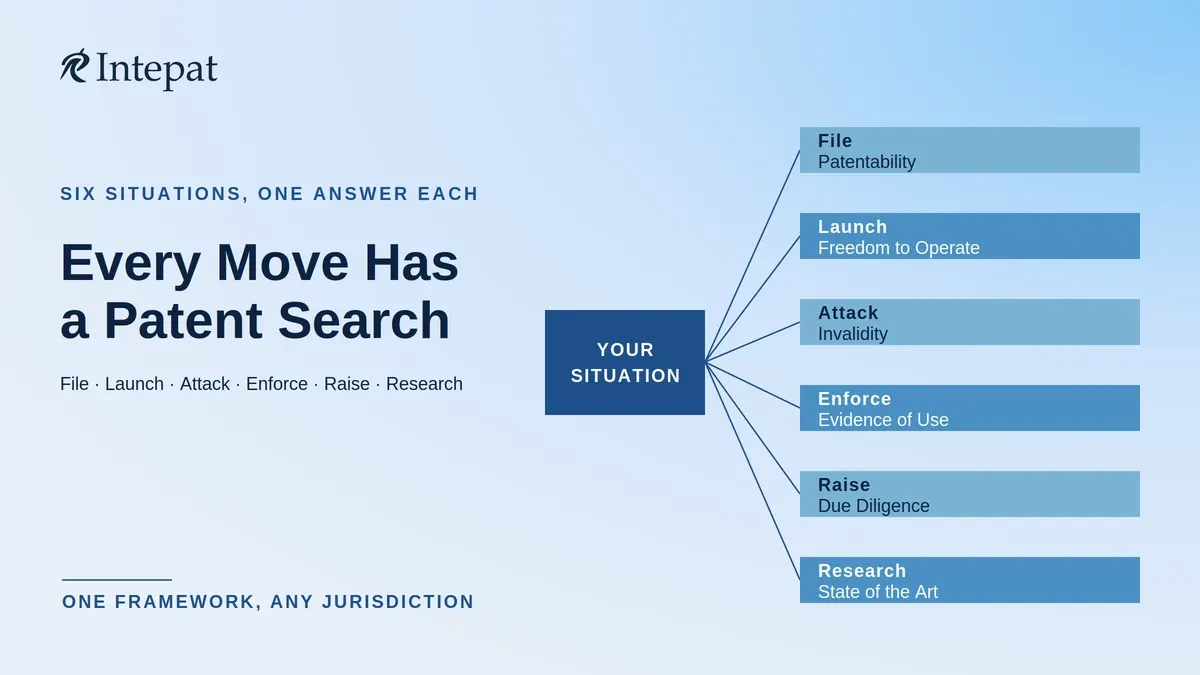
The types of patent search, and the question each one answers
There is no universal, standardised list of search types. The categories practitioners use are a services taxonomy that grew up around the work, and the bodies that publish on patent information do not organise it identically either: WIPO’s Guide to Using Patent Information sorts the field by what the reader is trying to do, the EPO by the kind of information involved. Because the labels are conventions rather than defined terms, two vendors can quote the same word for materially different work, so write down the question first. Four variables then follow from it, and they are the variables that change the price and the answer: the date cut-off, whether expired and abandoned rights count, which jurisdictions are covered, and whether the deliverable is documents or a legal opinion. Find your question in the left column; everything after the table is the detail behind the row.
| The question you are asking | The search that answers it | Date cut-off | Do expired rights matter | Territory | Output |
| What is already known in this field? | State of the art | None | Yes | Worldwide | Technical overview |
| Is my invention new and inventive? | Patentability or prior art | Filing or priority date | Yes | Worldwide for publications | Documents, with or without an assessment |
| Can I sell this product here without infringing? | Freedom to operate | None; status is what counts | Spent, but check if revivable | Market by market | Claim-level opinion |
| Can this granted patent be knocked out? | Invalidity prior art search | Priority date of the target claim | Yes | Worldwide for publications | Prior art mapped to the grounds that turn on publication or use; other grounds need separate review |
| Is anyone practising my claim? | Evidence of use | None | Not applicable | Where the product is sold | Product evidence |
| Where is activity concentrated, and who owns it? | Landscape analysis | Reporting window | Yes, as a data dimension | Defined in the brief | Counts, trends, named parties |
| What am I actually buying? | Due diligence | None | Yes | All jurisdictions held | Asset and risk register |
| What are competitors doing now? | Watch | Rolling | Lapses are the signal worth reporting | Defined in the brief | Periodic alerts |
Patentability and prior art share a row because they share all four settings and differ only in whether an assessment is applied on top. The deliverable column is also the cost column: a search whose output is documents costs less than one whose output is a signed opinion, and an opinion multiplies by the number of markets you ask about.
Searches that look backwards: patentability, prior art, and state of the art
These three ask what is already known, and none cares whether what is found is still in force. They differ on the date: patentability and prior art work runs to a filing or priority date, while a state of the art search has no cut-off at all, because its point is the whole published field.
A patentability search tests a defined invention against the standard patentability criteria before filing: is it new, meaning it has not already been disclosed anywhere in the world in any form before the filing date; does it involve an inventive step, meaning it would not have been obvious to someone skilled in the field; and is it capable of industrial application. Most patent systems apply some version of this three-part test, though the wording and the fine detail differ between them.
Novelty and inventive step are not the whole test, and this is where founders in software and life sciences get caught. Many systems, India included, exclude certain categories from patent protection outright regardless of novelty: a computer program or business method “as such,” or a new form of a known substance that does not improve on its known effect. Prior art searching can help identify the substance or the prior programme, but it does not resolve either exclusion, and both can still be raised years later as a ground to revoke a granted patent. What is sold as a “patentability search” is usually a prior-art exercise; whether your invention is outside patentable subject matter is a separate opinion, and for software it usually decides the application.
One asymmetry in examination practice should shape your brief. For novelty, an examiner is generally not permitted to stitch separate documents together to construct an anticipation; for inventive step, combining documents is allowed if a skilled reader would have been led to combine them. A search built only to find single anticipating documents will under-serve the obviousness question.
Your own earlier disclosure needs separate handling. Most systems, India included, give inventors no general grace period, so a launch or blog post before your filing date can destroy novelty wherever it discloses the claimed subject matter. A few narrow exceptions exist in some jurisdictions, commonly for disclosure at a recognised exhibition or in a paper read before a learned society, but they are strict on timing, and the burden of proving the exception usually sits with the applicant, not the office.
A prior art search is the evidence-gathering half of the same work, without the legal assessment on top. Prior art is used loosely here for material already disclosed to the public before your date; what counts against a claim depends on the ground in play, and most systems treat publication and public use differently. No authoritative source draws a bright line between a prior art search and a patentability search, so settle it in the engagement letter.
A state of the art search comes earlier still, before an invention is defined. It maps a technical field so that research effort is not spent re-deriving something disclosed thirty years ago, and its most valuable results are often expired patents, whose disclosure still teaches a method that patent no longer controls.
Searches about what is live: freedom to operate and patent watch
These two ask a different question: what rights currently stand in the way. The date cut-off disappears and legal status becomes everything.
A freedom to operate search is commissioned about a product, not an invention. WIPO describes it as beginning with a search of patent literature “for issued or pending patents, and obtaining a legal opinion as to whether a product, process or service may be considered to infringe any patent(s) owned by others”. Pending applications belong in scope too: in several systems, once an application publishes, the applicant gains some retrospective rights once the patent eventually grants, even though a suit generally cannot proceed until grant.
Territory governs the scope. Patent rights are granted, and enforced, country by country, so a freedom-to-operate search and opinion runs market by market. A patent family, the set of applications for one invention filed in different countries, with no visible member in your target market is not the same as no barrier there; it may simply not have been filed, or not yet be searchable. WIPO is candid about the ceiling: “while an absolute guarantee of freedom to operate will never be attainable, there are ways of minimizing the risks.”
A patent watch is the same enquiry run continuously rather than once. Most offices allow some form of third-party input on a pending application after publication and before grant, and most also set a minimum period after publication during which a patent cannot be granted. That minimum period is a floor set for the office’s own convenience, not a safe monitoring frequency for you: an application first checked right at that boundary can already be grantable, leaving no time to analyse it and prepare an objection. Build the watch cadence to leave working time inside the window, not to land on its edge. Post-grant challenge periods usually run separately and later, counted from the date of grant rather than the date of publication, so the watch has to read the publication journal, not just the register of granted patents.
Searches built around one patent: invalidity and evidence of use
Both start from a single identified patent and work outwards, and they run in opposite directions.
An invalidity search looks for prior art that defeats a granted claim, the numbered sentence at the end of a patent that fixes its legal boundary. Grant only confirms that an application cleared the office’s formal and procedural checks; it says nothing about whether the patent can survive a later, substantive challenge. A granted claim stays open to attack, whether by a revocation petition, an opposition proceeding, or as a defence raised in an infringement suit.
Note what the search does not cover. Only some invalidity grounds turn on prior art. Grounds such as wrongful obtaining of the invention, insufficient disclosure, a claim that is unclear or not properly supported, misrepresentation to the examiner, or secret prior use will never be surfaced by a prior-art search, because the evidence sits in the file wrapper or in the market, not in a patent database. Buy the search and the grounds review as two separate things.
The prior-art grounds are also not symmetrical on territory. Publication usually counts against a claim wherever in the world it happened; public knowledge and public use are more often counted only where they happened inside the country that granted the patent. A search built for one axis can miss the other. Patent revocation turns on which ground the evidence actually supports.
An evidence of use search, sometimes called an infringement search, runs the other way: it starts from a claim you own and looks for products that fall inside it. It has no official definition from WIPO, the EPO, or any national patent office, and its output is product evidence, not patent documents. The claim-by-claim comparison that then decides the question, on either side of a dispute, is covered in the guide to patent infringement analysis.
Where the patent covers a process rather than a product, the target changes: a competitor’s process is often invisible from outside the factory, so the search has to build a circumstantial case, and several systems ease the patentee’s evidentiary burden once product identity is shown. The deliverable is therefore evidence of identity first, and only then evidence about the process itself.
Searches built around a portfolio: landscape analysis and due diligence
A patent landscape analysis answers a strategic question about a field rather than a legal question about a right. WIPO’s Guidelines for Preparing Patent Landscape Reports concede that “there is no single or universally accepted definition of a Patent Landscape Report; in general, one can say that it constitutes an overview of patenting activity in a field of technology, in a specific geographical area”. It counts records and names parties, so landscape work commissioned to clear a product will disappoint.
Due diligence is better understood as an assembly than a distinct search. Before an acquisition, a licence or a funding round it combines ownership verification, legal status checks, family mapping, renewal history, and validity assessment on the assets that matter. Its findings are frequently negative: a missed renewal, an unrecorded assignment, an abandoned family member in the one market that mattered.
Legal status is the load-bearing input for both. A patent register is generally treated as reliable evidence of what is recorded on it, not as conclusive proof, and it usually covers granted patents only, so for a pending application the prosecution file itself is the source. A search-tool index entry carries no legal status of its own, and treating lapsed, abandoned, withdrawn and revoked records as one inactive heading discards the distinction that governs the decision.
Why an expired patent flips the answer
One line separates the two halves of the table above, and it is the most common source of a wasted search budget. Expiry ends a patent’s exclusive rights; it does not unpublish the document. A twenty-year-old lapsed patent can therefore still bear on a claim filed today while creating no infringement exposure of its own, though other patents, divisionals or pending applications may still cover the product.
Abandonment is different, and the loose phrase “expired or abandoned prior art” hides it. An abandoned application is often kept out of publication altogether, so it becomes prior art only if its contents became public some other way: an early-publication request, a foreign family member, or disclosure outside the patent system entirely. Status alone proves nothing about publication, in either direction.
Nor is a lapse the end of the enquiry. A missed renewal can sometimes be cured within a further window, and many systems allow a further limited period to restore a lapsed patent after that. The question worth asking is whether restoration can still be sought, or has been sought and remains unresolved, not simply whether a certain number of months has run since the patent lapsed.
Where Indian searches are run, and what those databases leave out
No private searcher can reproduce the full corpus a patent office searches internally, which typically adds technical-literature subscriptions and specialised collections beyond the public patent record. In India, one such collection is the Traditional Knowledge Digital Library, historically restricted to a handful of patent offices until India’s Cabinet approved a phased, paid opening to outside users in 2022; check the current access position before assuming it is open to you.
The public tools divide by coverage rather than quality, and none is built for non-patent literature, meaning the journal papers, conference proceedings, standards and manuals where much decisive prior art sits. An Indian patent search on InPASS reaches published applications, granted patents and the electronic register. WIPO PatentScope has carried the Indian collection since 2018 alongside the PCT collection, with cross-lingual retrieval across thirteen languages, machine translation, and exact and substructure chemical searching. Espacenet is a broad global collection, though the EPO calls it “an entry-level, internet-based patent document search service”.
One coverage gap is worth checking. Full text means the description and the claims, as against the front-page layer of title, abstract and applicant. Google’s coverage note introduces its office list with the words “we currently index full-text documents from the following patent offices”, and the twenty-two authorities named there do not include India. Google’s total patent count is larger than that list, but the note does not say which additional offices are covered at full-text depth, so check the current note before relying on it. A keyword sitting only in the body of an Indian specification, where most of the disclosure sits, therefore cannot be relied on to fire on Google Patents.
Classification is the counterweight to keyword recall, because it survives the vocabulary problem. Indian and international offices alike classify applications on the International Patent Classification, and the Cooperative Patent Classification refines it further; Indian practitioners commonly reach the CPC through Espacenet rather than the Indian record. Searching on patent classification alongside keywords is how the two failure modes cover for each other.
Neither axis carries chemistry or biology alone. A Markush claim covers a genus that keywords name poorly and classification does not isolate, and a sequence is retrieved by alignment rather than text, so those subjects need structure, sub-structure and sequence searching as additional modalities. Retrieval is not the legal test: identifying a known substance is only the first step in a novelty-of-form analysis, and the efficacy comparison that follows is separate work.
What no patent search can tell you
The plainest statements come from the databases themselves. WIPO’s Guide to Using Patent Information states that “at present no database has complete coverage of all patent documents ever published worldwide”. The PCT International Search and Preliminary Examination Guidelines go further, accepting that “even though completeness should be the ultimate goal of the international search, this goal may not be necessarily obtained, because of such factors as text search limitations and the inevitable imperfections of any classification system”.
On recency, most systems keep an application closed to the public for around eighteen months from filing, with journal publication typically following a little later. Both figures are defaults rather than guarantees: some applicants request earlier publication, and some applications never publish at all if they are abandoned or withdrawn in time. Treat the blind period as a default in either direction, not a promise.
On language, WIPO records that “a search using English language terms may only retrieve results with English language text”, which is why the cross-lingual and translation tools matter.
On the conclusion a null result supports, the EPO’s own disclaimer for Espacenet is the sentence to keep: “a null result from an espacenet search, for example, should not be interpreted as freedom of action.” The same page states that “business-critical, or financial decisions should not at all be based on the results of espacenet searches” and that the EPO “does not accept any responsibility for the accuracy of data and information originating from other authorities than the EPO”.
Automation has not moved this line. Patent offices that allow AI-assisted search generally still require the final result to be selected and validated by a human examiner using independent judgment. A tool can widen the query; it cannot validate the result.
Three practical consequences follow. First, a search is no defence to liability on its own. Most systems give a defendant a set of statutory or established defences to raise in an infringement suit, and a clean search report, by itself, is on none of those lists. Second, what a search finds, or what a competitor can show you should reasonably have found, can become evidence about what you knew, and awareness at the date of infringement affects the remedies available in several systems even where it does not stop an injunction. Search early enough that a design-around is still cheap. Third, where certainty about one product matters more than a general report, many systems let a party seek a declaration that a specific product does not infringe a specific patent, a narrower and faster question than a full clearance opinion, and one that typically does not itself decide whether the patent is valid.
What belongs in the search brief
The difference between a report you can act on and one you cannot is settled before the search starts. Six items belong in writing.
- The decision the search must serve, written as a question rather than a topic.
- The subject in two forms: claim or product language, and classification classes.
- The date cut-off, as a filing or priority date, or an express statement that there is none.
- Whether expired, lapsed and abandoned rights are in scope, and for a lapsed patent whether the possibility of restoration has been checked.
- The jurisdictions, and whether your home market is the priority set or one national slice among several.
- The deliverable: documents, an analysis, or a signed opinion, and who carries the judgment in it.
An unrecorded method cannot be repeated, updated, or defended to a buyer or an opponent, whatever office eventually examines the application.
Frequently asked questions
The recognised types are patentability, prior art, state of the art, freedom to operate, invalidity, infringement or evidence of use, landscape, due diligence, and watch. There is no single standardised list. They differ by date cut-off, whether expired rights count, territory covered, and whether the deliverable includes a legal opinion.
A patentability search asks whether an invention is new and inventive against everything published before the filing or priority date. A freedom-to-operate search asks whether a specific product can be sold in a specific market without infringing rights currently in force. Expired patents decide the first and are ordinarily irrelevant to the second, unless revivable.
Not necessarily. A prior art search addresses novelty and inventive step. It does not resolve whether your subject matter is patentable at all, which is a separate legal test in most systems, and many exclude a computer program or business method “as such” however new it is. Subject-matter eligibility is a separate assessment.
No, not in most systems. Examination confirms an application met the office’s formal and procedural requirements; it does not certify that the patent will survive a later challenge. A granted claim can still be revoked or invalidated on several grounds, most of which are also available as a defence in an infringement suit.
No. WIPO states that an absolute guarantee of freedom to operate will never be attainable, and the EPO tells Espacenet users that a null result should not be interpreted as freedom of action. Recently filed applications are ordinarily unpublished, so no search can see them, and a freedom-to-operate opinion manages that risk rather than removing it.
Expiry ends the exclusive rights but does not unpublish the document, so for state of the art, patentability, prior art, invalidity, landscape and due diligence work the disclosure still counts. For freedom to operate, that patent’s own rights are spent, though a lapsed patent may in some systems be restored, so check rather than assume it is permanently dead.
Before, if the search would change whether you file at all. A provisional application secures an earlier priority date only for what it actually discloses, and most systems then give roughly twelve months to file the complete specification. A search run first can show it is not worth completing.
InPASS is the Indian Patent Office system, and PatentScope has carried the Indian collection since 2018 with cross-lingual search and machine translation. A self-run search on either is a useful first screen, not a patentability or clearance opinion: no single free database gives complete coverage, and none reaches unpublished applications.
In most systems, applications are closed to the public for around eighteen months from filing, with the official journal listing typically following a little later. Both figures are defaults: some applicants request earlier publication, and applications that are abandoned or withdrawn early enough may never publish at all.
No, and the difference is worth pricing before you commission either. An invalidity search hunts prior art, which reaches only some invalidity grounds. Others, such as wrongful obtaining, insufficient disclosure, an unsupported claim, misrepresentation to the examiner, or secret use, are evidenced from the file wrapper or the market instead, so a full validity review is separate work.
Set the interval against the windows it protects, leaving working time inside them. Most systems set a minimum period after publication before a patent can grant, but that floor exists for the office’s convenience, not as a safe monitoring frequency: spotting an application at that boundary can leave no time to object. Post-grant challenges run separately, counted from grant.
Yes. The deliverable drives both: a search producing only documents costs less and moves faster than one producing a signed opinion, and an opinion’s cost and timeline multiply with each additional market it has to cover. Ask what the deliverable is before comparing quotes across vendors.
This article explains the types of patent search and the reasoning behind choosing one over another, for general information only. It is not legal advice. Deadlines for patent-office procedures, whether for opposition, restoration, or any other statutory step, run strictly in every system, and missing one can cost you the remedy. Confirm the current position in your jurisdiction and, for advice on your specific invention or product, consult a registered patent agent or attorney.