




India does not have a utility model system. If you are an Indian startup or MSME, every patentable invention must meet the full requirements of the Patents Act 1970: novelty, an inventive step, and industrial applicability. This article explains what utility models are, which countries offer them, and what your options are to protect an invention in India or abroad.
Quick Answer
• India has no utility model law. The Patents Act 1970 is the only patent-type protection route for inventions in India.
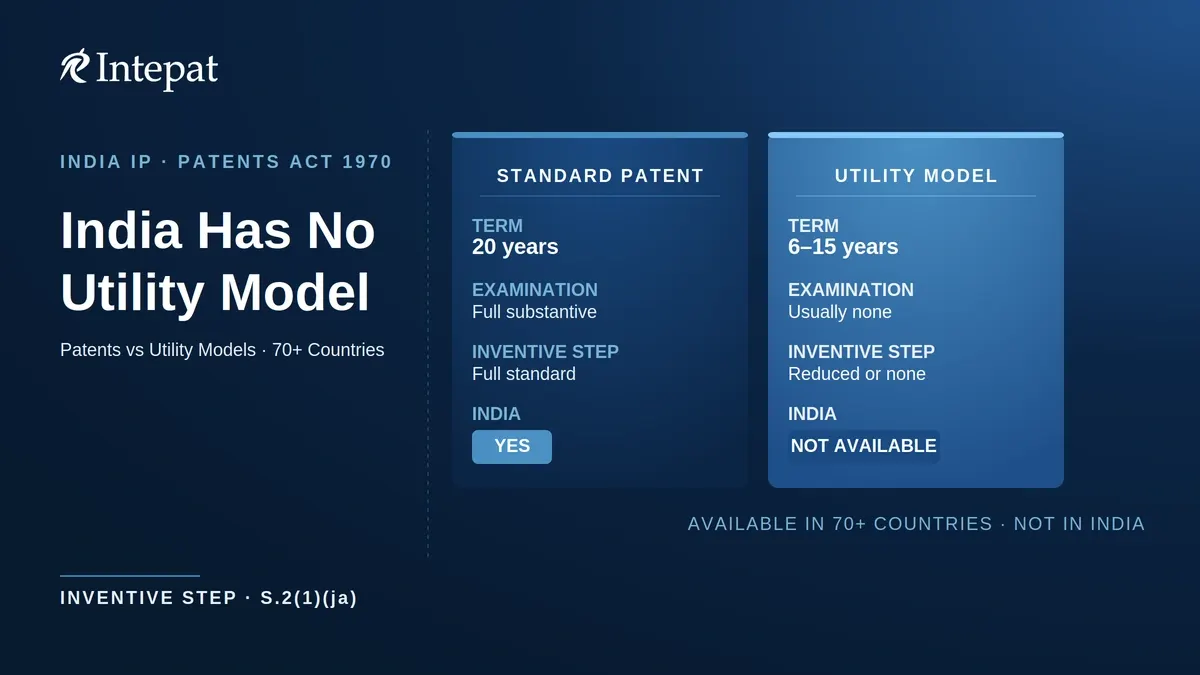
• Utility models (also called petty patents or innovation patents in different countries) exist in over 70 countries. They require novelty, but the inventive step threshold is lower, or absent altogether, compared to a standard patent.
• For Indian companies seeking utility model protection abroad, a PCT application is often the most efficient starting point, with national-phase entry in over 150 countries typically due at 30 months from the priority date (31 months for the Indian national phase specifically).
What is a utility model, and how does it differ from a patent?
A utility model is a registered intellectual property right that gives its holder the exclusive right to prevent others from commercially using a protected invention without authorisation, for a limited period. The concept is similar to a patent, but the requirements are less demanding and the rights are shorter-lived.
WIPO, the UN agency for international intellectual property, identifies three features that distinguish utility models from standard patents.
The inventive step requirement is lower in most utility model systems. While a standard patent requires an invention that is not obvious to a person skilled in the art, many utility model systems apply a reduced threshold, and some countries require no inventive step at all. In practice, utility model protection is often sought for incremental improvements to existing products: the kind of improvement that contributes commercially but might not clear the inventive-step bar for a full patent.
Most countries that offer utility models do not conduct substantive examination before registration. This makes the process faster, often six months to a year, and cheaper than obtaining a standard patent.
The term of protection is shorter. While a standard patent runs for 20 years from the filing date, utility model terms vary by country and typically fall between 6 and 15 years.
One further limit applies in many jurisdictions: utility model protection is restricted to certain categories of subject matter. Processes, chemical compounds, and biological matter are commonly excluded. Protection is typically available only for physical products or devices.
Utility models are not available in every country. Major economies that do not have a utility model system include the United States, the United Kingdom, Canada, and India.
India does not have a utility model: what that means for your invention
The Patents Act 1970 governs patent protection in India. India has no reduced-threshold utility model system or second-tier patent system open to applicants as an independent protection route; the only route for protecting a functional invention is the standard patent.
To qualify, an invention must satisfy three requirements: novelty (not anticipated by prior publication or use anywhere in the world before the filing date); an inventive step (technical advance compared to existing knowledge, or economic significance, or both, making the invention not obvious to a person skilled in the art); and capability of industrial application (the invention can be made or used in an industry). These requirements apply to every application filed at the Indian Patent Office.
This means that if your invention would qualify for utility model protection in Germany or China but does not meet the full inventive step standard under Indian law, it cannot be registered in India as any exclusive IP right under patent law. Your alternatives are design registration (which protects the visual appearance of a product but not its functional mechanism or technical working principle) or maintaining the improvement as a trade secret.
For a startup assessing whether to file in India, the foundational question is whether the invention genuinely meets the full patentability threshold. Understanding what can be patented in India and the inventive step standard under Indian patent law is the right starting point before committing to a filing.
| Practitioner note: |
| A common misconception is that India’s patent system is stricter than average. In fact, the three-part threshold (novelty, inventive step, industrial applicability) matches the standard applied in most major patent jurisdictions. India does not have a lower-tier option; it simply offers the same tier that most of the world uses. |
Side-by-side comparison: patents versus utility models
| Feature | Standard Patent | Utility Model |
| Inventive step required | Yes, full non-obviousness standard | Reduced threshold, or none, depending on country |
| Novelty required | Yes, absolute novelty in most countries | Yes in all countries; some accept local novelty only |
| Substantive examination | Yes, before grant | Usually no substantive examination before registration |
| Term of protection | 20 years from filing date | 6 to 15 years, varies by country |
| Typical time to rights | 2 to 5 years (indicative range) | 6 months to 1 year (indicative range) |
| Cost | Higher (examination fees, prosecution costs) | Lower (no examination fee in most countries) |
| Subject matter scope | Broad: products, processes, methods | Narrower: often limited to physical products or devices |
| Legal certainty of rights | High (examined and granted) | Lower (unexamined; more open to challenge) |
| Available in India | Yes | No |
The cost and speed advantages of utility models come with a trade-off: because the rights are granted without substantive examination, they carry more legal uncertainty than an examined patent. A registered utility model can be challenged and cancelled by a third party on grounds of lack of novelty or insufficient inventiveness, and the absence of an examiner’s prior-art assessment means that risk is higher than for a granted patent.
Which countries offer utility model protection?
Over 70 countries have some form of second-tier patent or utility model system, though the rules, scope, and duration vary considerably. There is no international utility model treaty equivalent to the Patent Cooperation Treaty for standard patents, so each country’s system operates independently.
China is by far the largest utility model jurisdiction by filing volume. WIPO’s IP Facts and Figures 2025 records approximately 3.2 million utility model applications filed by China-resident applicants in 2024. China’s utility model term is 10 years from the filing date, and registration typically takes around six months. Under Article 9 of the Chinese Patent Law, an applicant may file both a utility model application and an invention patent application for the same invention on the same day, with a dual-filing declaration in each, to obtain faster enforceable rights from the utility model while the invention patent undergoes substantive examination.
Germany has one of the oldest utility model systems (Gebrauchsmuster), with a term of up to 10 years, granted after formal examination only (substantive requirements are not examined before registration but may be raised in cancellation proceedings). Processes, including chemical and biological processes, are excluded from utility model protection; chemical and other technical products such as devices, apparatus, and substances can be protected.
Japan offers utility models with a 10-year term, registered without substantive examination.
South Korea has a utility model system with a 10-year term. Current applications (filed from 1 October 2006 onwards) are subject to substantive examination before registration, under a procedure broadly similar to patent examination. The earlier quick registration-before-examination system was repealed from that date.
Brazil offers utility models with a 15-year term, available for products, objects of practical use, or parts thereof that present a new form or arrangement.
Examination requirements, grace periods, and post-registration challenge procedures vary significantly across these jurisdictions. The “faster and cheaper” generalisation holds for many countries but not all; applicants should confirm current local rules before relying on speed or cost assumptions from general guidance.
A correction from the earlier version of this article: Australia phased out its innovation patent (its utility-model equivalent) under the Intellectual Property Laws Amendment (Productivity Commission Response Part 2 and Other Measures) Act 2020. IP Australia stopped accepting new original applications from 26 August 2021; divisional applications from pre-cutoff parents remain possible. All existing innovation patents will have expired by August 2029, eight years from the last filing date.
The US, UK, and Canada do not have utility model systems. In those countries, an incremental improvement either clears the full patentability bar or is not registrable as a patent-type right.
When should an Indian startup consider filing a utility model abroad?
If your invention meets the Indian patentability threshold, a standard patent in India remains the primary protection tool. The utility model question becomes relevant when your commercial strategy includes countries that offer the system and one or more of the following factors applies.
Short commercial life. If your product will be superseded in five to seven years by newer technology, a utility model’s shorter term may be sufficient, and faster registration gives you enforceable rights sooner.
Incremental improvement over existing products. If your improvement is commercially significant but may face difficulty clearing the full inventive step examination in a foreign patent office, a utility model in the relevant country can provide protection in that market without the risk of a failed examination.
Cost and resource constraints. Utility model filing and maintenance fees are generally lower than for standard patents. For an MSME with a limited IP budget, a utility model in a key export market may be more cost-effective than a full patent prosecution.
Parallel protection strategy in China. Under Article 9 of the Chinese Patent Law, only one patent right may be granted for an identical invention. However, the same applicant may file both a utility model application and an invention patent application for the same invention on the same day, with a dual-filing declaration in each. The utility model registers within months and provides immediate enforceable rights while the invention patent is examined. When the invention patent is ready to be granted, abandonment of the utility model is a prerequisite under the 2024 revised Implementing Regulations.
The decision on where to file, and whether to use a utility model or standard patent route in each country, is part of a broader international filing strategy. PCT filing is typically the most cost-efficient mechanism for Indian startups seeking multi-country protection: a single PCT application preserves options in over 150 countries, with national-phase entry due at 30 months from the earliest priority date (31 months for the Indian national phase). Under PCT Articles 43 and 44, applicants may indicate utility model protection at national-phase entry in countries whose law permits it.
How to protect your invention from India today
For an Indian startup or MSME, protecting an invention starts with the Indian Patent Office.
File a patent in India. If the invention meets the patentability criteria under the Patents Act 1970, the patent filing procedure involves filing a provisional or complete specification, paying the prescribed fees, and prosecuting the application through examination. The
types of applications available include ordinary, convention (Paris Convention priority), and PCT national-phase applications.
Use PCT for international coverage. A PCT application filed within 12 months of your Indian priority date preserves your options in over 150 countries. The standard national phase deadline is 30 months from the priority date (India allows 31 months for its own national phase). See the guide to PCT filing for Indian startups for costs and strategy.
File directly in utility-model countries. If your target market offers utility models, such as China or Germany, file directly in that country claiming Paris Convention priority from your Indian filing and elect the utility model route at the local office.
Understand the costs. Filing and prosecution costs vary considerably by route, jurisdiction count, and technology complexity. The guide to patent costs in India covers the official Indian fee schedule. For an overview of what a patent is and what rights it confers, and how to file a patent outside India, the linked articles cover both.
Frequently Asked Questions
No. India has no utility model, petty patent, or second-tier patent system open to applicants as an independent protection route. The Patents Act 1970 provides one independent route for protecting a functional invention: the standard patent, requiring novelty, an inventive step, and capability of industrial application. (A patent of addition exists for modifications to an already-patented invention, but is not a utility-model equivalent.)
A standard patent requires full novelty and a non-obvious inventive step, undergoes substantive examination before grant, and provides protection for 20 years from the filing date. A utility model requires novelty with a reduced or absent inventive step threshold, is registered without substantive examination in most countries, and provides protection for a shorter term, generally 6 to 15 years.
Over 70 countries have some form of second-tier patent or utility model protection, including China, Germany, Japan, South Korea, and Brazil. The United States, United Kingdom, Canada, and India do not have utility model systems. Australia phased out its innovation patent in 2021, with the last day for new original applications being 25 August 2021.
This depends on the law of the specific country. Some countries permit conversion between a utility model application and a patent application; others do not. There is no general rule that conversion is available in either direction. If considering this, confirm the current rules with a local patent attorney before relying on conversion as part of your filing plan.
Generally, yes, but lower cost comes with reduced legal certainty. Utility models are cheaper to obtain because most countries do not charge examination fees and registration is faster. However, because the right is granted without substantive examination, it can be challenged and cancelled by a third party through a cancellation proceeding on grounds of lack of novelty or inventiveness.
A PCT application is an international filing tool; it does not produce a utility model directly. Under PCT Articles 43 and 44, the applicant may indicate utility model protection at national-phase entry where permitted by national law. The PCT national-phase route and a Paris-route direct filing are distinct; China dual filing must be executed via Paris Convention within 12 months of the Indian priority date.
Yes. Via Paris Convention, an Indian applicant may file both a Chinese utility model and a Chinese invention patent on the same day, within 12 months of the Indian priority date, with a dual-filing declaration in each application. Via PCT national phase, the applicant chooses one type of protection at entry. Chinese utility models are registered without substantive examination, typically within six months.
No. In the United States, a “utility patent” is the standard full-examination patent for functional inventions, not a second-tier right. The US has no utility model system. A US utility patent requires full novelty and a non-obvious inventive step, undergoes substantive examination, and lasts 20 years from the filing date.
This article explains the relevant patent law and utility model systems as at June 2026 and is for general information only. It is not legal advice. Laws, fees, and procedures change over time, including the utility model rules of individual countries. For advice on your specific invention and the right protection strategy for your target markets, consult a registered patent agent.