




A patent landscape analysis maps patenting activity across a technology field so the pattern in the data can support a decision: whether to enter an area, what to build, whom to acquire, or where to license. It is a field-level study, not a clearance exercise for a particular product.
This guide covers what a landscape report contains, why organisations commission one, how the work is done, and how to read the output without drawing more from it than the data supports. Examples are drawn from India where a concrete figure helps, but the method applies to any jurisdiction.
Quick answer
- A patent landscape analysis is an overview of patenting activity in a technology field, built to answer a specific business, R&D or investment question.
- It shows who is filing, in what, where and how that is changing. It does not tell you whether your product infringes anyone’s claims.
- It is commissioned when a decision is large enough to justify evidence over instinct, most often before entering a field, acquiring a company, or setting an R&D direction.
What a Patent Landscape Analysis Actually Shows
There is no single accepted definition of a landscape report. The World Intellectual Property Organization’s guidelines describe one broadly as an overview of patenting activity in a technology field within a chosen geographic area, built to answer a specific policy or practical question for readers who are not all patent specialists.
That last point does more work than it appears to. A landscape is not a search result. It is an interpretation of one, prepared so that a board, an R&D head or an investment committee can act on it without reading a single claim. The standard it is judged against is not how many documents it found, but whether a reader without patent training finished it knowing what to do.
A patent landscape report usually resolves a large record set into a familiar set of measures: the number of patent families or inventions, national phase entries, granted patents, technology categories, the offices where applicants filed first and second, the most active applicants and inventors, and the most cited documents. Beyond those, a brief may call for citation or co-inventor networks, concept maps, or a shortlist of documents flagged for immediate legal attention.
Those measures are rarely read by one person alone. A landscape typically circulates across R&D, legal, business development and senior management, each of whom brings a different question to the same document: whether an approach is free to pursue, whether a right is enforceable, whether a partner is worth approaching, and whether the area justifies investment. That mixed readership is why the analysis has to survive translation out of patent language, and why a report written only for counsel tends to stall.
It is worth saying plainly what a landscape is not: an exhaustive list of every patent in a field. Scope is always bounded, by jurisdiction, by date, by classification and by the search terms used, and a report that does not state those bounds cannot be relied on or repeated.
Two adjacent products get confused with it. Patent mapping, sometimes used as a synonym, is properly the graphical representation of a dataset, usually organised around a single attribute such as topic similarity. It is one possible output of a landscape rather than another name for it. A patent watch is an ongoing alert service that flags newly published documents or status changes in a defined area, and is often set up after a landscape rather than instead of one.
Why Organisations Commission One
A landscape is commissioned when a decision is large enough that evidence beats instinct. WIPO frames these reports as a move away from decisions made on personal networks and intuition, and observes that organisations typically fund one when preparing a significant money or headcount commitment to a technology area.
The underlying logic is economic. Obtaining a patent is expensive, and maintaining a family across several jurisdictions costs a multiple of that over its life. Because the cost is real and recurring, a filing is a credible signal of intent in a way that an announcement is not. Patent documents also disclose technical detail that companies rarely publish anywhere else, which is why patent data reaches parts of a competitor’s programme that market research cannot.
Five decisions recur, and each asks a different question of the same dataset.
Competitor Monitoring
The opening question in most strategy sessions is whether a named competitor holds patent rights in an area of interest, followed immediately by how many and covering which aspects of the technology. Filings answer both. They also disclose expertise, timing and the direction of spending alongside the bare right to exclude, which is often the more useful part.
Technology Monitoring
Where competitor monitoring watches named organisations, technology monitoring watches a field. It suits an organisation moving into an area where it has no track record and cannot yet name the players. The report identifies the most active applicants, the inventors behind them, and the technical sub-categories the field has divided into, which is usually enough to decide whether to build internally or acquire.
Merger and Acquisition Due Diligence
A technology-based assessment tests whether two portfolios fit together. Two organisations working the same field while solving its central problems differently are complementary, which strengthens the case for a transaction. Heavy overlap weakens it, because the acquirer is paying for coverage it already holds. Neither conclusion is visible from financial diligence alone, and both sit alongside the legal side of patent due diligence rather than replacing it.
Licensing and Technology Transfer
An organisation that invested in a technology some years ago and has not commercialised it is more likely to entertain a licensing conversation than one still actively building. A landscape surfaces who those holders are and how old their positions are, which is the practical starting point for an approach.
R&D Direction
A patent is a right to exclude, so patent rights can constrain implementation choices. A landscape helps identify which approaches warrant claim-level review or a possible design-around before a research programme commits, which is considerably cheaper than discovering a blocking position two years into the work.
Policy, Funding and Research Use
Not every landscape is commissioned by a company. WIPO’s own published reports exist partly to support the targeting of innovation and industrial policy and to help evaluate its impact, and the same method serves research funders, universities and technology transfer offices deciding where to direct effort. A landscape can also map networks of inventors and the flow of knowledge between institutions and across borders, which is a question about a research ecosystem rather than about a market. Where the commissioning body is public, the report often has a second audience beyond the decision-maker, and is written to be published rather than held internally.
What a Landscape Is Not
A landscape answers a question about a field. Three other searches answer narrower questions about a specific invention, product or patent, and briefs that blur the two tend to buy the wrong output.
A patentability search runs before filing, testing a proposed invention against earlier disclosures to establish how broadly claims can be drafted. A freedom-to-operate opinion runs before launch, asking whether a defined product would fall within in-force claims in a jurisdiction, which requires reading claims against the actual embodiment. A patent invalidity search runs after grant, hunting for art or procedural defects capable of supporting a challenge. Where the open question is which of these fits the decision at all, the guide to the types of patent search maps the full set, and what counts as prior art explains the raw material all of them work from.
The boundary is a matter of report design rather than a fixed rule, and WIPO records that some landscape approaches fold in freedom-to-operate elements or non-patent market data. What does not change is the level the question sits at. A field-level study will not answer a claim-level question however large the dataset behind it, and commissioning one in the hope that it might is a common way to waste a search budget.
How a Landscape Is Built
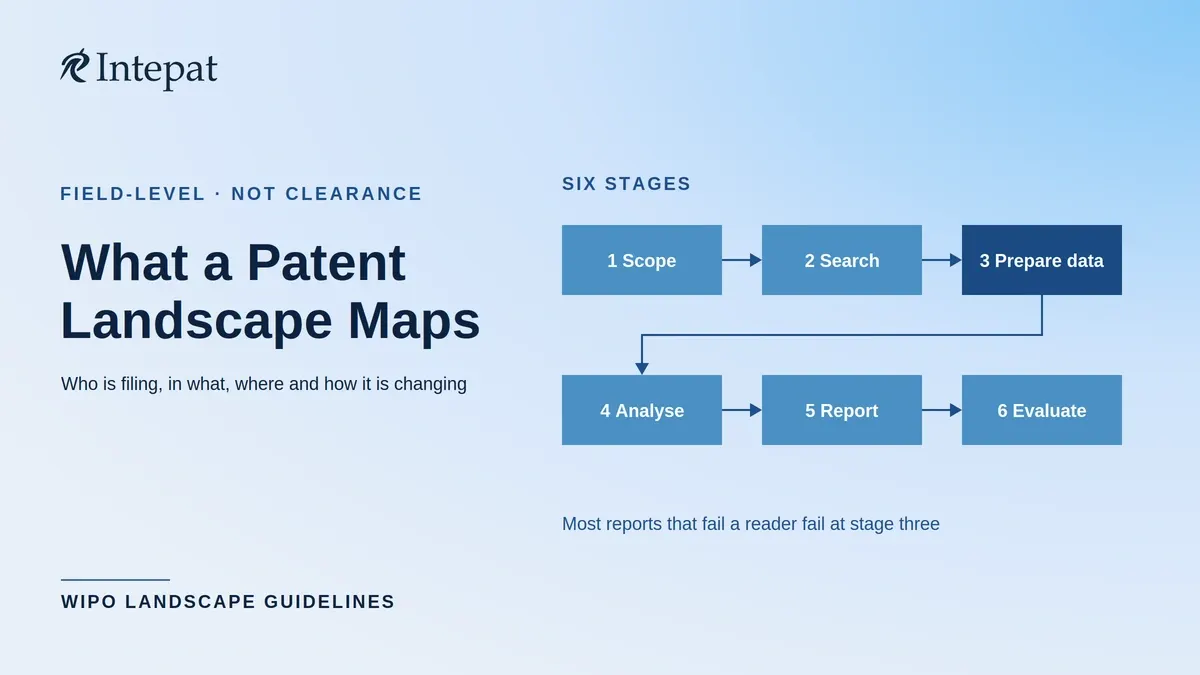
The patent landscaping process runs through six stages: define the scope, search, prepare the data, analyse, report, and evaluate. Most reports that fail a reader fail in the third stage, where raw results become a dataset, because that is where decisions get made quietly and then never disclosed.
Scope
Scope is settled before searching begins, and four choices belong in writing: which jurisdictions are covered, over what period, how patent families will be reduced, and whether non-patent literature is included. Each one moves the numbers. A report that leaves them implicit cannot be compared against any other report, or repeated later to see what changed.
Search
Search design combines technical concepts, synonyms, claim terminology and patent classification, because applicants describe similar technology in different words and any single keyword will catch unrelated fields alongside the target.
Whether to include non-patent literature is the scope decision most often left unmade. Journal papers, conference proceedings, standards documents, product manuals and archived web pages all disclose technology, and in fast-moving or research-led fields a substantial part of the state of the art never becomes a patent document at all. A landscape restricted to patents in such a field will understate how developed the area is and may show white space where an academic group has been publishing for years. Including non-patent sources costs time and adds noise, so the choice should be made deliberately against the question rather than by default.
Source choice is a real decision rather than a formality. A patenting authority is the only authoritative source for its own data, but its site covers one jurisdiction and rarely exports individual fields, so national collections suit a single-jurisdiction study and struggle with anything wider. Free multi-jurisdiction services such as Espacenet and WIPO’s Patentscope widen coverage at no cost. Commercial platforms add editorial titles and abstracts, deeper indexing, more fields and higher export limits, which is usually what justifies their cost on a large study.
Data Preparation
This is where a search result becomes a dataset. Applicant names are cleaned and grouped, families reduced, technology categories generated, and a decision taken about which date field drives the trend charts.
Applicant names are messier than most readers expect. One organisation appears under several spellings through transliteration, subsidiaries file under different names in different countries, and institutional groups may be aggregated under a parent label or listed separately depending on the source. A ranking built without stating how such groupings are treated produces a different answer depending on a choice the report never discloses.
Family reduction cuts the other way. One invention filed across eight jurisdictions generates eight records, while a rival filing only at home generates one. Compare them without reducing to families and the first applicant looks eight times as active. Simple families produce many narrowly defined groups, extended families fewer and broader ones, so the method has to be stated and applied consistently across every entity in the comparison.
Two further choices shape every chart quietly. The first is which date drives the trend lines: filing and priority dates indicate when inventions were actually developed, publication dates are weaker for that purpose, and grant dates say more about examination pendency than about innovation. The second is classification. The International Patent Classification is applied to publications of almost all jurisdictions while the Cooperative Patent Classification reaches only some, so a CPC-based cut silently drops coverage. Documents also carry several codes, and the first code listed in a database is not necessarily the main one, so selecting only the first will bias any classification-based analysis.
Analysis, Reporting and Evaluation
The measures described earlier are generated at this stage, and one discipline governs all of them: pre-grant applications are kept separate from granted patents throughout. They are not the same evidence. An application signals investment and interest but may never be granted. A grant asserts that the invention was new and inventive over the known prior art, and can be taken as a quality indicator for innovation activity rather than as a measure of the patent’s own quality, which is a separate analysis. A grant may also represent an enforceable right, if it remains in force. The timing of grant reflects examination pendency as much as anything about the invention, and varies considerably between jurisdictions and technology areas. Merging the two produces a count that describes neither.
Two smaller conventions follow from the same reasoning. Post-grant documents such as reissues and republications after opposition are normally filtered out, the exception being a claim-language analysis, where an amended specification should replace the original. And text analytics are generally not run across the full text of a patent, because the description discusses both the invention and the prior art it builds on, so a term found there may belong to either.
Reporting is written for readers without patent training, since a landscape only a specialist can interpret has failed its purpose. The report then carries a stated shelf life and a refresh trigger, and is evaluated against the question it was commissioned to answer rather than against the size of the dataset behind it.
Reading the Output Without Overreading It
A landscape produces confident-looking charts from data that carries known blind spots, and the charts do not display those blind spots alongside the numbers. Five habits separate a report a board can act on from one that quietly misleads, and each corrects for a specific way the underlying data is incomplete rather than wrong.
Treat a Count as Activity, Not as Risk
A chart of filings by applicant or year measures who is investing where. It does not measure how many enforceable rights stand between you and a market. Rights are territorial, so a family filed heavily in one region says nothing directly about another, and a published application that has not been examined may never become a right at all.
Expect the Recent Period to Look Empty
Applications are held confidential for eighteen months from their filing or priority date in most systems, so the newest filings in any field are invisible. Requests for early publication push in the opposite direction and make the picture uneven rather than merely delayed. A drop in the most recent period is usually a timing artefact, and a report that presents it as a trend is reading its own lag.
Treat White Space as a Hypothesis
An empty area on a chart may mean nobody is filing there. It may equally mean filings exist but have not published, that the search terms and classification codes missed them, or that the area is technically unattractive for reasons the data does not show. Confirm the cause before treating a gap as an opportunity.
Check What “Inactive” Is Hiding
Lapsed, expired, withdrawn, abandoned and revoked are different legal states with different consequences, and some may be reversible within a statutory window depending on the jurisdiction. Grouping them under one label is a frequent source of false comfort.
Ask Where the Status Came From
A database field reading “active” or “expired” is a convenience, not a legal record. Registers, prosecution files and official gazettes each carry different evidential weight, and the aggregators most landscapes are built from sit above all of them at one remove. Status also decays continuously while a report sits on a desk: renewal fees fall due, oppositions are filed and disposed of, and applications grant or lapse. For the handful of records that will actually drive a decision, the report should name the source and the date of verification per record rather than giving one date for the whole study, so a reader can tell which conclusions are still safe to act on.
When a Landscape Is Worth Commissioning
Four situations justify the cost, and they share a shape: a decision is about to be made that would be expensive or slow to reverse, and the information needed to make it well is sitting in patent records nobody has read. A landscape commissioned after such a decision documents it rather than informing it.
The first is entering a technology area the organisation has not worked in, where the report answers who is already there and how crowded the ground is. The second is an acquisition or a licensing negotiation, where portfolio overlap and the age of the target’s positions change what the deal is worth. The third is setting or resetting an R&D direction, where knowing which approaches are already claimed changes what the programme should attempt. The fourth is a periodic competitive review in a field moving fast enough that last year’s picture is no longer safe to rely on.
Six points settled before searching begins determine whether the report can carry the decision.
- Define the decision, not the technology. “Prepare a landscape on battery technology” is a weak brief. “Identify who is patenting thermal-management architectures for high-density EV battery packs, determine which approaches are gaining filing momentum, and flag families needing claim-level review before our architecture is frozen” tells the analyst what the report must support.
- State the scope in writing. Jurisdictions, period, family reduction method and whether non-patent literature is included.
- Record two dates. The search date and the status-verification date are rarely the same day and can be weeks apart on a large set.
- Name the source of legal status. Registers, prosecution files and official records each carry different weight, and a report claiming a record is “active” should say where that came from.
- Agree deliverables and how the report will be judged, including whether a shortlist for claim-level review is part of the scope.
- Set the refresh trigger. Tie it to the decision cycle and to any relevant statutory windows rather than to an annual calendar.
Intepat’s patent landscape analysis service is built around that first point, because a report scoped to a decision is the only kind that survives contact with one.
Where the field being studied is India, the underlying data behaves in ways that will mislead an analyst working from general assumptions, from the publication lag through to the statement of working that patentees and licensees are required to file. Those are covered in patent landscape analysis in India, alongside how to run the underlying searches on the Indian Patent Office databases.
Frequently asked questions
A patent landscape analysis is an overview of patenting activity in a technology field, within a chosen geographic scope, built to answer a specific business, R&D or investment question. It resolves a large set of patent records into measures a non-specialist can act on, such as who is filing, in what technical categories, and how that is changing.
A landscape describes a field; a freedom-to-operate opinion assesses whether one defined product would fall within in-force claims in a jurisdiction. The searches draw on overlapping records, but only the second involves reading claims against an actual embodiment, and only the second addresses infringement risk.
Not quite, though the terms are often used interchangeably. Patent mapping properly refers to the graphical representation of a dataset, usually organised around a single attribute such as topic similarity. It is one possible output of a landscape rather than another name for the whole exercise.
Because applications are held confidential for eighteen months from their filing or priority date in most systems. The newest filings in any field have not published yet. A fall in the latest period is almost always a timing artefact rather than a real decline in activity.
No. It can show that no relevant published records were found within a defined search scope and cut-off date, which is a narrower statement. Unpublished filings, search terms that missed a synonym, or classification codes that did not cover the area all produce the same empty chart.
No, they should be separated throughout. An application signals investment but may never be granted, while a grant carries an examiner’s assessment of novelty and inventive step. Merging them produces a count that measures neither filing appetite nor enforceable rights.
It changes who looks active. One invention filed in eight countries generates eight records, so an applicant filing internationally will appear far more active than one filing at home unless families are reduced. The method chosen also matters, since broader family definitions produce fewer and larger groups.
Tie the interval to the decision rather than the calendar. A field where filings publish continuously and an active product programme may warrant a refresh every six to twelve months. Refresh earlier if an architecture is being frozen, a transaction is closing, or a monitored application is approaching grant.
Neither is fixed, and both depend on scope: jurisdictions covered, the period searched, whether non-patent literature is included, and how much manual review the dataset needs. Ask for a scoped estimate against a defined question rather than assuming a standard timeline or fee applies.
This article explains what a patent landscape analysis covers and how one is produced, as at August 2026, and is for general information only. It is not legal advice. Patent procedures, publication timelines and fees differ by country and change over time; confirm the current position with the relevant national or regional patent office. A landscape report does not assess whether a specific product infringes any patent, and should not be relied on for that purpose. For advice on your own technology or a specific filing decision, consult a registered patent agent or attorney.