




A granted patent does not settle the question of validity. Under Indian patent law, any ‘person interested’ (interpreted by courts to mean a party with a real, present, and tangible commercial or legal interest, including commercial competitors, manufacturers, and other affected stakeholders) can seek revocation during the subsistence of the patent. The grounds are set out in Section 64 of the Patents Act, 1970, and they reach every element of patentability: novelty, inventive step, subject matter, disclosure, and entitlement. Understanding who may file, on what statutory grounds, and how courts assess those grounds is as important for patent owners as for challengers.
What Patent Revocation Does to a Granted Patent
Revocation of a patent in India is initiated by a petition under Section 64 of the Patents Act, 1970. Where the High Court is satisfied that a statutory ground is established, it may grant the petition and revoke the patent; it is then treated as having been invalid from the date of grant, subject to any judicial orders made in related proceedings.
The consequences of revocation for past licences, royalties collected, and damages already adjudicated depend on the specific facts and any judicial orders made in related proceedings; they are not automatically reversed.
This distinguishes revocation from other forms of patent termination. A patent that lapses for non-payment of renewal fees ceases to have effect from the date of lapse only; it does not affect the validity of the grant itself. Revocation reaches back to the origin.
The distinction between revocation, lapse, and abandonment matters practically for licensing arrangements, infringement claims, and damages periods. For a comparison of how each status operates, see inactive, lapsed, and abandoned patents in India.
Who Can File a Revocation Petition Under Section 64
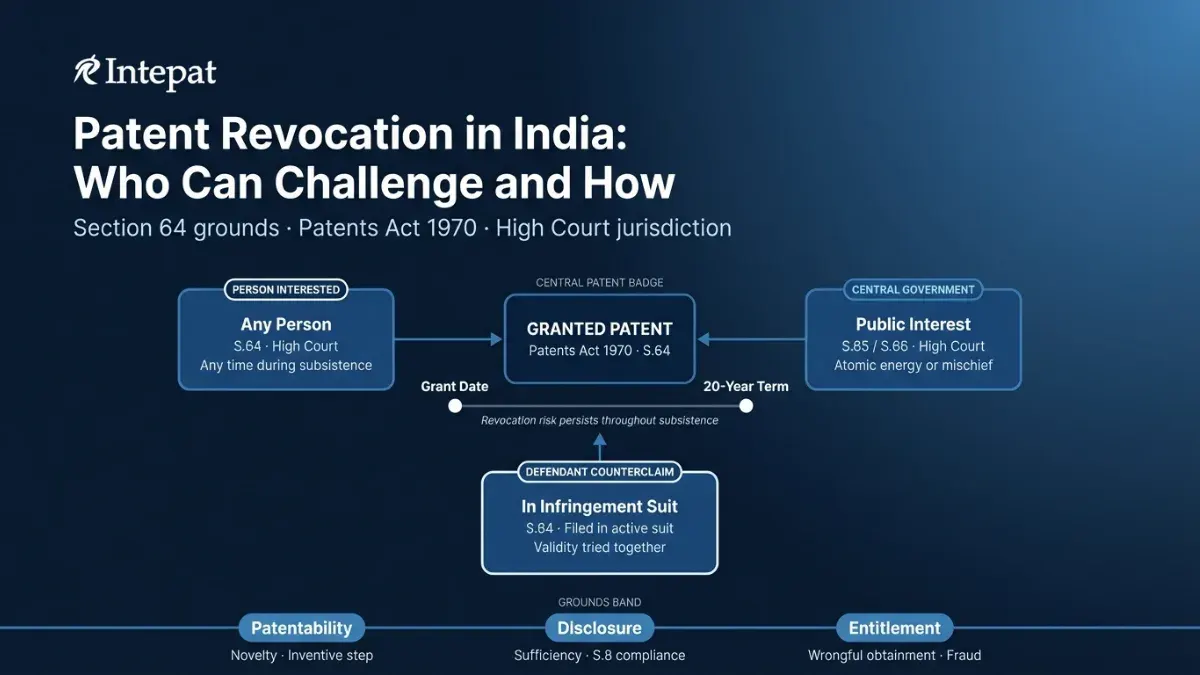
Under Section 64 of the Patents Act, 1970, a petition for revocation of a patent may be filed by any ‘person interested’, by the Central Government, or by a defendant raising revocation as a counterclaim in a suit for infringement of the patent.
The Central Government is also an independent petitioner under Section 64(1) and may seek revocation without any commercial interest requirement. A Central Government petition is filed before the High Court and proceeds in the same manner as any other revocation petition.
The second route arises when a patentee initiates patent infringement proceedings in India. A defendant in that suit may file a counterclaim for revocation of the patent in India. Once the counterclaim is on the record, the High Court adjudicates infringement and validity together in a composite proceeding, and the dispute is no longer confined to whether infringement occurred.
A defendant who receives an infringement claim has a strategic choice: defend on non-infringement grounds alone, or counterclaim for revocation and put the validity of the patent in issue. That choice should be made with full advice on the strength of the validity case.
High Court Jurisdiction After the Abolition of IPAB
Since the abolition of the Intellectual Property Appellate Board (IPAB) by the Tribunals Reforms Act, 2021, a petition for revocation under Section 64 must be pursued before the High Court. This applies to petitions by persons interested, by the Central Government, and to revocation counterclaims. Section 65, Section 66, and Section 85 each operate through their own distinct forums as described in this article.
Jurisdiction lies before the competent High Court, determined by territorial-jurisdiction principles including cause of action, the respondent’s residence or place of business, or other connecting facts establishing that court’s jurisdiction. Two procedural routes exist: a standalone petition filed by a person interested or the Central Government, or the counterclaim route where the patentee has already initiated infringement proceedings.
Indian courts have confirmed that parallel challenges on identical grounds should not be used to create procedural advantage or inconsistent outcomes. The Supreme Court in Enercon (India) Ltd. v. Aloys Wobben emphasised this principle; the concern is tactical duplication, not a blanket prohibition on all concurrent proceedings where distinct remedies are legitimately invoked.
Key Section 64 Grounds and How They Are Applied
Section 64 of the Patents Act, 1970 sets out 17 grounds on which the High Court may revoke a patent on a petition. The grounds most frequently invoked in practice are set out in the table below.
The official statutory text is available at Section 64, Patents Act 1970. The grounds may be grouped as follows.
| Statutory ground | Legal requirement |
| Lack of novelty (s.64(1)(e)) | Publicly known or used in India, or published in India or elsewhere, before priority date |
| Earlier Indian patent (s.64(1)(a)) | Invention claimed in a valid claim of earlier priority date in another granted Indian patent |
| Absence of inventive step (s.64(1)(f)) | Invention obvious or does not involve any inventive step having regard to what was publicly known or used in India or published before the priority date |
| Not an invention (s.64(1)(d)) | The subject of the claim is not an invention within the meaning of this Act |
| Not useful (s.64(1)(g)) | The invention, so far as claimed, is not useful |
| Not patentable under this Act (s.64(1)(k)) | The subject of the claim is not patentable under this Act, even if it qualifies as an invention |
| Wrongful obtainment (ss.64(1)(b),(c)) | Patent granted to a person not entitled to apply, or obtained wrongfully in contravention of the rights of the petitioner |
| False suggestion or representation (s.64(1)(j)) | Patent obtained on a false suggestion or representation made to the Patent Office |
| Section 8 non-disclosure or false information (s.64(1)(m)) | Failed to disclose information required by Section 8, or furnished information false in any material particular |
| Secrecy/foreign filing violation (s.64(1)(n)) | Contravened secrecy directions under Section 35, or made a foreign patent application in contravention of Section 39 |
| Insufficient description or no best method (s.64(1)(h)) | Specification does not enable a person with average skill in the art to work the invention, or does not disclose the best method known to the applicant |
| Claim scope unclear or not fairly based (s.64(1)(i)) | Scope of a claim not sufficiently and clearly defined, or claim not fairly based on matter disclosed in the specification |
| Prior public use (s.64(1)(e)) | Invention publicly known or publicly used in India before the priority date of the claim |
| Secret use in India (s.64(1)(l)) | Invention secretly used in India before the priority date of the claim, other than by authorised Government use or by the communicating party |
| Traditional knowledge (s.64(1)(q)) | Invention anticipated by knowledge, oral or otherwise, available within any local or indigenous community in India or elsewhere |
Section 64(1) presently enumerates 17 revocation grounds, and Section 64(4) provides a separate revocation route in relation to Government use under Section 99, where the High Court is satisfied that the patentee has without reasonable cause failed to comply with a Central Government request to make, use, or exercise the patented invention for Government purposes on reasonable terms. The table above covers the grounds most frequently invoked in practice; the remaining grounds include lack of utility (s.64(1)(g)), claim scope insufficiently defined or not fairly based on disclosure (s.64(1)(i)), contravention of secrecy directions under Section 35 or of the foreign filing prohibition under Section 39 (s.64(1)(n)), amendment of specification obtained by fraud (s.64(1)(o)), and failure to disclose or wrongly mentioning the source or geographical origin of biological material used in the invention (s.64(1)(p)).
Each ground carries a distinct evidential burden. A granted patent carries weight because it has passed examination, but validity remains fully open to challenge and the challenger must substantiate the Section 64 ground with evidence. A petition that merely raises technical objections without evidential support will not succeed.
Subject matter exclusions under Sections 3 and 4 feature frequently in revocation proceedings, particularly in pharmaceutical, software, and biotechnology disputes. The scope of those exclusions is covered in detail in the Intepat guide on what cannot be patented in India.
Revocation vs Post-Grant Opposition — Where Each Route Applies
Post-grant opposition must be filed within 1 year of the date of publication of grant and is decided by the Controller; revocation can be filed during the subsistence of the patent and is adjudicated by the High Court. As a general matter, opposition is faster and lower cost; revocation carries the full weight of civil litigation.
A detailed treatment of the opposition mechanism is in the Intepat guide on patent opposition proceedings in India; the comparison below focuses on the practical choice between the two routes.
Post-grant opposition must be filed within 1 year of the date of publication of the grant. It is decided by the Controller of Patents, Office of the Controller General of Patents, Designs and Trade Marks (CGPDTM). The grounds largely mirror Section 64 but the forum and timeline are constrained.
Revocation faces no such time bar. A petition may be filed at any point while the patent remains in force. The forum is the High Court, and the proceedings carry the full weight of civil litigation, including evidence on affidavit, cross-examination, and technical expert testimony.
The practical implication is sequencing. A competitor aware of a patent at grant may choose post-grant opposition for its speed and lower cost. A defendant served with an infringement claim years later has no opposition window remaining and must file a revocation petition.
Sections 65 and 66: Revocation in Atomic Energy and Public Interest Matters
Sections 65 and 66 of the Patents Act, 1970 allow the Central Government to revoke a patent in exceptional circumstances: Section 65 where the invention relates to atomic energy within the scope of the Atomic Energy Act, 1962, and Section 66 where a patent is found to be mischievous to the State or prejudicial to the public. Neither is available to a private challenger.
Before a Section 66 revocation is notified in the Official Gazette, the patentee is given an opportunity of being heard. Both provisions are extraordinary powers; neither operates as a routine validity mechanism.
Section 85: Revocation After a Compulsory Licence
Section 85 of the Patents Act, 1970 allows the Controller to revoke a patent after a compulsory licence has been granted, if the patented invention has not been worked in India, public requirements remain unsatisfied, or the invention is not available at a reasonably affordable price, but only after 2 years from the date of the compulsory licence order.
The mechanism is a further safeguard for public access: if the conditions that justified compulsory licensing persist despite the licence, revocation becomes available. The full framework for how compulsory licences are obtained is covered in the Intepat guide on compulsory licensing of patents in India.
The statutory text confirmed from the Patents Act project file sets out three grounds on which a Section 85 application may be made: the patented invention has not been worked in the territory of India; the reasonable requirements of the public with respect to the patented invention have not been satisfied; or the patented invention is not available to the public at a reasonably affordable price.
A Section 85 application cannot be made until at least 2 years have elapsed from the date of the order granting the first compulsory licence. Revocation under Section 85 is discretionary and not automatic upon lapse of that period; the Controller must be satisfied that the statutory grounds persist. The application is filed with the Controller, not the High Court. The working obligation underpinning this route is connected to the Form 27 disclosure requirement; see working of patents and Form 27 in India for how that obligation operates.
Section 85 is a distinct revocation pathway: unlike Section 64 (High Court) and Section 66 (Central Government), a Section 85 application is made to the Controller and requires that at least 2 years have elapsed from the date of the compulsory licence order. These procedural differences matter for timing any challenge.
Why Most Revocation Petitions Never Reach a Verdict
In practice, many revocation disputes are commercially resolved before a final adjudication on the merits. Petitions are often filed as leverage: to weaken a patentee’s licensing position or shift the negotiating dynamic, and are withdrawn once a settlement or licence is reached. Cost exposure, litigation timelines, and injunction risk in parallel infringement proceedings often drive early commercial resolution.
A competitor facing an enforcement threat may file a petition to weaken the patentee’s licensing position and shift the negotiating dynamic. Where a licence is agreed or enforcement ceases, the petition is withdrawn.
One of the most significant predictors of revocation vulnerability is claim drafting quality at the time of filing. Patents with broad, poorly supported claims, specifications that do not enable the full scope claimed, or claim language that strays into Section 3 excluded territory are disproportionately exposed. Alongside lack of inventive step under Section 2(1)(ja) (the most frequently invoked ground in contested proceedings), insufficient disclosure and Section 8 failures are the grounds challengers reach for first. Those vulnerabilities are set at filing; the drafting decisions made years earlier determine the outcome.
Section 8 non-compliance is a regularly pleaded revocation ground, but whether it succeeds depends on the nature of the omission, its materiality, intent, and the court’s assessment of whether it affected examination. Challengers obtain the patentee’s foreign prosecution history (examination reports from the EPO, USPTO, or other offices) and compare it against what was disclosed to the Indian Patent Office. Claim construction compounds the problem: claims narrowed abroad but left broad in India create an obvious target.
Reducing Revocation Exposure — What Patent Owners Can Act On
Patent owners can reduce revocation exposure by ensuring the specification fully enables the claimed invention, keeping claim scope within what is genuinely disclosed, maintaining active Section 8 compliance throughout prosecution, and conducting a validity review before initiating any infringement action.
A specification that fully enables the claimed invention, describes the best method known to the applicant, and limits claim scope to what is genuinely disclosed reduces vulnerability under multiple Section 64 grounds simultaneously. Specific exposures that challengers exploit include unsupported claim breadth relative to disclosure, functional claiming without adequate structural support, and claim language that embeds Section 3 exclusions. A patent that cannot be worked by a person skilled in the art from the specification alone is exposed on sufficiency grounds regardless of its novelty.
Section 8 compliance requires active management throughout prosecution, not just at filing. Every foreign filing in the same family must be disclosed; examination reports, amendments, and grant or refusal decisions in other jurisdictions must be updated as they arise.
For patents already granted, a validity review before enforcement is initiated is worth the investment. A patentee who sues on a weak patent invites a counterclaim for revocation that puts the validity of the entire patent in issue. The cost of a pre-enforcement review is a fraction of contested High Court proceedings.
Where revocation is threatened or filed, early engagement with the technical record (claim charts, prosecution history, expert evidence) shapes both the pleadings and the outcome. Indian courts do not encourage delay.
If a patent is commercially important, validity should be stress-tested before enforcement, licensing escalation, or inbound due diligence. Early review is less costly than contested proceedings.
Frequently Asked Questions
Revocation proceedings generally apply during the subsistence of a patent. Once a patent has expired, a standalone petition for revocation may be treated as infructuous or lacking practical consequence, unless tied to ongoing or pending proceedings. Where infringement or validity proceedings were already pending at the date of expiry, however, the question of validity and the consequences for past acts can remain live in those proceedings. The position depends on the specific facts and the stage of any ongoing litigation.
Once a counterclaim for revocation is filed, infringement and validity are ordinarily adjudicated together before the High Court. Under Section 104 of the Patents Act, 1970, the suit and counterclaim proceed in that court together. Issue sequencing and case management remain at the court’s discretion; a stay of the infringement claim is not an expected or routine consequence of filing a counterclaim. A patentee who initiates infringement proceedings should assess the strength of their patent’s validity before filing, precisely because the counterclaim route is always available to the defendant.
Yes. Revocation nullifies the patent from the date of grant. The patent is treated as though it should not have been granted. This affects licensing agreements entered into during the patent’s apparent life, infringement damages claims covering the period before revocation, and any exclusivity that was exercised. The retrospective effect is one reason why patentees take revocation petitions seriously even when they believe the grounds are weak.
There is no fixed statutory timeline for revocation proceedings before the High Court. In practice, contested revocation matters involving technical evidence, expert witnesses, and complex claim construction can take several years to reach a final decision. The Delhi High Court and Bombay High Court, which hear the majority of patent matters, have in recent years taken steps to streamline IP litigation, but complexity and court calendar remain the primary variables. Early case management, including clear pleadings, agreed technical glossaries, and focused issues, measurably reduces duration.
This article covers Indian patent law as at March 2026 under the Patents Act, 1970. Law and procedure may change. Readers should seek specific legal advice based on their factual situation.