




Patenting medical procedures is barred in India by Section 3(i) of the Patents Act 1970, which excludes processes for the medicinal, surgical, curative, prophylactic, diagnostic, therapeutic or other treatment of human beings. Products are not excluded. Diagnostic kits, devices, equipment and instruments remain patentable if they meet the ordinary conditions of patentability.
This guide states the position under Indian law, with a short comparison against the European Patent Convention, the United Kingdom and the United States at the end. It reflects the Patents Act as amended to 1 August 2024 and the Delhi High Court’s Section 3(i) framework as of Hirotsu, 17 January 2026; case law has continued to develop since and should be checked before filing.
Summary
- Section 3(i) bars processes, not products. Kits, devices, machines and instruments sit outside the exclusion.
- The exclusion is a public policy protection for clinical practice. It is not a consequence of any failure to satisfy industrial applicability.
- India draws no distinction between in vivo and in vitro methods. A laboratory test can still be a diagnostic method.
- A method that confirms the absence of a condition is still diagnosis. Whether an intermediate or supporting result is diagnostic depends on what the claimed process itself determines.
- A software-only diagnostic tool also requires Section 3(k) examination, which sits alongside the Section 3(i) inquiry rather than replacing it.
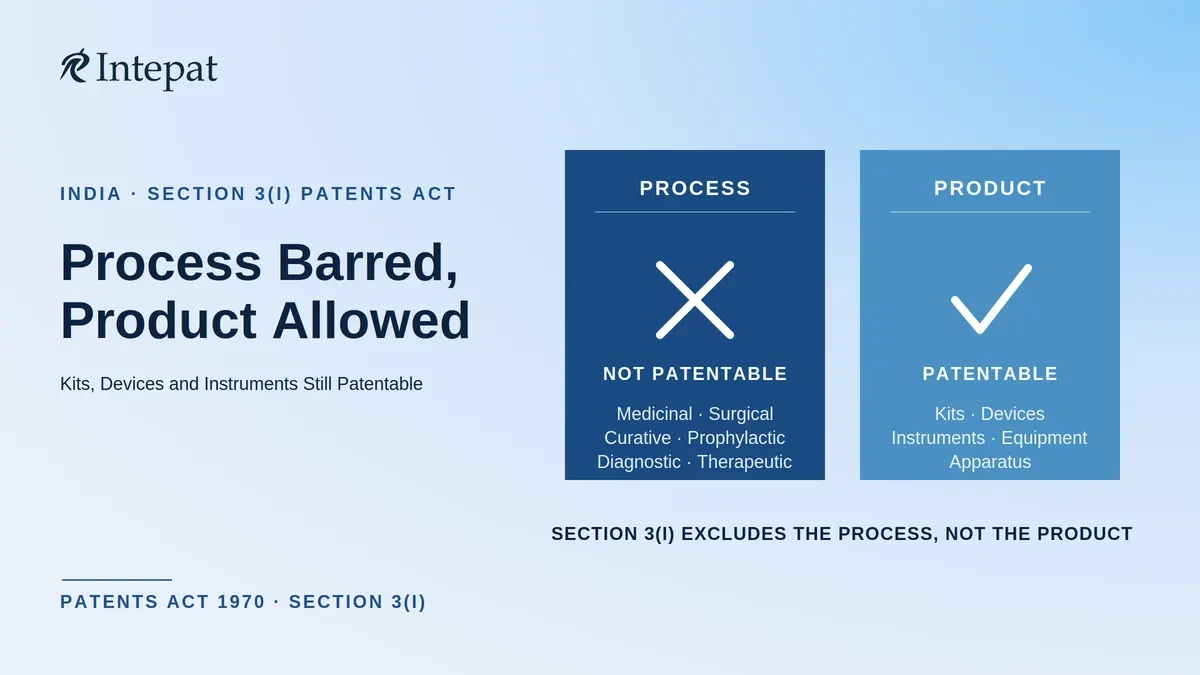
What Section 3(i) excludes, and what it leaves open
Section 3(i) declares not to be an invention “any process for the medicinal, surgical, curative, prophylactic diagnostic, therapeutic or other treatment of human beings or any process for a similar treatment of animals to render them free of disease or to increase their economic value or that of their products.” Six named categories are followed by a residual limb, “or other treatment,” which catches methods that fit none of the named descriptions.
The two limbs are not symmetrical. The qualifying words “to render them free of disease or to increase their economic value or that of their products” attach only to the animal limb, as the Delhi High Court confirmed in Natera. A human treatment process is therefore caught whether or not it renders anyone free of disease.
The opening word matters as much as the list. Section 3(i) excludes a “process,” and the Court held the intention is to exclude process claims, not product claims. Two adjacent provisions complete the picture: Section 3(h) excludes agriculture or horticulture methods, and Section 3(j) excludes plants and animals other than micro-organisms, and essentially biological processes for their production. See our guide to what can be patented in India for the wider set of exclusions.
The Patents (Amendment) Act 2002 produced the current wording with effect from 20 May 2003, inserting “diagnostic, therapeutic” and deleting “or plants,” which the plant exclusion re-enacted in modified form in Section 3(j). Methods of treating plants now fall outside Section 3(i), though Sections 3(h) and 3(j) may separately require consideration depending on the claim.
Why patenting medical procedures is barred on public policy grounds
A common explanation is that medical methods are excluded for lack of industrial applicability. That is not the Indian position, and adopting it produces the wrong response to an examination objection.
Section 2(1)(ac) defines “capable of industrial application” as the invention being capable of use in an industry, which a diagnostic method at commercial scale may independently satisfy. Section 3(i) is a separate bar that operates whether or not Section 2(1)(j)’s industrial applicability requirement is met, so arguing commercial utility does not answer it.
The rationale the Delhi High Court identified is a public policy one: protection for medical practitioners, para-medical personnel, nurses and technicians, so that a process they apply on their own skill and knowledge does not become a private monopoly. The Court held the exclusion was intended “to safeguard the autonomy and efficacy of the medical profession in delivering essential care”, and not to impose a blanket bar on innovation relating to diagnosis or treatment. Professional judgment is a relevant purposive consideration in that analysis, but the Section 3(i) inquiry ultimately turns on the substance of the claimed process.
What the Delhi High Court has held
In Natera Inc. and Anr. v. The Assistant Controller of Patents and Designs, C.A.(COMM.IPD-PAT) 16/2023, 9 October 2025, Justice Prathiba M. Singh set out a structured reading of Section 3(i), with an amicus curiae appointed on the construction of the provision.
The Court’s summary runs to six propositions:
- Products used for diagnosis or therapeutic purposes, including kits, equipment, machines and physical products, fall outside Section 3(i) and are patentable if they satisfy the conditions of patentability.
- The exclusions are directed at processes employed by medical practitioners, para-medical personnel and nurses, with each of the named terms in the provision read in that light.
- Tools used for diagnosis are outside the exclusion, but a tool consisting only of software must be examined under Section 3(k) for technical effect.
- The words “to render them free of disease or to increase their economic value” qualify the treatment of animals alone.
- Mere identification of a regimen for the use of medicines in a particular manner, frequency or form is excluded.
- Methods of treatment of plants are not covered by Section 3(i).
Two further holdings narrow the room applicants have assumed. The Court rejected the argument that a method must conclusively identify an illness to be diagnostic, holding that a result confirming the absence of a condition is equally diagnosis. It also confirmed that Section 3(i) draws no distinction between in vivo and in vitro processes.
Two later decisions applied this framework. In Medilabo RFP Inc. v. Controller of Patents, C.A.(COMM.IPD-PAT) 16/2024, 24 November 2025, Justice Tejas Karia set aside a Section 3(i) composition-claim refusal, holding that claims define the boundaries of protection and are construed against the specification, and remanded without ruling on the merits. In Hirotsu Bio Science Inc. v. Assistant Controller, C.A.(COMM.IPD-PAT) 45/2023, 17 January 2026, the same judge upheld refusal of an in vitro cancer-detection method, since a screening process capable of identifying a disease remains diagnostic even where further testing is needed to confirm it.
The claim forms that survive Section 3(i), and where drafting fails
The Manual of Patent Office Practice and Procedure, paragraph 09.03.05.08, records Registry practice, not statute. It states a patent may be obtained for a surgical, therapeutic or diagnostic instrument or apparatus, and that prostheses, artificial limbs and body measurements are patentable. It treats cosmetic-purpose applications as outside therapy, while catching cosmetic treatment amounting to a surgeon’s operation. Verified as of August 2026.
Three recurring Section 3(i) drafting problems. A treatment regimen recast as a dosing method is caught by proposition five above. A second medical use claim runs into Section 3(d), which excludes the mere discovery of any new property or new use for a known substance, so India has no equivalent of the European purpose-limited product claim.
The third is claim construction, where Natera and Medilabo illustrate opposite outcomes from one shared principle, that claims are construed in light of the specification rather than read in isolation from it. In Natera the final claims, read with the specification, disclosed a lung cancer diagnostic process, and the appeal failed. In Medilabo, working examples and a therapeutic end use did not justify treating a genuine composition claim as a method of treatment, and the refusal was set aside. The outcome turns on what the claim actually covers, not on which side of the line the drafter intended.
Natera applied the Supreme Court’s warning in Novartis AG v. Union of India, (2013) 6 SCC 1, against patent scope set by artful drafting, and confirmed grant abroad does not compel grant in India. Where the step is performed by software, the CRI Guidelines 2025 framework for Section 3(k) becomes the operative examination framework alongside, not instead of, Section 3(i), as it does for AI and machine learning inventions used in assistive diagnosis.
How India compares with the EPC, the UK and the United States
The Indian bar is textually wider than its European ancestor. Article 53(c) of the European Patent Convention excludes methods for treatment by surgery or therapy and diagnostic methods “practised on the human or animal body.” That qualifying phrase creates the in vitro carve-out. Natera records that India’s own Uruguay Round proposal followed the European wording, but the phrase reached neither the TRIPS Agreement as adopted nor Section 3(i).
| India | EPC and UK | United States | |
| Nature of the rule | Subject-matter exclusion, Section 3(i) | Subject-matter exclusion, EPC Article 53(c), Patents Act 1977 Section 4A(1) | No medical-method-specific statutory exclusion comparable to Section 3(i) |
| In vitro diagnostic methods | No carve-out | Carve-out for methods practised on the body | Not applicable |
| Known substance for a new medical use | Barred by Section 3(d) | Novel under EPC Article 54(4) and (5) and UK Section 4A(2) to (4) | Claimed as a process under 35 U.S.C. 100(b), not as a purpose-limited product |
| Enforcement position | Ordinary remedies for what is granted | Ordinary remedies for what is granted | Remedies disapplied against practitioners for a defined medical activity, 35 U.S.C. 287(c)(1) |
The United States position is often overstated. There is no medical-method-specific bar and no general loss of recourse. Section 287(c)(1) of title 35 disapplies the remedies provisions against a medical practitioner or related health care entity for a “medical activity,” but Section 287(c)(2)(A) excludes from that term the use of a patented machine, manufacture or composition of matter, a patented composition use, and a biotechnology process. The immunity is narrow and does not reach the device and biotechnology claims a diagnostics portfolio rests on.
Deciding what to file for an Indian diagnostics portfolio
For an Indian filing or national phase entry, drafting follows the product and process division, not how inventive the method is.
Lead with product claims. A kit, assay system, reagent composition, device or instrument is not excluded by Section 3(i) merely because of its diagnostic or therapeutic end use, and Natera and Medilabo both support that distinction. Draft method claims around the substance and output of the process, not avoided vocabulary, since the Court reads claims against the specification and is not persuaded by drafting that veils what the process does. Where the analysis is computational, prepare the technical effect argument for Section 3(k) at drafting stage rather than at the first examination report, because amendment room is constrained by Section 59.
Two habits are worth retiring: treating a foreign grant as predictive of the Indian outcome, and saving the Section 3(i) analysis for prosecution, by which point the claim architecture is fixed and the description already contains whatever a Controller quotes back. A claim-form review before filing costs less than an appeal. See our claim structure and claim types overview and the Patents Act practitioner guide for the examination framework.
Frequently asked questions about Section 3(i)
No. The Delhi High Court confirmed in October 2025 that Section 3(i) draws no distinction between in vivo and in vitro processes. A test performed on a blood or tissue sample outside the body can still be a diagnostic method. The European Patent Convention carve-out for methods practised on the body has no Indian equivalent.
Yes. Section 3(i) excludes processes, not products. Kits, equipment, machines, instruments and other physical products used for diagnosis or therapy fall outside the exclusion and are assessed on the ordinary requirements of novelty, inventive step and industrial application under Sections 2(1)(j) and 2(1)(ja).
No. The words naming plants were removed from Section 3(i) by the Patents (Amendment) Act 2002 with effect from 20 May 2003, and the Delhi High Court has held that plant treatment methods fall outside the provision. Sections 3(h) and 3(j) may separately require consideration depending on the claim.
Not in the European purpose-limited product form. Section 3(d) excludes the mere discovery of a new use for a known substance, so a mere new-use claim fails, and a treatment-method formulation may additionally engage Section 3(i). The United Kingdom and the EPC confer novelty on such a use under Section 4A(4) and Article 54(5) respectively. India has no comparable novelty fiction.
No. The Delhi High Court rejected the argument that only methods conclusively identifying an illness are diagnostic. A process producing a result that confirms the absence of a condition also falls within diagnosis, and whether a supporting or preliminary result is itself diagnostic depends on what the claimed process determines, not on how confidently it is expressed.
This article explains the law on Section 3(i) of the Patents Act 1970 in India as at August 2026 and is for general information only. It is not legal advice. Section 3(i) jurisprudence has continued to develop through successive Delhi High Court decisions, and the outcome in any case turns on the claims and the specification as filed. For advice on a specific invention, consult a registered patent agent.