




Patent registration in Chennai is normally done online on the IP India portal, and your application is handled by the Chennai Patent Office at Guindy. It serves Tamil Nadu, Karnataka, Kerala, Andhra Pradesh, Telangana, Puducherry and Lakshadweep. Fees are the same everywhere in India and start at Rs 1,600 for individuals, startups, small entities and educational institutions filing online.
This guide covers patent applications filed in India under the Patents Act 1970 and the Patents Rules 2003. It is written for founders, MSME owners, researchers and students based in Chennai. It explains which office handles your file, what you pay, how long examination takes, and what IP India’s own records show about Chennai’s filings. Fees and figures are verified as of November 2026.
Quick answer: File online on the IP India portal. If you are the sole or first-named applicant and you are based in Chennai, the Chennai Patent Office is ordinarily your office, and filing needs no visit. Budget Rs 1,600 to file (up to 30 pages and 10 claims) and Rs 4,000 to request examination if you qualify for the lower fees. A startup or small entity can ask for faster examination on Form 18A.
How Patent Registration in Chennai Works
For patent filing in Chennai, your office is fixed by where the sole or first-named applicant lives, is domiciled or does business, or where the invention was made. For Chennai applicants that is ordinarily the Chennai Patent Office. Filing is normally online, and you do not ordinarily need to visit, though the Controller can require your presence where necessary.
India has one Patent Office, which works from a head office and branch offices at Kolkata, Delhi, Mumbai and Chennai. The one that handles your file is called the appropriate office. It is the office for the place where the applicant, or the first-named applicant in a joint application, normally resides, has a domicile or has a place of business, or the place from where the invention actually originated (Rule 4). A foreign applicant with no place of business or domicile in India is placed by the Indian address for service it gives.
Once fixed, the office is not ordinarily changed, although the Controller may transfer an application. The Patent Office also says its four offices work as a virtual single office. The office decides which branch handles your file; the law, fees and deadlines are the same everywhere.
You can read your office from your application number. In the current 12-digit format, the fifth digit is the office code: 1 for Delhi, 2 for Mumbai, 3 for Kolkata and 4 for Chennai. An application filed at Chennai in 2025 therefore has a number beginning 20254.
Filing is normally online. A patent agent must file every document electronically, and a paper filing carries a 10 per cent additional fee. If you are resident in India, you need a written permit from the Controller before filing abroad, unless you filed an application for the same invention in India at least six weeks earlier and no secrecy direction applies, or any such direction has been revoked (Section 39). Our guide to the patent filing procedure in India walks through each step.
The Guindy Office and What It Handles
The Chennai Patent Office is on G.S.T. Road, Guindy, Chennai 600032. It serves five states and two Union Territories, so applicants in Bengaluru, Hyderabad and Kochi file there too. It has so far received about 44 per cent of India’s published 2025 applications, with publication still running; an independent analysis puts it ahead of Delhi.
The Patent Office Manual lists the Chennai office’s territory as Andhra Pradesh, Karnataka, Kerala, Tamil Nadu and Telangana, with Puducherry and Lakshadweep. Mumbai also serves five states, and Delhi and Kolkata cover the rest of India. The address appears on the IP India contact page, which lists the Patent Office, the Trade Marks Office and the Geographical Indications Registry in the same Guindy building.
We counted the office’s intake on InPASS, IP India’s public patent search, on 2 November 2026. Of 98,684 published applications filed in 2024, 38,166 were filed at Chennai, which is 38.7 per cent. For 2025 the count already stands at 48,033 of 108,593, about 44 per cent, and it will grow as the rest of the year’s applications are published.
An independent analysis reached the same result. The PatentAssist.ai India Patent Filing Report 2026 found that Chennai received 44.4 per cent of the published applications filed in 2025, against 38.6 per cent for Delhi. In 2020 the order was the other way round, with Delhi at 41.2 per cent and Chennai at 32.7 per cent.
Applications naming a Chennai applicant and applications handled by the Chennai Patent Office measure different things. The office serves a much wider territory than the city, so the two totals should not be treated as interchangeable. Either way, fees and deadlines are the same at every office.
What Chennai’s Filing Data Shows
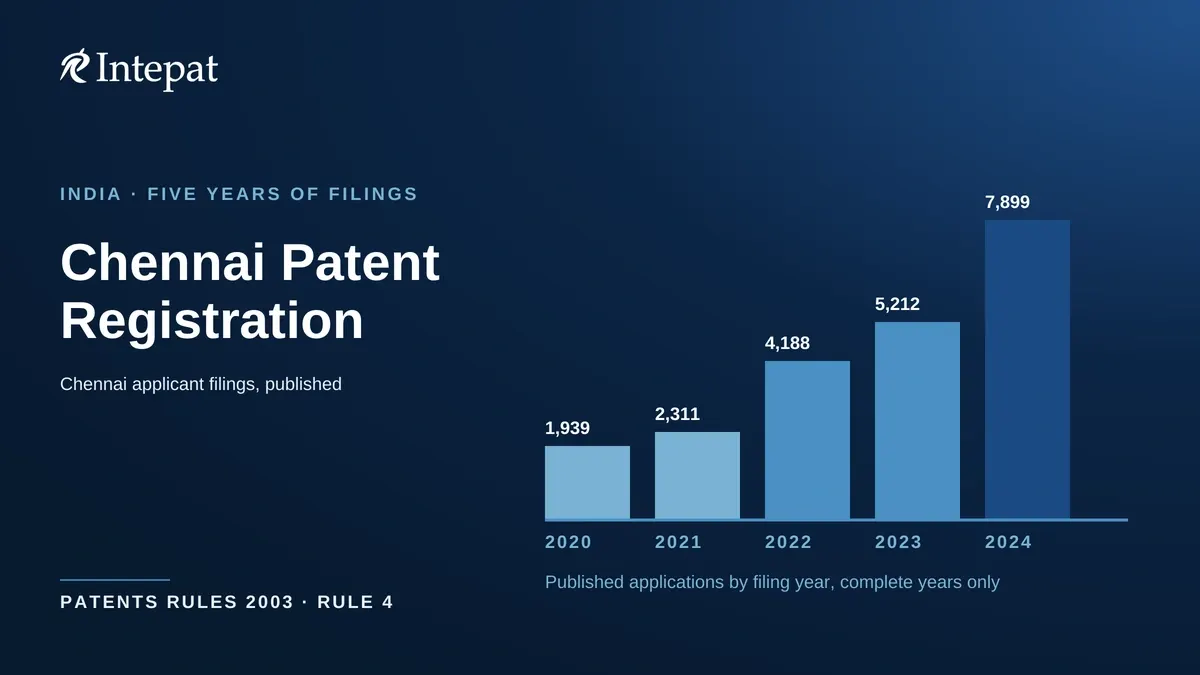
Applications naming a Chennai applicant address rose about fourfold in four years. Published applications with a Chennai applicant address rose from 1,939 in 2020 to 7,899 in 2024. By November 2026, the 2025 count had passed 10,800, with publication still running for the later months of that year.
| Filing year | Published applications with a Chennai applicant address |
| 2020 | 1,939 |
| 2021 | 2,311 |
| 2022 | 4,188 |
| 2023 | 5,212 |
| 2024 | 7,899 |
| 2025 (incomplete) | 10,818 |
Source: IP India InPASS public search, read on 2 November 2026: published applications whose Applicant Address field contains the text “Chennai”, by Indian filing date. Publication comes about 18 months from the filing or priority date, whichever is earlier, so 2025 is incomplete. Applications withdrawn early or under a secrecy direction are not published and are missing from every year.
The state picture is the same. The Patent Office’s Annual Report ranks Tamil Nadu first among all states for applications by Indian applicants in 2024-25, with 15,440, up from 9,565 the year before by our sum of the report’s state table. That is a 61 per cent rise in one year. Applicants from the five states and Puducherry that file at Chennai made up nearly half of all 68,201 applications by Indian applicants that year, by our calculation from the report’s state table.
Several Chennai institutions appear in the report’s top-applicant tables. The PatentAssist.ai report ranks Saveetha Institute of Medical and Technical Sciences second in India for applications filed in 2025, with 2,493, behind only Qualcomm. Sathyabama Institute of Science and Technology (624), Vellore Institute of Technology, Chennai (606) and Saveetha Engineering College (570) also sit in its top 25.
Filings are not patents. The same report names IIT Madras as India’s top academic patentee in 2025, with 193 patents granted. Filing counts do not show whether a patent was granted or what the granted claims protect. A grant needs a timely request for examination and a complete reply to the examination report, which the sections below explain.
Government Fees for Patent Registration in Chennai
Fees are national, so a Chennai filing costs the same as one in Delhi. Individuals, startups, small entities and educational institutions pay the lower rate. Other applicants pay five times as much for most steps. These are e-filing fees; a paper filing carries a 10 per cent additional fee.
| Step | Lower rate (Rs) | Other applicants (Rs) |
| Application, Form 1 (up to 30 pages and 10 claims) | 1,600 | 8,000 |
| Each page above 30 | 160 | 800 |
| Each claim above 10 | 320 | 1,600 |
| Early publication, Form 9 | 2,500 | 12,500 |
| Request for examination, Form 18 | 4,000 | 20,000 |
| Expedited examination, Form 18A (online only) | 8,000 | 60,000 |
| Renewal, years 3 to 6, each year | 800 | 4,000 |
| Renewal, years 7 to 10, each year | 2,400 | 12,000 |
Source: First Schedule to the Patents Rules 2003, checked on 2 November 2026.
The lower rate applies only where every applicant is in a lower-rate class. If any applicant falls outside those classes, the higher rate applies. A startup, small entity or educational institution files Form 28 with each document that carries a fee; Form 28 itself costs nothing.
Take a Chennai startup that files a fresh, unpublished complete specification of 36 pages with 12 claims and wants faster examination. Filing costs Rs 1,600, plus Rs 960 for six extra pages and Rs 640 for two extra claims, so Rs 3,200. Expedited examination costs Rs 8,000, and the Form 9 that must go with it costs Rs 2,500. The total is Rs 13,700.
On the normal route the same startup pays Rs 3,200 plus Rs 4,000, which is Rs 7,200. Professional fees for drafting and filing are extra. Our patent fee calculator works out the official fees for your page and claim count.
How Long It Takes, and When Expedited Examination Helps
Your application is published about 18 months after filing and is examined only after you ask for it. The Patent Office says a decision takes a few years on the normal route. On the expedited route it says most cases are decided within about a year of the request.
Publication comes 18 months from the filing date or the priority date, whichever is earlier. The office then publishes it in the journal, ordinarily within a month. You can ask for earlier publication on Form 9, and the office ordinarily publishes within a month of that request. From publication you have the same privileges and rights as if the patent had been granted, but you cannot sue for infringement until it is granted.
Nothing is examined until you, or another interested person, file a request for examination on Form 18. For applications filed on or after 15 March 2024, the request is due within 31 months of the priority date or the filing date, whichever is earlier. Applications filed before that date keep the earlier period of 48 months, and later dates apply in a few cases, such as divisional applications. If no request is made in time, the application is treated as withdrawn.
Expedited examination is open to startups, small entities, applicants who are all natural persons with at least one woman among them, government departments, government companies, certain government institutions, and a few other categories. The request is made online only, within the same period as an ordinary request.
The request form is Form 18A. Unless the application has already been published early on request or a Form 9 is already on file, it must be accompanied by a Form 9. An ordinary request already on file can be converted to an expedited one on Form 18A, with the eligibility documents and the conversion fee of Rs 4,000 at the lower rate.
The route is well used. The Patent Office’s Annual Report records 7,154 requests for expedited examination in 2024-25, 1,026 of them from startups. It states that in the majority of cases grant or final disposal comes within an average of one year from the request, against a few years on the normal route. Our expedited examination guide covers the eligibility categories, the Form 18A procedure and the fees.
If you contest objections and ask to be heard, the hearing may be held by video conference and is treated as held at the Chennai office. Your agent can handle a Chennai application from anywhere.
Tamil Nadu Support for Chennai Applicants
A Tamil Nadu government page states a subsidy of 75 per cent of the cost of filing a patent application, including the first maintenance fee of the granted patent, up to Rs 3 lakh per patent. The state’s scheme portal lists manufacturers as beneficiaries and gives a claim window of six months from receiving the patent.
These terms come from Tamil Nadu government pages. A District Industries Centre page states the rate, the cap and the maintenance-fee cover, and the state’s scheme portal lists manufacturers as beneficiaries and gives the six-month claim window. The portal still shows a 50 per cent rate, so confirm the current terms with your District Industries Centre before you count on the refund. Our Tamil Nadu patent subsidy guide covers the eligibility conditions and the claim steps, and our guide to patent reimbursement schemes for startups covers the startup routes.
Before You File in Chennai
Several problems can be avoided before filing. Search the prior art, decide whether a provisional application fits your timeline, and settle who the applicant is. Each choice is easier to get right at the start than to fix later.
A prior art search tells you what is already published and shapes the claims you draft. It can also help you judge whether filing is worth the cost. A search is not a guarantee of grant, but it can reduce surprises in the examination report.
A provisional application secures an early filing date for what it discloses. Later claims get that date only where they are fairly based on the provisional specification. Before a pitch or a conference paper, check that it covers the technical features you will reveal. The complete specification must follow within 12 months, or the application is deemed abandoned.
The applicant must be a person claiming to be the true and first inventor, the assignee of that person’s right to apply, or the legal representative of a deceased person who was entitled to apply (Section 6). Any of them may apply alone or jointly. This matters in colleges, where an IPR cell may help with the draft. Our Coimbatore guide answers who should be named as applicant when a college IPR cell helped, and the same answer applies in Chennai. Applicants in Karnataka can read our Bangalore guide for the Karnataka picture.
Five Patent Deadlines to Track
Five dates decide whether a Chennai application, and later the patent, survives. Put each in your calendar as soon as its trigger date is known, and set a reminder well before it. Missing some of them ends the application unless relief is granted.
If a period set by the Rules is about to be missed, or has been, Rule 138 lets the Controller extend it or condone the delay by up to six months, on a Form 4 request made within that six-month window. The fee is Rs 10,000 a month at the lower rate. The power is discretionary, not automatic, and it does not reach periods fixed by the Act itself, such as the 12 months for a complete specification.
- Complete specification: within 12 months of filing a provisional application, or the application is deemed abandoned.
- Form 3, the statement and undertaking on foreign applications: within six months of filing, if you are prosecuting, or to your knowledge someone you claim through or who claims through you is prosecuting, an application abroad for the same or substantially the same invention. Updated details of other foreign applications are due within three months of the issue of the first examination report.
- Request for examination on Form 18 or Form 18A: within 31 months of the priority date or the filing date, whichever is earlier (48 months for applications filed before 15 March 2024). If missed, the application is treated as withdrawn.
- Putting the application in order after the first examination report: six months from the date the report is issued. A Form 4 request with the fee can extend this by three months, on the ordinary and the expedited route alike; ask for it before the original six months run out. If the application is not put in order in time, it is deemed abandoned.
- Renewal fees: due every year from the third year, before the previous year ends. The period can be extended by up to six months on a Form 4 request with the fee. If the patent is granted more than two years after filing, the fees already due can be paid within three months of the grant being recorded, or, on a Form 4 request with the fee, within an extended period of up to nine months from that date. If a fee is not paid in time, including any extension, the patent ceases to have effect.
Frequently Asked Questions
It is, if the sole or first-named applicant lives, is domiciled or does business in Tamil Nadu, Karnataka, Kerala, Andhra Pradesh, Telangana, Puducherry or Lakshadweep, or the invention was made there. A foreign applicant without a place of business or domicile in India is placed by its Indian address for service. The office is not ordinarily changed, though the Controller may transfer an application (Rule 4).
No. You file and reply online, and patent agents must file electronically. If your objections go to a hearing, it may be held by video conference and is treated as held at the Chennai office. The Controller can still require your personal signature or presence where it considers this necessary (Rule 135).
Official fees are national. For an individual, startup, small entity or educational institution, filing costs Rs 1,600 and a request for examination Rs 4,000, so Rs 5,600 before extra pages, claims or renewals. Other applicants pay Rs 8,000 and Rs 20,000. Professional fees for drafting and filing are extra.
Yes. A startup can request expedited examination on Form 18A, online only, for Rs 8,000. Unless the application has already been published early on request or a Form 9 is on file, the request must come with a Form 9. The Patent Office reports that most expedited cases are decided within about a year of the request.
Yes. The Act lets an applicant draft the specification and appear before the Controller personally. You can file online yourself, and unlike a patent agent you may also file on paper, at a 10 per cent higher fee. The claims decide what your patent protects, so it is safer to have a registered patent agent draft them.
Yes. A patent has effect throughout India, whichever office handled it. Its maximum term is 20 years from the filing date, or from the international filing date for a PCT national phase application, subject to renewal fees from the third year. It does not protect you abroad; for that you must seek protection in each country or region you need.
This article explains the law on patent registration in Chennai in India as at November 2026 and is for general information only. It is not legal advice. Government fees, forms, and procedures change; confirm current figures with the Indian Patent Office before you file. For advice on your specific invention, consult a registered patent agent.