




Software copyright registration in India registers your source code as a literary work with the Copyright Office on Form XIV. Since a 2021 rule change, you must file at least the first and last 10 pages of source code, or the whole of it if under 20 pages, at a standard fee of Rs 500 per work, with nothing redacted.
A software copyright registration India application goes through the same Copyright Office process used for any literary work, on Form XIV, under the Copyright Act, 1957 and the Copyright Rules, 2013. The process covers copyright registration for mobile app India filings just as much as web applications or backend codebases.
| Quick answer: |
| Software and apps register with the Copyright Office as a “computer programme,” a literary work. Since a 2021 rule change, you must file at least the first and last 10 pages of source code (or all of it if under 20 pages), with nothing redacted, at a standard fee of Rs 500 per work. Copyright protects the code’s expression, not the underlying idea or functionality; registration itself only records the work’s particulars and gives them prima facie evidentiary value. |
Software copyright registration India: why it counts as a literary work
Source code and mobile apps register with the Copyright Office as a “computer programme,” a form of literary work (Section 2(o), Copyright Act, 1957). Registration records the work’s particulars on the Register of Copyrights, which Section 48 makes prima facie evidence of those particulars in any court; registration itself is not a precondition for copyright to exist.
The Copyright Act does not create a separate right for software. Section 2(o) provides that literary work “includes computer programmes, tables and compilations including computer databases,” and Section 2(ffc) defines a computer programme as a set of instructions expressed in words, codes, schemes, or in any other form, including a machine-readable medium, capable of causing a computer to perform a particular task or achieve a particular result.
Copyright subsists in an original literary work under Section 13(1)(a). Software meets the same originality standard as any other literary work, not novelty, but skill and judgment in the expression. That is also why registration is optional: copyright arises automatically on creation and fixation, and registration only places the particulars on the public record, a distinction covered in full in is your original work automatically protected by copyright.
What you must file: source code, and the 2021 change most guides still miss
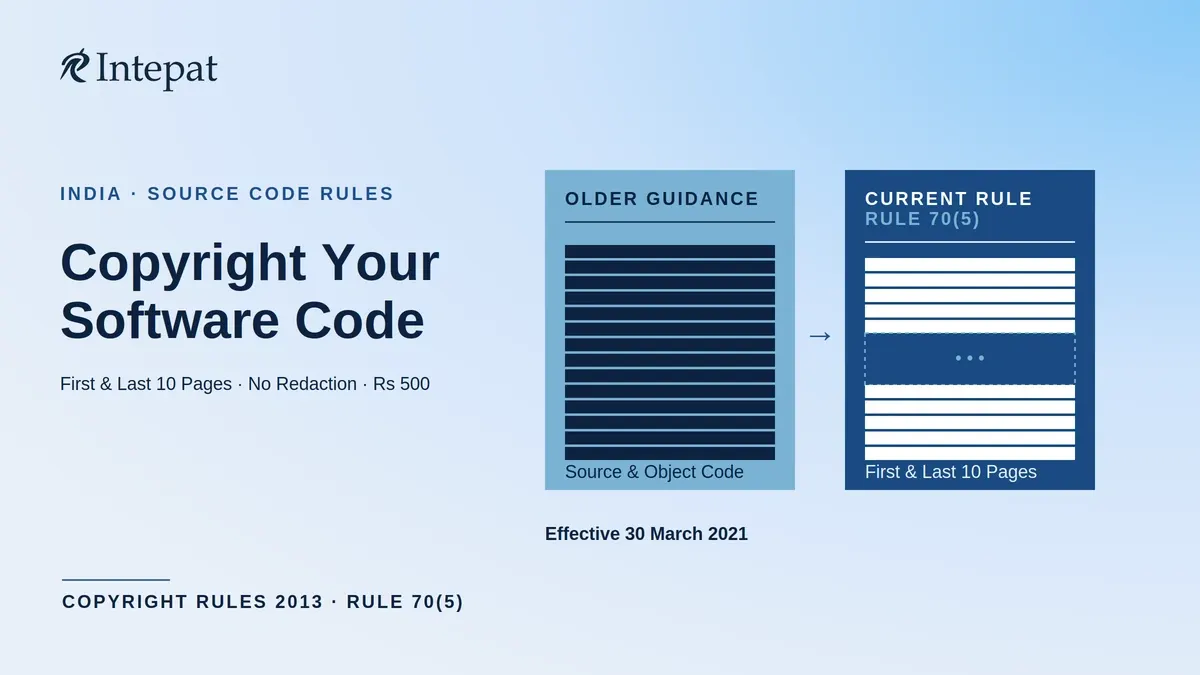
Since a rule change on 30 March 2021, a computer programme application under Form XIV must include at least the first and last 10 pages of source code, or the entire source code if it runs under 20 pages, with no portion blocked out or redacted (Rule 70(5), Copyright Rules, 2013).
That is a narrower requirement than the one still repeated in a lot of secondary guidance, and even in the Copyright Office’s own 2018 practice manual illustration, which describes filing “source and object code” in full. This is the single most important update for anyone handling source code copyright India filings today: the current rule 70(5), substituted with effect from 30 March 2021, replaces that older requirement, and no blocked-out or redacted portion is permitted in whatever pages you do file.
The rule sets a floor, not a ceiling: filing the first and last 10 pages satisfies it, and nothing in the rule stops an applicant filing more. The no-redaction condition applies regardless of how many pages are filed, so proprietary sections within them cannot be blacked out. If your source code runs under 20 pages in total, you file all of it instead of splitting into a first-and-last-10 selection.
The rest of the Form XIV checklist for a software filing
Beyond the code itself, a software application needs the work classed as “Software or Computer Programme” rather than plain “Literary” on the Statement of Particulars, the actual programming language named in the language field, the applicant’s own signature rather than the advocate’s, and an original no-objection certificate if the applicant is the owner rather than the author.
The Statement of Particulars has a dedicated class option for this: Column 4 is marked “Software or Computer Programme,” not “Literary,” which routes the filing correctly, per the Copyright Office’s Literary Works manual. Column 6, the language field, takes the actual programming language, such as C, C++, C# or Java, rather than the applicant’s usual language of correspondence.
Only the applicant, an author or an owner, may sign each part of the form; an advocate cannot sign on the applicant’s behalf even under a power of attorney (rule 70(3)). The same rule requires an original no-objection certificate from the author where the applicant is the owner rather than the author. If the applicant is a firm or organisation, an authorised signatory may sign instead, sometimes backed by a board resolution. Where the author has died, the Statement of Particulars instructions call for the date of death plus either a notarised affidavit on inheritance of rights or a no-objection certificate from all the author’s legal heirs, in place of the author’s own NOC; confirm the current requirement for the specific chain of title before filing.
For the wider registration procedure common to every category of work, see how copyright registration works step by step. If the Office comes back with a discrepancy letter on any of these points, replying to a copyright objection or discrepancy letter sets out what to file and by when.
What software copyright registration costs
The standard fee for registering a computer programme is Rs 500 per work, under Second Schedule item 9(a). The higher Rs 2,000 fee under item 9(b) applies only to an artistic work used in relation to goods or services, a scope narrowed by a 2021 amendment that removed literary works from that item.
This is another point where dated guidance misleads: before 30 March 2021, item 9(b) read “Literary or Artistic work…used…in relation to any goods,” with no “services” limb at all, and a literary work, including software, used in relation to goods alone could attract the Rs 2,000 fee. The same 30 March 2021 amendment added “or services” to the item and dropped “Literary or” from it, so a computer programme filed as a literary work is billed at the standard Rs 500 rate today regardless of any commercial use (verified as of August 2026). For the full fee schedule across every category, including cinematograph and sound recording rates, see the complete copyright registration cost breakdown.
What the registration covers, and what it does not
Copyright protects the software’s code as written, not the underlying idea, algorithm or functionality it performs. Per Copyright Office practice for a software registration, that protection extends to any screen display the filed code generates, provided the same person owns both and the generating code is actually submitted; a bare screenshot cannot substitute for the code in that filing.
The Copyright Office’s practice manual for literary works states this directly, as its registration practice for software filings: a programme’s registration covers the screen displays it generates, but only if the applicant owns both the code and the display, and only where the code generating the display is actually filed, not merely described. A screenshot alone, without the underlying code, does not meet the Manual’s requirement for what a software registration must include.
What copyright does not reach is the idea behind the software, such as a general approach, an algorithm, or the functionality a user experiences: Indian copyright law protects the particular expression of code, not the underlying concept, a general principle explored further in the idea-expression dichotomy in copyright law and, for interface design specifically, in copyright in a graphical user interface. A competitor who builds different code to the same function or look has not necessarily infringed your registration. For a broader look at protecting an app developer’s work beyond the filing mechanics, see copyright protection for app developers and their software.
Copyright registration versus a software patent
Copyright and patent protection answer different questions through different offices. Copyright, not its registration, protects the specific code as written; registering it with the Copyright Office records the particulars, with Section 48 evidentiary value, and costs a few hundred rupees. Whether the underlying technical solution is separately patentable is a narrower question decided under the Patents Act, with its own eligibility rules and a longer, costlier examination.
This article does not restate the patentability test for software-related inventions; that is a distinct area of patent law with its own current guidelines, and it deserves its own careful reading rather than a summary here. For the substantive test and the Patent Office’s approach to computer-related inventions, see protection of computer-related inventions in India and the 2025 CRI guidelines under section 3(k). The practical point for a founder is sequencing: copyright registration is worth doing early and cheaply for the code you already have, while a patentability assessment for any genuinely new technical method is a separate decision with its own timeline.
Timeline: what happens after you file
The Copyright Office first runs a formality check: an incomplete application gets a compliance letter and a “Work Awaited” status until you respond. Separately, the thirty-day objection window runs from the date the Registrar receives the application, not from completion of the formality check (rule 70(10)); anyone with a competing claim can object before the Registrar proceeds.
This sequence is the same for every category of work, not specific to software, and it is worth knowing before you file: the formality check looks at the basics (the correct source-code pages, a complete Form XIV, the fee, and a power of attorney if one applies). The applicant must separately give notice of the application to every person who claims or has an interest in the work, or who disputes the applicant’s rights to it (rule 70(9)). If the Office does issue a compliance letter, it is not a rejection; it identifies exactly what is missing so you can respond.
The thirty-day window exists to let a person with a genuine competing interest raise it before registration, not to create a general appeal period. If no objection arrives and the Registrar is satisfied the particulars are correct, processing continues on a first-come, first-served basis, and the actual time to a certificate depends on the Office’s workload rather than a fixed statutory deadline. If you do receive a discrepancy letter or a third-party objection, replying to a copyright objection or discrepancy letter in India sets out what each situation calls for and by when.
Frequently Asked Questions
Is copyright registration compulsory before I sell or license my software?
No. Copyright in software arises automatically once code is written and fixed in tangible form; registration is not a precondition. It creates an official record on the Register of Copyrights and a certificate useful as evidence in a dispute or during due diligence.
Is my source code made public when I register it?
The Register of Copyrights and its indexes are open to public inspection; anyone may take copies on payment of the prescribed fee (Section 47). That covers the recorded particulars, such as title and ownership. Whether the filed source code is separately open to inspection is not addressed in the materials reviewed, so confirm current practice before filing anything sensitive.
Can I register just one module of a larger codebase?
Each Form XIV application must relate to one work only (Rule 70(2)), so a filing should be one identifiable, accessible piece of code, not a bundle of unrelated modules. Whether a module counts as its own separately registrable work is fact-specific; the Rules set no general test for it, so check before filing rather than assume either way.
Does registering my app’s copyright also protect its name or logo?
No. Copyright protects your source code and, if you also own and file it, the screen display the code generates. Your app’s name is a trademark question, and any logo or icon is a separate artistic work with its own filing route, not covered here. See trademark and copyright for how the two overlap.
Do I need a lawyer or agent to file Form XIV myself?
No rule requires it. An applicant may file Form XIV directly, and only the applicant, not an advocate, may sign the application, the Statement of Particulars, and the Statement of Further Particulars. In practice, many founders still instruct an IP professional to handle the source-code preparation, the notice requirements, and the follow-up if the Office raises a discrepancy.
This article explains the law on software and mobile app copyright registration in India as at August 2026 and is for general information only. It is not legal advice. Procedures and fees change; confirm current requirements with the Copyright Office before you act. For advice on your specific work, consult an IP lawyer.
Sources
- Copyright Act, 1957, Sections 2(o), 2(ffc), 13(1)(a), 47 and 48. Government of India.
- Copyright Rules, 2013, Chapter XIII (Rule 70), Copyright Office consolidated text with gazette footnotes, and Form XIV’s General Instructions and Statement of Particulars filing instructions, Copyright Office, Government of India.
- Copyright Rules, 2013, Second Schedule (fees), items 9(a) and 9(b), Copyright Office consolidated text with gazette footnotes.
- Copyright (Amendment) Rules, 2021, G.S.R. 225(E), 30 March 2021, as recorded in the Copyright Office’s consolidated Rules footnotes (sources 2 and 3 above).
- Practice and Procedure Manual 2018, Literary Works, Copyright Office, Government of India, Sections 2, 6 and 9.