




Industrial applicability determines whether an invention can actually be patented in India. Under Section 2(1)(ac) of the Patents Act, 1970, an invention must be capable of being made or used in an industry in order to qualify for patent protection. Along with novelty and inventive step, industrial applicability forms one of the three essential patentability requirements examined by the Indian Patent Office.
The term “industry” is interpreted broadly and includes manufacturing, agriculture, and other practical technical activities. The law does not require commercial success. However, the invention must be workable, reproducible, and capable of performing the technical function described in the specification.
In practical terms, the industrial applicability test ensures that patents are granted only for technological solutions that can function in real-world industrial settings. Speculative ideas, non-operational concepts, or inventions that cannot operate as claimed will fail this requirement during patent examination.
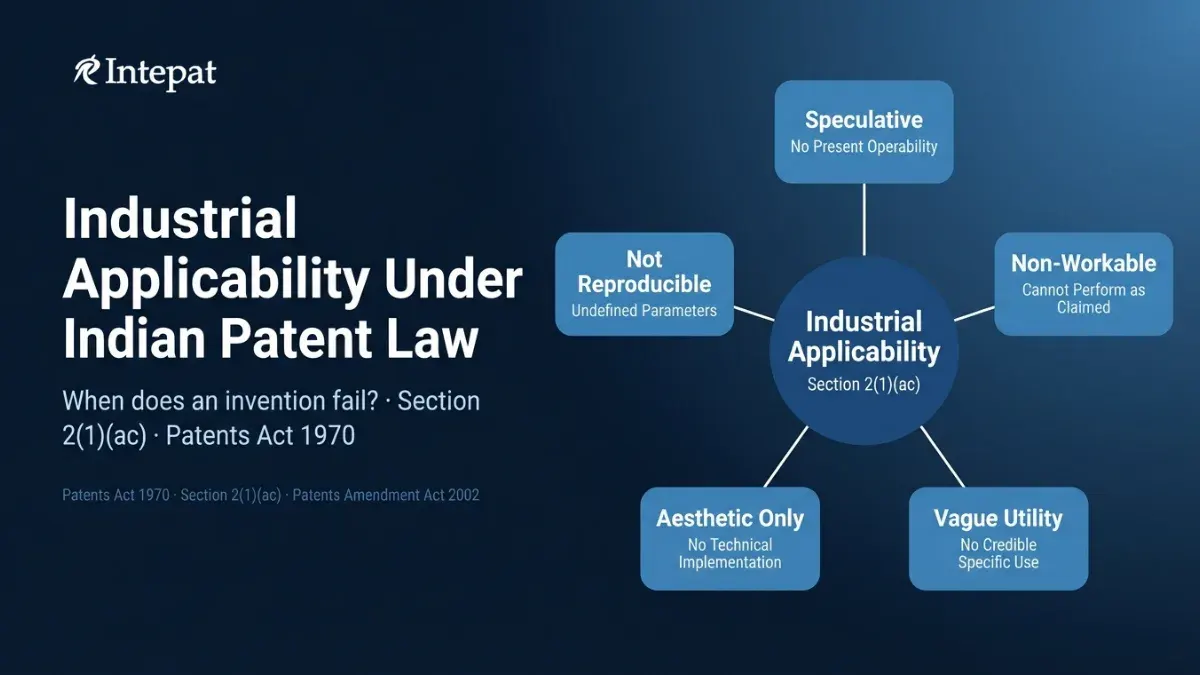
Industrial Applicability in Indian Patent Law (Section 2(1)(ac))
Section 2(1)(ac) of the Patents Act, 1970 defines “capable of industrial application” as an invention that is capable of being made or used in an industry. This definition was introduced through the Patents (Amendment) Act, 2002 to align Indian law with international standards under the TRIPS Agreement and the Patent Cooperation Treaty.
The language appears simple, but its implications are significant. The invention must demonstrate practical operability. It should not be merely theoretical, speculative, or dependent on undefined future research. The requirement focuses on technical feasibility, whether the invention can actually function in a real industrial setting.
Importantly, “industry” is interpreted broadly. It is not confined to manufacturing or heavy machinery. It includes agriculture, commercial technical activity, and other practical applications that involve physical or technological implementation.
Industrial applicability does not require proof of profitability. The law does not ask whether the invention will succeed commercially. It asks whether the invention can work as claimed.
How Indian Courts Interpret Industrial Applicability
Indian courts have consistently clarified that industrial applicability is concerned with practical workability, not mere theoretical possibility.
In Lakhapati Rai & Ors. v. Srikissen Dass & Ors., the court explained that “utility” does not mean superiority or improvement over prior knowledge. It means practicability. The invention must be capable of performing what it claims to perform.
Similarly, earlier judicial observations such as in Young & Neilson v. Rosenthal & Co. emphasised that the invention must offer a real, usable contribution to industry, not an abstract idea.
A more structured understanding emerged in the F. Hoffmann-La Roche decision, where the court observed that an invention must have credible practical application. Even if the invention is not in its final commercial form, there must be demonstrable operability. A purely speculative disclosure will not satisfy the requirement.
This judicial interpretation aligns industrial applicability with the broader patentability framework in India. An invention may be novel and involve inventive step, yet still fail if it cannot be practically implemented. (See also our detailed discussion on Novelty in Indian Patent Law and Inventive Step under Section 2(1)(ja).)
Industrial applicability therefore acts as a functional filter. It prevents patent protection from being granted to inventions that cannot operate in real-world conditions, even if they appear technically sophisticated on paper.
It also operates independently from subject-matter exclusions. For example, an invention that falls within patent-eligible subject matter may still be refused if it lacks demonstrable industrial application. (For a separate discussion on exclusions, refer to What Cannot Be Patented in India.)
When Does an Invention Fail the Industrial Applicability Requirement?
An invention fails the industrial applicability requirement when it cannot demonstrate credible and practical operability. The assessment is grounded in whether the invention can function in a real industrial or technical setting.
The most common situations where failure occurs include:
Speculative or Theoretical Inventions
If the disclosure suggests that the invention might work in the future after further research, but does not establish present operability, the requirement is not satisfied. Patent law does not protect research proposals or incomplete experimental concepts.
Inoperable or Non-Workable Claims
If the invention, as described, cannot perform what is claimed or contradicts established scientific principles, it fails the test. An invention that cannot operate as disclosed cannot be considered industrially applicable.
Unproven Biological or Chemical Utility
In biotechnology or pharmaceutical applications, merely identifying a compound or sequence is insufficient. The application must disclose a specific and credible use. Vague statements of potential therapeutic benefit will not meet the threshold. This often intersects with issues discussed under Section 3(d) and patentability in pharmaceuticals.
Abstract or Purely Aesthetic Concepts
Ideas that lack technical implementation or industrial functionality do not qualify. Even if novel, such subject matter may fail independently of exclusions under Section 3 of the Patents Act.
Implausible or Non-Credible Utility
If the claimed utility is implausible or unsupported by the disclosure, the invention may be refused. The specification must enable a person skilled in the art to understand how the invention achieves the stated result.
Industrial applicability functions as a credibility filter. It ensures that patent protection is granted only where the invention demonstrates real-world technical capability, not theoretical ambition.
Industrial Applicability in Europe, the United States, and Japan
Industrial applicability is not unique to India. It is a globally recognised patentability requirement, although terminology and doctrinal emphasis differ across jurisdictions.
Europe: Article 57 of the European Patent Convention
Under Article 57 of the European Patent Convention, an invention is considered industrially applicable if it can be made or used in any kind of industry, including agriculture. The European Patent Office interprets “industry” broadly, covering practical technical activity rather than aesthetic or purely intellectual concepts.
The focus is on technical feasibility. An invention that cannot be carried out or that contradicts established scientific principles will not satisfy the requirement. In biotechnology cases, the EPO requires disclosure of a specific, credible function, particularly for gene sequences and biological materials.
United States: Utility Requirement under 35 U.S.C. §101
United States patent law does not use the term “industrial applicability.” Instead, 35 U.S.C. § 101 requires that an invention be “useful.”
The utility requirement in the United States demands credible and specific practical use. If the application fails to demonstrate how the invention works, or if the asserted utility lacks credibility, the application can be rejected. The United States Patent and Trademark Office also applies a heightened standard in biotechnology cases, requiring substantial and specific utility.
Although terminology differs, the underlying principle is similar to India. The invention must function as claimed and must not be speculative.
Japan: Industrial Applicability under Article 29
Under Article 29(1) of the Japanese Patent Act, an invention must have industrial applicability to be patentable. The concept of “industry” includes manufacturing, agriculture, mining, and commercial technical activities.
However, Japan maintains certain restrictions in relation to medical methods performed on the human body. While medical devices and pharmaceuticals may be patentable, methods of medical treatment are generally excluded.
Industrial Applicability under the PCT Framework
The Patent Cooperation Treaty also incorporates industrial applicability under Article 33(4). The requirement applies during international search and examination phases, particularly where the invention appears speculative or lacks demonstrated practical use.
Across major jurisdictions, the common thread is clear. Patent systems protect inventions that demonstrate real and credible technical application. Abstract ideas, hypothetical concepts, or disclosures that cannot be practically implemented are consistently filtered out.
Why Industrial Applicability Is Required in Patent Law
Industrial applicability exists to ensure that patent protection is granted only to inventions that contribute real and functional technological value. Patent rights confer a time-limited monopoly. Such protection is justified only when the invention delivers a workable technical solution.
The requirement serves several structural purposes.
First, it prevents speculative filings. Without this filter, applicants could secure exclusive rights over incomplete research ideas or hypothetical concepts that may never function in practice. This would distort innovation incentives and create unnecessary barriers to genuine technological development.
Second, it protects the integrity of the patent system. Patent law is designed to reward disclosure of reproducible knowledge. If an invention cannot be made or used, the disclosure does not advance industry. Granting rights in such cases would undermine the foundational exchange underlying patent protection.
Third, it reduces the risk of abusive or strategic filings. Industrial applicability operates as a practical safeguard against attempts to claim control over undeveloped scientific possibilities, particularly in emerging areas such as biotechnology and artificial intelligence.
Finally, it aligns with international harmonisation principles. Across India, Europe, the United States, Japan, and the PCT framework, the consistent expectation is that an invention must demonstrate credible and real-world functionality.
Industrial applicability is therefore not a procedural formality. It is a structural threshold that reinforces technical credibility, prevents speculative monopolies, and ensures that patent protection corresponds to genuine industrial contribution.
How to Draft a Patent Application to Demonstrate Industrial Applicability
Industrial applicability objections often arise not because the invention lacks utility, but because the specification does not clearly demonstrate it. Careful drafting is therefore critical.
Clearly Describe How the Invention Works
The specification must explain the technical mechanism by which the invention achieves its stated result. Functional language alone is insufficient. The disclosure should allow a person skilled in the art to understand how the invention operates in practice.
Avoid Speculative or Prophetic Statements
Statements suggesting that the invention “may potentially” achieve future results without present operability can weaken the application. The description should focus on demonstrated or technically supportable functionality.
Provide Credible Technical Examples Where Necessary
In chemical, pharmaceutical, or biotechnology inventions, the application should disclose a specific and identifiable use. If experimental data is available, it strengthens credibility. Even in early-stage filings, the practical application must be clearly articulated.
Ensure Claims Align with the Disclosure
Overly broad claims that extend beyond the demonstrated functionality can trigger industrial applicability objections. The scope of the claims should be supported by the technical teaching in the specification.
Demonstrate Reproducibility
The disclosure must enable replication. If the invention depends on undefined parameters, incomplete processes, or uncertain conditions, it risks being viewed as non-workable.
Industrial applicability is closely connected with enablement and sufficiency of disclosure. An invention that cannot be made or used based on the description provided may face objections under multiple provisions of patent law.
From a practical standpoint, applicants should ensure that the specification clearly establishes real-world functionality at the time of filing. This reduces examination risk and strengthens enforceability post-grant.
Industrial Applicability as a Key Patentability Requirement
Industrial applicability is often viewed as straightforward, but in practice it is a decisive filter in patent examination.
An invention may satisfy novelty. It may demonstrate inventive step. However, if it cannot be made or used in a real industrial context, patent protection will not be granted. The requirement ensures that exclusive rights are reserved for technological solutions that are credible, workable, and reproducible.
The law does not require commercial success. It requires technical operability. The invention must perform the function it claims and must be capable of practical implementation at the time of filing.
In emerging fields such as biotechnology, pharmaceuticals, artificial intelligence, and advanced materials, this requirement becomes particularly significant. Broad claims unsupported by demonstrated utility frequently attract objections during examination and can later weaken enforceability.
Industrial applicability therefore operates as a structural safeguard. It protects the integrity of the patent system and ensures that patent monopolies are granted only for real and functional innovations.
For applicants, the implication is clear. A carefully drafted specification that establishes credible technical application is essential not only for grant, but also for long-term validity and enforcement strength.
Strengthen Your Patent Before Examination Begins
Have your specification reviewed to ensure industrial applicability is clearly and defensibly established.
Legal Disclaimer:
This post is for informational purposes only and does not constitute legal advice. Please consult a registered patent agent for advice specific to your situation.
Frequently Asked Questions on Industrial Applicability
Yes. Under Section 2(1)(ac) of the Patents Act, 1970, every invention must be capable of being made or used in an industry. If this requirement is not satisfied, the application can be refused.
No. The law does not require proof of profitability. It requires that the invention is technically workable and capable of practical implementation.
Yes. Even if an invention satisfies novelty and inventive step, it will be refused if it cannot function in a real industrial setting or if its utility is speculative.
If the asserted utility lacks technical credibility or cannot be supported by the disclosure, the invention may be rejected during examination. The specification must enable the claimed functionality.
The terminology differs, but the purpose is similar. India uses “industrial applicability,” while United States law requires “utility” under 35 U.S.C. § 101. Both require credible and practical use.
Yes. Applications involving genes, compounds, or biological materials must disclose a specific and identifiable function. Vague or hypothetical therapeutic statements are insufficient.
Yes. If it is later shown that the invention could not perform as claimed, the patent may be challenged and revoked on grounds related to lack of utility or insufficiency.