




Class 35 is the service class for advertising, business management, office functions, and the retail and wholesale services that bring goods together for customers to buy. It is also one of the most commonly misunderstood: a trademark Class 35 India application is sometimes filed because the business sells its own products online, and selling goods is not, for classification purposes, a service.
On our analysis of Registry records, Class 35 carries the highest filing volume of the classes we track. Under the Trade Marks Act 1999 and the Trade Marks Rules 2017, the Registrar classifies services using the current edition of the Nice Classification published by WIPO, which is NCL(13-2026), in force since 1 January 2026. For the other 44 classes, see the full trademark class list for India.
Quick answer: Class 35 covers advertising and marketing, business management and consultancy, office functions, and retail, wholesale and online-marketplace services. It does not cover the goods you sell, which need a registration whose specification names them, and it does not cover financial services (Class 36), transportation logistics (Class 39), software development or website hosting (Class 42), or legal services and intellectual-property licensing services (Class 45). The government fee is charged for each class and each mark: Rs 4,500 for an individual, startup or small enterprise filing online, Rs 9,000 for everyone else.
What Class 35 covers
WIPO’s explanatory note describes Class 35 as mainly the services of business management, operation, organisation and administration of a commercial or industrial enterprise, together with advertising, marketing and promotional services. The note’s examples can be grouped into four broad kinds.
The first is retail. WIPO’s Class 35 list for the 2026 edition describes it as bringing goods together for others, excluding their transport, so that customers can conveniently view and buy them, whether through retail stores, wholesale outlets, vending machines, mail-order catalogues or electronic media such as websites. The second is advertising, marketing and promotion, which the note illustrates with distribution of samples, development of advertising concepts and the writing and publication of publicity texts, and lists alongside shop-window dressing, public relations, trade-fair organisation, the production of teleshopping programmes and search engine optimisation for sales promotion.
The third is commercial assistance and administration: personnel recruitment, negotiation of business contracts for others, import and export agency services, book-keeping, business and financial auditing, tax preparation and filing, and similar back-office work. The fourth is office functions, such as appointment scheduling, computerised file management and telephone switchboard services. Commercial administration of the licensing of other people’s goods and services also sits here, while the licensing itself does not.
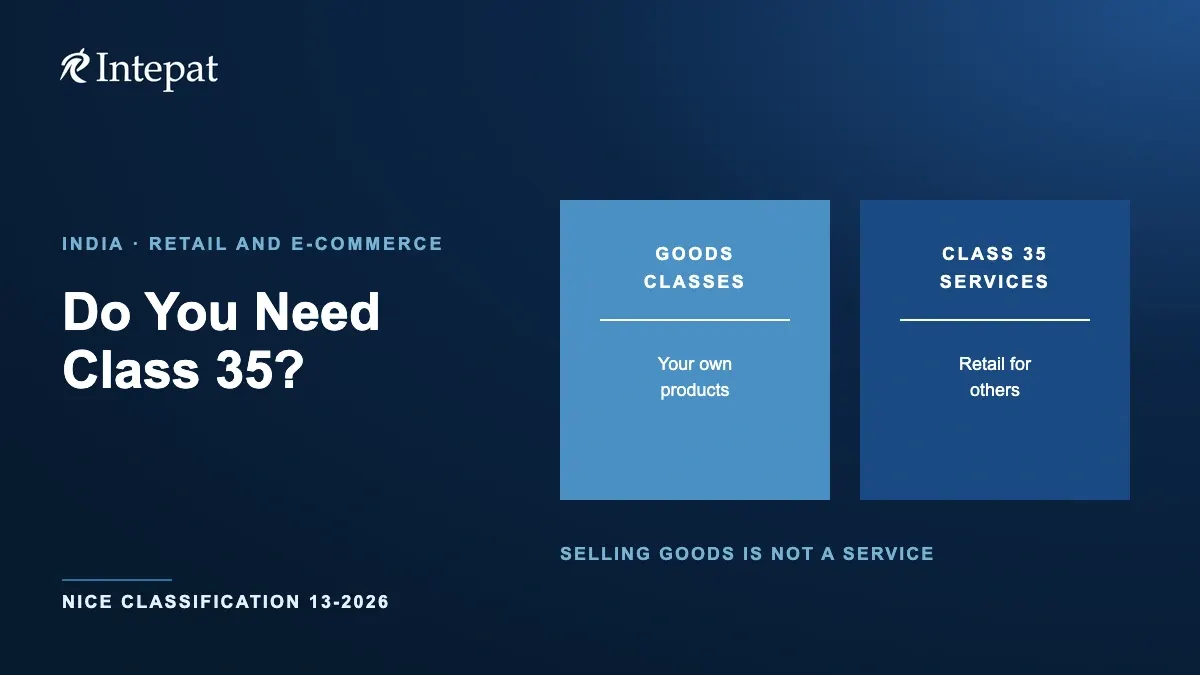
Selling goods is not a service
The Class 35 note says, for the purposes of classification, that the sale of goods is not considered to be a service. A brand that manufactures shoes and sells them, in its own shops or from its own website, is selling goods rather than supplying a service to anyone else, and the mark is protected for the shoes by a registration whose specification names them. What a Class 35 registration protects, where the specification claims it, is the retail service itself: the shop, the chain, the marketplace. The two registrations are not interchangeable, because they cover different goods or services.
Do you actually need Class 35?
It depends on what the mark identifies, not on whether you have a website. For a business selling its own products, the relevant goods classes are usually the starting point. Class 35 is then assessed separately, against the retail or wholesale services actually offered or genuinely planned under the mark. Owning the products does not settle that assessment either way.
| What the business does | Where to start |
|---|---|
| Makes and sells only its own products | The goods classes. Assess Class 35 on the retail service, if any, offered under the mark |
| Runs a store or online shop under the same name | Goods classes first. Add Class 35 only where a retail service is supplied to others or genuinely planned |
| Runs a marketplace or multi-brand retail operation | Class 35 is the core filing, because bringing a variety of goods together, for the benefit of others, so customers can view and buy them is the service the note describes |
| Advertises, recruits, keeps books or runs campaigns for clients | Class 35, though design or training work supplied alongside may fall in Class 42 or Class 41 |
| Makes products and sells them only to distributors | The goods classes. Assess Class 35 separately where the mark identifies wholesale services supplied or genuinely planned |
Any service claimed but not used creates non-use exposure: a claim filed without a genuine intention to use it is exposed from the start, and even a genuinely intended claim is exposed once five years of non-use have run. A registration can be taken off the register in respect of the services registered, on application by a person aggrieved, either because the mark was registered with no bona fide intention to use it for those services and there has in fact been no bona fide use up to three months before the application, or because a continuous period of five years from the date the mark was actually entered in the register has elapsed, up to three months before the application, without bona fide use. Removal is not automatic: the Act lets the Registrar or the High Court refuse it in defined cases, for example where the mark was genuinely used before the relevant date or in the relevant period for services of the same description or associated services, unless the person applying for removal has been, or could properly be, permitted to register an identical or closely resembling mark of their own for those services on the ground of honest concurrent use or other special circumstances, and on the five-year ground, non-use shown to be due to special circumstances in the trade, and not to any intention to abandon the mark or not to use it for those services, does not count against you.
What Class 35 does not cover
The Nice note lists nine exclusions, and a few further services are classified elsewhere by what they actually are. Both kinds are set out below: services often mistaken for Class 35, and where they actually go. Each belongs in its own class, and the fee is charged per class, so several services in one class can share one specification and one fee.
| Service | File in class |
|---|---|
| Financial analysis, financial management, financial sponsorship | 36 |
| Stock brokerage, real estate management | 36 |
| Transportation logistics | 39 |
| Energy auditing, graphic design of promotional materials | 42 |
| Legal services for negotiating contracts, licensing of intellectual property, legal administration of licences, copyright management, domain name registration | 45 |
| Website development and hosting, software as a service | 42 |
| Education, training and entertainment | 41 |
The first five rows are the note’s own exclusions. The last two are not in the note: they follow from the Class 42 and Class 41 entries for those services. Two distinctions trip up technology businesses in particular. Designing the promotional material is Class 42 while placing and running the advertising is Class 35, and licensing intellectual property is Class 45 while the commercial administration of someone else’s licensing programme is Class 35. Note also that producing teleshopping programmes sits inside Class 35, so not every kind of content production belongs in Class 41.
For 2026, the entries for renting office machines and equipment, including rental of office equipment in co-working facilities, were deleted from Class 35 in NCL(13-2026), and three entries were added: recording the transfer of stocks as an office function, cost management of construction projects, and arranging subscriptions to multimedia content for others. The last of those matters to anyone bundling or reselling streaming subscriptions.
Drafting a Class 35 specification
A vague specification is a particular risk in this class, because “business services” could mean almost anything. The Rules require the names of services to correspond, as far as may be, to the classification published by the Registrar, and allow the Registrar to refuse a claim to a whole class or a large variety of services unless satisfied that the breadth is justified by the use the applicant has made or intends to make of the mark.
For retail, name the goods: “retail services relating to clothing” rather than “retail services” on its own. TMclass lists “Retail services for clothing” and “Retail services for foodstuffs” among the wording the Indian office has listed as accepted, and the same pattern works for other goods. For a marketplace, the Nice term “provision of an online marketplace for buyers and sellers of goods and services” is listed for India and describes the service rather than the technology. Influencer marketing and the promotion of goods or services through influencers are also listed. You may claim more than one group in the same Class 35 specification, provided each entry describes services supplied or genuinely intended to be supplied under the mark.
Checking the term against the Registry’s index is a step, not a guarantee. A listed description says nothing about whether the mark itself is registrable, and an absent description does not keep a properly worded service out of an application.
What a Class 35 registration does, and does not do, in a dispute
A registration covers the services the specification names. It does not give a monopoly over the class: the Supreme Court said in Nandhini Deluxe that a proprietor cannot enjoy a monopoly over the entire class of goods, particularly where the mark is not being used on certain goods in that class. That was an opposition case about whether a mark should be registered, not an infringement suit, so it speaks to the breadth of a registration rather than to what counts as infringement. Class numbers do not decide infringement either: infringement turns on the similarity of the marks and of the goods or services and whether confusion or association is likely, and in defined circumstances reaches use on dissimilar goods or services.
Marketplace enforcement shows how specific the question becomes. In Lifestyle Equities v. Amazon Technologies, the Delhi High Court removed the marketplace company from the case by an order of 2 March 2023, reproduced in its judgment of February 2025, once that company had complied with the court’s directions and undertaken to remove listings as and when directed. The February 2025 judgment then ran against a different Amazon entity, as owner of a word mark it had licensed to the seller, the single judge holding that infringement by the licensee fixed liability on the licensor.
That reasoning was questioned on appeal at the interim stage. In July 2025 a Division Bench stayed the judgment so far as it awarded damages and costs, saying it was prima facie unaware of any law supporting the licensor findings, and recording that its own observations were prima facie only and not binding at the hearing of the appeal. The Supreme Court declined to disturb that order, dismissing the petition against it on 24 September 2025 and giving its reasons in a judgment of 7 October 2025, while leaving the main appeal to be decided on its merits. An interim stay is not a final reversal, and as matters stood at that judgment the appeal had still to be heard.
The infringement found concerned apparel, not a retail service, but the case shows that the question of who answers for an infringing listing turns on each party’s actual role: platform, seller, brand owner or licensor. It is not authority that a marketplace is liable for what its sellers list.
Trademark Class 35 India: government filing fees and what the register shows
The government fee is per class and per mark: Rs 4,500 for an individual, a startup or a small enterprise filing online, Rs 9,000 for every other applicant, and Rs 5,000 and Rs 10,000 for the same filings on paper (verified as of November 2026). The lower rate depends on the applicant being an individual, a startup or a small enterprise, and a startup or small enterprise has to establish that status with the application; otherwise the fee is the higher one. These are government fees, and professional fees and other chargeable work are separate. A brand that wants both its goods class and Class 35 pays the fee twice, and one application can carry both.
Class 35 carries the highest filing volume of the five classes in this series, which are 25, 35, 9, 42 and 30. Intepat IP’s analysis of Trade Marks Registry records, which is our own analysis and not a statistic published by the Registry, shows 464,608 Class 35 applications filed between November 2016 and 20 October 2026, including 70,116 in 2025 against 54,291 in 2024, and 72,246 more between January and 20 October 2026.
Of everything filed in the class over that period, 46% stood registered or had protection granted on 20 October 2026, and 13% had ended, grouping abandoned, refused, withdrawn and otherwise terminated applications together. About 12% were under objection and about 3% in opposition, and the remaining quarter were awaiting examination, under examination, advertised or at codification. Those shares are a cross-section taken on 20 October 2026, not a success rate. The 2025 filings on their own show why: of the 70,116 applications filed that year, about half were still under examination on that date and only 1.4% had reached registration.
Before you file in Class 35
Decide first whether the mark identifies a service you supply to others or only the goods you sell. If it is only the goods, file the goods classes, and add Class 35 when you supply, or genuinely plan to supply, a retail or other Class 35 service under the mark.
If Class 35 belongs in the filing, write the specification around what the business does or genuinely plans to do under the mark, and leave out the groups of services that belong to other classes. Run a trademark search across Class 35, your goods classes and related classes before paying for any of them. Earlier identical or similar marks for similar goods or services may lead to an objection or a refusal where confusion is likely, and the owner of a mark well known in India can oppose an identical or similar mark even for unrelated services, where your use without due cause would take unfair advantage of, or harm, the earlier mark’s distinctive character or repute. Our trademark classification tool helps identify the relevant classes and service descriptions; a trademark clearance search is the separate step that checks earlier marks. Filing several classes in one application keeps the paperwork together, though the fee stays per class.
FAQ
Not for the products themselves. Selling your own goods is not a service for classification purposes, so the goods are protected by a registration in the goods classes that names them. Class 35 is worth adding where you supply, or genuinely plan to supply, a retail or marketplace service to others under the mark.
Class 35. Bringing a variety of goods together, for the benefit of others and excluding their transport, so that customers can conveniently view and buy them, including through a website, is the retail service the Class 35 note describes, and “provision of an online marketplace for buyers and sellers of goods and services” is listed for India. Building or hosting the platform itself is a Class 42 service.
No. Graphic design of promotional materials is excluded from Class 35 and sits in Class 42. Website development and hosting and software as a service are also Class 42 services. Developing advertising concepts and running the advertising stay in Class 35, so an agency that also designs promotional material should consider both classes.
It is safer to name the goods, such as “retail services relating to clothing”. The Rules ask for service names that correspond, as far as may be, to the published classification, and the Registrar may refuse to accept an application claiming a whole class or a large variety of services unless the breadth is justified by use made or intended.
Not automatically. A registration covers the services its specification names, and class numbers do not decide infringement. The question turns on the similarity of the marks and of the goods or services and whether confusion or association is likely, and in defined circumstances use on dissimilar goods or services can infringe. A goods-class registration is the direct protection for the products.
The fee is charged per class and per mark: Rs 4,500 online for an individual, a startup or a small enterprise, with proof of startup or small-enterprise status filed with the application, and Rs 9,000 online for every other applicant, or Rs 5,000 and Rs 10,000 on paper. A goods class and Class 35 in one application means paying the fee for each class.
This article explains how retail, e-commerce and business services are classified for trademark registration in India as at November 2026 and is for general information only. It is not legal advice. Class headings, government fees and Registry practice change; confirm the current Nice edition and fee schedule before you file. For advice on the classes that fit your business, consult a trademark attorney.
Sources
- The Trade Marks Act, 1999 (Act 47 of 1999), India Code consolidation as on 1 June 2026: https://www.indiacode.nic.in/bitstream/123456789/1993/1/a199947.pdf
- The Trade Marks Rules, 2017 (G.S.R. 199(E)), with the First Schedule fees as shown on IP India’s forms and official fees page (as at November 2026): https://ipindia.gov.in/pages/trade-marks/learn/forms-and-official-fees
- WIPO, Nice Classification, 13th edition, version 2026 (NCL(13-2026)), Class 35 heading, explanatory note and list: https://nclpub.wipo.int/enfr/?class_number=35&explanatory_notes=show&lang=en&menulang=en¬ion=class_headings&version=20260101
- Lifestyle Equities C.V. and Another v. Amazon Technologies Inc., Supreme Court of India, SLP (C) No. 19767/2025, order of 24 September 2025 (reasons in 2025 INSC 1190, 7 October 2025): https://api.sci.gov.in/supremecourt/2025/38535/38535_2025_8_20_64594_Order_24-Sep-2025.pdf
- EUIPO, TMclass, office database “India (CGPDTM)”, read 20 October 2026: https://euipo.europa.eu/ec2/