




How to trademark a name in India: file it with the Trade Marks Registry, usually as a plain word mark, in the classes (categories of goods and services) you trade in. The name must tell your goods or services apart from others’ and should not conflict with an earlier mark for similar goods or services. Company registration does not do this for you.
This guide covers brand names, business names and personal names under the Trade Marks Act, 1999 and the Trade Marks Rules, 2017, with fees verified as of November 2026. The Trade Marks Registry is part of IP India and is separate from the Patent Office. The guide is written for founders, small business owners and individuals choosing and protecting a name.
| Quick answer: Pick a name that does not describe what you sell, search for earlier marks, choose your classes, and file the name as a word mark on Form TM-A. Expect objections for descriptive names and, under the Registry’s draft examination manual, for common names or surnames used alone. If the mark falsely suggests a connection with a living person, or someone who died within twenty years before you file, the Registrar may ask for written consent. |
Can you trademark a name in India?
Yes. The Trade Marks Act lists a name among the things that count as a mark, and “name” includes an abbreviation of a name. To register, the name must be capable of distinguishing your goods or services from those of others. A name that fails that test is refused, whoever owns it.
The test is about the goods or services, not about the name in the abstract. A word that says nothing about a product can work as a trademark for it, while the same word may be refused for goods it describes. That is why the class and the list of goods or services you file matter as much as the name itself.
Registration is what gives you the statutory right to sue for infringement. Subject to the Act’s other provisions, a valid registration gives the owner “the exclusive right to the use of the trade mark in relation to the goods or services in respect of which the trade mark is registered”. Without registration you cannot sue for infringement, although a claim for passing off (where another trader presents its goods or services as yours) remains open.
Which names register easily, and which run into objections
Invented names and words unrelated to the product usually pass examination most easily. Names made up only of words that describe the goods or services are refused unless they had become distinctive through use before filing. Under the Registry’s draft examination manual, common names and surnames used alone are treated as prima facie (at first sight) not distinctive.
The Act refuses marks “devoid of any distinctive character”, marks that consist only of indications that may serve in trade to describe the kind, quality, quantity, intended purpose, value, geographical origin, time of production or other characteristics of the goods or services, and marks that have become customary in everyday language or in established trade practice. An exception saves a mark that “has acquired a distinctive character as a result of the use made of it” before the filing date, or that is a well-known trade mark (one known to a substantial part of the relevant buying public). Deceptive marks, and names whose use is barred by the law on official emblems and names, such as names suggesting government backing, are refused too.
| Type of name | Example (illustrative) | Likely position at examination |
|---|---|---|
| Invented word | ZORVEX for skincare | Usually the easiest to register, subject to earlier marks |
| Ordinary word unrelated to the product | MONSOON for accounting software | Usually registrable, subject to earlier marks |
| Name that describes the product | FRESH BAKES for a bakery | Likely refused unless it had become distinctive through use before filing |
| Common first name or common surname used alone | A common surname for clothing | Prima facie objection under the draft manual, unless distinctiveness through earlier use is shown |
| Name of a living person who is not you | A sports star’s name on shoes | If the mark falsely suggests a link with that person, the Registrar may require their written consent |
The draft Manual of Trade Marks Practice and Procedure (revised draft, August 2026) says marks “consisting of a common name or surname, or the name of a particular section of citizens of India, are prima facie regarded as not capable of distinguishing goods/services”. It gives the reason as the Act’s protection for honest use of a person’s own name. The draft also says names of gods and goddesses that are also used as personal names may be treated as personal names, unless shown with an image of the deity. It is not law, but it shows how the Registry proposes that examiners approach these names; see our guide to distinctive and descriptive marks.
Your own name, or someone else’s
You can register your own name, though a common name or surname used alone faces the objection above. If a mark falsely suggests a link with another living person, or someone who died within twenty years before filing, the Registrar may ask for written consent. Registration does not stop others trading honestly under their own names.
The Act covers a mark that “falsely suggests a connection with any living person, or a person whose death took place within twenty years” before the filing date. In those cases the Registrar may require written consent from the person, or from the legal representative of the person who has died, and may refuse to proceed without it.
The Rules already let the Registrar ask for written consent whenever the name or representation of a living person, or of someone who died within twenty years before the application, appears on a mark. The revised draft manual would make this a routine check: it tells examiners to ensure consent is filed whenever a mark contains the name, signature or likeness of an identifiable person, including an AI-generated likeness. That would include a company filing its founder’s name, so have the founder sign a consent for the company. Until the manual is final, treat this as a sign of where examination practice may move, and get any consent signed before you file.
The protection for your own name has limits. The Act preserves “any bona fide use by a person of his own name or that of his place of business”, which protects honest trading under a real name. It does not give you a registration, and a dishonest use of your own name to ride on another brand is not protected.
Company registration does not protect your name
Registering a company or limited liability partnership (LLP) name with the Ministry of Corporate Affairs (MCA) does not register a trademark. MCA’s advisory tells applicants to check proposed names against registered trademarks in the matching class, and using another’s registered mark as your business name can infringe it. File the name as a trademark early.
The statutory exclusive right comes from registration by the Registrar of Trade Marks, for the goods or services listed. Company, GST and Udyam registrations serve company-law, tax and MSME purposes; none of them is a trademark registration. For a fuller comparison, see our page on trade name versus trademark.
MCA’s advisory on name reservation (booklet of 12 March 2026) tells applicants to compare the words in a proposed company name with registered trademarks and to match the business activity code to the trademark class. It warns that a name similar to a registered trademark in the same type of business “may be rejected”. In its example, the applicant is told to obtain a no-objection certificate from the owner of the registered word mark in the matching class. A separate paragraph requires any such certificate to carry the digital signature of the trademark holder, applicant or authorised signatory (where a company issues it, its authorised signatory signs on the company’s letterhead) and to state the class and application number.
Even after incorporation, the risk continues. Under the Trade Marks Act, a person infringes a registered trademark by using it “as his trade name or part of his trade name, or name of his business concern” for goods or services covered by the registration. Search the trademark register before you reserve a company name, and file the trademark before or alongside incorporation.
If you have already been trading under the name, the position is stronger than a register search suggests. A registered owner cannot stop someone who, personally or through a predecessor in title (an earlier owner of the business or mark), has continuously used an identical or nearly resembling mark for those goods or services from a date before the earlier of two dates: the registered owner’s (or its predecessor’s) first use, and the registration. That defence has to be proved in a dispute; registering early avoids having to rely on it. On the application, claim the date you first used the name; a claim of earlier use needs an affidavit with supporting documents such as invoices.
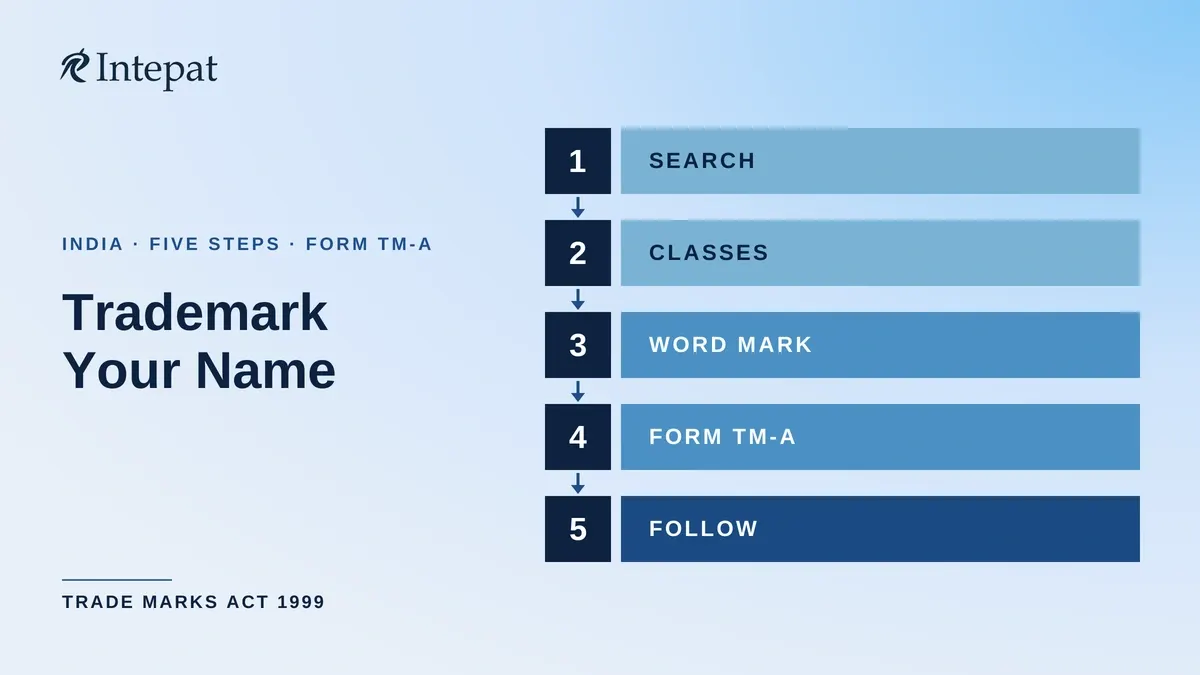
How to trademark a name in India: five steps
Search for earlier marks, choose your classes, decide what to file (usually the plain word first, if it is distinctive and clear of earlier marks), file Form TM-A with the fee for each class and each mark, and follow the application through examination and opposition. A registered mark dates from the filing date and lasts ten years, renewable.
- Search. The Registry’s public search asks you to sign in with a one-time password sent to your email or mobile (in current portal practice); our guide to the trademark public search walks through it. Search the market and the web too, because businesses using a name without registering it do not appear on the register.
- Choose your classes. The Registry groups goods and services into 45 classes; see our class list. If you also run a store or online shop that brings goods together for customers, check Class 35 for that retail service; it does not replace the class for the goods themselves. A different class number alone does not avoid a conflict: the usual test is whether the marks and the goods or services are similar enough to cause confusion, and a mark with a reputation can reach further. List the goods or services you actually sell or plan to, because a claim to everything in a class can be refused.
- Decide what to file. Filing the name in plain letters as a word mark protects the word itself; a logo is a separate mark with its own fee. Our comparison of word marks and logos explains the choice.
- File Form TM-A online on IP India’s e-filing portal, yourself or through a trademark agent or attorney. One application can cover several classes, with a fee for each class; our guide to filing on Form TM-A covers the form.
- Follow the application. The Registry examines it and may object, then advertises it so others can oppose; the registration process sets out each stage.
File in the name of whoever will own the brand. Under the draft manual, a sole trader files in their own full name, with the shop name added as a trading style (as an individual, a sole trader pays the lower fee under the Rules); a company files in its own name, and a director cannot be the applicant for it; a partnership names every partner. A founder can file before the company exists if the application states the intention to assign the mark to the company being formed; the company must then be recorded as owner within six months of the registration being advertised, or within a further period of up to six months allowed on Form TM-P, or the registration stops having effect. Our guide to trademark ownership covers that choice.
The lower filing fee applies to an individual, a startup recognised under the Startup India initiative (foreign entities have their own test), or a small enterprise, meaning one whose investment in plant and machinery (or equipment, for services) is within the limit set for a medium enterprise under India’s MSME law, as the Rules define it. Many medium-sized businesses therefore qualify, including companies. File the certificate of startup or small-enterprise status with the application; the draft manual mentions a Udyam registration number.
| Step (per class, per mark unless stated) | E-filing fee (Rs) | Physical filing fee (Rs) |
|---|---|---|
| Application: individual, recognised startup or small enterprise | 4,500 | 5,000 |
| Application: all other applicants | 9,000 | 10,000 |
| Preliminary advice on distinctiveness, before filing (per request) | 1,800 | 2,000 |
| Expedited processing, on top of the application fee: individual, startup or small enterprise | 20,000 | Not available |
| Expedited processing, on top of the application fee: all other applicants | 40,000 | Not available |
| Counter-statement to an opposition | 2,700 | 3,000 |
| Renewal, every applicant | 9,000 | 10,000 |
| Late renewal within six months of expiry (surcharge, plus the renewal fee) | 4,500 | 5,000 |
| Restoration of a removed registration, applied for within one year of expiry (plus the renewal fee) | 9,000 | 10,000 |
These are government fees on the IP India forms and fees page, verified as of November 2026; professional fees are separate, and our fees guide covers the other stages. Preliminary advice suits a surname or common name: if the advice is favourable and you file within three months, but the Registrar then objects that the mark is not distinctive, you can withdraw by written notice within one month of receiving the objection and have the filing fee repaid.
After filing, watch the deadlines. If the examiner objects, reply within one month of receiving the examination report and, as a precaution, ask in the same reply to be heard; an unanswered report may lead to the application being treated as abandoned. Once the application is advertised, anyone may oppose within four months, and if someone does, you must file a counter-statement within two months of receiving the notice, or the application is deemed abandoned. The Act tells the Registrar to register an accepted application, once the opposition period has run without opposition or any opposition has failed, within eighteen months of filing, unless the Central Government directs otherwise.
A registered mark is treated as registered from the filing date (or from a priority date claimed) and lasts ten years. Renewal can be filed up to one year before expiry and costs the same for every applicant. Within six months after expiry you can still renew with a surcharge; after that, the Registrar may restore the mark if an application is made within one year of expiry and it is just to do so. A registered name not genuinely used for five continuous years after it was entered on the register (counted up to three months before the challenge) can be removed, for the unused goods or services, on the application of a person aggrieved.
| Protect Your Brand Name |
| Our trademark team checks and files your name. |
| File Your Name |
FAQ
Yes, if it can distinguish your goods or services. A common name or surname used alone faces a prima facie objection under the Registry’s draft manual, unless it had already become distinctive through use before you filed. Adding a distinctive word or logo helps. Registration will not stop others trading honestly under their own names.
Yes. Claim your date of first use on the application, backed by an affidavit and invoices. If you (or a predecessor) used the name continuously from before the other party (or its predecessor) first used or registered it, whichever is earlier, once proved, their registration cannot stop it or, by itself, block your application. It can also help answer a distinctiveness objection. It does not replace registration.
Yes, in some cases. A registration gives exclusive rights for the goods or services it covers, so the same name can coexist on unrelated products where confusion is unlikely. A mark with a reputation in India can also be protected on unrelated goods where the use, without due cause, takes unfair advantage of or harms its reputation or distinctiveness.
No. Those registrations serve company-law, tax or MSME purposes, and none of them is a trademark registration. The exclusive right to a brand name comes from registering it as a trademark with the Trade Marks Registry. Without that registration you cannot sue for infringement, and against a copier you would have to rely on a passing off claim instead.
Yes, if you genuinely intend to use it: the Act allows an application for a mark “used or proposed to be used” by the applicant. A person aggrieved can apply to remove it for goods or services not genuinely used for five continuous years after registration, or sooner if it was registered with no genuine intention to use it and has not been used.
No. Use TM at any stage, and ® only after registration, for the registered goods or services. Falsely claiming registration risks a penalty of one half per cent of sales, turnover or professional receipts in audited accounts, or Rs 5 lakh if less, appealable within sixty days of receiving it. Ignoring the order for ninety days can add a Rs 1 lakh fine, up to a year in prison, or both.
This article explains the law on registering a name as a trademark in India as at November 2026 and is for general information only. It is not legal advice. Government fees, forms, and procedures change; confirm current figures with the Trade Marks Registry before you file. For advice on your specific mark, consult a trademark attorney.
Sources
- Trade Marks Act, 1999 (consolidation as on 1 June 2026), India Code: https://www.indiacode.nic.in/bitstream/123456789/1993/1/a199947.pdf
- Trade Marks Rules, 2017, First Schedule, IP India forms and official fees page (as at November 2026): https://ipindia.gov.in/pages/trade-marks/learn/forms-and-official-fees
- Ministry of Corporate Affairs, Advisory for Stakeholders for Name Reservation and Incorporation of Company and LLP (booklet of 12 March 2026): https://www.mca.gov.in/bin/dms/getdocument?mds=Yyau8%252FQveEEgOSo722nczw%253D%253D&type=open
- Office of the Controller General of Patents, Designs and Trade Marks, A draft of Manual of Trade Marks Practice and Procedure (revised draft, August 2026): https://ipindia.gov.in/storage/uploads/others/ZAyEj620WLCcGtFi4vdUIxKpI4vVJvUnbPwGcZOQ.pdf