




A conflicting trademark application in India can be opposed only within 4 months from the date of Trade Marks Journal publication. After this statutory window closes, the mark can proceed toward registration even if it conflicts with your brand. Because the Trade Marks Registry does not issue automatic alerts to brand owners, Trademark Watch in India is the only reliable way to detect and challenge conflicting applications before the opposition deadline expires.
India receives over 500,000 trademark applications every year, making it one of the highest-volume trademark jurisdictions globally. Not every application is filed with legitimate intent. Some target adjacent classes; others attempt to register foreign brands that have not yet been filed in India.
Without a structured trademark watch service in India, these filings typically remain unnoticed until the opposition window has closed.
For startup founders building a brand, in-house legal teams managing portfolios, and foreign companies entering the Indian market, Trademark Watch is the mechanism that converts a hidden risk into a manageable compliance process..
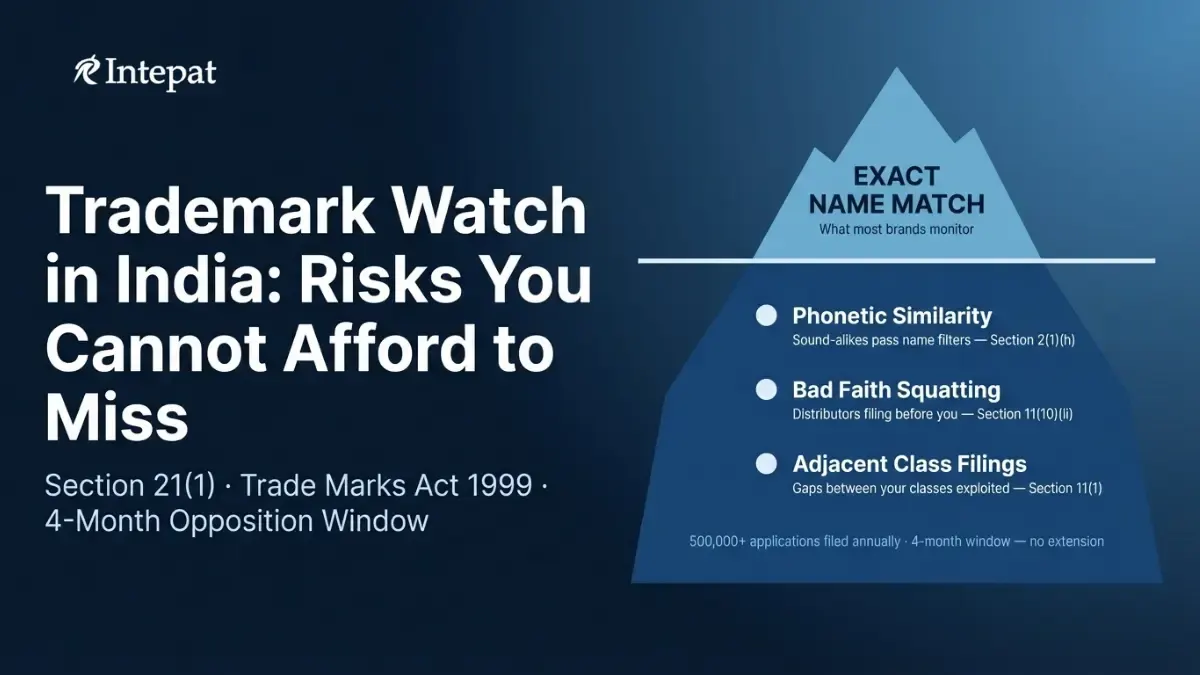
What Is Trademark Watch in India and Why It Matters
| ⚠ Deadline Reminder |
| The opposition deadline runs from the publication date in the Trade Marks Journal, not from the date you receive a trademark watch India alert. A delay in acting on an alert directly reduces the time available to assess, instruct counsel, and file Form TM-O. |
| Trademark Watch in India — Definition |
| Trademark watch is the systematic monitoring of the Indian Trade Marks Journal and related digital platforms to detect newly filed trademarks that may conflict with an existing brand before the four-month opposition deadline expires under Section 21(1) of the Trade Marks Act, 1999. |
Most trademark enforcement failures in India share the same root cause: the brand owner ran trademark monitoring India limited to exact copies of their mark. A competitor files under a name that sounds identical but looks different. A squatter registers the brand in an adjacent class. A domain is grabbed in parallel with a trademark application. None of these surface in an identical-name search, and by the time the damage is visible, the four-month trademark opposition India window has long since closed.
Trademark watch India is the systematic monitoring of trademark filings and publications to identify marks that may conflict with your own before that window closes. A trademark watch service India focuses primarily on the Indian Trade Marks Journal, published every Monday by the Office of the Controller General of Patents, Designs and Trade Marks (CGPDTM) at ipindia.gov.in. Every trademark application that passes examination is published in the Journal before registration, giving third parties a fixed opportunity to oppose. Without trademark monitoring India, that opportunity is invisible to the legitimate brand owner.
A complete trademark watch service India covers three scopes: identical filings, phonetically similar marks, and adjacent-class applications where a conflicting mark could cause consumer confusion or dilute your brand.
Trademark watch before filing India is as important as trademark watch after registration India. If a third party files a confusingly similar mark before you do, the examiner may cite it as a conflicting earlier mark during examination of your application under Section 11, or the third party may use their pending application to oppose yours once it is published in the Journal. Either outcome delays or defeats your registration. In practice, trademark monitoring India is most effective when it runs continuously across both phases. The Indian Trade Marks Journal can be accessed at Trademarks Journal website.
For a full overview of the Indian trademark registration process that trademark watch supports, see: trademark registration process India.
The Four-Month Opposition Window: India’s Hardest Deadline
Under Section 21(1) of the Trade Marks Act, 1999, any person may file a trademark opposition India within four months from the date of publication in the Indian Trade Marks Journal. This is the governing deadline for trademark opposition India, and it is absolute.
The Trade Marks Rules, 2017 (effective 6 March 2017) removed the Registrar’s earlier discretionary power to grant a one-month extension to this period. A notice of opposition filed on day 121 will not be accepted, regardless of the reason for the delay. There is no discretion and no remedy for a missed filing.
Opposition is initiated by filing Form TM-O with the Trade Marks Registry, together with the prescribed fee, within this four-month window. The notice must state the grounds for opposition and identify the earlier mark or right on which the claim is based. Once filed, the applicant has two months to file a counter-statement. If no counter-statement is filed, the application is deemed abandoned.
Because the deadline runs from the publication date, not from when you become aware of the application, Trade Marks Journal monitoring India is the only reliable protection. A mark published on a Monday may be registered by the corresponding Monday four months later if no opposition is filed. The trademark watch function in India exists precisely to close this information gap. The full text of the Trade Marks Act, 1999 is available at India Code for reference.
| Deadline Reference: Trademark Opposition in India |
| Statutory basis: Section 21(1), Trade Marks Act, 1999; Trade Marks Rules, 2017 (effective 6 March 2017) |
| Opposition period: 4 months from date of publication in the Trade Marks Journal |
| Extension: Not available. The period cannot be extended under any circumstances. |
| Form: TM-O (Notice of Opposition), filed with the relevant Trade Marks Registry office |
| Counter-statement by applicant: 2 months from receipt of notice (no extension) |
| Journal published: Every Monday at ipindia.gov.in |
For detailed guidance on the trademark opposition India procedure and evidence stages, see: trademark opposition procedure in India .
Risk 1: Why Trademark Watch Must Cover Phonetic Similarity
A startup registers a brand name pronounced ‘Novatek’ in Class 9. A competitor files ‘Nevatek’ in the same class. Spoken aloud, the distinction nearly disappears. The startup’s trademark monitoring India covers only identical names. The application completes its four-month window uncontested and proceeds to registration. The startup now faces a registered mark it cannot challenge without cancellation proceedings under Section 57.
This scenario is governed by Section 2(1)(h) of the Trade Marks Act, 1999, which defines a mark as deceptively similar if it so nearly resembles another mark as to be likely to deceive or cause confusion. Section 11(1) of the Trade Marks Act, 1999 uses this as a relative ground for refusing registration: if a proposed mark is identical or similar to an earlier mark for identical or similar goods or services and there is a likelihood of confusion, registration must be refused. Phonetic similarity trademark India cases consistently apply this provision.
Indian courts do not apply this test by placing two marks side by side and counting differences. The Supreme Court established the governing standard in Amritdhara Pharmacy v. Satya Deo Gupta (AIR 1963 SC 449), holding that AMRITDHARA and LAKSHMANDHARA were deceptively similar because consumers were likely to focus on the shared element DHARA. The Court held that similarity must be assessed from the perspective of an average consumer who may not remember a mark perfectly, rather than through a side-by-side technical comparison. This standard was consistently applied in Parle Products (P) Ltd. v. J.P. & Co., Mysore (1972) and remains the governing test today. The question is whether, on encountering the later mark after some time has elapsed, an average consumer would pause and wonder whether the marks are the same or connected.
Phonetic similarity alone is sufficient. Indian courts have held that any one of phonetic, visual, or conceptual similarity is sufficient to establish a likelihood of confusion. A trademark watch service India that filters only for visual matches will miss the entire category of sound-alike filings, which in practice represent a substantial share of bad faith trademark India applications in technology, FMCG, and pharmaceutical classes.
Conceptual similarity adds a further dimension in India’s multilingual market. In cases involving SURYA and BHASKAR (both meaning ‘sun’ in different languages) and PEACOCK and MAYUR (peacock in Hindi), courts found deceptive similarity despite no visual or phonetic overlap. A fintech brand named ‘Aakash’ (sky in Hindi) and a competitor filing ‘Sky’ in the same class faces the same risk. Transliteration and cross-language equivalence are live trademark watch India considerations.
For how Indian courts evaluate phonetic, visual, and conceptual similarity in practice, see: deceptively similar trademarks examples . Where a conflict crosses into active use, see: trademark infringement in India.
Risk 2: Bad Faith Filings and Trademark Squatting India
The second category of risk is bad faith trademark India registration, commonly known as trademark squatting India. The mechanism is the same in every case: a third party files a trademark application it has no genuine right to, before the legitimate owner can act. For startups, the risk is an opportunist filing ahead of a brand that has not yet registered. For foreign brands, the risk is a distributor or importer registering the mark in their own name before the legitimate owner files in India.
Trademark Watch for Startups India: The Growth Phase Risk
For startups, the exposure is highest during the growth phase before trademark registration has been prioritised. A brand that gains visibility through social media, product launches, or press coverage is a visible target. A competitor or opportunist who files a phonetically similar mark during this window does not need to prove any connection to the original brand. They simply need to reach the Registry first.
A fintech startup builds a user base over 18 months and gains press coverage without filing a trademark application. A third party registers an almost identical domain name and files in Class 36 (financial services). By the time the startup files, both the domain and the class are held by someone with no connection to the brand. Recovering either requires separate proceedings. A trademark watch service India running from the point of any public brand profile would have flagged the application within days of Journal publication.
Trademark Watch for Foreign Brands India: The Distributor Squatting Risk
For foreign brands, the most common trademark squatting India pattern involves importers or former distributors. A company begins selling its products in India through a distribution arrangement. Before it files for trademark registration in India, the distributor registers the mark in its own name, citing proposed use or prior use through the import activity. When the legitimate owner tries to register, it finds its own mark is already on the Indian register in a third party’s name.
In BPI Sports LLC v. Saurabh Gulati (Delhi High Court, 2023), a US supplements company had used BPI SPORTS since 2009. Before BPI filed in India, a distributor registered the mark in his own name. The court found this was trademark squatting India under Section 11(10)(ii) and ordered the registration removed. The same pattern was confirmed in Goodai Global Inc. v. Shahnawaz Siddiqu (Delhi High Court, January 2025), involving a Korean beauty brand squatted before its India launch.
Trademark squatting India is addressed through Section 11(10)(ii) of the Trade Marks Act, 1999, which requires the Registrar to take bad faith into account when considering both trademark applications and opposition proceedings. This provision applies at the examination stage and on opposition, making it the primary statutory ground for challenging a squatting registration before it is granted. The Delhi High Court confirmed in BPI Sports that squatting constitutes bad faith trademark India under this provision, and that a registration obtained through squatting is liable to removal on a rectification petition under Section 57.
The BPI Sports case illustrates a key limitation for foreign brands. Under Toyota Jidosha Kabushiki Kaisha v. Prius Auto Industries Ltd., (2018) 2 SCC 1, Indian courts require a foreign brand to demonstrate Indian goodwill to succeed on passing off under Section 11(3). BPI Sports could not, so relief came through Section 11(10)(ii) alone. For foreign brands without Indian commercial activity, this makes trademark watch for foreign brands India and direct registration before any distributor arrangement the primary available protection.
In practice, trademark watch India that identifies a bad faith trademark India application before the opposition window closes allows the legitimate owner to oppose under Section 21 and prevent registration entirely. Post-registration cancellation under Section 57, while available, is slower, more expensive, and carries a higher evidentiary burden.
Who Needs Trademark Watch India and When to Start
The table below identifies the specific risk each profile faces and the trigger that makes trademark monitoring India most urgent.
| Profile | Specific Risk to Watch For | Urgency | Start Point |
| Startup (mark filed or registered) | Phonetic variants filed by competitors; parallel domain registrations by opportunists | High | At the time of your own filing — trademark watch after registration India alone is too late |
| Startup (mark not yet filed) | Opportunistic filings by competitors who have spotted your brand’s public visibility | Critical | Trademark watch before filing India — a conflicting application filed ahead of yours directly obstructs your own registration |
| SME with multiple classes | Adjacent-class filings exploiting gaps between your registered classes | High | Immediately; audit which adjacent classes your commercial activity covers and extend trademark monitoring India to cover them |
| Indian in-house counsel (portfolio) | Phonetic transliterations; regional language variants; cross-class conflicts | High | Continuous trademark monitoring India across all live marks; scope reviewed annually as the portfolio evolves |
| Foreign brand entering India via distributor | Distributor or importer trademark squatting India before direct registration | Critical | Before appointing a distributor — trademark watch for foreign brands India must run in parallel with any distribution arrangement, not after |
| Foreign brand with no India presence | Pre-emptive blocking filings; no trans-border reputation to rely on for passing off under Prius doctrine | Critical | As soon as the brand has any public profile — trademark watch service India should begin before formal market entry |
What a Trademark Watch Service India Should Cover
A trademark watch service India calibrated for this market needs to go beyond scanning the Trade Marks Journal for exact name matches. The following elements address phonetic similarity, bad faith filings, and digital threats in turn.
Trade Marks Journal Monitoring India
The Indian Trade Marks Journal is published every Monday. Trade Marks Journal monitoring India should be reviewed promptly each week: the four-month trademark opposition India window runs from the publication date, not the alert date. In practice, trademark watch service India providers typically return a conflict report within 5 to 7 working days of each Monday publication.
Phonetic Variant Coverage
Trademark monitoring queries in India must capture marks that sound like your brand, not only marks that look like it. In practice, phonetic similarity trademark India filings are common in pharmaceutical, technology, and FMCG sectors.
Multi-Class Monitoring
Registration is class-specific in India, but the deceptive similarity analysis is not. A competing mark in Class 29 can ground a conflict with a registered mark in Class 30 if the goods overlap commercially. In practice, trademark watch in India for a portfolio brand typically extends to three to five adjacent classes beyond each core registration, depending on the brand’s commercial reach.
Domain Name and Digital Monitoring
A trademark squatting India actor will often register a domain name and a trademark application in parallel, as the fintech scenario above illustrates. Trademark monitoring India should include domain registrations that incorporate your mark or phonetic variants. This provides earlier warning of a coordinated bad faith trademark India strategy and generates evidence of the registrant’s intent, which strengthens a subsequent Section 11(10)(ii) or Section 57 claim.
Marketplace and Social Media
Unauthorised use of your mark on Amazon India, Flipkart, or Meesho may precede a formal filing. Detecting marketplace infringement early generates evidence of the infringer’s commercial activity, which is relevant to any subsequent trademark opposition India or cancellation action.
What to Do When Your Trademark Watch in India Finds a Conflict
When a trademark watch India alert identifies a potentially conflicting application, the following steps should be taken promptly given the non-extendable four-month trademark opposition India deadline.
| Five-Step Response to a Trademark Watch India Alert |
| Step 1: Confirm the publication date and calculate the opposition deadline |
| Step 2: Assess the conflict — instruct your attorney here, not at Step 4 |
| Step 3: Preserve evidence of prior use if bad faith is suspected |
| Step 4: File Form TM-O before the four-month deadline |
| Step 5: Proceed through counter-statement, evidence, and hearing stages |
- Confirm the publication date and calculate the trademark opposition India deadline. The four months run from publication, not from when the trademark watch India alert was received.
- Assess the conflict on visual, phonetic, and conceptual grounds. If you are a startup or SME without in-house legal capability, instruct your trademark attorney at this step, not at Step 4.
- If bad faith trademark India is suspected, preserve evidence of your prior use, registration history, and any commercial relationship with the applicant. This is essential for a Section 11(10)(ii) or Section 57 claim.
- File Form TM-O before the four-month deadline. The notice must state the grounds and identify the earlier mark or right on which the claim is based.
- The trademark opposition India then proceeds through counter-statement, evidence, and hearing stages before the Registry. A successful opposition results in refusal of the application.
If the four-month window has already expired, trademark opposition India is no longer available. The remaining route is a rectification petition under Section 57 of the Trade Marks Act, 1999, which allows the High Court to order removal of a registered mark where registration was obtained in bad faith, by fraud, or contrary to the Act. Following the abolition of the Intellectual Property Appellate Board by the Tribunals Reforms Act, 2021, rectification petitions under Section 57 are now filed before the High Court (original side) or the Registrar depending on the procedural stage. This route remains available after registration but is more expensive, slower, and carries a higher evidentiary burden than a timely trademark opposition India.
For step-by-step guidance on filing Form TM-O, see: how to file trademark opposition India. To check the status of a published application in the Trade Marks Journal, see: trademark application status India.
Conclusion
Trademark watch in India is not a compliance checkbox. It is the mechanism that makes the four-month trademark opposition India window usable. Without Trade Marks Journal monitoring India, the window closes silently while a conflicting mark moves toward registration.
The scenarios in this article are not edge cases. A startup’s brand squatted during its growth phase, a portfolio brand infringed across adjacent classes, a foreign company blocked by its own distributor: each one arises regularly in Indian practice. Each one was preventable at the trademark watch India stage. None was preventable after the trademark opposition India window closed.
Start your trademark watch service India at the point your brand has any public profile. Register your mark before appointing any distributor or reseller. Extend your trademark monitoring India scope beyond identical matches to cover phonetic similarity trademark India variants and adjacent classes. If a conflicting application appears in the Trade Marks Journal, instruct counsel immediately. The four-month trademark opposition India window does not wait. In an opposition-based trademark system like India, the absence of trademark watch effectively means surrendering that right entirely.
Legal Disclaimer
This post is for informational purposes only and does not constitute legal advice. For advice specific to your situation, consult a registered trademark agent or attorney.
Protect Your Brand in India
If a conflicting trademark appears in the Trade Marks Journal next week, would your brand know before the opposition window closes? Our trademark watch service alerts you to conflicting filings before the four-month opposition deadline. We respond within 24 hours.
All consultations remain 100% confidential.
Frequently Asked Questions
Under Section 21(1) of the Trade Marks Act, 1999, any person may file a trademark opposition India within four months from the date of publication in the Indian Trade Marks Journal. This period is fixed and cannot be extended. Form TM-O must be filed within this window. The Trade Marks Rules, 2017 (effective 6 March 2017) removed the earlier one-month discretionary extension that the Registrar could previously grant.
A trademark watch service India for a startup should cover at minimum: the Trade Marks Journal for identical and phonetically similar marks in your registered class and adjacent classes; domain name registrations incorporating your mark or phonetic variants; and marketplace listings on Amazon India and Flipkart. Trademark watch before filing India is equally important: a conflicting application filed ahead of yours can obstruct your own registration and force a costly response before you have even begun the opposition stage.
During examination, the primary trademark watch India risk is a conflicting application that the examiner cites against yours, or that the applicant uses to oppose your mark once it publishes. After registration is granted, the scope shifts: the priority becomes identifying third-party filings that could dilute your registered mark or exploit gaps in your class coverage. In practice, trademark monitoring India after registration should extend to adjacent classes and phonetic variants, not just identical filings in your registered class. A registered mark that is not actively monitored can be eroded over time by a series of incremental filings that individually fall below the threshold for obvious infringement.
Trademark watch for foreign brands India must prioritise Trade Marks Journal monitoring India to flag squatting applications before the four-month window closes. Under the Prius territoriality doctrine, foreign brands without Indian goodwill cannot rely on passing off under Section 11(3), making early opposition under Section 21 the primary available remedy.
Yes, through a rectification petition under Section 57 of the Trade Marks Act, 1999, relying on Section 11(10)(ii), which requires the Registrar to take bad faith into account. The Delhi High Court confirmed in BPI Sports (2023) and Goodai Global (2025) that trademark squatting India constitutes bad faith under this provision. However, following the Supreme Court’s ruling in Toyota Jidosha Kabushiki Kaisha v. Prius Auto Industries Ltd., (2018) 2 SCC 1, a foreign brand without Indian goodwill cannot rely on passing off under Section 11(3). Early direct registration, supported by trademark watch for foreign brands India from the point of any public brand profile, is the most reliable protection.
Trademark watch India is not a statutory obligation under the Trade Marks Act, 1999. However, the Act operates on an opposition-based system: third parties bear full responsibility for identifying conflicting applications within the four-month window. The absence of trademark monitoring India does not suspend deadlines. In practice, the cost of a trademark watch service India is a fraction of the cost of a post-registration Section 57 rectification petition.
The terms are used interchangeably in practice. Trademark watch India and trademark monitoring India both refer to systematic surveillance of the Trade Marks Journal to identify potentially conflicting filings. Some trademark watch service India providers also extend coverage to marketplaces, domains, and social media, but there is no statutory distinction between the two terms.