




A Vienna code is a numeric label from WIPO’s Vienna Classification that identifies the visual elements in a logo or device mark, an animal, a geometric shape, or a colour. India’s Trade Marks Registry assigns these codes to figurative marks it examines, and the same codes let anyone search the public register for marks sharing a classified visual feature before filing in India.
Quick answer
| A Vienna code is WIPO’s classification number for the visual elements in a logo or device mark. India’s Registry assigns one to figurative marks it examines.Vienna-code search is free on India’s public search portal, alongside word and phonetic search.The current edition, the tenth, took effect on 1 January 2026. India has been a party to the Vienna Agreement itself, not just a user of the classification, since 2019.A shared Vienna code means two marks carry the same classified figurative feature, not that they are legally similar. Section 11 of the Trade Marks Act 1999 has more than one refusal ground: Section 11(1) covers identity or similarity plus a likelihood of confusion, including likely association; Section 11(2) covers well-known marks, only where use without due cause takes unfair advantage of, or is detrimental to, the earlier mark’s distinctive character or repute; and Section 11(3) covers passing off or copyright. Under Section 11(5), the last two can be raised only in opposition by the earlier proprietor. A Vienna-code search speaks only to Section 11(1).A code match is a signal, not a conclusion: it does not, by itself, confirm conflict, and no match does not, by itself, confirm the mark is clear. |
What a Vienna Code Identifies in a Trademark
The Vienna Agreement Establishing an International Classification of the Figurative Elements of Marks was adopted at Vienna on 12 June 1973 and entered into force on 9 August 1985. It created the Vienna Classification, a hierarchical system that sorts every figurative element that can appear in a mark, an animal, a building, a musical note, a geometric shape, into categories, divisions, and sections.
A main-section code is written as three numbers separated by full stops: category, then division, then section. WIPO’s worked example codes a girl eating as 2.5.3, category 2 (human beings), division 5 (children), section 3 (girls); a more specific auxiliary section is appended after a comma, giving 2.5.3, 18. The tenth edition comprises 29 categories, 145 divisions, 844 main sections, and 937 auxiliary sections.
The Vienna code is not the same classification as the Nice Classification that groups goods and services into filing classes. Nice classes describe what the mark covers, shoes, software, restaurant services; Vienna codes describe what it looks like. A single application can carry both: a Nice class for the goods, and one or more Vienna codes for a device, logo, or figurative element.
Why a Word-Only Trademark Search Misses Device Marks
Every trademark application filed in India is examined before it can proceed, and that examination includes a mandatory search among earlier marks, run under Rule 33(1) of the Trade Marks Rules 2017: “a search shall also be conducted amongst the earlier trademarks, registered or applied for registration, for the purpose of ascertaining whether there are on record in respect of the same goods or services or similar goods or services any trademark identical with or deceptively similar to the trademark applied for.” That search happens whether or not the applicant ran one first. The Manual of Trade Marks glosses “identical” as reproducing an earlier mark with only insignificant differences an average consumer might miss, and “deceptively similar” as so nearly resembling it as to be likely to deceive or cause confusion.
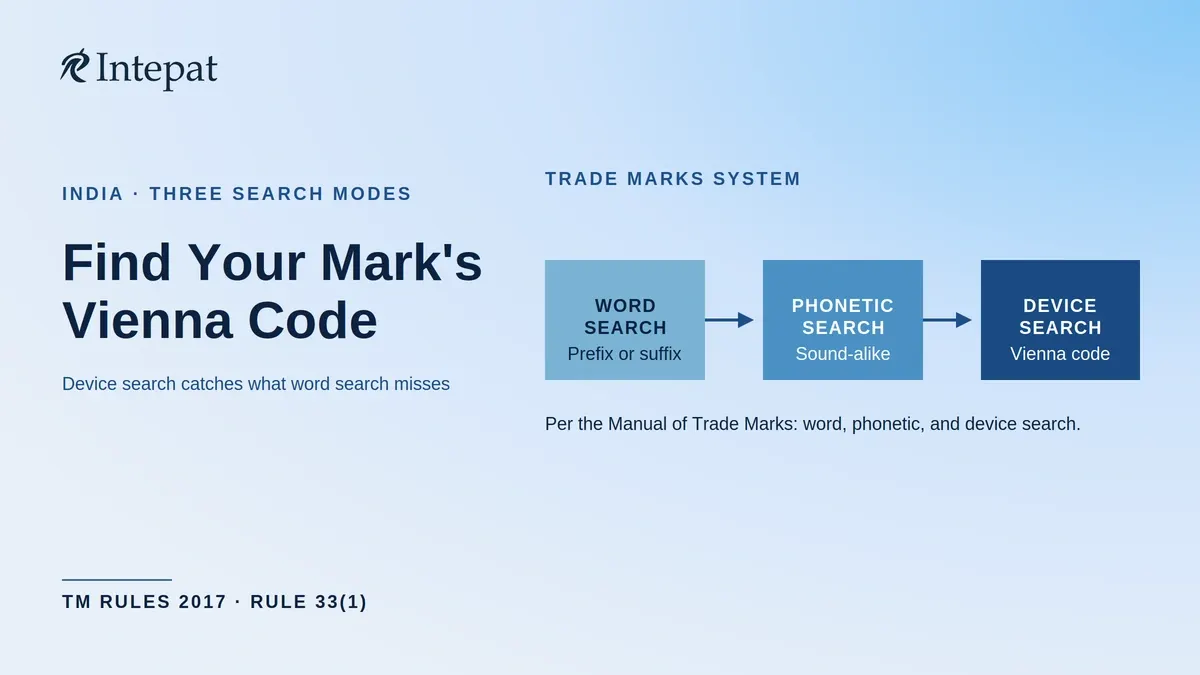
Per the Registry’s Manual of Trade Marks, a 2015 draft and still the most current published practice guide on the point, the Trade Marks System supports three search modes: word (prefix or suffix matching), phonetic (sound-alike variants), and device (matching by the Vienna codes assigned to a mark’s figurative elements), since a logo has no letters for a word or phonetic search to compare.
This is the core reason a general public trademark search needs a device-search step for logo marks: a search limited to the applied-for word will not surface an earlier logo that shares no letters with it but shares the same visual motif. Two marks can be visually similar, and therefore capable of colliding under the Registry’s own conflict standard, without a single letter in common.
The legal standard a Vienna-code hit is eventually read against is this: under Section 11(1), a mark cannot be registered if it is identical or similar to an earlier mark, the goods or services are identical or similar, and this creates a likelihood of confusion, which the section says includes likelihood of association. A Vienna-code search does not itself apply this standard: it retrieves marks coded the same way, which still have to be compared as a whole against their actual goods or services. Section 11(1) is not the whole of Section 11: Section 11(2) separately bars a mark similar to a well-known earlier mark even for dissimilar goods, only where use without due cause would take unfair advantage of, or be detrimental to, its distinctive character or repute, and Section 11(3) preserves passing-off or copyright objections; under Section 11(5), both can be raised only by the earlier proprietor in opposition. A Vienna-code, word, or phonetic search may retrieve records relevant to Section 11(1); nothing relevant to Section 11(2), 11(3), or 11(5).
| Practice note. |
| A Vienna-code search may retrieve some of the same marks an examiner’s mandatory search under Rule 33(1) would surface, but it does not decide acceptance; that turns on the full Section 11 analysis. A shared code does not establish similarity, and no shared-code result does not establish the mark is clear to file. |
The 29 Vienna Classification Categories
The table below lists all 29 top-level categories of the Vienna Classification, tenth edition, in force from 1 January 2026. Each category divides into divisions and sections; categories are the level most searchers need before narrowing a search.
| Category | What it covers |
| 1 | Celestial bodies, natural phenomena, geographical maps |
| 2 | Human beings |
| 3 | Animals |
| 4 | Supernatural, fabulous, fantastic, or unidentifiable beings |
| 5 | Plants |
| 6 | Landscapes |
| 7 | Constructions, structures for advertisements, gates or barriers |
| 8 | Foodstuffs |
| 9 | Textiles, clothing, sewing accessories, headwear, footwear |
| 10 | Tobacco, smokers’ requisites, matches, travel goods, fans, toilet articles |
| 11 | Household utensils |
| 12 | Furniture, sanitary installations |
| 13 | Lighting, wireless valves, heating, cooking or refrigerating equipment, washing machines, drying equipment |
| 14 | Ironmongery, tools, ladders |
| 15 | Machinery, motors, engines |
| 16 | Telecommunications, sound recording or reproduction, computers, photography, cinematography, optics |
| 17 | Horological instruments, jewelry, weights and measures |
| 18 | Transport, equipment for animals |
| 19 | Containers and packing, representations of miscellaneous products |
| 20 | Writing, drawing or painting materials, office requisites, stationery and booksellers’ goods |
| 21 | Games, toys, sporting articles, roundabouts |
| 22 | Musical instruments and their accessories, music accessories, bells, pictures, sculptures |
| 23 | Arms, ammunition, armour |
| 24 | Heraldry, coins, emblems, symbols |
| 25 | Ornamental motifs, surfaces or backgrounds with ornaments |
| 26 | Geometrical figures and solids |
| 27 | Forms of writing, numerals |
| 28 | Inscriptions in various characters |
| 29 | Colours |
Table verified against the Vienna Classification, tenth edition, World Intellectual Property Organization, in force 1 January 2026.
A mark with a leaping animal falls under Category 3; a mark built entirely from a geometric device falls under Category 26; a mark claiming colour as a distinctive feature can also carry a Category 29 code. A device mark may carry more than one code, since a logo can combine a pictorial element with a background shape or border.
How India’s Trade Marks Registry Uses Vienna Codes
Once a trademark application is filed and data entry is complete, applications containing a device mark are routed through the Registry’s Vienna Codification Section before being allotted to an examiner. Per the Manual of Trade Marks, officials there “codify the figurative elements of the trade marks appearing in the application for registration” and “enter codes as per the International Classification of the Figurative Elements of Marks under the Vienna Agreement” into the Trade Marks System.
Section 148(1) of the Trade Marks Act 1999 establishes a general public-inspection right: the register “shall, subject to such conditions as may be prescribed, be open to public inspection at the Trade Marks Registry,” with computer-maintained entries inspected by printout, and in person at a Registry office on payment of the First Schedule fee under Rule 121 of the Trade Marks Rules 2017. Separately, the Registry runs an online public-search facility covering the same three search modes; no notification names it as Section 148(1)’s implementation, so both are described here only because they serve the same purpose.
How to Run a Vienna Code Search on the Public Search Portal
India’s Trade Marks Registry operates its public search facility at tmrsearch.ipindia.gov.in, which offers a dedicated Vienna Code Classification search option alongside word, phonetic, and class search, and well-known marks lookup. In current portal practice, verified as of July 2026, the portal requires sign-in by email or mobile number with OTP verification before a search can be run; portal workflows change, so treat the sequence below as indicative.
- Identify the visual elements of the mark being cleared, an animal, a geometric shape, a natural phenomenon, and match each to its category, division, and section from the classification table.
- Open the public search portal and select the Vienna Code Classification search option rather than word or phonetic search.
- Enter the Vienna code and class the interface asks for. The exact input format (category, division, or section level; single or multiple codes) sits behind OTP login and is not independently verified; only the option’s existence is confirmed.
- Filter the results against the actual goods or services the new mark will cover; the Nice class is an organising filter, not the Section 11(1) legal test.
- Review each returned mark’s full representation, not just its code, since two marks can share a Vienna code while differing enough overall to fall outside the “deceptively similar” standard.
This device-mode search is a companion to, not a replacement for, the word and phonetic search steps covered in a full public-search walkthrough. Treat the portal’s results as a screening aid, not proof it reproduces the Registry’s internal Trade Marks System described in the Manual of Trade Marks; no source confirms an exact match.
Reading a Vienna Code Search Result: A Worked Example
Take a hypothetical: a sports-footwear applicant plans to register a logo built around a leaping panther. Animals fall under Vienna Category 3, narrowed by a leaping posture within that category’s divisions. A search limited to Category 3 and cross-checked against Class 25 (footwear) could return marks carrying a comparable leaping-feline device on record in that class. This is a hypothetical mark, not a real registration; no authenticated Registry record is cited. The same search could just as easily return no shared-code result; an empty result only means nothing was retrieved under the entered criteria, not that the mark is clear to file.
A hit like that does not, by itself, confirm infringement or predict refusal. It flags an earlier mark with a comparable visual motif in an overlapping goods category, the combination Section 11(1) tests: identity or similarity of marks and goods, and likelihood of confusion. Colour, pose, stylisation, and overall impression still have to be weighed, which a code cannot capture; a close match is a reasonable point to seek a second opinion before filing.
The 2026 Vienna Classification Update and India’s Treaty Status
Two currency facts matter for anyone searching or filing in 2026. First, WIPO’s Vienna Classification moved to its tenth edition, in force from 1 January 2026, superseding the ninth edition current since 2023. The 29 top-level categories are unchanged between editions, but this article does not verify whether every division and section number also carried over, so do not assume a code from the ninth edition is unchanged without checking the current text.
Second, India is not merely a user of the classification as an internal Registry tool: it acceded to the Vienna Agreement itself on 7 June 2019, in force for India from 7 September 2019. On accession, India declared under Article 4(5) that it would not commit to including section numbers in official documents and publications, and under Article 16(2) that it would not be bound by the Article 16(1) dispute-settlement mechanism referring disputes to the International Court of Justice.
For a foreign IP counsel filing into India, directly or via the Madrid Protocol, this practice sits inside the treaty framework applicable among Vienna Agreement contracting parties, not a purely domestic convention. How quickly the Registry adopts each new WIPO edition internally is a matter of practice, not a published Rule; its Manual of Trade Marks is a draft dated 10 March 2015, predating both Vienna editions, the 2017 Rules, and India’s 2019 accession, so confirm edition-sensitive questions with the Registry directly, not the Manual.
When to Combine Vienna Code Search with Professional Clearance
A DIY Vienna-code search on the public portal is a reasonable first pass for a founder screening a straightforward logo before filing. It becomes less sufficient for a composite word-plus-device mark, several figurative elements each with its own code, or a portfolio search across classes and jurisdictions.
In-house counsel managing a portfolio typically need Vienna-code, word, and phonetic hits cross-referenced in one risk view. Foreign counsel filing into India for the first time often work from a WIPO Global Brand Database or EUIPO-style image search that does not map onto how India’s examiners weigh a Vienna-code hit under Section 11(1).
For any of these situations, WIPO’s Global Brand Database extends device-mark search across multiple national and international registers in a single interface, and image-based search tools at EUIPO and WIPO can locate visually similar marks without requiring a Vienna code to be identified first. WIPO has also launched an AI-assisted tool that suggests Vienna codes directly from an uploaded mark image. None of these tools substitute for a professional trademark search and clearance opinion that reads the Vienna-code, word, and phonetic results together against the specific goods or services filed.
Frequently Asked Questions
A Vienna code is a number assigned under the Vienna Classification, WIPO’s international system for classifying the figurative elements of a mark, such as an animal, shape, or symbol. Per the Registry’s Manual of Trade Marks, marks containing a device element are assigned a Vienna code and searched against earlier marks coded the same way.
Yes. India’s Trade Marks Registry public search portal offers a Vienna Code Classification search option at no fee, alongside word mark and phonetic search. Section 148(1) of the Trade Marks Act 1999 separately establishes a right to inspect the register, though this article does not find an official notification that ties the online portal specifically to that section.
No. A Vienna-code match is a retrieval result, not a legal test: it flags a visual similarity, and the marks still have to be compared under Section 11(1), including their actual goods or services and the likelihood of confusion. Section 11(2) also bars a mark similar to a well-known earlier mark for dissimilar goods, if using it without due cause would take unfair advantage of, or be detrimental to, its distinctive character or repute; Section 11(3) covers passing off or copyright. Under Section 11(5), both are raised only by the earlier proprietor in opposition.
A Nice class groups the goods or services a mark covers, such as footwear or software. A Vienna code classifies what the mark looks like, the animal, shape, or symbol it depicts. A single application can carry a Nice class for its goods and one or more Vienna codes for its device.
The tenth edition, published by WIPO, entered into force on 1 January 2026 and is the current WIPO edition. It carries the same 29 top-level categories as the ninth. This article does not find a published source confirming when the Registry’s own internal or public search systems began applying the tenth edition, so treat “current WIPO edition” and “edition the Registry’s systems are running” as two separate facts.
Yes. India acceded to the Vienna Agreement Establishing an International Classification of the Figurative Elements of Marks on 7 June 2019, with the accession entering into force on 7 September 2019.
This article explains the law on Vienna-code trademark search in India as at July 2026 and is for general information only. It is not legal advice. Registry search practice and classification editions change; confirm current details with the Trade Marks Registry or WIPO before you rely on a search result. Vienna-code search is one component of clearance, not a substitute for a full search opinion; for advice on a specific mark, consult a trademark attorney.