




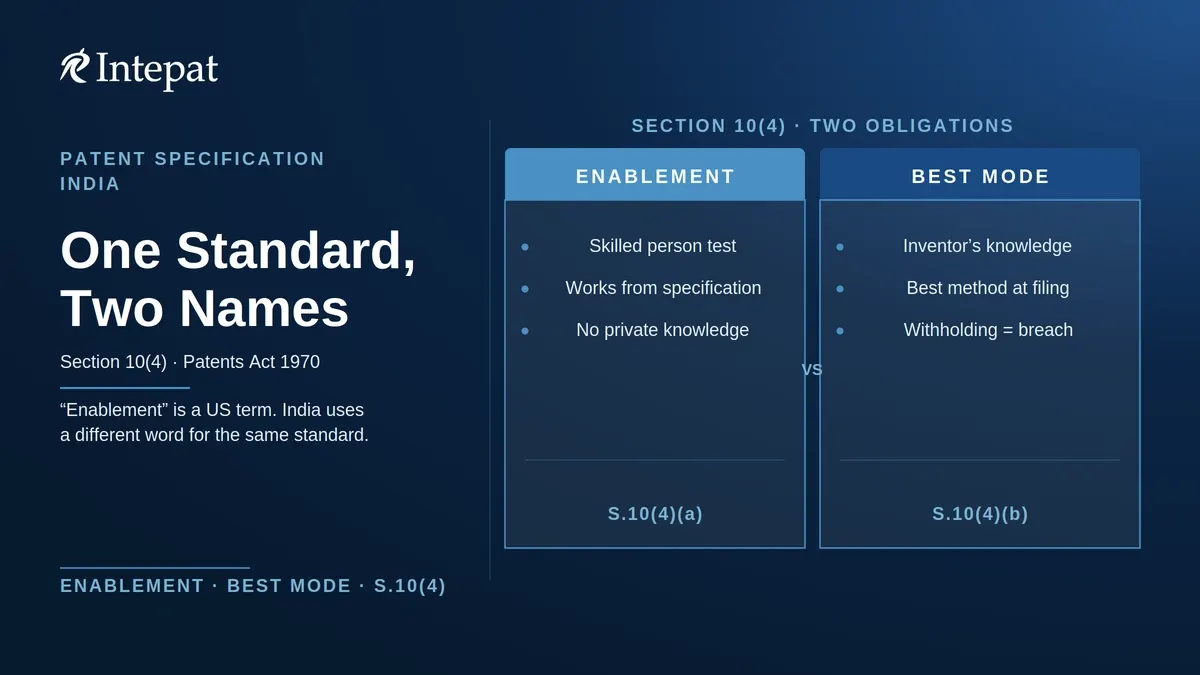
“Enablement” is not a term the Patents Act 1970 uses, but it is the shorthand practitioners use for the sufficiency standard under Section 10(4)(a): the complete specification must describe the invention so fully that a person with average skill in the relevant field in India can work it from the complete specification without additional inventive effort.
Key Points
• Indian patent law does not use the word “enablement.” The statutory standard is that the complete specification must fully and particularly describe the invention so a person of average skill and average knowledge in India can perform it.
• Enablement and best mode are related but different obligations. Enablement is an objective standard measured by what a skilled person can do with the specification. Best mode is a subjective inquiry into what the inventor privately knew at the filing date.
• TRIPS Article 29(1) establishes the international floor: mandatory clear and complete disclosure; optional best mode.
• India requires both; Europe requires only enablement; the United States requires both at examination, but post-grant litigation cannot be used to invalidate a claim solely on best-mode grounds.
• Former IPAB decisions support the position that a specification need not disclose every possible embodiment; however, the disclosure must enable the invention as claimed, and the best method known to the applicant must be disclosed even if it is not separately claimed.
Why Indian Patent Law Does Not Use the Word “Enablement”
The term “enablement” is imported from United States patent practice, where 35 USC 112(a) uses it explicitly. The Patents Act 1970 does not. When practitioners in India refer to the “enablement requirement,” they are describing what Section 10(4)(a) requires: that every complete specification “fully and particularly describe the invention and its operation or use and the method by which it is to be performed.”
The Manual of Patent Office Practice and Procedure translates that statutory language into an operational standard: disclosure in a complete specification must be such that a person of average skill and average knowledge in India can perform the invention based on what is disclosed, without additional experimentation or inventive effort.
The terminological gap matters in practice. A specification satisfying US enablement standards is not automatically sufficient under Indian law; the two jurisdictions apply similar concepts through different statutory frameworks and skilled-person benchmarks. For a full treatment of what the Patents Act requires you to disclose across each element of Section 10(4), see the disclosure requirements article. For practitioner guidance on drafting a complete specification to the Indian standard, that article covers the steps in detail. This article focuses on the conceptual distinction practitioners most often need to navigate: enablement versus best mode.
Enablement vs Best Mode: What Is the Difference?
The two requirements are related but measure different things, and conflating them in a specification is a drafting error.
Enablement is an objective standard. It asks what a person with average skill and average knowledge in India could do with the specification as written. The inventor’s private knowledge is not the benchmark. The question is whether the skilled reader, working from the words on the page, can reproduce the invention without having to make further inventive contributions of their own. The Controller of Patents, applying a Controller decision in Application No. 00094/C.A.L./2002, held that the Controller must put themselves in the position of a person skilled in the art when assessing this standard.
Best mode is a subjective inquiry. It asks what the inventor actually knew at the filing date as the preferred way of carrying out the invention, and whether that knowledge was disclosed. Section 10(4)(b) of the Act requires the applicant to “disclose the best method of performing the invention which is known to the applicant and for which he is entitled to claim protection.” The question is not whether a skilled person could have worked out a better method, but whether the applicant withheld one they already knew.
This distinction has a practical consequence: an applicant can satisfy enablement by describing one working method clearly, even if they knew of a significantly better method and did not disclose it. Satisfying enablement in that way does not satisfy the best mode requirement. Both obligations must be met independently.
To make the distinction concrete: if the invention is a chemical composition for treating a condition, the specification must describe the ingredients, proportions, preparation method, and relevant conditions so a skilled chemist in India can reproduce the result from the complete specification. That satisfies enablement. But if the applicant privately knew that a modified formulation produced a significantly better outcome, omitting that formulation breaches the best mode obligation, even if the disclosed version works perfectly well.
The Manual of Patent Office Practice and Procedure (Section 05.03.12) extends the best mode obligation through the provisional period: the applicant must disclose the best method known at the date of filing the complete specification, including any improvement acquired after the provisional application was filed but before the complete specification was filed. For guidance on how that transition works in practice, see sufficient disclosure in practice.
How TRIPS Treats Enablement and Best Mode
The obligation to provide enabling disclosure in patent applications has an international anchor. Article 29(1) of the TRIPS Agreement, which India is bound by as a WTO member, states: “Members shall require that an applicant for a patent shall disclose the invention in a manner sufficiently clear and complete for the invention to be carried out by a person skilled in the art and may require the applicant to indicate the best mode for carrying out the invention known to the inventor at the filing date.”
Two features of that provision matter. First, enabling disclosure is mandatory for all WTO members. Second, requiring best mode disclosure is expressly optional. TRIPS sets a floor; individual member countries can go further. The table below shows how the three major patent jurisdictions have used that flexibility.
| Jurisdiction | Enablement / sufficiency required? | Best mode required? | Post-grant consequence |
| India (Patents Act 1970) | Yes, Section 10(4)(a) | Yes, Section 10(4)(b) | Revocation under Section 64(1)(h) if specification insufficient or best method not disclosed |
| Europe (EPC) | Yes, Article 83 EPC | No separate best-mode requirement | Insufficiency can be raised in opposition or revocation |
| United States | Yes, 35 USC 112(a) | Yes at filing and examination | Best-mode failure is not a ground to cancel, hold invalid, or hold unenforceable a claim in litigation (35 USC 282(b)(3)(A), effective 16 September 2011) |
India requires both. Failure to disclose the best method is an independent ground for revocation under Section 64(1)(h) of the Act; see the guide to
India requires both. Failure to disclose the best method is an independent ground for revocation under Section 64(1)(h) of the Act; see the guide to patent revocation proceedings in India for the petitioner scope, procedure, and grounds in full.
Europe requires only enablement. Article 83 of the European Patent Convention requires that the application disclose the invention sufficiently clearly and completely for a skilled person to carry it out. There is no separate best mode requirement in the EPC.
United States requires both at examination under 35 USC 112(a). However, following the Leahy-Smith America Invents Act (effective 16 September 2011), failure to disclose the best mode is no longer a ground on which a patent claim may be cancelled, held invalid, or held unenforceable in litigation under 35 USC 282(b)(3)(A). Best mode remains a filing obligation; it is no longer a post-grant litigation weapon.
India’s position is therefore more stringent than Europe’s and matches the US pre-AIA position in terms of post-grant consequences: a granted Indian patent remains vulnerable to revocation on best mode grounds throughout its life.
What Indian Courts and the Former IPAB Have Said
One Delhi High Court decision and two former IPAB decisions are commonly cited in Indian sufficiency and best-mode discussions. The IPAB was abolished by the Tribunals Reforms (Rationalisation and Conditions of Service) Act, 2021; the revocation jurisdiction it previously exercised now vests in the High Courts. The decisions below carry historic authority; they continue to be cited and applied as persuasive precedent, but the forum for future revocation proceedings is the High Court, not a reconstituted board.
Ram Narain Kher v Ambassador Industries [AIR 1976 Delhi 87]. In this Delhi High Court decision, the defendant argued that the invention had not been adequately described in the patent specification. The court did not grant an injunction and acknowledged the defendant’s sufficiency objections, confirming that failure to meet the description standard under what is now Section 10(4) is a valid basis for revocation under Section 64(1). The decision pre-dates the IPAB era and stands as early judicial recognition that description adequacy is a live challenge ground.
Tata Global Beverages Limited v Hindustan Unilever Limited [TRA/1/2007/PT/MUM]. The former IPAB held that the sufficiency requirement is satisfied when at least one way of working the invention is clearly described, enabling a skilled person to carry it out. The board also ruled that Section 10(4) does not require disclosure of all conceivable ways of operating the invention, only the best method known to the applicant at filing. Breadth of enablement does not require exhaustive disclosure of every embodiment.
FDC Limited v Sanjeev Khandelwal and Others [OA/15/2009/PT/MUM]. The former IPAB held that although the applicant is obliged to submit the best method, the patent claims do not need to be representative of that best method. The claim scope and the best mode disclosure are independent obligations; the best method need not be the subject of any claim.
Together these decisions confirm that the Indian standard is neither maximally demanding (every conceivable embodiment) nor minimal (any description that is not entirely opaque). A clearly described working method can satisfy the sufficiency requirement where it enables the invention as claimed without requiring the skilled person to supply missing inventive steps; it is not a universal safe harbour for broad genus claims, functional claims, or inventions in unpredictable technology fields. The best method must be disclosed but need not be claimed.
Can You Fix an Enablement Gap After Filing?
Knowing that a specification may not enable the invention fully is one thing. Fixing it after the complete specification has been filed is another. Section 59 of the Patents Act bars any amendment that would introduce matter not in substance disclosed in the specification before the amendment. A missing technical teaching cannot be added after filing unless it was already in substance present in the original specification. An applicant can clarify or explain what the specification already taught; they cannot use an amendment to supply an enabling disclosure that was absent at the filing date.
The amendment bar means the sufficiency assessment is locked to the disclosure as filed. An applicant who responds to a First Examination Report raising a sufficiency objection must work with the technical content already in the specification. If that content does not support the invention as claimed, the options at that stage are narrowing the claims to what the disclosure supports or arguing the existing disclosure is sufficient for the skilled person, not supplementing it. This risk applies equally to post-grant opposition proceedings: an opponent who raises enablement or best mode as a challenge is testing the specification as it stood at filing, not as the applicant might wish it had been written.
The practical implication: every technical detail, every worked example, every operating condition the applicant knows and regards as important to working the invention, must be in the complete specification before it is filed. The specification is not a draft to be improved after examination begins.
Frequently Asked Questions
FAQ schema note: 6 Q&A pairs, each answer 40–60 words, definitional format, schema-ready for FAQPage structured data.
| What does “enablement” mean in Indian patent law? | “Enablement” is a term practitioners borrow from US practice to describe the sufficiency standard in Section 10(4)(a) of the Patents Act. The Act does not use the word. The standard requires a complete specification to describe the invention so a person of average skill and average knowledge in India can perform it from the complete specification without additional inventive effort. |
| Is the enablement standard the same as the best mode requirement? | No. Enablement under Section 10(4)(a) is an objective standard: could a skilled person in India work the invention from the complete specification? Best mode under Section 10(4)(b) is a subjective inquiry: did the applicant disclose the method they actually regarded as best at the filing date? Both must be satisfied; meeting one does not satisfy the other. |
| Does India require both enabling disclosure and best mode disclosure? | Yes. Section 10(4)(a) requires a full and particular description sufficient for a person in India with average skill and average knowledge to perform the invention. Section 10(4)(b) separately requires disclosure of the best method known to the applicant at the time of filing. Failure to meet either is a ground for revocation under Section 64(1)(h). |
| What is the consequence of not disclosing the best method? | A granted patent may be revoked by the High Court on petition of any person interested or the Central Government, or by counterclaim in an infringement suit, on the ground that the complete specification does not disclose the best method of performing the invention known to the applicant at filing. This risk persists throughout the patent life. |
| Can a specification be amended after filing to fix an enablement gap? | No. Section 59 of the Patents Act prohibits any amendment that would introduce matter not in substance disclosed in the specification before the amendment. An enabling detail absent at the filing date of the complete specification cannot be added later. The specification must be self-sufficient and fully enabling at the moment it is filed. |
| Do claims need to describe the best method the applicant disclosed? | No. The former IPAB held in FDC v Sanjeev Khandelwal that although the applicant must disclose the best method in the specification, the claims themselves need not be representative of that best method. The disclosure obligation and the claim-drafting obligation are independent; the best method can appear in the description without being the subject of any specific claim. |
This article explains the law on enablement and best mode requirements in patent specifications in India as updated at June 2026 and is for general information only. It is not legal advice. Case law citations refer to decisions of the former IPAB, which was abolished in 2021, and of the courts; the revocation jurisdiction now vests in the High Courts. Government fees, forms, and procedures change; confirm current requirements with the Indian Patent Office before you file. For advice on your specific invention, consult a registered patent agent.