




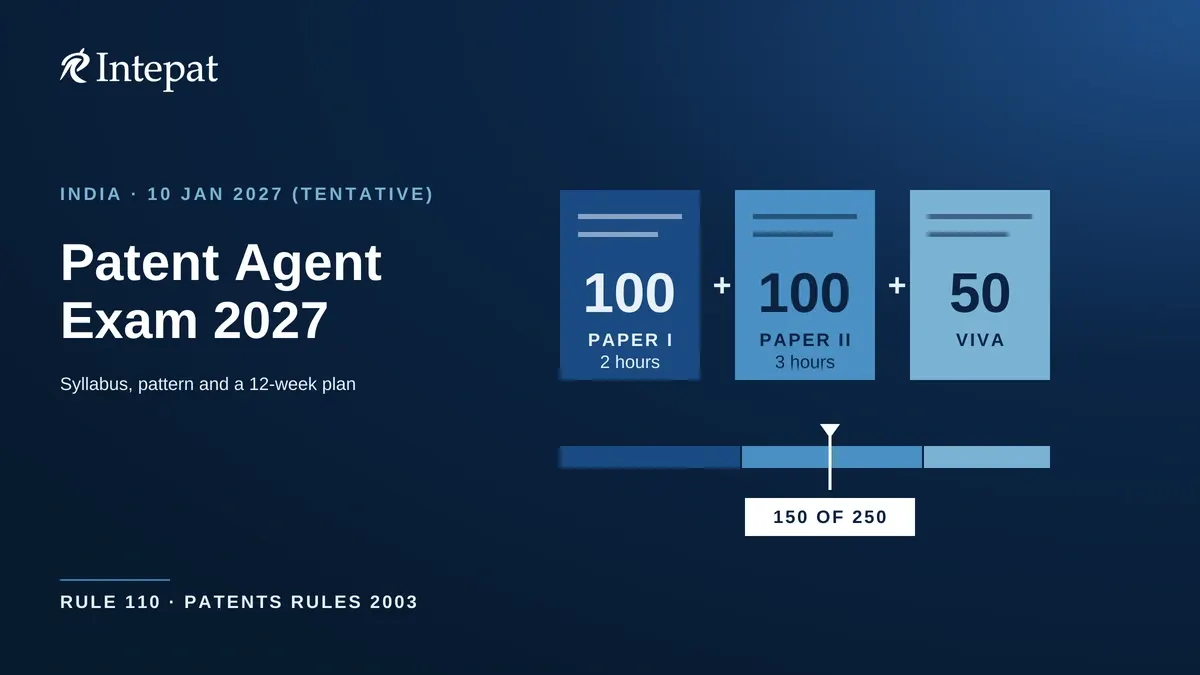
The Patent Agent Exam 2027 is tentatively scheduled for Sunday, 10 January 2027: a two-hour objective Paper I and a three-hour descriptive Paper II, each of 100 marks, then a 50-mark viva for those scoring 50 per cent in each. The patent agent exam syllabus covers the Patents Act and Rules, the Designs Act and Rules, and IP jurisprudence.
The examination is conducted in India by the Office of the Controller General of Patents, Designs and Trade Marks under Section 126 of the Patents Act, 1970 and Rule 110 of the Patents Rules, 2003. Registration closed on 30 September 2026, so this guide is for candidates who have applied; as at 16 October 2026, about twelve weeks remain. The 2027 arrangements come from the CGPDTM public notice of 23 June 2026. The question counts and mark allocations come from the official 2026 papers and describe that examination, not a confirmed PAE 2027 format (verified as of October 2026).
| Quick answer: |
| In 2026, Paper I comprised 50 questions in five parts, and Paper II comprised thirteen descriptive questions ending in a 20-mark specification-drafting task; the 2027 notice confirms only each paper’s duration, total marks and type (objective for Paper I, descriptive for Paper II), not the question counts or parts, and allows Paper I questions with more than one correct option. You need 50 marks in each paper to reach the viva and 60 per cent of the total marks to pass. Design questions carried at least 14 marks in the 2026 Paper I and 20 in Paper II. |
What the Patent Agent Exam 2027 notice fixes
The CGPDTM notice of 23 June 2026 schedules the written examination for 10 January 2027 at fifteen cities, with Paper I from 10 a.m. to 12 noon and Paper II from 2 p.m. to 5 p.m. It describes the whole schedule as tentative, so check the IP India examination page rather than relying on the dates alone.
The fifteen centres are Ahmedabad, Bangalore, Chandigarh, Chennai, Delhi, Guwahati, Hyderabad, Indore, Jodhpur, Kolkata, Lucknow, Mumbai, Nagpur, Pune and Thiruvananthapuram. The centre chosen at application cannot be changed after final submission. Candidates chose English or Hindi as the question-paper language when applying, and that choice is also final.
The timeline after the written papers is laid out in the notice. Admit cards are expected online from 15 December 2026. Written results are expected in the second week of February 2027, the viva in physical mode in the last week of February, and final results in the third week of March. A candidate with a disability who needs a reader or writer must email the office before 25 December 2026 with a disability certificate.
The application fee was Rs 1,600, the figure prescribed for a request to sit the qualifying examination (First Schedule, entry 35, read with Rule 109(3)). The office checks eligibility only when it issues the certificate, not when it accepts an application, so a candidate who sits without meeting the Section 126 conditions can pass the papers and still be unable to register. Apart from passing the examination and paying the separate fee prescribed for registration, those conditions are Indian citizenship, completion of the age of 21 years, and a degree in science, engineering or technology from a university established under law in India, or an equivalent qualification specified by the Central Government. For when these conditions must be met, check the notice and any later update on the IP India examination page; the guide to becoming a patent agent in India walks through them.
Paper I: the pattern from the 2026 paper
Paper I in 2026 had 50 questions across five parts for 100 marks in two hours, with no negative marking: Part A, 30 questions at 2 marks each; Parts B1 and B2, five questions each at 1 mark; Parts C1 and C2, five questions each at 3 marks. Sets A to D carried the same questions in a different order.
Part A was conventional multiple choice with one correct option. Many questions were scenario-based: a term-expiry comparison between an ordinary, a convention and a PCT national phase application; an inventor who posted about the invention on LinkedIn months before filing; a licence with three restrictive conditions; a patent of addition whose main patent is under revocation in the High Court. Each needs the provision and its scope, not the section number alone.
Part B1 was assertion-and-reasoning with the four standard options, and Part B2 paired two statements to be marked true or false. Part C1 posed five three-mark problems, including a prior-claiming scenario, a claim-by-claim inventive-step analysis against three documents, and a question on who files Form 27 when co-owners and licensees are all working the patent. Part C2 was five matching questions: who may file which proceeding, the compulsory-licence sections, forms against their provisions, six cases against the principle each decided, and four statutory definitions.
One point to note for 2027: the notice says Paper I questions may have “one and/or more than one option correct”. The 2026 paper limited Part A to a single correct option. Read the instructions on the day before assuming the 2026 format carries over.
Paper II: what the 2026 descriptive paper asked
Paper II in 2026 was three hours for 100 marks across three parts (Part A 40, Part B 30, Part C 30), all questions compulsory and no negative marking. Instruction 9 told candidates they were “expected to quote relevant sections and rules as well as prescribed forms in the answer”, which is the marking signal for the whole paper.
Part A had eight five-mark questions. They covered enablement and sufficiency of disclosure (opening with a quotation from the US Supreme Court in Amgen v Sanofi), the provisions governing amendment at each stage, a novelty assessment of four claims against four prior-art documents, the working of patents and its exceptions, marking requirements under the Designs Act, a post-grant opposition where the cited art was the patentee’s own earlier filings, design registrability and the design-copyright interface, and a Japanese applicant who exhibited in India after publication abroad.
Part B had three ten-mark problems: inventorship requests by a co-inventor, by an outsider and then a fraud allegation, with the fee for each; five non-patent instruments that affect how the Patents Act operates; and the procedure for cancelling a registered design that lacked novelty. Part C was the drafting test. Question 12 (10 marks) asked for the documents a patent agent would draft to challenge a former colleague’s patent on facts pointing to lack of inventorship, non-disclosure of biological source, implausible data and undisclosed foreign filings. Question 13 (20 marks) gave an AI-controlled air purifier and three prior-art documents and asked for a complete specification “along with two independent claims, each having two dependent claims”.
Where the marks went in 2026: the Rule 110 syllabus in practice
Rule 110(2) prescribes Paper I on the Patents Act, the Patents Rules, the Designs Act, 2000 and the Designs Rules, 2001, and Paper II on drafting and interpretation of patent specifications, design specifications and other documents. The 2027 notice adds “Matters related to IP Jurisprudence”. The 2026 papers show how that syllabus translates into marks.
The Designs Act is not a footnote. Nine selected design-related questions in the 2026 Paper I carried 14 of 100 marks, and a further two-mark question on which IP rights fit a product also involved designs; Paper II added 20 marks on designs across marking, registrability and cancellation. A candidate who skips the Designs Act gives away between a quarter and two-fifths of the marks needed to clear each paper. The industrial design registration guide is a starting point, but the Act and Rules themselves must be read.
| Paper I topic, 2026 (our analysis) | Questions and marks | What was asked |
| Designs Act and Rules | 9 questions, 14 marks | Definition of a set; fee for recording an assignment of two designs; who is a proprietor; what is an article; prior publication abroad; the Section 18 search; copyright in a design applied to more than fifty articles |
| Selected recent developments | 5 questions, 10 marks | Section 4, which the question described as amended to allow patents for nuclear-energy inventions subject to Section 38 of the SHANTI Act, 2025; the Jan Vishwas (Amendment of Provisions) Act, 2023 and the penalty under Section 146(2); the Form 32 complaint against a person falsely claiming to be a patent agent; the WIPO Treaty on Intellectual Property, Genetic Resources and Associated Traditional Knowledge, 2024; the revised Form 27 |
| Claim and prior-art reasoning | 6 questions, 12 marks | Section 2(1)(l) new invention; the Section 31 grace period; dependent and independent claims; anticipation by prior claiming; inventive step against three documents |
| Case law | 1 question, 3 marks | Natera, DS BioPharma, Immunas Pharma, Dimminaco, Vifor and the Regents of the University of California, matched to Sections 3(c), 3(d) and 3(i), living microorganisms, Sections 10(4) and 10(5), and product-by-process claims |
| PCT procedure | 4 questions, 7 marks | The PCT timeline; Section 39 permission for a PCT filing at RO/IN; fees at RO/IN; international and supplementary search |
| Fees and forms | 6 questions, 15 marks | Designs assignment fee; RO/IN fees; sequence-listing fee caps; Forms 15, 17, 19 and 21 matched to their provisions; Form 27; Form 32 |
The table is our analysis of the 2026 Set A paper, not an official weighting for 2027. Categories overlap (the fees and forms row shares questions with the Designs, PCT and recent-developments rows), marks are counted for whole questions including mixed ones, and the rows are selected topics rather than a complete map of the paper. Another matching question, on who may appeal an adjudicating officer’s order, also touched the newer penalty-adjudication route.
Recent developments were tested directly, and the SHANTI Act, 2025 on nuclear inventions and the revised Form 27 working statement each carried a question. Read the Act and Rules as currently amended, with particular attention to recent changes: the 2026 paper drew on instruments from 2023, 2024 and 2025. Claim reasoning, the next block by marks, rewards candidates who can run a novelty and inventive-step test on a given set of documents rather than recite the definitions.
How passing works: Rule 110(3) and what follows
Rule 110(3) requires a minimum of fifty marks in Paper I and fifty in Paper II, and declares a candidate passed only on an aggregate of sixty per cent of the total marks. With the viva at 50 marks, the total is 250 and the aggregate threshold is 150.
The notice applies the first limb as 50 per cent in each paper to be called for the viva, and the viva schedule is announced only after the written examination.
The viva is physical and carries 50 marks. The notice does not publish its content, so prepare it as an oral test of the same syllabus and of your own Paper II answers rather than as a formality. Keep the signed e-admit card: the notice says only signed cards are valid for the viva and for registration.
Passing does not make you a patent agent. Registration follows an application on Form 22 with the registration fee of Rs 3,200 and the first year’s continuance fee of Rs 800, payable with it, then Rs 800 every year on 1 April, all on e-filing; the physical-filing figures are Rs 3,500 and Rs 880 (First Schedule, entries 34 and 36; Rule 111). A candidate who sat before graduating must file a copy of the science, engineering or technology degree within six months of the final result to complete registration. The fee schedule as a whole is set out in the patent fees guide.
A 12-week plan built from the Act and Rules
The office recognises no coaching institute and advises candidates to read the Act, the Rules, related case law and the previous papers on its website. As at 16 October 2026, about twelve weeks remain, which can be enough for that reading if it is sequenced against where the 2026 marks fell.
The plan below is an illustrative patent agent exam preparation schedule built on Rule 110, not on any coaching syllabus; adjust it to your starting knowledge. It assumes about two hours of reading on weekdays, with the past papers kept for the weekends, and it front-loads the Act because every later week depends on it.
| Weeks | Read | Output |
| 1 to 4 | Patents Act, 1970, chapter by chapter, from the official consolidation read with later amending Acts, including the Jan Vishwas (Amendment of Provisions) Act, 2026, which, from a date the Central Government notifies, renames the Chapter XX heading, adds a proviso to Section 118 and omits Section 119 | One page per chapter: section numbers, time limits, who may act; one short claim-drafting exercise a week |
| 5 to 7 | Patents Rules, 2003 with the 2024 and 2025 amendments (the 2025 amendment substituted the penalty-adjudication chapter and Forms 32 and 33), the First Schedule fees and the Second Schedule forms; the October 2025 draft code of conduct for patent agents, read as a draft only | A fee-and-form table from memory, checked against the Schedule; one five-mark Paper II answer a week |
| 8 to 9 | Designs Act, 2000 and Designs Rules, 2001 | Notes on definitions, registrability, marking, cancellation and the copyright overlap |
| 10 | Recent developments, the cases named in the 2026 paper, PCT timelines | A dated list of what changed and which section it touched |
| 11 to 12 | 2026 Papers I and II under exam timing | Paper I checked against the answer key for the set attempted; Paper II reviewed against the provisions, completeness, reasoning and drafting quality |
Weeks 1 to 4 build the skeleton: the overview of patent law in India helps with orientation, but the Act must be read in full because Paper I asks for the exact scope of a provision, not its gist. The 2026 Act’s patent amendments take effect from the date or dates the Central Government notifies in the Official Gazette, so confirm the date for each change before relying on the new proviso to Section 118 or the omission of Section 119. Short drafting exercises from the first week mean claim writing is not left to the last fortnight. Weeks 5 to 7 are where fee and form questions are won; in 2026 these were worth 15 marks between them, and in most rows the First Schedule sets a lower fee for natural persons, startups, small entities and educational institutions than for other applicants, which examiners use to build options.
Weeks 11 and 12 are for full mock papers. Sit the whole 2026 Paper II in three hours; at 20 of 100 marks, the air-purifier specification merits roughly 36 minutes as a starting budget, adjusted for reading and review, which is a suggestion rather than an official limit. Write claims that read on the invention but not on the three prior-art documents, and apply the provisions on the contents of a specification accurately while producing a complete, supported specification. The guides to patent claim structure and the parts of a patent specification cover the form.
Then sit Paper I in two hours and check it against the answer key for the set you attempted; the 2026 key accepted more than one answer for one question in Set B. The key covers Paper I only, so review Paper II answers against the provisions, completeness, reasoning and drafting quality, ideally with a registered patent agent. Treat every wrong answer as a provision to reread.
Frequently Asked Questions
The 2026 Paper I and Paper II instructions both stated that there was no negative marking. The 2027 notice is silent on the point, so it is not confirmed for 2027. If the 2027 instructions again rule out negative marking, attempt every question in Paper I, since an unanswered question and a wrong one would then score the same.
A candidate without the degree in hand can sit, but the notice requires a copy of the science, engineering or technology degree within six months of the final result to complete registration. Eligibility is checked only at the certificate stage, so a candidate who cannot produce the degree in time cannot complete registration, whatever the result.
Yes. The notice required candidates to choose English or Hindi as the question-paper language at the time of application, and the choice became final on submission. Its instructions state that the medium of writing is English or Hindi and that candidates who selected Hindi receive their papers in Hindi; it does not address answering in the other language.
No. The notice states that no request for a change of centre will be considered once the application is submitted by final submit, and the centre on the admit card is final. A candidate who appears at a different centre risks cancellation of the answer booklet and result. Fees are not refunded if the candidate does not appear.
The notice fixes the viva at 50 marks, in physical mode, in the last week of February 2027, open only to candidates with at least 50 per cent in each written paper. It does not publish the content. Under Rule 110 it counts towards the 60 per cent aggregate. Prepare it as an oral test of the syllabus and of your own written answers.
This article explains the law on the patent agent qualifying examination in India as at October 2026 and is for general information only. It is not legal advice. Government fees, forms, and procedures change; confirm current figures with the Indian Patent Office before you file. For advice on your specific invention, consult a registered patent agent. Examination arrangements are set by the CGPDTM; confirm them on the IP India website.