




A trademark show cause hearing takes place when the Trade Marks Registry is not satisfied with your written response to an examination report, or when you request a hearing yourself. The Registry gives you an opportunity to appear, personally or through an authorised agent, and explain why the mark should proceed to registration. Failure to appear can have serious consequences, as explained below.
This applies to trademark applications examined by the Trade Marks Registry in India under the Trade Marks Act, 1999 and the Trade Marks Rules, 2017. If your online status now reads “Ready for Show Cause Hearing,” the sections below explain what triggered the hearing and what you should do next. To understand where this stage falls within the wider registration process, see our complete guide.
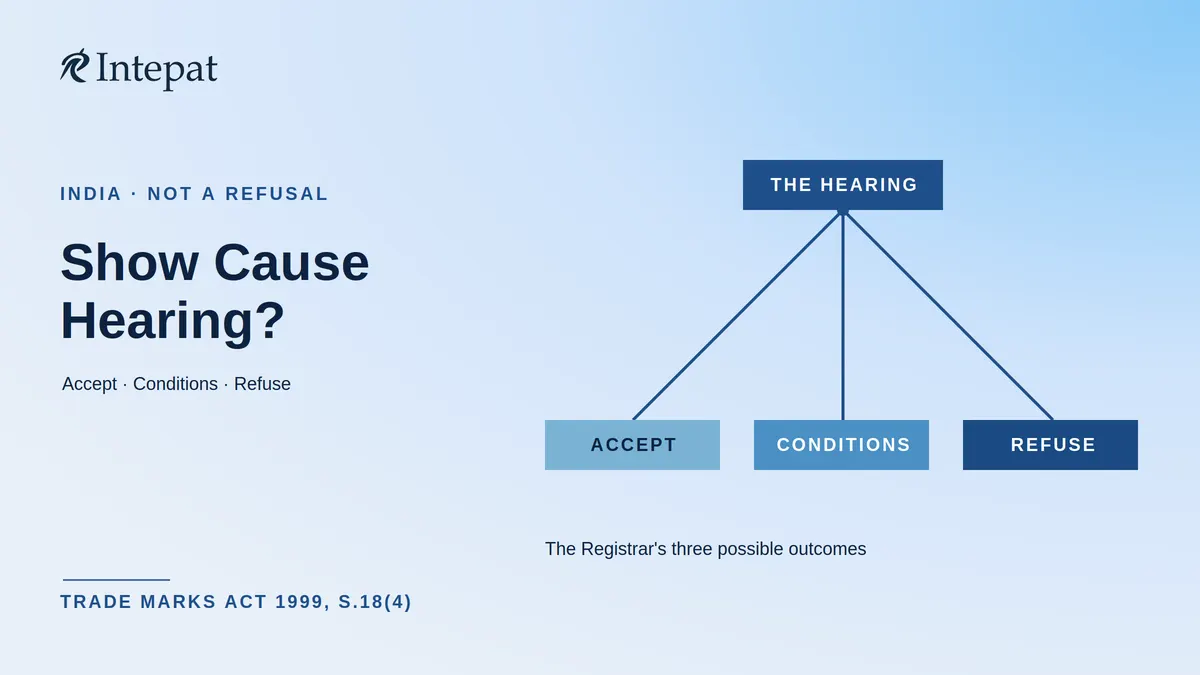
Quick answer: A show cause hearing is scheduled when your response to a trademark examination report does not satisfy the Registrar, or when you request a hearing yourself under Rule 33(6). You or your authorised agent appears in the format specified in the hearing notice, either in person or by video conference, following which the Registrar may accept the mark, accept it subject to conditions, or refuse the application.
Why Your Status Shows “Ready for Show Cause Hearing”
Your application moves to a show cause hearing when the Registry considers your reply to the examination report and remains unsatisfied that the objections have been overcome, or when you have requested a hearing yourself under Rule 33(6) of the Trade Marks Rules, 2017. The online status then changes to “Ready for Show Cause Hearing.”
This is a standard stage in Indian trademark prosecution and does not mean that the mark has been refused. After you file a written reply to an examination report, which is the Registry’s written notice of its objections to your application, an authorised officer reviews the response. If the reply overcomes the objection, the application proceeds to advertisement; if it does not, the matter is listed for what the Registry’s own procedure calls a show cause hearing, with hearing notices and officer allotment handled through the Registry’s system as applications are taken up. If speed matters more than cost, Rule 34 allows you to request expedited processing through Form TM-M on payment of the First Schedule fee (Rs. 20,000 for individuals, startups and small enterprises, and Rs. 40,000 for others, through e-filing only). Where expedited processing applies, subsequent stages, including the scheduling of any show cause hearing, are also to be dealt with expeditiously.
There are two distinct paths to a hearing, and each calls for different preparation. Either the objections raised in your examination report remain unresolved after your written reply, and the officer lists the matter for a hearing on that basis, or you request a hearing yourself, for example where you consider the issue better addressed through oral submissions than entirely on paper. In either case, the hearing officer’s focus follows the nature of the objection in the examination report: a distinctiveness objection turns on the mark itself and evidence of its use, while an objection based on a cited earlier mark or application turns on the similarity between the marks and the respective goods or services.
“Ready for Show Cause Hearing” is the status label itself, visible when you check your application status or directly through the IP India status portal after filing your reply. Seeing this status does not mean that your mark has been rejected. It means the application has moved beyond the written-reply stage and is awaiting scheduling for an oral hearing before a Registry officer.
What Happens at a Trademark Show Cause Hearing
The hearing is held on the notified date and time, at a place within the territorial jurisdiction of the Registry office handling your application, as determined by the Registrar under Rule 115(1). Whether conducted physically or by video conference, the purpose is the same: you or your authorised agent explain why the mark should be accepted.
Rule 115(1) expressly permits hearings by video conferencing, a provision in force since the Trade Marks Rules, 2017 came into effect, and a hearing conducted in this manner is deemed to have taken place at the appropriate Registry office. Whether your hearing is held in person or by video conference is determined by the Registrar, not by your own preference. Check the hearing notice, which specifies the mode of hearing, rather than assuming either format.
The Registry office that hears your case depends on the territorial jurisdiction applicable to your filing. Under Rule 4, the office of the Trade Marks Registry having jurisdiction over your application, including for any hearing under Rule 115(1), is generally determined by your principal place of business in India or, where you have no place of business in India, by the address for service stated in the application. At the hearing, the designated officer calls the matter, and you or your agent address the specific objections raised in the examination report, typically by arguing that the mark is inherently capable of distinguishing your goods or services or that it has acquired distinctiveness through use.
This is a one-sided prosecution hearing between you and the Registrar, not an adversarial trial or an opposition proceeding between two parties. You or your agent present the arguments and evidence properly filed in connection with the hearing, and the officer may ask questions to test those submissions. Evidence before the Registrar is ordinarily given by affidavit; under Section 129, the Registrar may take oral evidence instead of, or in addition to, affidavit evidence where considered appropriate. The hearing concludes once the officer has heard enough to decide the matter or to identify any further material that may still be required.
How to Prepare
Preparation means having your authority documents in order, alongside evidence that answers the specific objection raised in your examination report, properly placed on the record rather than simply brought along. What you need depends on the objection.
- Authorisation, if an agent or attorney is appearing on your behalf: this is filed on Form TM-M (Rule 19(1)), and once filed, appearances before the Registrar may be made through that agent.
- An affidavit for any factual evidence you rely on, with supporting documents properly exhibited to it. Evidence before the Registrar is ordinarily given by affidavit (Section 129). This applies where you are proving something, such as use of the mark; it does not turn a legal argument, such as comparing your mark and goods against a cited earlier mark, into affidavit evidence on its own.
- Evidence of use, where the objection concerns distinctiveness: invoices, advertising material, and dated samples showing the mark in the market, exhibited to an affidavit. A mark that is otherwise devoid of distinctive character, that is descriptive, or that consists exclusively of indications that have become customary in the current language or established trade practices, is not refused if it had already acquired a distinctive character through use before the date you applied, or if it is itself a well-known mark (Section 9(1) proviso); a well-known-mark claim needs its own supporting basis, not a bare assertion. If your original application already claimed use before the filing date, that claim itself had to be supported by an affidavit and documents at filing (Rule 25(2)), which is a useful starting point for the same evidence at hearing.
- A comparison against any cited marks, if the objection is based on a cited earlier mark or application, addressing how your mark and goods differ, or why coexistence would not confuse consumers.
- Any earlier Registry decisions on comparable facts that support your argument, where you have them.
For help telling a distinctiveness objection from a descriptiveness one, and building the right evidence for each, a trademark attorney can review your specific examination report before the hearing date.
A worked example: if the objection is that your mark is descriptive of the goods, an unsupported assertion that the mark is well known will not carry the hearing, and neither will invoices simply handed to the officer. Dated evidence such as invoices, advertising spend, and packaging showing the mark in use on your specific goods before you filed needs to go in as exhibits to your affidavit, which is what actually puts it on the record for the acquired-distinctiveness argument. Evidence from after your filing date can round out the picture, but it does not by itself satisfy the proviso, which looks at distinctiveness acquired before that date.
Possible Outcomes
After hearing your submissions, the Registrar has three options: accept the application, accept it subject to conditions, or refuse it (Section 18(4)). If the Registrar refuses the application or accepts it only on conditions, the order must record the grounds and the material relied on in writing (Section 18(5)).
An accepted application moves to advertisement in the Trade Marks Journal, the same next step as an application accepted without a hearing. Conditional acceptance means the mark can proceed only subject to whatever amendments, modifications, conditions, or limitations the Registrar has thought fit to impose (Section 18(4)), before the application proceeds further.
A hearing can also be adjourned, though neither Rule 33 nor Rule 115 sets out the grounds or process for this; treat it as a request to the Registrar’s discretion, and follow the instructions in your own hearing notice, rather than assuming a standard procedure exists.
If You Don’t Appear, or Your Application Is Refused
Not appearing carries real risk. If you fail to appear at the scheduled hearing and no reply to the office objections has been submitted at all, the Registrar may treat the application as abandoned (Rule 33(7)).
Do not rely on a technical reading of that rule as a safety net. File your substantive reply within the one month Rule 33(4) allows, and if you cannot attend the hearing itself, apply for an adjournment rather than treating a last-minute reply as a substitute for attendance.
If you genuinely cannot finish your reply within that month, Rule 109 read with Section 131 lets you apply for an extension of up to one further month, even after the month has already run.
The application is made on Form TM-M, with the prescribed fee; the Registrar has to be satisfied there is sufficient cause. This supplements the deadline rather than replacing it.
Abandonment and refusal are different in kind. Abandonment under Rule 33(7) ends the application without the Registrar ever reaching a decision on the mark itself, while refusal, or conditional acceptance, is a decision on the merits.
Section 91 is not framed as limited to refusals: it gives an appeal from “any order or decision of the Registrar under this Act, or the rules made thereunder” (Section 91(1)), language wide enough to reach an abandonment order in principle. Whether a specific abandonment gives an applicant something concrete to appeal, and when the three-month clock would start, turns on what the Registrar actually communicated and on the facts of that file; treat it as a question for a trademark attorney on your specific matter, not as a settled proposition either way.
Section 18(5) requires the Registrar to record the grounds for the refusal or conditional acceptance, and the materials relied on, in writing. Getting that reasoned record, rather than a procedural lapse, is one practical reason attendance and a timely reply matter: it gives you something concrete to work with, whether through a review under Section 127(c) or an appeal.
Before an appeal, Section 127(c) also lets the Registrar review his own decision.
An application for that review, on Form TM-M with the prescribed fee (Rs. 3,000, or Rs. 2,700 for e-filing, under Entry 15 of the First Schedule), filed within one month of the decision and extendable by a further month on request under Rule 119, is worth weighing against going straight to the High Court.
If the outcome is refusal, the appeal route is the High Court, not the Intellectual Property Appellate Board. The IPAB was abolished in 2021, and Section 91 of the Trade Marks Act now provides for an appeal to the High Court within three months of the date the order is communicated to you. A late appeal can still be admitted if you satisfy the Court there was sufficient cause for the delay (Section 91(2)).
The date that starts your three-month appeal window is when the Registrar’s decision is communicated to you (Section 91(1)).
Rule 36 is the mechanism for actually obtaining the Registrar’s written statement of the grounds for a decision. Applying within thirty days, on Form TM-M, with the prescribed fee (Rs. 1,000, or Rs. 900 for e-filing, under Entry 13 of the First Schedule), for that statement fixes the date you receive it as the date of the decision for calculating your appeal period, in place of the original bare communication.
This is subject to Rule 36(2): if the decision included requirements you did not object to, the Registrar will not issue that statement until you have complied with them. This deemed-date rule comes from Rule 36(3) itself.
Frequently Asked Questions
It means your written reply to the examination report did not fully resolve the Registry’s objections, or you asked for a hearing yourself, and your case is now waiting to be scheduled for an oral hearing before a Registry officer (Rule 33(6)). It is a stage in prosecution, not a refusal.
Yes. Rule 115(1) allows a hearing to be held in person, at a place within the Registry’s territorial jurisdiction, or by video conference or other audio-visual device. The hearing notice sets the format; a hearing held by video conference is deemed to have taken place at the appropriate Registry office.
If you do not appear and have filed no reply, the Registrar may treat the application as abandoned (Rule 33(7)). File your reply within the one month Rule 33(4) allows, and apply for an adjournment if you cannot attend; Rule 109 also lets you apply for an extension on Form TM-M if you need more time.
Your agent’s authorisation on Form TM-M if represented, and an affidavit for any factual evidence you rely on, such as proof of use for a distinctiveness objection (Section 129). For an objection based on a cited earlier mark, your response is usually a legal comparison of the marks and goods, not affidavit evidence.
Yes. Section 91 allows an appeal to the High Court within three months of the order being communicated, with a late appeal possible on sufficient cause. This replaced the earlier route to the Intellectual Property Appellate Board, abolished in 2021. You can also ask the Registrar to review the decision under Section 127(c) and Rule 119, within one month.
The Rules do not fix a specific period for this. The Registrar may indicate the outcome at the hearing itself or communicate the order afterward; either way, a refusal or conditional acceptance must be accompanied by written grounds and the materials relied on (Section 18(5)).
This article explains the law on trademark show cause hearings in India as at August 2026 and is for general information only. It is not legal advice. Government fees, forms, and procedures change; confirm current figures with the Trade Marks Registry before you file. For advice on your specific mark, consult a trademark attorney.