




When a trademark owner or applicant dies in India, the application or registration does not end by itself. The Registrar can be asked, on Form TM-M, to put the successor into a pending application, on proof of the death and of how the interest passed, and, on Form TM-P, to record the heirs on a registered mark. We found no pause in any deadline.
This guide covers the death of a trademark owner in India under the Trade Marks Act, 1999, with fees and forms checked as of November 2026. It applies where an individual who personally owned a mark, or was named as its applicant, has died. A company is a separate owner, so the death of its founder or director does not by itself change the registered owner. Who inherits the brand under succession law is a separate question, and this is general information, not advice on any estate.
Quick answer: First find out whether the mark is still an application or already registered. For an application, ask the Registrar on Form TM-M to substitute the successor, with proof of the death and of how the interest passed (the “transmission”). For a registered mark, the person entitled applies on Form TM-P with a certified copy of the document passing title and a statement of case. The government e-filing fees are listed at Rs 900 (the amendment fee) and Rs 9,000 per mark (the assignment or transfer fee), with caveats below, and we found no pause in any deadline.
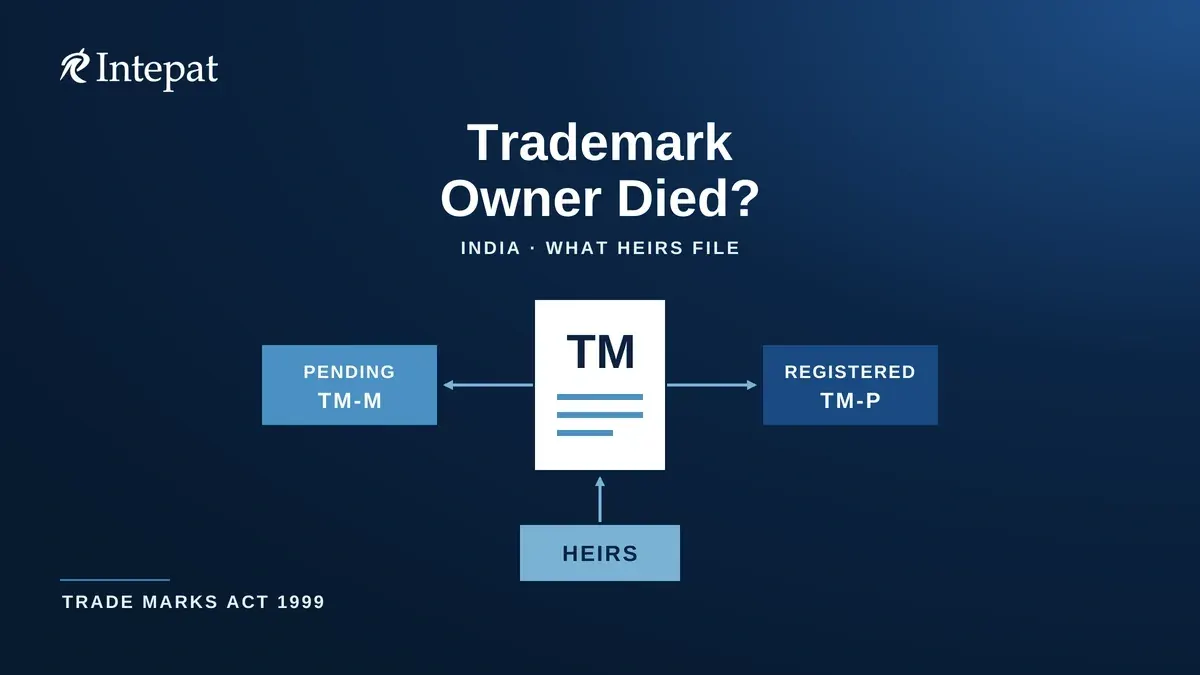
Death of a trademark owner in India: pending or registered?
The first step is to check the status of the mark, because the route depends on it. Before registration, the person named is an applicant and the successor replaces that name in the application. After registration, the person named is the registered owner and the heirs are recorded as the new owner.
Use the application number from the filing receipt, or ask the trademark attorney who filed it. If neither exists, search the Registry’s online public search (it asks for an OTP sign-in) for the owner’s name or the brand, where the search allows. A mark is registered only once the register shows it as registered, however long the business has used it.
Do not assume that the business can simply carry on without updating the register. The register is the public record of who owns the mark, and the Act ties two consequences to it. The Act provides for renewal on application by the registered proprietor, and for a registered mark, until the heirs apply for recording, their transmission is ineffective against a person who acquires a conflicting interest in the mark without knowing of it.
Pending application: substitute the successor
The Rules allow the Registrar to substitute the successor in interest for the deceased applicant, on Form TM-M. The word is “may”: substitution is not automatic, and it needs proof of the death and of the transmission of the interest. The Bombay High Court, discussed below, took the prima facie view that this power is one coupled with a duty to find out who the successor is.
The Rules do not list the papers. Examples are the death certificate, any will, and a document showing who is entitled, such as a legal-heir certificate (an official record of the heirs) or a family settlement (a written arrangement among them). Check that the names and addresses are consistent and explain any difference. Whether an unprobated will (one a court has not validated) is enough is not answered by the Rules, and the Bombay High Court said it was not ruling on the succession-law questions raised on the wills in its case.
If the person who died was also a party to a proceeding before the Registrar, such as an opposition, the Act separately lets the Registrar substitute the successor in that proceeding on request and proof, or let it continue without substitution where the surviving parties sufficiently represent the interest.
Registered mark: record the heirs on Form TM-P
The Act treats a person who becomes entitled to a registered mark by “transmission” in the same way as an assignee. Transmission includes passing by operation of law and devolution on the personal representative of a deceased person. That person applies to the Registrar to register title and is then registered as owner.
The application is made on Form TM-P, with a certified copy of the document that passes title and a statement of case. The Registrar ordinarily disposes of it within three months of the application, may ask for further proof only where there is reasonable doubt about a statement or document, and impounds an instrument that is not properly stamped. Where the validity of the transmission is disputed between the parties, the Registrar may refuse to register it until a competent court has decided.
The Act and the Rules set no deadline for this application after a death. File promptly all the same: until it is filed, the transmission does not bind a person who acquires a conflicting interest without knowledge of it, and the register keeps naming a person who has died. Identify who is legally entitled before filing. If the family wants one person to hold the mark, make sure the arrangement properly transfers the other heirs’ interests, because the Registrar may refuse to record while the validity of the transmission is disputed between the parties, until a court decides. Our guide to assignment of trademarks in India covers the parallel route for a sale, and our guide to trademark ownership in India explains who should hold a family brand.
What the Bombay High Court said in the Mafatlal case
The Bombay High Court judgment of 19 November 2026 (Varun Atulya Mafatlal v Shree Vallabh Chandak, Commercial Miscellaneous Petition 27 of 2024) shows what can go wrong when an application is not properly substituted after a death.
The applicant applied for the SUNGRACE MAFATLAL marks in 2011 and died in July 2013. In December 2015 a relative applied for recording as subsequent owner, producing a will and death certificates, but neither side could show that any order was passed on those applications. The registration certificates were nevertheless sealed in the dead applicant’s name in May and August 2017. In July 2018 the relative was recorded as owner and is said to have assigned the marks to a buyer the next day, and the buyer was recorded as owner in September 2018.
The applicant’s grandson challenged those entries in December 2023. The court held him to be a person aggrieved (someone entitled to bring the petition) but rejected his petition as barred by limitation: the three years ran from the 2018 entries, expired in 2021 while his father was alive, and did not restart because the grandson discovered the entries in 2023. In the court’s words, the right to seek rectification “cannot spring back to life” for each new generation.
The court then acted on its own. It observed that the Registry registered a person who had been dead for nearly four years despite knowing of the death, and directed a new rectification case on its own motion. It issued notice to the current owner, the earlier recorded owner and the dead applicant’s estate, asking why the 2017 registration should not be cancelled, how the Class 25 mark, which the dead applicant’s will does not mention, could have passed to the earlier recorded owner and then validly to the current one, and why the protection of the registration should not be stayed meanwhile. It also called for an affidavit from the Controller General’s office on how the Registry handles an applicant’s death, with replies due by 15 January 2027 and the new case listed for directions on 20 January 2027. It did not rule on the validity of the wills.
The grandson’s petition is finally decided, but whether the marks are cancelled is open. Until the court decides, the case shows what the Registry can be asked to explain, not what the final rule will be.
For a family business the lessons are practical. A filing is not an order: after reporting a death, keep the receipt, check the status and chase a written order or a recorded entry. Do not accept a registration issued in the name of someone who has died without taking advice. The time bar in the case concerned a challenge to someone else’s entry, not the recording of your own title, but it shows that old entries become hard to undo.
Deadlines that keep running
We found nothing in the Act or Rules that pauses an examination reply, a hearing or a renewal because an applicant or owner has died. The table lists the figures that matter, with government e-filing fees as shown on the IP India forms and official fees page, last updated 5 November 2026.
| Step | Period or trigger | E-filing fee (Rs) |
|---|---|---|
| Substitute the successor in a pending application (TM-M) | Before registration is entered | 900 (amendment fee) |
| Record heirs on a registered mark (TM-P) | No deadline in the Rules; ordinarily decided within three months of filing | 9,000 per mark (assignment fee) |
| Reply to an examination report | One month from receipt; the application may be treated as abandoned without a reply | The fee page lists none |
| Renew a registration (TM-R) | Ten years counted from the application date (or a convention priority date), then from each expiry; may be filed up to one year early | 9,000 per class |
| Renew late, with surcharge | Within six months after expiry | 4,500 plus the renewal fee, per class (13,500 in all) |
| Restore after removal | After six months and within one year of expiry, if the Registrar allows | 9,000 plus the renewal fee, per class (18,000 in all) |
Fees were verified as of 6 November 2026. The fee page lists no fee for a death specifically. Rs 900 is its fee for amending an application and Rs 9,000 its fee for registering a subsequent proprietor on an assignment or transfer, so confirm both before filing. Paper filing costs more. The Registrar can extend some times by up to one month on Form TM-M, for sufficient cause and even after the time has run out, but not times that the Act itself fixes, such as the two months from receipt of an opposition notice to file a counterstatement, failing which the application is treated as abandoned, or some times fixed by the Rules. A missed hearing without a reply can also lead the Registrar to treat the application as abandoned.
The Registry’s renewal notice goes to the address for service on the register, which after a death may no longer reach anyone, so do not wait for it. If a renewal falls due while the heirs are still waiting for recording, file to record them first or together, because the Act provides for renewal on application by the registered proprietor, and take attorney advice that week. Where a mark was registered within six months before, or after, its renewal date, the renewal fee may be paid within six months of the actual registration date, so check the certificate. For the renewal side, see our guides to renewal of a trademark in India and a trademark removed for non-renewal; for the examination side, replying to an examination report.
If nothing was filed after the death
If the death was not reported, check the register first. For a pending application, ask for substitution now. For a mark registered in the owner’s lifetime, apply on Form TM-P and keep every document showing how the interest passed. If registration was granted after the applicant’s death, as in the Mafatlal case, a TM-P alone may not cure the defect, so take advice first.
The Act also lets the Registrar or the High Court rectify the register (correct or cancel an entry) on their own motion, after notice and a hearing. For the Registrar, the Rules require a notice allowing at least one month to apply for a hearing, and a person who does not respond may be treated as not wishing to take part. The Bombay High Court, which said it had no rules of its own on the procedure, adopted the same one-month minimum. In the Mafatlal case the scrutiny followed a registration granted after the applicant’s death with the relative’s 2015 applications unresolved and no formal substitution. A mark registered in the owner’s lifetime and not yet updated should still be recorded promptly. If another family member or an outsider disputes the succession, the issue may become a rectification case; our guide to rectification of a registered trademark explains that route.
A checklist for a family business
Seven steps cover the process for a family business, in this order. Settle who will hold the mark before filing anything, because every later step names that person.
- Find the application number, or search the register, and check whether the mark is pending or registered.
- Obtain the death certificate and the papers showing how the interest passes.
- Agree in writing who is entitled and which person or entity will hold the mark.
- File Form TM-M for a pending application, or Form TM-P for a registered mark, and take attorney advice if the heirs disagree or the registration followed the death.
- Keep the filing receipt, check the status and chase a written order or recorded entry.
- Note the next renewal date and any examination or hearing date, and ask for substitution in any live proceeding.
- Put any licence to relatives or the business in writing; see our guide to licensing trademark rights.
FAQ
Not by itself. The Rules allow the Registrar to substitute the successor in interest on Form TM-M, on proof of the applicant’s death and of the transmission of the interest. The word used is “may”, so substitution is not automatic, although the Bombay High Court took the prima facie view that the power is one coupled with a duty to find out who the successor is.
The person who becomes entitled to the mark by transmission applies on Form TM-P. The Act’s definition of transmission includes devolution on the personal representative of a deceased person, so a personal representative can apply as well as a person who inherits. The application carries a certified copy of the document passing title and a statement of case.
The Rules we read do not mention probate. The Bombay High Court noted that the wills in the Mafatlal case were not probated, and said it was not ruling on the succession-law questions raised on them. Whether an unprobated will establishes title depends on succession law and the estate, so ask a trademark attorney before filing.
Nothing in the Act we read ends a registration on the owner’s death. A registration lasts ten years from the application date and is renewed on application by the registered proprietor, so the family must renew on time. A mark removed for non-payment may be restored after six months and within one year of expiry, if the Registrar is satisfied it is just, at a higher fee.
Record the heirs now on Form TM-P if the mark was registered in the owner’s lifetime, or ask for substitution if it is still pending. The Rules set no deadline for recording, but check the renewal history first, because a mark whose renewal and restoration periods have passed may already be removed. The Mafatlal time bar concerned a challenge to another person’s entry.
The Registrar may rectify the register on his own motion, after notice and an opportunity to be heard, and the notice must allow at least one month to ask for a hearing. In the Mafatlal case the High Court used its own power and adopted that minimum. A notice starts a hearing process that can end in an entry being changed or removed.
This article explains the law on the death of a trademark owner or applicant in India as at November 2026 and is for general information only. It is not legal advice. Government fees, forms, and procedures change; confirm current figures with the Trade Marks Registry before you file. For advice on your specific mark, consult a trademark attorney.
Sources
- Trade Marks Act, 1999 (consolidation as on 1 June 2026), India Code: https://www.indiacode.nic.in/bitstream/123456789/1993/1/a199947.pdf
- Trade Marks Rules, 2017, and official fees and forms, IP India (as at November 2026): https://ipindia.gov.in/pages/trade-marks/learn/forms-and-official-fees
- Varun Atulya Mafatlal v Shree Vallabh Chandak, Commercial Miscellaneous Petition No. 27 of 2024, Bombay High Court, 19 November 2026 (copy of the court’s PDF): https://www.livelawbiz.com/pdf_upload/2026/11/21/varun-atulya-mafatlal-713522.pdf