




Domain name trademark registration in India gives you statutory brand rights that owning the domain alone never provides. Under the Trade Marks Act 1999, registration gives exclusive rights to the name, the ability to stop others from using a confusingly similar version, and the right to claim damages or an account of profits.
This article covers Indian law. Domain names are globally registered addresses; trademark rights are jurisdiction-specific. Cross-border protection requires separate filings or a Madrid Protocol application.
| Quick answers |
| • A domain name registration does not create trademark rights. Those come from use or from registration with the Trade Marks Registry. • The e-filing fee for a TM-A trademark application is Rs 4,500 per class for individuals, startups, and small enterprises; Rs 9,000 per class for all other applicants. Both figures are verified as of July 2026. • A registered trademark lasts ten years and can be renewed indefinitely. • If someone takes your brand in a .in domain, the route to recover it is INDRP; if it is a .com or other generic domain, the route is UDRP. The two policies apply different legal tests, and the difference can change the outcome of a real dispute. |
What registering a domain name actually gives you
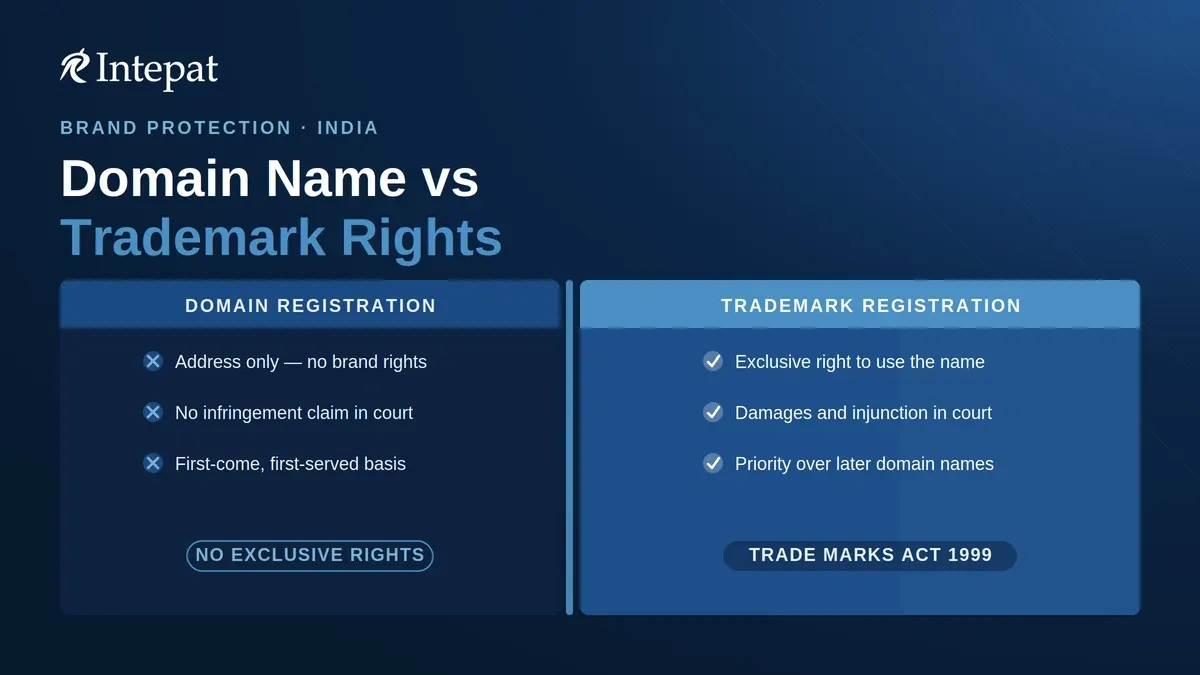
When you register yourbrand.in or yourbrand.com, you are securing an address, a technical locator that directs browsers to your website. Domain registrations operate on a first-come, first-served basis, managed through ICANN for generic domains and through NIXI for .in domains. There is no IP screening at registration: the registrar does not check whether your chosen name conflicts with an existing trademark.
What you get from a domain registration is the right to use that specific address for the registration period, typically one to two years, and to renew it. You do not get any right to stop others from using the same name in another domain extension, on social media, in their business name, or in a physical shop. You also do not get the right to bring an infringement suit or recover damages if a competitor uses a similar name.
That matters because most brand disputes in India are not about who owns the .in URL. They are about who has the right to use the name at all, online and offline. Domain registration does not answer that question.
What a trademark adds that a domain name registration does not
The Trade Marks Act 1999 gives a registered proprietor the exclusive right to use the mark in relation to the goods or services for which it is registered, and to obtain relief in respect of infringement. That right is what allows you to write to a competitor and require them to stop, and to go to court if they do not.
Three things trademark registration does that a domain registration cannot:
It stops others from using your brand name, even in a domain they registered first. A domain registrar issues on first-come, first-served. The Trade Marks Registry considers who has priority of use and registration. If you have a registered trademark and someone later registers a confusingly similar domain, your trademark right is the basis for challenging it.
It gives you a court claim with damages. The Act provides that relief in an infringement suit includes an injunction and, at the plaintiff’s option, either damages or an account of profits. A domain registration gives you no cause of action in court.
It protects the name across classes of goods and services, not only at one URL. A trademark registration in a specific class covers all use of a confusingly similar mark in that class, whether the use is online, in print, in a shop, or in another domain extension.
For unregistered marks, the common law of passing off still applies. The Act preserves the right of action against any person for passing off goods or services as those of another. But to succeed in passing off, you must prove that your mark has acquired goodwill and reputation in India, that the defendant’s use misrepresents the source, and that this causes you damage. That is a heavier burden than an infringement claim, which relies on registration.
Can a domain name be registered as a trademark in India
Yes, a domain name can be registered as a trademark in India, but it must meet the same registrability requirements as any other mark. The Trade Marks Registry applies the standard legal tests under the Trade Marks Act 1999.
The distinctiveness requirement. A mark must be capable of distinguishing your goods or services from those of others. Marks that are devoid of distinctive character, or that consist exclusively of words describing the kind, quality, quantity, intended purpose, value, or geographical origin of the goods or services, are refused under Section 9 of the Act. A domain name that is purely descriptive, for example onlinefruitshop.in, would face an objection on this ground, because the name simply describes what the business does.
The Act provides a route around this barrier: a mark that would otherwise be refused for descriptiveness can still be registered if, before the date of the application, it has acquired a distinctive character as a result of use. This means that a domain name you have used long enough to be recognised by the public as identifying your business can qualify for registration even if it started out as descriptive.
What the Registry examines. The Registry looks at whether the domain name, stripped of its technical suffix (the .com, .in, or .org part), is distinctive enough to function as a trademark. The suffix itself is not generally considered distinctive, because all domain names carry one. The substance of the name is what matters.
Which part of the domain to register. The table below sets out the main choices and when each fits best.
| Filing option | When it may fit | Scope to consider |
| Core brand as a word mark | The same name appears on products, apps, invoices, and across multiple domains | Usually the commercially useful filing, subject to clearance and registrability |
| Full domain wording | The complete address is consistently presented as the source identifier | Protection is tied to the mark as filed and the covered goods or services |
| Logo or composite mark | Stylisation is commercially important or the word element alone faces registrability difficulty | The registration may depend more on the overall visual presentation |
Class selection. Trademark registration in India is class-based. Goods and services are classified in the manner prescribed by the Rules, following the Nice Classification (45 classes). You register in the class or classes that cover your actual business. A technology platform would typically register in Class 42; an online retailer may need multiple classes. Getting the class right affects both what you are protected against and the cost of the application.
A common mistake is registering only in the class most obviously connected to the business, and then finding that a competitor is using a similar name in a related class the registration does not cover. Conducting a trademark search before filing helps identify both existing conflicts and the right class strategy.
Search earlier rights before filing
Filing a trademark application does not automatically clear the name. Section 9 bars marks that lack distinctiveness or are purely descriptive. Section 11 means earlier rights in a confusingly similar name, whether from a prior registration or from established commercial use, may be raised against the application in examination or opposition.
Registration is also not a complete answer to prior users. A person who has continuously used an identical or nearly resembling mark from a date before the registered proprietor’s use, or before the date of registration, retains the right to continue that use. How prior use rights work is part of assessing what a registration will deliver.
A clearance search should cover the core brand element, close spellings, phonetic variants, and related classes. Domain availability does not substitute for this: a name can be available as a domain and blocked as a trademark.
Domain name trademark registration: what it costs and how long it lasts
Filing fee. The TM-A application fee is set by the First Schedule to the Trade Marks Rules 2017. The e-filing fee is Rs 4,500 per class per mark for individuals, startups, and small enterprises. For all other applicants, it is Rs 9,000 per class per mark. Physical filing costs Rs 5,000 and Rs 10,000 respectively. These figures are verified as of July 2026; confirm current figures with the Trade Marks Registry before filing.
| Applicant category | E-filing | Physical filing |
| Individual, startup, or small enterprise | Rs 4,500 | Rs 5,000 |
| All other applicants | Rs 9,000 | Rs 10,000 |
The full breakdown of fees by applicant type, class, and renewal stage is in the firm’s trademark fees guide.
Term and renewal. A trademark registration lasts ten years from the date of registration, after which it can be renewed for further periods of ten years. There is no limit on the number of renewals, so a mark can be held indefinitely by an owner who keeps it current. Missing the renewal date triggers a grace period rather than immediate loss, but letting registration lapse carries risks, including the possibility of a third party filing for the same name. Renewal procedures and timing are in the trademark registration process guide.
What registration gives you from day one. From the date of application, you can use the TM symbol next to your name as a marketplace signal that you have a pending application. The ® symbol is reserved for registered marks only, after the registration is confirmed. This distinction matters: using ® before registration is a compliance issue that can affect your position in an opposition or enforcement action.
Someone is using your brand in their domain: choosing your route
If you discover that someone has registered a domain name that incorporates your trademark, or a confusingly similar version of it, three routes are available in India.
Administrative dispute resolution: INDRP for .in domains, UDRP for generic domains. These are faster and less expensive than litigation. They are decided by a single arbitrator or panel, and their remedies are limited to transfer or cancellation of the domain. Neither policy awards damages.
The .in Dispute Resolution Policy (INDRP) is administered by NIXI, the National Internet Exchange of India, which operates the .in registry. A complaint is filed with NIXI, an arbitrator is appointed within five working days, and the award is made within 60 days of the arbitration commencing, extendable by up to 30 days in exceptional circumstances. The filing fee is Rs 30,000 plus 18% GST, verified as of July 2026. Before sending any notice to the registrant, consider whether doing so may prompt them to change or remove the website before you have captured evidence. Screenshot the domain content and preserve registration data first.
For generic domain extensions such as .com, .net, and .org, the Uniform Domain Name Dispute Resolution Policy (UDRP) applies, administered by accredited providers including WIPO, the UN agency for intellectual property.
Court proceedings. A suit for trademark infringement or passing off before the District Court offers the full range of remedies: injunction, and at the plaintiff’s option, either damages or an account of profits, with or without delivery-up of infringing material for destruction. Court proceedings take longer and cost more than administrative routes, but where damages are material or the defendant is operating at scale, the court route gives remedies that neither arbitration policy can match.
For suits involving a registered trademark, the plaintiff may sue in the District Court where the plaintiff carries on business. For a passing-off suit involving an unregistered mark, that extended forum provision does not apply; the suit must be brought where the defendant carries on business or where the cause of action arose.
Cease-and-desist correspondence. A letter from a trademark agent or attorney often resolves a dispute without formal proceedings. Many domain squatters who are not commercially active respond to a formal demand. This is especially worth attempting where the registrant is based in India and the domain is not actively trading, and provided you have preserved all relevant evidence before making contact.
For more on the passing-off claim and what it requires, see the article on passing-off action for domain names. For a full treatment of cybersquatting, bad-faith registration, and how courts have addressed it in India, see the cybersquatting in India guide.
Why the .in route and the .com route are not the same test
This difference is specific enough to change the outcome of a real dispute, and it is rarely explained clearly enough to be useful.
INDRP uses a disjunctive bad-faith test. Under the INDRP policy, a complainant must show that the domain was registered or is being used in bad faith, or for an illegal or unlawful purpose. Satisfying either limb is sufficient.
UDRP uses a conjunctive bad-faith test. Under UDRP paragraph 4(a)(iii), a complainant must show that the domain was registered and is being used in bad faith. Both limbs must be satisfied. Losing on either one means losing the complaint.
On the face of it, this makes a .in complaint easier to win than a UDRP complaint where the squatter registered in bad faith but has since left the domain inactive. That reading is partly right but needs one qualification.
Passive holding of a domain does not automatically defeat a UDRP complaint. WIPO Overview 3.0, section 3.3, records the consensus position that inactive holding can still support a bad-faith finding where the panel considers the overall circumstances: the mark’s distinctiveness and reputation, the respondent’s failure to provide any evidence of good-faith use, and the implausibility of any legitimate use. The disjunctive INDRP test gives a clearer route where use cannot be established, but a well-evidenced UDRP complaint can still succeed against a passive squatter.
The more fundamental point is this: INDRP governs .in domains and UDRP governs generic top-level domains. They are not alternatives for the same domain. A complainant with a stolen .in domain files under INDRP. A complainant with a stolen .com files under UDRP. Filing under the wrong policy would result in a complaint that cannot proceed. The firm’s UDRP guide covers the full UDRP process for generic domains.
How Indian courts treat domain names
Indian trademark law does not have a provision that specifically addresses domain names. The courts have instead applied existing trademark and passing-off principles to domain disputes, and the position has been consistent since the first reported case in 1999.
Yahoo Inc v Akash Arora, decided by the Delhi High Court in 1999, was the first domain passing-off case in India. The court held that a domain name is more than an internet address and that using a name closely resembling an established internet brand was capable of misleading the public. The court granted the injunction even though the defendant had added the word “India” to the domain name, holding that the addition was insufficient to distinguish it.
The Supreme Court addressed the position directly in Satyam Infoway Ltd v Sifynet Solutions Pvt Ltd (2004). The Court held that domain names serve as business identifiers online, distinguishing the specific internet businesses of different companies, and that they are entitled to protection in the same way trademarks are. The Court also confirmed what remains the legal position today: India has no legislation that explicitly addresses domain name dispute resolution. Protection comes through passing off and, where a trademark is registered, through infringement law.
The practical consequence is that your strength in a court dispute depends primarily on the strength and priority of your trademark rights, not on whether you own the domain. A registered trademark, properly maintained, is a stronger instrument in a domain dispute than a domain registration held for ten years.
What to do before you file
Registering a domain name and registering a trademark are two separate acts. Doing both in the right order reduces the risk of conflict.
Before filing, a thorough trademark clearance search will show whether any existing registration or pending application conflicts with your chosen name. The search should cover all classes in which you intend to use the mark, phonetic variants, and confusingly similar marks. Many domain names that look distinctive conflict with earlier registrations in the relevant class.
After registration, understanding trademark symbols and keeping the right documentation keeps your registration current and enforceable.
For businesses seeking well-known trademark status, the enforcement position is stronger: well-known marks in India are protected across all classes, reducing the risk of a squatter claiming a legitimate interest based on a different line of business.
A full overview of trademark classes, the available remedies in trademark enforcement, and a guide to what a trademark is and the types available are in the linked articles.
Frequently Asked Questions
No. Registering a domain name does not create trademark rights. Trademark protection in India comes from registration under the Trade Marks Act 1999 or from established use that gives rise to passing-off rights. A domain name registration is a technical address allocation and carries no right to stop others from using the same name commercially.
Yes, provided the domain name meets the registrability standards under the Trade Marks Act 1999. The name, excluding the technical suffix, must be distinctive or must have acquired distinctiveness through use before the application date. Names that are purely descriptive of the goods or services face an objection unless acquired distinctiveness can be demonstrated.
The core brand is usually the more commercially useful filing where the same name appears across products, apps, invoices, and multiple domain extensions. Filing the full domain address may fit where that complete address is consistently used as the source identifier. Either choice is subject to clearance, distinctiveness, and the goods or services claimed.
The e-filing fee for a TM-A application is Rs 4,500 per class for individuals, startups, and small enterprises. For all other applicants, the fee is Rs 9,000 per class. Each class requires a separate fee. These figures are from the First Schedule to the Trade Marks Rules 2017, verified as of July 2026.
A trademark registration lasts ten years from the date of registration and can be renewed for further ten-year periods. There is no cap on renewals, so a mark can be held indefinitely. Renewal fees must be paid on time; a grace period applies, but the mark can be removed from the register if fees are not settled.
INDRP governs .in domain disputes through NIXI. UDRP governs covered generic top-level domains through approved providers. INDRP requires bad faith in registration or use; UDRP requires bad faith in registration and use. Passive holding can still support UDRP bad faith on the right facts, but the disjunctive INDRP test is clearer where active use cannot be shown.
Yes. For a .in domain, an INDRP complaint with NIXI can result in transfer or cancellation if the three-limb test is met. For a generic domain, the route is UDRP. Court proceedings are also available and can produce damages. The right to use the recovered domain depends on your underlying trademark and use rights.
Not invariably. INDRP recognises rights in a name, trademark, or service mark. UDRP panels may accept an unregistered mark where evidence shows consumers associate it with the complainant’s goods or services. A registered trademark makes the complainant’s rights far easier to establish and reduces the scope for the respondent to challenge the first limb of the test.
This article explains the law on domain name trademark registration in India as at July 2026 and is for general information only. It is not legal advice. Registry fees, forms, and timelines change; confirm current details with the Trade Marks Registry before you act. INDRP fees should be confirmed with NIXI directly. Deadlines in enforcement and dispute resolution are strict; missing one can affect your rights. For advice on your specific mark or dispute, consult a qualified trademark agent or attorney.