



A patent is an exclusive statutory right granted under the Patents Act, 1970 that allows an inventor to prevent others from making, using, selling, or importing the patented invention in India for up to 20 years from the date of filing. Most founders treat it as a certificate. It is not. It is a legally enforceable right, and whether it actually protects anything depends entirely on how well the underlying invention was defined, prosecuted, and maintained.
In practice, most patent applications in India do not fail because the invention lacks merit. They fail because the specification does not enable the invention, or the claims do not capture the inventive contribution at the correct level of abstraction.
Picture a SaaS startup in Bangalore. The founding CTO has spent 18 months building a proprietary data compression algorithm that reduces API response times by 60 percent. The product is already generating early revenue. A Series A round is three months away. The CTO wants to know: should we file a patent before the investor meeting? Does it protect us from a well-funded competitor who could reverse-engineer the algorithm once we launch? What happens if we wait?
This guide answers those questions in full. It covers the legal definition under Indian law, the three patentability criteria, the types of patents available, the business and legal benefits of filing, how the Indian system works from application to grant, international protection options, and the real cost of doing nothing. Practitioners arriving for a specific section can navigate directly using the headings below.
For the step-by-step filing procedure, see Patent Filing in India: Step-by-Step Procedure and Process. For the examination process after filing, see Patent Examination in India: Procedure, Timelines and Deadlines.
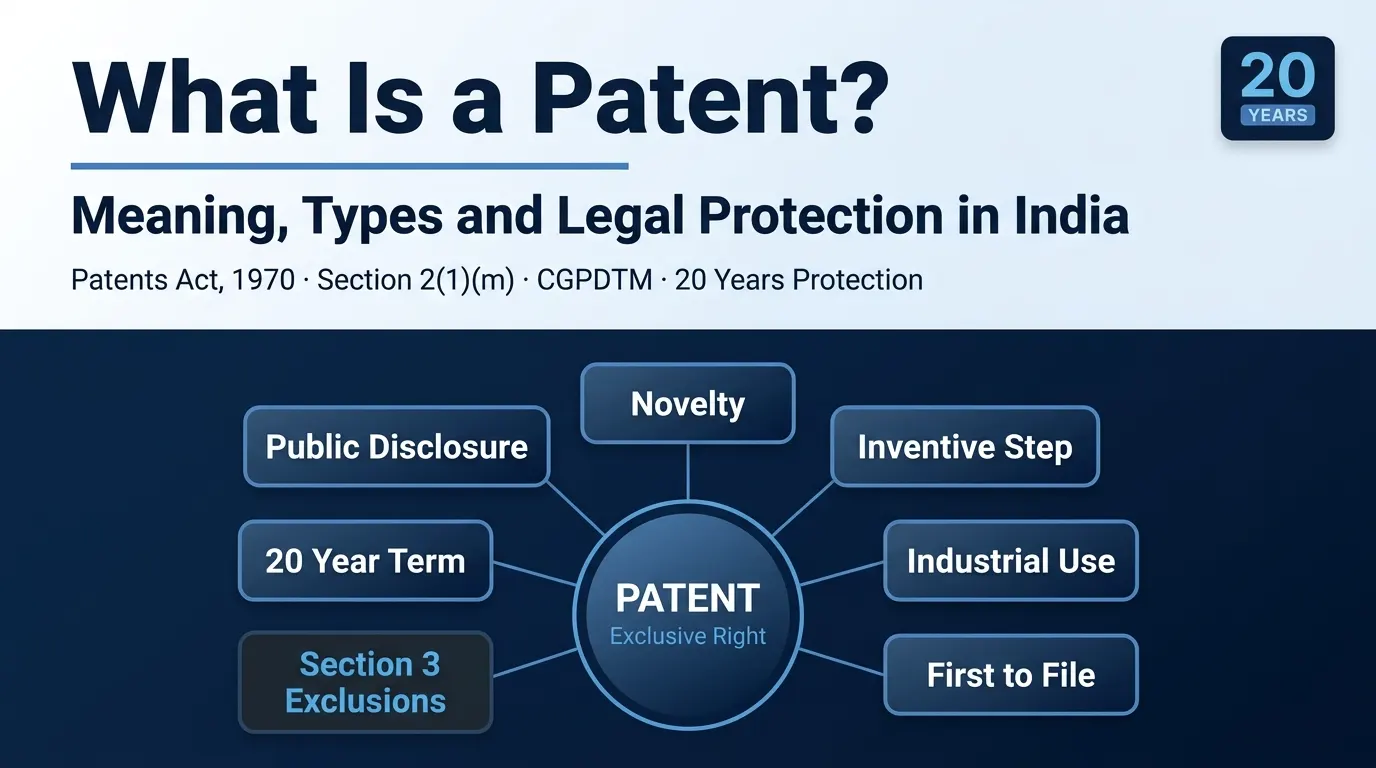
Key Takeaways
- Definition: A patent is a time-limited exclusive right granted by the government in exchange for full public disclosure of the invention.
- Duration: 20 years from the date of filing in India. Renewal fees are payable from the third year, calculated from the date of filing.
- Three criteria: Novelty, inventive step, and industrial applicability. All three must be satisfied. Section 3 and Section 4 list what is excluded regardless of these criteria.
- Filing is not the finish line: Submitting an application does not trigger examination. You must separately file a Request for Examination (Form 18) within 31 months and pay the prescribed fee, or the application is permanently withdrawn.
- What cannot be patented: Section 3 and Section 4 of the Patents Act, 1970 exclude abstract mathematical methods, business methods, computer programs per se, discoveries of natural phenomena, and nuclear inventions, among others.
- India is a first-to-file jurisdiction: Priority belongs to the first applicant to file, not the first to invent.
- Provisional filing is available: A provisional application reserves your priority date before the complete specification is ready, giving up to 12 months to file the complete application.
| Estimate Your Patent Filing Cost |
| Filing fees vary by applicant type: natural person, startup, small entity, or company. Use the Patent Fees Calculator to get the applicable government fee for your situation before you decide. |
Quick Reference: Indian Patent at a Glance
| Parameter | Detail |
| Governing statute | Patents Act, 1970 (as amended) |
| Administering authority | Office of the Controller General of Patents, Designs and Trade Marks (CGPDTM) |
| Protection period | 20 years from the filing date (or priority date); renewal fees payable from the third year, calculated from the date of filing |
| Patentability criteria | Novelty [Section 2(1)(l)], Inventive Step [Section 2(1)(ja)], Industrial Applicability [Section 2(1)(ac)] |
| Application form | Form 1 (Application for Patent) + Form 2 (Provisional or Complete Specification) |
| Examination trigger | Form 18 (Request for Examination): 31-month deadline for post-15 March 2024 filings |
| Expedited examination | Form 18A: available to startups, small entities, female applicants, and PCT-route applicants |
| Publication | Automatic at 18 months from priority date; early publication via Form 9 |
| Renewal fees | Annual, from year 3; non-payment results in lapse under Section 53 |
1. What Does “Patent” Mean? The Legal Definition and Its Limits
The Patents Act, 1970 defines a “patent” under Section 2(1)(m) as a patent for any invention granted under the Act. Under Indian law, a patent is the specific bundle of rights the Act creates and the CGPDTM administers, giving exclusive control over making, using, selling, and importing the invention for 20 years. The right is not inherent; it is conferred.
An “invention” under Section 2(1)(j) means a new product or process involving an inventive step and capable of industrial application. The two parts work together: the invention must be new, and it must be something you can actually build or use. A purely theoretical idea, a mathematical formula with no specific application, or a method of doing business does not qualify; regardless of how innovative it seems to the person who thought of it.
Exclusivity in practice
Section 48 of the Patents Act gives the patentee the exclusive right to prevent third parties who have not obtained the owner’s consent from making, using, offering for sale, selling, or importing the patented product in India. For a patented process, the same exclusivity applies to the process itself and to the product directly obtained by that process.
This means that an infringer does not need to copy your patent document or even know your patent exists. If a competitor independently develops the same invention and launches it commercially, you can enforce your rights against them. The right protects the territory of the invention, not just the specific document.
What a patent does not protect
A patent does not protect a brand name, logo, or trade dress; that is trademark law. It does not protect a creative work such as software code, a manual, or a design aesthetic, which fall under copyright and design law respectively. It does not protect confidential information that you choose not to disclose, which is governed by trade secret law.
A patent requires full public disclosure of the invention. Once an application is published (automatically at 18 months from the priority date), the technical details become publicly accessible. This is the core bargain of the patent system, known as the quid pro quo: society grants you a time-limited monopoly; in exchange, you teach the world how your invention works. After the 20-year period expires, anyone can use the invention freely.
The quid pro quo: why the system exists
Before such systems existed, inventors faced an impossible choice: keep an invention secret (losing the ability to commercialise it openly) or disclose it (allowing competitors to copy it). The system resolves this by creating a legal mechanism that rewards disclosure.
2. The Three Patentability Criteria Under Indian Law
The three patentability criteria in India are novelty, inventive step, and industrial applicability. All three must be satisfied for a patent to be granted. A deficiency in any one of the three is grounds for refusal.
2.1 Novelty
Section 2(1)(l) defines a “new invention” as one that has not been anticipated by prior art. Prior art under Indian law includes any document, use, or disclosure anywhere in the world before the date of the patent application. India does not limit prior art to Indian publications: a journal article published in Germany, a US patent granted in 2019, or a product demonstrated at a trade show in Japan all constitute prior art against an Indian patent application.
Sections 29 through 34 provide a limited set of grace period exceptions: prior disclosure at certain international exhibitions under Section 31, and prior disclosure in a paper read before a learned society under Section 30. These exceptions are narrow. The safest position is always to file before any public disclosure, since relying on a grace period exception carries prosecution risk. For a detailed treatment of prior art and anticipation, see Novelty requirements in Indian patent law.
For the Bangalore SaaS startup in our opening scenario: if the CTO demonstrated the algorithm in a product demo at a startup competition six months ago, that demonstration constitutes prior disclosure. Whether it bars novelty depends on whether it was sufficiently enabling, meaning a person skilled in the field could reproduce the invention from it. A general product demo is usually insufficient. A technical presentation with implementation details could be fatal to novelty.
When in doubt, file first. The cost of a provisional application is a fraction of the cost of finding out the disclosure was enabling.
2.2 Inventive Step
Section 2(1)(ja) defines “inventive step” as a feature of an invention that involves technical advance over existing knowledge, or that has economic significance, and that makes the invention not obvious to a person skilled in the art.
The “person skilled in the art” is a legal construct: a hypothetical expert who knows everything in the prior art but has no capacity for inventive thought. If such a person would arrive at the invention simply by combining existing pieces of knowledge in an obvious way, the invention lacks an inventive step.
The test is objective, not subjective. An examiner cannot simply assert that the invention feels obvious: they must identify the specific prior art combination and explain why the skilled person would have been motivated to combine it in the way the invention does.
In practice: combining two known technologies in a way that achieves a predictable result is generally obvious. Combining them in a way that achieves an unexpected result, or solving a problem that the prior art recognised but failed to solve, is more likely to pass the inventive step test. For a cross-jurisdictional comparison of how India, Europe, and the US apply the inventive step and non-obviousness standards, see Non-obviousness: comparison between India, Europe and the US. For software-adjacent inventions, the inventive step analysis often overlaps with the Section 3(k) question discussed in Section 2.4 below.
2.3 Industrial Applicability
Section 2(1)(ac) defines industrial applicability as the ability of the invention to be made or used in an industry. The standard is broad: manufacturing, agriculture, and technology all qualify. The requirement becomes material primarily for speculative or AI-driven inventions where operability at the time of filing is unclear. For most technology inventions it does not present an obstacle. For the full statutory analysis, see Industrial applicability in Indian patent law.
2.4 What Cannot Be Patented: Section 3 and Section 4 Exclusions
Clearing the three criteria is not enough on its own. Section 3 of the Patents Act lists categories of subject matter that are simply not patentable under Indian law, regardless of how novel or inventive they are. If your invention falls within any of these categories, the criteria do not matter.
The exclusions most relevant to technology and startup applicants include:
- Section 3(k): A mathematical or business method, a computer program per se, or algorithms. This is the primary barrier for software patent applications. The word “per se” is critical: it means a computer program that is merely a computer program, with no associated technical effect or contribution, is excluded. A program that produces a technical effect beyond the normal physical interactions between the program and the computer on which it runs may be patentable.
- Section 3(m): A mere scheme or rule or method of performing a mental act or method of playing a game.
- Section 3(d): A new form of a known substance that does not result in the enhancement of the known efficacy of that substance. Most frequently applied in pharmaceuticals, but capable of affecting chemical and material innovations more broadly.
- Section 3(j): Plants and animals in whole or any part thereof other than microorganisms, including seeds, varieties, species, and essentially biological processes for the production of plants or animals.
- Section 3(p): Traditional knowledge or an aggregation or duplication of known properties of traditionally known components.
Section 4 separately excludes inventions relating to atomic energy, referencing Section 20(1) of the Atomic Energy Act, 1962. No patent can be granted for any invention that is useful for or relates to the production, control, use, or disposal of atomic energy.
For the complete list of Section 3 exclusions with examples and case analysis, see What cannot be patented in India. For software and AI-based inventions, the CGPDTM’s CRI Guidelines 2025: Practitioner’s Guide to Software Patent Examination provide the operative examination standard for Section 3(k) objections. The technical effect test is the central analytical tool.
3. Types of Patents and Patent Applications in India
India recognises six types of patent applications: provisional, complete, convention, PCT national phase, patent of addition, and divisional. Each serves a different strategic purpose. Choosing correctly at the outset preserves options that cannot easily be recovered later. Read more: Types of Patent Applications in India.
3.1 Provisional Application
A provisional application, filed under Section 9(1) with Form 2, allows an applicant to secure a priority date before the complete specification is ready. The provisional specification must describe the invention sufficiently to establish the subject matter, but it does not need to contain full claims.
The applicant has 12 months from the filing date of the provisional application to file the complete specification. If the complete specification is not filed within this period, the application is treated as abandoned.
A provisional application is the right choice when the invention is sufficiently defined to describe but the claims are not yet finalised, or when the applicant needs to present the invention to investors or partners before the complete specification is ready. Filing a provisional costs less than a complete application and stops the prior art clock from running against you while you refine the invention.
For the full procedure, see How to File a Provisional Patent Application in India.
3.2 Complete Application
A complete application is filed directly under Section 9(1) or as a follow-on to a provisional application within the 12-month window. The complete specification must contain the title, full description, drawings (if any), an abstract, and the claims. The claims define the scope of protection, meaning what the patent covers.
The quality of the complete specification determines the ultimate value of the patent. A poorly drafted specification may result in objections that cannot be overcome, or in claims that are so narrow after amendment that the patent protects little of commercial value. This is the primary reason professional prosecution adds value that is difficult to recover later.
3.3 Other Application Types
Four further application types are available under the Patents Act. Each preserves the priority date of an earlier filing.
| Application Type | Purpose and Key Deadline |
| Convention Application (Section 135) | Claims priority from a Paris Convention country filing. Must be filed within 12 months of the earliest priority date. Standard route for foreign applicants extending Indian protection. |
| PCT National Phase (Section 7(1A)) | Entry within 31 months from priority date for applications filed on or after 15 March 2024. India also serves as ISA; examiners conduct prior art searches for PCT applications filed through India. See PCT National Phase India: 31-Month and RFE Rule. |
| Patent of Addition (Section 54) | Protects an improvement to an existing patented invention without a new application. Same expiry date as the main grant. If the main grant lapses, the addition may continue as an independent patent subject to statutory conditions. See Patent of Addition vs Divisional Application. |
| Divisional Application (Section 16) | Filed when a single application claims more than one invention. Retains the parent filing date. Subject matter must not repeat claims from the parent application. |
4. Why File a Patent? Nine Business and Legal Benefits
There is one core commercial reason to file: you get the right to stop a competitor from using your technology. Everything else on this list – the investor signal, the licensing revenue, the balance sheet asset – flows from having that right, or is a cost of not having it.
4.1 Exclusive Market Rights
A granted patent under Section 48 gives you the right to seek an injunction, damages, or an account of profits against any infringer. The Delhi High Court and other High Courts have granted interim injunctions in patent infringement cases, which can halt a competitor’s production or sales while the main suit is heard. In practice, many infringement disputes resolve before reaching trial, the existence of the patent and the credibility of the claim is often enough.
For a SaaS company, this matters more than most founders realise. “Making” the invention includes running the process on a server. A competitor who builds the same functionality independently and launches a competing service is still infringing; it does not matter that they wrote their own code. The right covers the technical territory, not the specific implementation.
4.2 Investor and Due Diligence Signal
Institutional investors, including venture capital funds, private equity, and strategic acquirers, often evaluate patent portfolios as a proxy for technical defensibility. A Series A investor seeing a filed (or granted) application on a core algorithm can point to protectable technical differentiation, a technology novel enough to survive examination, and a company that has begun building an IP portfolio.
The signal works even before grant. A pending application establishes a priority date and “patent pending” status, enough to anchor the IP conversation at a due diligence meeting. Founders who have filed, even provisionally, consistently have smoother investor conversations about IP than those who have not. For more on portfolio strategy, see our guide on the importance of building a patent portfolio.
4.3 Reduced Filing Fees for Startups and Small Entities
The First Schedule to the Amendment Rules, 2024 prescribes significantly lower fees for startups, small entities, and natural persons. For e-filing, a startup pays ₹1,600 for Form 1 versus ₹8,000 for a company, a saving of ₹50,000 or more across the full prosecution lifecycle. Startup eligibility requires DPIIT recognition; small entity status requires a Udyam Registration Certificate. Use the Patent Fees Calculator to confirm fees for your entity type.
4.4 Licensing Revenue
Under Section 70, the owner can grant exclusive or non-exclusive licences. The non-exclusive route lets you license the same technology to multiple parties simultaneously, royalty income without transferring the right or building the product yourself. For research institutions, universities, and companies that hold a patent but cannot scale manufacturing, this is sometimes the only realistic commercialisation path. See Patent Licensing and Commercialisation.
4.5 Freedom to Operate and Cross-Licensing
A patent in your portfolio creates negotiating leverage with competitors who hold blocking rights in adjacent technology areas. Most large technology companies do not actively sue on their portfolios, they hold them as a deterrent. The implicit message to any competitor considering an infringement claim is: we have rights too. Without a portfolio, that conversation is one-sided.
4.6 Three Further Commercial Advantages
Publication at 18 months creates a competitive intelligence window: your competitors’ applications on InPASS and WIPO PatentScope reveal their R&D directions, and your own published specification establishes prior art that prevents them from patenting around your disclosed approach. Granted patents are also intangible balance-sheet assets that can be valued, securitised, and used as collateral for structured finance. And under Section 108, courts can award injunctions, damages, or disgorgement of profits against infringers; Indian courts have moved toward commercially meaningful awards rather than nominal amounts.
4.9 Foundation for International Filing
An Indian filing date establishes a Paris Convention priority date usable in other countries within 12 months. A PCT application from India extends that window to 30-31 months across 150+ countries. Every downstream international application rests on how well the Indian specification and claims are drafted. See How to File a PCT International Application from India.
5. When Should You File? Four Decision Triggers
The theoretical case for filing is straightforward. The harder question is timing. Most inventors and founders delay filing not because they decide against it, but because no single moment feels urgent enough. These four triggers identify when delay stops being a planning choice and starts being a risk.
Before investor discussions — a pending application is a diligence asset
Institutional investors conduct IP diligence. A pending application on a core technology is a concrete diligence asset; an unfiled invention is a gap. The CTO in our opening scenario is three months from a Series A: filing a provisional now still captures the priority date before the investor relationship begins. A provisional filed two weeks before a seed round costs far less than the legal complexity of an unfiled invention when due diligence starts.
Before any public disclosure — India has no general grace period
India does not operate a general grace period for inventor disclosures. A conference presentation, a product demo, a blog post, a pitch deck shared without an NDA, any of these can constitute prior art against your own application. The rule is simple: file before you disclose.
When the technology is your moat
Not every feature of a product warrants a patent. The relevant question is whether the technology at issue is the reason customers choose your product over a competitor. If the answer is yes, that technology is worth protecting. A patent on a peripheral feature has limited strategic value. A patent on the core mechanism that drives retention, margin, or competitive advantage is a material business asset.
When the market is competitive and visible
The risk of a competitor filing first scales with market size and visibility. A startup operating in stealth in a niche market faces different timing pressures than a company preparing a public launch in a sector with well-funded incumbents. As a general rule: the larger and more competitive the target market, the earlier the filing should occur relative to launch.
6. How the Indian Patent System Works: From Filing to Grant
The Indian patent process has five stages: filing, automatic publication at 18 months, a separately filed Request for Examination (Form 18), examination and response to the First Examination Report, and grant or refusal. The process is deferred by design; filing does not trigger automatic review. The examination request deadline is the single most consequential date in the entire lifecycle.
6.1 Filing
An application is filed at one of the four Indian Patent Office branches (Delhi, Mumbai, Chennai, or Kolkata), with jurisdiction determined by the applicant’s address for service. E-filing is available and is the standard route. The filing package includes Form 1 (Application), Form 2 (Provisional or Complete Specification), and any additional forms required for the applicant’s situation (Form 3 for Section 8 disclosures, Form 5 for declarations as to inventorship, and so on).
6.2 Publication
Publication happens automatically 18 months from the priority date, and the applicant does not need to trigger it. The practical reason this matters: from the publication date, third parties can search and read your specification. If you need publication earlier (for a licensing discussion or an investor meeting), file Form 9 and the Office typically publishes within a month.
Publication triggers the ability of third parties to file pre-grant opposition. It also begins the period during which the patent specification is publicly searchable.
6.3 Request for Examination
This is the most operationally critical deadline in the Indian patent lifecycle. Under Section 11B of the Patents Act, examination commences only after the applicant (or any interested person) files a formal Request for Examination (Form 18) and pays the prescribed fee.
| Critical Deadline — Form 18 (Request for Examination) |
| For applications filed on or after 15 March 2024: the RFE must be filed within 31 months from the priority date. For earlier applications, the deadline is 48 months. Missing either deadline results in deemed withdrawal under Section 11B(4), a statutory lapse with no statutory mechanism for condonation or revival. Rule 137(2)(iv) expressly bars condonation. See Filing the Request for Examination in India: Deadlines, Consequences and Procedure for the full compliance guide. |
6.4 Examination and First Examination Report
Once the RFE is filed, the Controller assigns it to an examiner under Section 12. The examiner conducts a prior art search under Section 13 and prepares the First Examination Report (FER). Under the ordinary examination route, the FER currently issues 12 to 24 months after RFE filing across most technology fields.
The FER sets out objections under the Act, typically including novelty, inventive step, patentable subject matter, and formal requirements. The applicant has 6 months from the FER date to respond, with a 3-month extension available via Form 4 if filed before the initial period expires.
Applicants who qualify for expedited examination (startups, small entities, female applicants, and certain PCT-route applicants) can file Form 18A to enter a priority queue where the FER typically issues within 1 to 3 months. For eligibility criteria and procedure, see Expedited Patent Examination in India.
6.5 Grant or Refusal
After the applicant’s response to the FER resolves all objections, or after a hearing under Section 14 if required, the Controller may grant or refuse the application under Section 15. Grant is not a formality roughly a third of examined applications are refused or abandoned before this point. A granted patent is published in the Official Journal and annual renewal fees become payable from the third year.
For the full examination workflow including FER structure, response strategy, and hearing procedure, see Patent Examination in India: Procedure, Timelines and Deadlines.
7. Patent Protection Beyond India: Paris Convention and PCT
An Indian patent protects only within Indian territory. Two mechanisms extend that protection internationally: the Paris Convention, which gives a 12-month window to file in other member countries from the Indian filing date, and the Patent Cooperation Treaty (PCT), which extends that window to 30-31 months across 150+ countries through a single international application. An Indian filing establishes the priority date for both.
One point that surprises many applicants: a poorly drafted Indian specification does not just weaken the Indian patent; it becomes prior art against your own foreign applications. Every national phase entry downstream draws on the same disclosure. Getting the Indian filing right is not just an Indian concern. For the complete PCT national phase procedure from India, see How to File a PCT International Application from India.
8. The Cost of Not Filing: What Happens When a Competitor Patents Your Invention
Not filing a patent is itself a risk decision. India is a first-to-file jurisdiction: whoever files first holds the priority date, regardless of who invented first. If a well-funded competitor has been watching the Bangalore SaaS startup since its public beta and files a patent on the same data compression method next month, the CTO faces exactly the consequences listed below, not as a hypothetical but as a prosecution reality. The cost of a provisional filing in year one is typically less than one hour of litigation time.
India operates a first-to-file system. The applicant who files first holds the priority date, regardless of who developed the invention earlier. There is no “first to invent” defence in Indian patent law equivalent to the US pre-AIA system. If a competitor files a patent application covering your technology before you do, they may obtain rights they can then assert against you in your own market.
The practical consequences of a competitor holding such rights over technology you use include: an injunction forcing you to redesign or shut down the relevant product feature; a compulsory licence demand, where you pay ongoing royalties for permission to continue; damages or an account of profits for the period of infringement before the injunction; and the loss of a patent portfolio asset that you could have used for cross-licensing or investor purposes.
The technology does not need to be identical. A competitor with a broadly drafted patent covering a method or process may be able to assert it against a product that uses a similar but independently developed method. Claim scope, not inventive similarity, determines infringement. This is why claim drafting quality matters: an overly narrow patent is little better than no protection at all.
For a startup heading into a Series A round, a competitor’s patent on core technology is a material due diligence finding that can reduce the valuation, require an escrow for indemnification, or in extreme cases block the transaction entirely. The cost of filing a provisional application in the first year of product development is trivially small against this risk.
Most Indian patent applications that fail share four predictable failure patterns: Section 3(k) mis-framing of the claims, claim scope that is too narrow or too broad, premature public disclosure before filing, and an incomplete specification. At Intepat we see all four regularly. All are avoidable before filing. None are easily corrected after the First Examination Report arrives. At that point the specification is locked and the examiner’s prior art has already been cited.
9.1 Section 3(k) Mis-Framing
Section 3(k) is the most common source of patentable subject matter objections in technology applications; we see it in roughly half of all technology applications we take over from self-filers or offshore agents unfamiliar with Indian examination practice. The examiner objects that the claimed invention is a computer program per se or an algorithm. The failure is almost always in how the claims are framed, not in the underlying technology.
An application that claims “a method comprising the steps of: receiving data, processing data using algorithm X, outputting result Y” will receive a Section 3(k) objection if the technical effect of that processing is not established in the claims and specification. The technical effect (improved speed, enhanced security, reduced bandwidth, a measurable physical outcome) must be part of the claim structure, not merely mentioned in the description. Applications that treat technical effect as a narrative assertion rather than a claim element routinely fail at examination. For the step-wise examination framework and worked examples under the 2025 CRI Guidelines, see CRI Guidelines 2025: Practitioner’s Guide to Software Patent Examination.
9.2 Claim Scope Too Narrow or Too Broad
Claim scope is the most consequential drafting decision in a patent application. Claims that are too broad will be rejected for lack of novelty or inventive step. Claims that survive examination by being narrowed down to very specific implementations protect only that specific implementation. A competitor can design around them with minimal effort.
The right scope captures the inventive concept at the level of abstraction that reflects the genuine contribution, broad enough to matter commercially, narrow enough to survive examination. This is harder than most applicants expect. It is the single most consequential drafting decision, and it cannot be meaningfully corrected after filing. For a detailed analysis of how inventive step is assessed in India, see Inventive step in Indian patents.
9.3 Premature Public Disclosure
A significant number of Indian patent applications are filed after the inventor has already disclosed the technology publicly. The most common version we see: a startup demo day presentation where the founder walked through the technical architecture in enough detail that a skilled engineer could reproduce it. The disclosure may have occurred at a conference, in a journal article, on a company website, or in a pitch deck shared without an NDA. Where the disclosure was enabling, novelty is destroyed and the application will fail at examination.
The failure is compounded when the applicant does not disclose the prior disclosure to the examiner. Section 8 requires disclosure of corresponding foreign applications; it does not require disclosure of the applicant’s own prior art. But an examiner who discovers the prior disclosure independently will cite it, and the applicant will have no response. Filing before disclosure is the only reliable protection.
9.4 Incomplete or Inadequate Specification
Section 10(4) of the Patents Act requires the complete specification to fully and particularly describe the invention and its best method of performance. An application that describes the invention at a high level without enabling a skilled person to reproduce it will receive a sufficiency of disclosure objection. This is particularly common in applications where the invention involves a novel combination of known elements; the application describes the combination without explaining why the combination produces the inventive result.
A specification that passes the sufficiency test at filing is also more defensible at every subsequent stage: examination, opposition, and post-grant validity challenge. The cost of inadequate specification is paid repeatedly through the prosecution lifecycle, not just once.
Summary
A patent under the Patents Act, 1970 grants a 20-year exclusive right through the CGPDTM to inventors who publicly disclose a novel, inventive, and industrially applicable invention. That right covers making, using, selling, and importing the protected product or process in India, and is enforceable through the civil courts.
The three patentability criteria (novelty, inventive step, and industrial applicability) must all be satisfied, and the invention must not fall within the Section 3 or Section 4 exclusions. For software and AI-based inventions, the Section 3(k) analysis under the 2025 CRI Guidelines determines whether a technical effect is sufficient to take the invention outside the computer program per se exclusion.
India operates on a deferred examination model. Filing does not trigger automatic review. The Request for Examination (Form 18) must be filed within 31 months for post-15 March 2024 applications; missing this deadline results in permanent deemed withdrawal with no revival mechanism. Startups and small entities qualify for reduced fees and expedited examination (Form 18A), which reduces FER wait times from 12-24 months to 1-3 months.
The commercial case for filing rests on exclusivity, investor signalling, licensing revenue, and the first-to-file risk. The strength of every downstream international application, and every benefit this guide describes, depends on how well the original Indian specification and claims are drafted.
The outcome of a patent application in India is determined less by the idea itself and more by how precisely the invention is defined, disclosed, and claimed at the time of filing.
Disclaimer: This article is provided for general informational purposes only and does not constitute legal advice. Patent law involves complex statutory and factual analysis. Consult a registered Indian Patent Agent for advice specific to your invention and circumstances.
Frequently Asked Questions
A patent is a government-granted right that lets you stop others from making, using, selling, or importing your invention in India for up to 20 years from the date you file your application. In exchange, you publicly disclose how your invention works.
Protection lasts 20 years from the date of filing, or from the international filing date for PCT national phase applications. Renewal fees are payable from the third year, calculated from the date of filing. Non-payment results in lapse under Section 53.
Section 3 excludes: mathematical and business methods; computer programs per se; algorithms; discoveries of natural phenomena; abstract theories; new forms of known substances without enhanced efficacy (Section 3(d)); plants, animals, and essentially biological processes; and traditional knowledge. Section 4 separately excludes atomic energy inventions. See What cannot be patented in India for the full list with examples.
Section 3(k) bars patenting of a computer program per se. Software that produces a specific technical effect beyond the normal interaction between a program and a computer (for example improved hardware performance, reduced network latency, or enhanced data security) may be patentable if the other criteria are met. The 2025 CRI Guidelines from the CGPDTM provide the current examination standard. See CRI Guidelines 2025: Practitioner’s Guide to Software Patent Examination.
For e-filing, a startup pays ₹1,600 for Form 1 versus ₹8,000 for a large entity. Total prosecution costs typically range from ₹25,000 to ₹80,000 in government fees for a startup, depending on application complexity. Professional fees for drafting and prosecution are separate. Use the Patent Fees Calculator for a breakdown by entity type.
For applications filed on or after 15 March 2024, missing the 31-month Form 18 deadline results in deemed withdrawal under Section 11B(4). This is permanent. Rule 137(2)(iv) expressly bars condonation and there is no statutory mechanism for revival. Check the filing date against 15 March 2024 to confirm which deadline applies.
A patent protects an invention: a new product, process, or composition. It lasts 20 years and requires public disclosure of how the invention works. A trademark protects a brand identifier such as a name, logo, or distinctive sign, and can be renewed indefinitely as long as it remains in use. They protect different aspects of a business and are obtained through separate processes.
Individual inventors can self-file. The practical question is whether the resulting application will be drafted well enough to protect what the invention is worth. Self-drafted claims are frequently too narrow or too broad, and errors in specification drafting are difficult to correct after filing. A registered Indian Patent Agent brings claim drafting expertise, knowledge of current examiner practice, and familiarity with Section 8 compliance obligations. If the invention will be the basis for licensing, enforcement, or international filing, professional prosecution is the right call.