




An invention can be patented in India if it is a new product or process, involves an inventive step, is capable of industrial application, and is sufficiently disclosed in the specification, provided it does not fall within the subject-matter exclusions in Sections 3 and 4 of the Patents Act, 1970. Each requirement is assessed independently on the invention’s own merits.
The framework for what can be patented in India sits in the Patents Act, 1970 and the Patents Rules, 2003. This article sets out the five patentability requirements the Indian Patent Office applies at examination, how those requirements correspond to grounds of opposition under Section 25, and the misconceptions that most often lead to refusal.
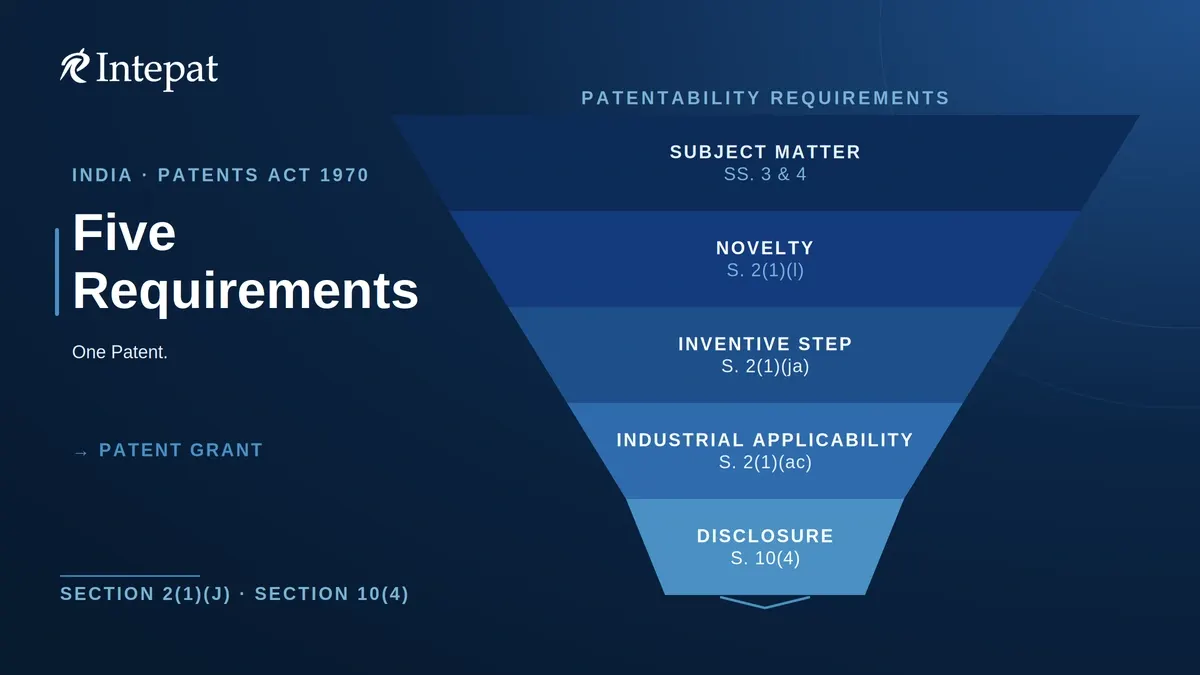
| Five patentability requirements every application must clear: |
| The claimed subject matter is a product or process and avoids the exclusions in Sections 3 and 4. The subject matter has not fallen into the public domain anywhere in the world before the relevant priority date of the claim (Section 2(1)(l)). The invention involves a technical advance or economic significance making it non-obvious to a person skilled in the art (Section 2(1)(ja)). The invention is capable of being made or used in an industry (Section 2(1)(ac)). The complete specification fully and particularly describes the invention, discloses the best method of performing it, ends with claims defining the scope of protection, and is accompanied by an abstract (Section 10(4)). An unresolved objection on any requirement may result in refusal. Each requirement corresponds to one or more grounds of pre-grant or post-grant opposition under Section 25 of the Patents Act, 1970. |
What types of inventions can be patented in India?
Before turning to the tests, a practical picture of what qualifies is useful. Every entry in the table below is subject to the individual requirements of novelty, inventive step, industrial applicability, and sufficient disclosure.
| Often capable of patent protection | Requires careful analysis | Ordinarily excluded |
| New mechanical devices, machines, and components | Software and AI implementations with a claimed technical contribution | Bare ideas and abstract concepts |
| Improved industrial and manufacturing processes | Pharmaceutical forms and combinations (Section 3(d) applies) | Claims whose substance is a business or commercial method |
| New materials and chemical compositions | Diagnostic devices and imaging systems (diagnostic methods for humans require Section 3(i) analysis) | Methods of medical treatment (Section 3(i)) |
| Technical control and communication systems | Inventions involving micro-organisms or microbiological processes (Section 3(j) applies) | Methods of agriculture or horticulture (Section 3(h)) |
| Engineered micro-organisms (expressly excepted by Section 3(j)) | Computer-related inventions with a specific technical effect | Computer programs per se and algorithms (Section 3(k)) |
| Legislative update (July 2026) |
| The SHANTI Act, 2025 (No. 39 of 2025, Gazette 21 December 2025) provides for substitution of Section 4 of the Patents Act with a conditional regime under which the Central Government may, in its discretion, grant patents for certain peaceful-use nuclear inventions subject to Section 38 of that Act. That provision is conditional and discretionary: strategic, sensitive, and national-security inventions remain excluded, and the Controller must obtain Central Government directions where the question arises. Commencement of the relevant provisions depends on a Gazette notification under Section 1(2) of the SHANTI Act. No commencement notification had been identified as of July 2026. The operative Section 4 position should be confirmed from the applicable commencement notification before any reliance is placed on the substituted provision. |
The five patentability requirements under Indian law
Section 2(1)(j) of the Patents Act, 1970 defines “invention” as a new product or process involving an inventive step and capable of industrial application. Sections 3 and 4 name categories that “are not inventions within the meaning of this Act.” Section 10(4) sets the disclosure requirements for the complete specification. Together these provisions generate five patentability requirements:
- Requirement 1 (Subject matter): The claim covers a product or process and does not fall within a Section 3 or Section 4 exclusion.
- Requirement 2 (Novelty): The subject matter has not fallen into the public domain anywhere in the world before the relevant priority date of the claim.
- Requirement 3 (Inventive step): The invention involves a technical advance or economic significance that makes it non-obvious to a person skilled in the art (Section 2(1)(ja)).
- Requirement 4 (Industrial applicability): The invention is capable of being made or used in an industry (Section 2(1)(ac)).
- Requirement 5 (Disclosure): The complete specification satisfies the requirements of Section 10(4) and the claim unity requirements of Section 10(5).
An unresolved objection on any requirement may result in refusal. These requirements are not assessed in a fixed statutory sequence; objections may be raised together and may be overcome by submissions, evidence, or a permissible amendment. Each requirement also corresponds to one or more grounds of opposition under Section 25, discussed later.
Patentable subject matter: fitting the Section 2(1)(j) definition
The first requirement has two components. First, the claimed subject matter must be a product or process. Section 2(1)(j) defines invention as “a new product or process involving an inventive step and capable of industrial application.” A bare idea is not a product or process. A mere discovery falling within Section 3(c) is also excluded. For the distinction between an idea and a patentable invention, the linked article sets out the analysis.
Second, the claim must not fall within the exclusions in Sections 3 and 4. Section 3 lists categories that “are not inventions within the meaning of this Act.” Key exclusions include Section 3(c) (mere discovery of a scientific principle or abstract theory), Section 3(d) (mere new forms of known substances without enhanced efficacy), Section 3(h) (methods of agriculture or horticulture), Section 3(i) (processes of medical treatment for humans and animals), Section 3(j) (plants and animals, seeds, varieties and species, and essentially biological processes, but micro-organisms are expressly excepted), Section 3(k) (mathematical or business methods, computer programs per se, and algorithms), and Section 3(p) (traditional knowledge). The full treatment of each Section 3 category is in the companion article.
A claim covering a practical application in healthcare or agriculture may satisfy industrial applicability while a process of treatment or an agricultural method claimed in the same application remains excluded under Section 3(i) or Section 3(h). The two assessments are separate.
Novelty: no prior public disclosure anywhere in the world (Section 2(1)(l))
An invention must be new. Section 2(1)(l) defines “new invention” as any invention or technology which has not been anticipated by publication in any document or used in the country or elsewhere in the world before the date of filing of the patent application with complete specification, that is, the subject matter has not fallen in the public domain or does not form part of the state of the art.
India follows an absolute novelty standard. A prior publication in any document anywhere in the world, or a prior public use that makes all features of the claimed invention publicly accessible, may constitute anticipating prior art. A disclosure by the inventor in a technical paper can also defeat novelty where it discloses every feature of the later claim, unless a specific non-anticipation provision applies.
Novelty is assessed at the relevant priority date of each claim. Section 11(1) of the Patents Act, 1970 provides that there shall be a priority date for each claim of a complete specification. Where a claim is fairly based on a previously filed Indian provisional specification, the priority date is the date of that provisional filing (Section 11(2)). Where it is based on an earlier Indian application filed within twelve months, it is that earlier date (Section 11(3A)). Where a Convention application is involved, Section 137 governs. In all other cases, the priority date is the date of filing of the complete specification (Section 11(6)).
India does not provide a general grace period covering all inventor disclosures. Sections 29 to 34 of the Patents Act, 1970 contain limited non-anticipation provisions for defined circumstances. These include: certain publications obtained from the inventor without consent, where the inventor filed the application as soon as reasonably practicable (Section 29(2)); communications to Government (Section 30); display at a Central Government-notified exhibition or a paper read before a learned society, subject to filing within twelve months of the exhibition opening or the paper reading (Section 31); public working in India for the purpose of reasonable trial only, where it was reasonably necessary to work in public, within one year before the priority date (Section 32); and use or publication of matter described in a provisional specification, after the date of that provisional filing (Section 33). Outside these specific provisions, a public disclosure before the relevant priority date constitutes prior art. For a deeper treatment of how novelty is assessed in Indian patent examination, the linked article covers the case law and examination practice in detail.
A claim lacks novelty where one prior art document contains every feature of the claim, either expressly or necessarily by implication.
Inventive step: non-obviousness over the prior art (Section 2(1)(ja))
Section 2(1)(ja) defines “inventive step” as a feature of an invention that involves technical advance as compared to the existing knowledge or having economic significance or both, and that makes the invention not obvious to a person skilled in the art.
The definition has two elements that must both be satisfied. The invention must involve a technical advance over the existing knowledge or have economic significance, or both. And it must not be obvious to a person skilled in the art: a notional person with ordinary competence in the relevant technical field, aware of the common general knowledge in that field at the priority date, but without inventive faculty.
The Delhi High Court Division Bench, in F. Hoffmann-La Roche Ltd. & Anr. v. Cipla Ltd. (RFA(OS) Nos. 92/2012 and 103/2012, 2015:DHC:9674-DB, decided 27 November 2015), at paragraph 151, formulated a five-step inquiry for assessing obviousness: (i) identify the person ordinarily skilled in the relevant art; (ii) identify the inventive concept embodied in the claim; (iii) determine the common general knowledge at the priority date; (iv) identify the differences between the prior art and the claimed invention; and (v) decide, without hindsight, whether those differences would have been obvious to the skilled person. The CRI Guidelines 2025 prescribe a substantially similar five-point analysis for inventive step in the assessment of computer-related inventions.
For inventive step, an examiner may consider multiple prior art documents where the prior art provides a reason for the skilled person to combine their teachings. An unexpected technical effect may support non-obviousness, but the assessment is claim-specific and fact-specific.
Deeper treatment: how inventive step is evaluated in Indian patent prosecution and the comparative approach in India, Europe, and the United States.
Industrial applicability (Section 2(1)(ac))
Section 2(1)(ac) defines “capable of industrial application,” in relation to an invention, as meaning that the invention is capable of being made or used in an industry. The term “industry” is read broadly. A practical application in healthcare, information technology, engineering, or manufacturing may satisfy industrial applicability. Where a claim concerns a method of medical treatment or an agricultural method, however, the separate Section 3(i) or Section 3(h) exclusion applies, independent of the industrial applicability assessment. Industrial applicability requires a credible and practical use. A vague, speculative, or purely theoretical application is insufficient. A specification that names a desired outcome without disclosing how to produce it may raise issues under both this requirement and the sufficiency of disclosure requirement in Section 10(4). For a fuller treatment, the industrial applicability requirement under Indian patent law is covered in the linked article.
Sufficient disclosure in the complete specification (Section 10(4))
An invention that satisfies the first four requirements still fails if the specification does not describe it adequately. Among other requirements, Section 10(4) of the Patents Act, 1970 requires every complete specification to: (a) fully and particularly describe the invention and its operation or use and the method by which it is to be performed; (b) disclose the best method of performing the invention which is known to the applicant and for which the applicant is entitled to claim protection; (c) end with a claim or claims defining the scope of the invention for which protection is claimed; and (d) be accompanied by an abstract to provide technical information on the invention.
The operative standard is enablement: a person skilled in the relevant technical field must be able to perform the invention from the specification without undue experimentation. Common failure modes include specifications that describe a desired outcome without disclosing a working mechanism, claims that are broader than the disclosure supports, and specifications that omit a feature the invention depends on. Where the Controller considers it necessary in a particular case, a model or sample may be required under Section 10(3) before the application is found in order for grant; such model or sample does not form part of the specification.
For computational, algorithmic, or model-based inventions, the CRI Guidelines 2025, published by IP India on 29 July 2025 (verified as of July 2026), provide CRI-specific guidance on the existing disclosure and enablement requirements. These Guidelines explain examination practice but do not amend or override the Patents Act or the Patents Rules. Merely reciting generic computing hardware does not by itself establish a technical contribution sufficient to avoid Section 3(k). Separately, Section 10(4) requires enough implementation detail for a skilled person to perform the claimed invention; depending on the claimed contribution, this may require details of the data flow, model architecture, system integration, training data characteristics, or the mechanism by which the technical effect is achieved.
Section 10(5) of the Patents Act, 1970 adds that the claims must relate to a single invention, or to a group of inventions linked so as to form a single inventive concept, must be clear and succinct, and must be fairly based on the matter disclosed in the specification. Deeper treatment: the requirement of sufficient disclosure in a patent specification and how a Form 2 complete specification is structured.
Subject-matter exclusions: Sections 3 and 4
Sections 3 and 4 create subject-matter exclusions that apply independently of novelty, inventive step, and industrial applicability. An invention that falls within an excluded category cannot be patented regardless of how novel or inventive it may be.
Section 3(k) deserves particular attention for software and AI applicants. The CRI Guidelines 2025 framework for Section 3(k) assessment, published by IP India on 29 July 2025, sets out a stepwise test examining whether the claim delivers a technical effect or technical contribution beyond the mere running of a program on general-purpose hardware. A claim whose substance is a business or commercial method remains excluded even if the method is implemented on computers or networks. A technical solution is not converted into a business method merely because it operates in a commercial setting; the substance of the claim, not its form or context, determines whether the Section 3(k) exclusion applies.
For the full treatment of each Section 3 category with case law, the companion article on subject matter that cannot be patented in India covers the exclusions in detail.
How the five requirements correspond to Section 25 opposition grounds
The five requirements correspond to several grounds of pre-grant and post-grant opposition under Section 25 of the Patents Act, 1970. The correspondence is not one-to-one.
Under Section 25(1), where an application has been published but a patent has not yet been granted, any person may oppose on: prior publication anywhere (Section 25(1)(b)); prior claiming in an Indian application with an earlier priority date (Section 25(1)(c)); prior public knowledge or public use in India before the priority date (Section 25(1)(d), geographically limited to India); obviousness (Section 25(1)(e)); subject matter not an invention or not patentable under the Act (Section 25(1)(f)); and insufficiency of disclosure (Section 25(1)(g)). Section 25 also contains additional grounds (wrongful obtaining, Section 8 non-disclosure, convention timing, biological source, traditional knowledge) with no counterpart in the five patentability requirements above.
Lack of industrial applicability is not an expressly named standalone ground; it would ordinarily be raised through Section 25(1)(f) on the basis that the subject matter is not an invention within the meaning of the Act, since industrial applicability forms part of the Section 2(1)(j) definition.
Under Section 25(2), at any time after grant but before the expiry of one year from the date of publication of grant of a patent, any person interested may file post-grant opposition on corresponding grounds, with “any person interested” replacing the pre-grant “any person.” An unresolved deficiency in novelty, inventive step, or disclosure is not closed by the grant certificate; it remains open to challenge within the statutory post-grant period. Separate revocation remedies under Section 64 may also be available.
Misconceptions that lead to refusal
- “An idea can be patented if it is novel enough.” Section 2(1)(j) requires a product or process with a technically defined implementation. A concept or insight, however novel, is not a product or process. A strong novelty argument does not convert an idea into a patentable invention.
- “A working prototype is needed to file.” A physical prototype is not a filing prerequisite. Section 10(1) requires every specification to describe the invention; Section 10(4) requires the complete specification to enable a person skilled in the art to perform it. Reduction to practice is not required. The Controller may in a particular case require a model or sample under Section 10(3).
- “A confidential disclosure to investors does not affect novelty.” Whether a pre-filing disclosure made the claimed subject matter publicly available is fact-specific. An NDA should not be treated as an automatic safeguard; the terms, circumstances, and evidence of each disclosure determine the outcome.
- “Software cannot be patented in India.” The Section 3(k) exclusion targets a “computer program per se.” A computer-related invention that delivers a technical effect or contribution beyond the mere execution of code on general-purpose hardware may qualify. The CRI Guidelines 2025 provide a stepwise framework for that assessment.
“A prior art search after filing is enough.” A pre-filing patentability search can help identify the closest prior art and inform how the claims and disclosure are constructed. It cannot guarantee that all prior art has been identified or that a patent will be granted. For the distinction between search types, see patentability search vs prior art search.
Where to go from here
An invention must satisfy each of the five patentability requirements to receive a patent, and the patent once granted remains open to post-grant opposition for one year from publication of grant. The starting point for most applicants is an internal invention disclosure that identifies the technical problem, the closest existing solutions, and the specific feature that distinguishes the invention from those solutions. A pre-filing patentability search built on that disclosure shapes the specification and the claims.
The full text of the Patents Act, 1970 is available on the India Code portal.
Primary sources
- Patents Act, 1970: India Code – https://www.indiacode.nic.in/handle/123456789/1392
- Patents Rules, 2003: IP India – ipindia.gov.in
- CRI Guidelines 2025: IP India, published 29 July 2025
- SHANTI Act, 2025 (No. 39 of 2025): Gazette of India Extraordinary, 21 December 2025
- F. Hoffmann-La Roche Ltd. & Anr. v. Cipla Ltd., RFA(OS) Nos. 92/2012 and 103/2012, 2015:DHC:9674-DB, Delhi High Court Division Bench, 27 November 2015
Frequently Asked Questions
No. Section 2(1)(j) of the Patents Act, 1970 defines an invention as a new product or process, not an idea. An application may initially be accompanied by a provisional specification, but a complete specification satisfying Section 10(4) is required for grant. A bare idea, without a defined product or process, does not meet the definition.
No. A physical prototype is not a filing prerequisite. Section 10(1) requires every specification to describe the invention. Section 10(4) requires the complete specification to fully describe the invention and enable a person skilled in the art to perform it. Reduction to practice is not required. The Controller may in a particular case require a model or sample under Section 10(3).
In most cases, yes. Section 2(1)(l) sets an absolute novelty standard: a public disclosure before the relevant priority date can defeat novelty where it makes all features of the claim publicly available. India has no general grace period. Sections 29 to 34 provide limited non-anticipation provisions for specific circumstances, including notified exhibitions and learned society papers under Section 31, subject to filing within twelve months.
A software or AI-related invention may be patentable where it delivers a technical effect or contribution beyond running a program on general-purpose hardware, subject to Section 3(k). The CRI Guidelines 2025 (IP India, 29 July 2025) provide a stepwise assessment framework. The invention must also satisfy novelty, inventive step, industrial applicability, and disclosure. A claim whose substance is a business method remains excluded.
Five requirements: (1) the claim covers a product or process and avoids Sections 3 and 4; (2) subject matter not in the public domain before the relevant priority date (Section 2(1)(l)); (3) invention involves an inventive step, Section 2(1)(ja); (4) capable of industrial application, Section 2(1)(ac); and (5) specification satisfies Section 10(4). Each requirement corresponds to opposition grounds under Section 25.
Disclaimer
This article is intended for general information on Indian patent law and does not constitute legal advice. Patentability turns on the technical facts of each invention and on how the specification and claims are drafted. The operative position regarding the commencement of the SHANTI Act, 2025 provisions affecting Section 4 of the Patents Act should be confirmed from the relevant Gazette commencement notification before any reliance is placed on a substituted Section 4 regime. Readers considering a patent filing should consult a qualified patent agent or attorney before acting on the information above.