




A vernacular-first brand in India faces a trademark problem that no English-only filing solves. The Trade Marks Registry evaluates marks across scripts phonetically, and courts treat translations as legally equivalent to the original. This article tells founders and MSME owners exactly what to file, in which form, and in which order.
| AT A GLANCE |
| • File your mark in the script you actually use in trade. If you use Devanagari (the script used to write Hindi), file in Devanagari; if you use both Roman and Devanagari, file both. |
| • Rule 28 of the Trade Marks Rules 2017 requires a precise transliteration and translation for any script other than Hindi or English. Without it, the examiner defers examination and the application risks being deemed abandoned. |
| • The Registry’s phonetic search engine catches sound-alike marks across scripts. A word-only search in Roman is not sufficient for a Hindi name. |
This article covers Indian trademark law only. Fees and Registry practice are stated as of July 2026 and are subject to change.
Why a Hindi or Regional Name Is Not Automatically Safe
Choosing a Hindi or regional-language name does not provide inherent protection through unfamiliarity. Examiners assess descriptive meaning and search for conflicting marks regardless of script.
Section 9(1) of the Trade Marks Act 1999 disqualifies marks that consist exclusively of indications serving to designate the kind, quality, quantity, intended purpose, values, geographical origin, or other characteristics of the goods or services, or marks that have become customary in the current language or in the established practices of the trade. The examiner applies this bar regardless of script. A mark meaning “pure” in Hindi faces the same descriptiveness objection under Section 9(1)(b) as the word “pure” applied in English to dairy products. The Manual of Trade Marks confirms that where an applied mark is in a language other than English or Hindi, the examiner requires transliteration and translation before examination can proceed, precisely so that the descriptive content of the mark can be assessed.
On distinctiveness more broadly: the Trade Marks System used by examiners runs phonetic searches, not only visual ones. A Hindi brand name that sounds like an existing registered mark in any script can attract a Section 11(1) objection for likelihood of confusion or association with an earlier mark. The phonetic search module returns earlier marks with phonetic similarity to the applied mark, and the examiner may expand the search beyond the automatically selected class.
How the Registry Searches a Vernacular Mark
The Manual of Trade Marks sets out three search modes available to the examiner: word mark search, phonetic search, and device mark search. In the phonetic search mode, the examiner specifies one or two phonetic variants of the applied mark and the system returns all earlier marks with phonetic similarity. The system is not script-aware in the way a human reader would be: it is working from the sounds the marks make, not from the visual character set they use.
This matters for vernacular marks because of how Indian scripts are structured. Devanagari, Tamil, Kannada, Malayalam, and other Indic scripts organise their characters by the sounds they represent, place and manner of articulation. A name in Devanagari and its Roman transliteration will, almost by definition, share the same sound sequence. In practice, this means that when the examiner searches for the Roman transliteration of your brand name, the system can surface earlier marks in Devanagari, Tamil, or Gujarati that carry the same sounds, and vice versa. A conflict can be found between two marks that look completely different on the page.
The public search portal at IP India offers a phonetic search tab. A pre-filing check that runs only a word search in Roman script misses this layer of the register entirely. For a guide to what each search mode returns, see Intepat’s trademark search guide.
What Rule 28 Requires When You File a Non-English Script
Rule 28 of the Trade Marks Rules 2017 states: where a trademark contains one or more words or numbers in scripts other than Hindi or English, the applicant must provide in the application a precise transliteration and translation of each such word and number in English or Hindi, and state the language to which the word or number belongs.
Three practical points follow from this:
First, the rule applies to scripts, not only to languages. A mark written in Tamil, Kannada, Telugu, Gujarati, Bengali, or any other Indic script that is neither Devanagari nor Roman will require transliteration and translation, even if the language itself is widely understood in the filing jurisdiction.
Second, non-compliance is a substantive deficiency, not a minor procedural gap. The Manual of Trade Marks records that if the trademark applied for registration is in a language other than English or Hindi, the examiner defers examination and communicates a deficiency notice requiring the applicant to supply the transliteration. Applications that do not comply within the notified period are treated as abandoned.
Third, the transliteration and translation are endorsed on the register as a formal record of the language, the Roman-script sound, and the English meaning. This endorsement has practical consequences for how the Registry and competitors search for and compare later applications against the mark.
A fourth point applies to coined marks. Transliteration should reflect sound; translation should reflect actual meaning. A purely coined word with no literal meaning should not be given an invented translation. Where no meaning exists, that should be stated.
Marks written in Hindi or Devanagari do not require transliteration under Rule 28, because Hindi and Devanagari are listed alongside English as the baseline scripts for which no separate transliteration obligation is imposed. A filing in Devanagari proceeds on the standard track.
Translation Is Not a Loophole: What Courts Have Said
The most consequential legal principle for vernacular-first brands is that a translation of a registered mark into another language does not create a new, non-conflicting mark for infringement purposes. Indian courts have applied this principle consistently.
In Bhatia Plastics v Peacock Industries (AIR 1995 Del 144), the Delhi High Court restrained the use of “PEACOCK” as deceptively similar to the registered mark “MAYUR” on plastic goods. The word “mayur” means peacock in Hindi. The court held that a trader who has acquired exclusive rights to a mark in one language can restrain a competitor from copying that mark by translating it into another, given how many people in India know more than one language.
In February 2026, the Delhi High Court returned to this principle in Victoria Foods Pvt Ltd v Ashad Trading Co (CS(COMM) 135/2026, 2026 SCC OnLine Del 862). The plaintiff held registered rights in the mark RAJDHANI for food products. The defendants used the English translation “CAPITAL” on similar goods. The court found a prima facie case of infringement and passing off, granted an ex parte ad interim injunction, and confirmed that conceptual and semantic equivalence between a registered mark and an infringing mark is a recognised basis for relief.
Both cases apply the standard from Amritdhara Pharmacy v Satyadeo Gupta (AIR 1963 SC 449): deceptive similarity is assessed from the standpoint of an ordinary purchaser with imperfect recollection, comparing marks as a whole. The Cadila Health Care v Cadila Pharmaceuticals ((2001) 5 SCC 73) framework adds phonetic, visual, and conceptual similarity, the nature of the goods, and the literacy level of the likely consumers as further factors.
The enforcement consequence runs in both directions. A Hindi brand can use this doctrine to stop English-language imitations, as Victoria Foods shows. But a new brand that picks a Hindi name translating an existing English registered mark, or transliterates an existing mark in a different script, may face an infringement action even if the visual marks look nothing alike.
For a detailed look at how courts assess deceptively similar trademarks and the absolute and relative grounds for refusal at examination, see the relevant Intepat guides.
The Filing Sequence: Which Scripts to Register and When
The starting point is the script in which the brand actually operates. A mark is protected in the form in which it is used and registered. A Devanagari application protects the mark as filed; it does not automatically protect an identical Roman transliteration as a separate registered right.
The table below sets out the principal filing choices and when each applies:
| Mark version | File separately when |
| Devanagari word mark | The brand uses Hindi script as its primary customer-facing form |
| Roman-script word mark | The Roman transliteration is used independently online, on invoices, or in English-medium advertising |
| Regional-script word mark (Tamil, Kannada, etc.) | The brand will operate in that regional market and that version will be used independently |
| Bilingual composite logo | Both scripts appear together as a single badge; Rule 28 compliance required for non-Hindi/English elements |
| Stylised or device mark | The artwork has independent commercial recognition beyond the word element |
For a founder using only Hindi in Devanagari at launch, the priority filing is the Devanagari word mark. This establishes the registration date and the priority claim for the Registry’s examination of later applications. Note that an earlier unregistered user who has continuously used the same mark before that date is protected under Section 34 and cannot be restrained by the later registered mark.
Where the brand operates across both Hindi and English media, file both the Devanagari word mark and the Roman transliteration as separate applications in the same class. This costs two fees but gives two registration dates and two registered assets. Once both are registered, the translation equivalence doctrine provides statutory rights against both forms and against any script variant a court would treat as phonetically or conceptually equivalent.
Where the brand name will also appear in regional scripts, each script-variant is a separate mark for registration purposes and carries its own Rule 28 requirement. File in the order of market entry to secure priority in each script as early as possible.
A note on composite marks: a composite mark (a logo that contains both Devanagari and Roman text) is treated as a single device mark application. Section 17(1) of the Trade Marks Act 1999 confers on the proprietor the exclusive right to use the mark taken as a whole, and Section 17(2) makes clear that registration of the composite does not confer any exclusive right in a component part that is not separately registered or is of non-distinctive character. Where the word elements are the commercially important part, a word mark application for each script is stronger than a composite device application.
For startup-specific filing considerations including fee concessions under the SIPP scheme, see trademark registration for startups. For MSME owners, see the guide to trademark registration for MSMEs.
Once filed, use each version consistently: packaging, invoices, websites, marketplace listings, and advertising should follow the filed spelling and intended pronunciation. Preserve dated evidence for each version used independently. Post-launch monitoring should extend beyond exact copies to cover alternative transliterations, sound-alike spellings, relevant translations, and domain or marketplace use; see Intepat’s trademark watch guide for the Registry journal monitoring process.
What a Multilingual Trademark Search Must Cover
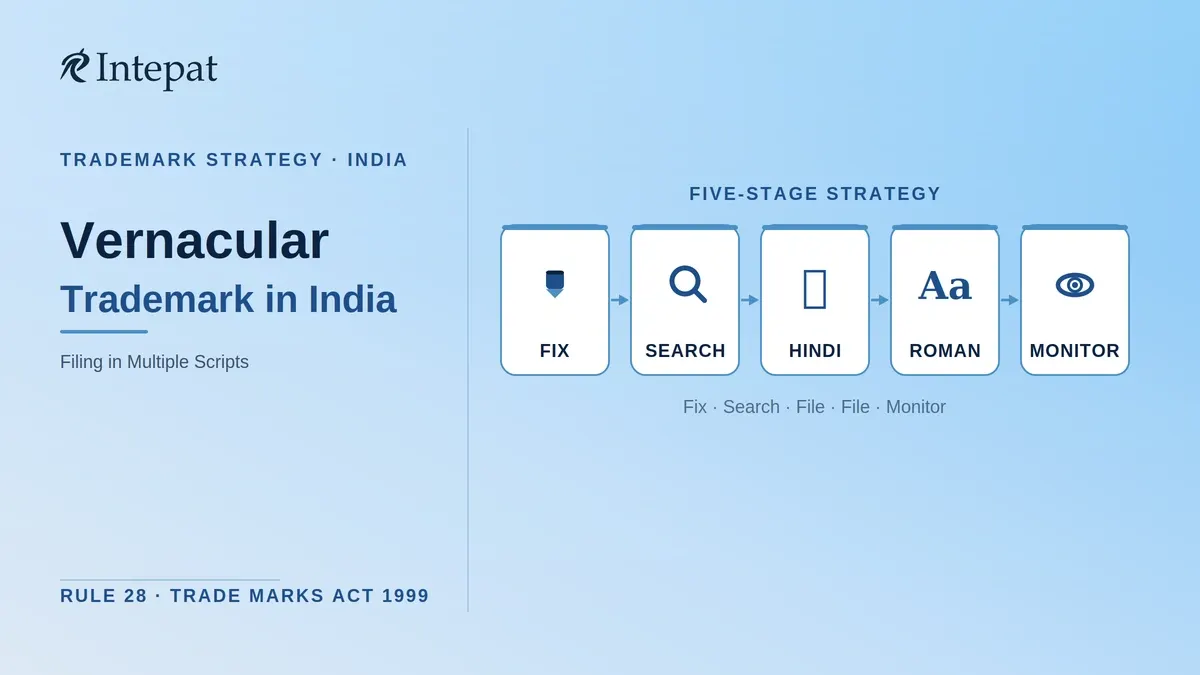
Before running any search, fix the brand’s linguistic identity in writing: the exact native-script representation, intended pronunciation, approved Roman spelling, literal and commercial meaning, known regional variants, and the goods or services the brand will cover. Inconsistent spellings or pronunciations across packaging, digital assets, and advertising can cause the search to miss earlier rights and leave the portfolio misaligned with actual use.
A clearance search for a vernacular mark must then go beyond the obvious Roman-script word search. The following queries are the minimum:
A phonetic search in the public portal, using one or two phonetic variants of the applied name, across the primary filing class and at least one adjacent class. For a Hindi name, this should include both the Devanagari transliteration and the Roman version as separate phonetic queries, since the portal’s phonetic engine treats them as separate inputs.
A word mark search on the Roman transliteration, to catch earlier Roman-script marks that are phonetically identical to the proposed Hindi name. These will not be surfaced by a Devanagari or script-specific search alone.
A conceptual/translation check: identify the meaning of the proposed mark in Hindi and in any regional language, and search for registered marks in English or other languages that carry the same meaning. The Bhatia Plastics and Victoria Foods line of cases establishes that these conceptual equivalents are legally relevant, and they will not be captured by any automated phonetic search.
A search across the classes of goods or services in which the brand will trade, not only the primary class. A Hindi food brand filing in Class 30 should check Class 29 and Class 31 at minimum, given how the Trade Marks Registry treats goods of the same description across adjacent classes.
For a detailed walkthrough of the IP India public search portal and how to run each search type, see Intepat’s trademark public search guide and the broader trademark clearance search strategy. The results of a self-conducted search do not substitute for a professional clearance opinion, particularly for marks where the conceptual similarity question is close.
When Your Registration in One Script Protects You in Another
A single registered mark in one script does not automatically extend to every script in which the same sounds can be written. The registration protects the mark as filed, and the scope of that protection in a dispute is assessed by the courts using the deceptive similarity test, including phonetic and conceptual equivalence.
A registration gives you a priority date and the statutory presumption of validity under Section 31 of the Trade Marks Act 1999. When a later applicant files a sound-alike mark in a different script, the examiner’s phonetic search should surface your registration and trigger a Section 11(1) objection. This is the first line of protection.
In enforcement, a court will apply the Amritdhara and Cadila factors to assess whether the defendant’s mark, taken as a whole, is deceptively similar to your registered mark, considering how an ordinary consumer with imperfect recollection would react to both marks in the relevant market. Where phonetic or conceptual equivalence is strong, as in MAYUR/PEACOCK or RAJDHANI/CAPITAL, the courts have been willing to find infringement even when the visual marks share no characters.
A Devanagari word mark registration provides a meaningful foundation, and the translation/transliteration doctrine extends its legal reach. That reach is tested case by case. The most robust position is registrations in both the Devanagari and Roman forms of the name, with independent priority dates in each relevant class.
For details on responding to an examination report where your mark has been cited as conflicting with an earlier registration, see Intepat’s guide to trademark objection replies. For the distinction between registered and unregistered marks and the different enforcement routes available, see unregistered vs registered trademark.
Frequently Asked Questions
A Hindi Devanagari filing and a Roman-script filing are treated as separate marks requiring separate applications in India. If your brand operates under both forms, filing both is advisable. A single Devanagari registration does not give independent registration-based rights over the Roman transliteration, though the deceptive similarity doctrine may extend protection in a dispute.
Rule 28 of the Trade Marks Rules 2017 requires a precise transliteration and translation for any trademark word or number in a script other than Hindi or English. Without it, the examiner defers examination and issues a deficiency notice. An application that does not comply within the notified period is treated as abandoned under the Manual of Trade Marks.
Indian courts treat translations as legally relevant to the deceptive similarity assessment. In Victoria Foods v Ashad Trading (2026), the Delhi High Court found that “CAPITAL” infringed the registered mark “RAJDHANI” for food products, as both convey the same meaning. The strength of a translation-based claim depends on how distinctive and well-used your mark is.
Yes. Section 9(1)(b) of the Trade Marks Act 1999 disqualifies marks consisting exclusively of indications designating the kind, quality, purpose, value, or other characteristics of the goods. The examiner reviews the Rule 28 transliteration and translation to assess this. A Hindi word directly describing the product faces the same refusal as its English equivalent.
The examiner specifies one or two phonetic variants of the applied mark; the Trade Marks System returns all earlier marks with phonetic similarity, regardless of script. For a Devanagari mark, searching the Roman transliteration surfaces phonetically similar earlier marks in any script. The public IP India portal’s phonetic tab works on the same principle.
Fee concessions are based on applicant category, not on the script of the mark. DPIIT-recognised startups filing through the SIPP scheme pay the concessional statutory fee per class, and individuals and Udyam-registered MSMEs are entitled to the reduced rate under the Trade Marks Rules 2017 First Schedule. The script chosen does not affect which fee tier applies.
Legal disclaimer: This article is for informational purposes only and does not constitute legal advice. Trademark law and Registry practice are subject to change. For advice specific to your situation, consult a registered trademark attorney.