




The patent filing procedure in India is the process of securing a patent for an invention under the Patents Act 1970. It runs through roughly seven stages: drafting and filing the application, publication, requesting examination, the examiner’s report, your reply, and grant. Each stage has its own forms, fees, and deadlines.
This guide covers filing in India under the Patents Act 1970 and the Patents Rules 2003, including the changes made by the Patents (Amendment) Rules 2024. It is written for founders, startups, and first-time applicants who want to understand how to file a patent in India, what actually happens after they file, and what they must not miss. If your goal is the mechanics of submitting through the online portal, see our guide to the patent e-filing procedure in India. You will also see this called patent registration; in India a patent is filed, examined, and then granted, and “registration” is simply the everyday word people use for the whole journey.
- Quick answer for applicants
- You can file in two ways: online through the patent office portal, or in person at one of four offices (Kolkata is the head office; Delhi, Mumbai, and Chennai are branches).
- A patent is not examined automatically. You must file a separate request for examination (Form 18) within 31 months of your priority or filing date. Miss it, and the application is treated as withdrawn, with almost no way back.
- After the examiner’s report (the FER), you have six months to put the application in order, extendable by a further three months on request.
- Indicative e-filing cost for a startup or small entity: about Rs 1,600 to file plus Rs 4,000 for examination, before excess-page and excess-claim fees.
- Your application is published automatically at 18 months. Early publication is optional and costs extra.
At a glance, here is what each stage asks of you and the deadline that goes with it.
| Stage | What to remember |
| Filing | File Form 1 with the specification (Form 2), plus drawings if needed |
| After a provisional | File the complete specification within 12 months |
| Publication | Automatic at 18 months, unless you request early publication |
| Examination | File the request (Form 18) within 31 months |
| Examiner’s report (FER) | Respond within 6 months, extendable by 3 |
| Grant | Your rights become enforceable once the patent is granted |
| Renewal | Pay annual renewal fees to keep the patent alive |
Who can file a patent application in India
The Patents Act allows three categories of person to apply for a patent, alone or jointly. The first is the true and first inventor, the person who actually made the invention. The second is an assignee, someone to whom the inventor has transferred the right to apply, such as the company an inventor works for. The third is the legal representative of a deceased person who was entitled to apply.
For startups, the practical question is usually whether to file in the inventor’s own name or in the company’s name. That choice affects who owns the patent, how it is assigned later, and how investors view your IP. In most startups the founders or employees are the inventors, and the company files as their assignee, so the right paperwork to transfer the invention to the company needs to be in place before filing. We cover the trade-offs in our guide on filing a patent in the name of an individual or a business. If the company files as an assignee, the proof of the right to apply should ideally go in with the application; if it does not, it must be furnished within six months of filing.
Where to file: online or at the patent office
You can submit a patent application online through the e-filing portal, or physically at the appropriate patent office, either in person or by post. Most applicants now file online, and several steps, such as expedited examination, are only available electronically. Our patent e-filing guide walks through the portal, digital signature, and payment requirements.
India has four patent offices: the head office in Kolkata and branch offices in Delhi, Mumbai, and Chennai. You do not get to pick freely. The correct office is fixed by where you live or carry on business, or by the place from which the invention originated. If you have no residence or business in India, the office is decided by the address for service you provide, often your patent agent’s address. So if your agent is based in Bangalore, your filing typically goes to the Chennai office, which covers Karnataka.
Each office serves a defined region. Broadly, Mumbai covers the western states such as Maharashtra and Gujarat; Delhi covers the northern states such as Punjab, Rajasthan, and Uttar Pradesh; Chennai covers the southern states including Karnataka, Tamil Nadu, and Telangana; and Kolkata covers the rest of the country. You file at the office for your region, not the one nearest to you.
Worth knowing: Once the appropriate office is decided, it ordinarily cannot be changed for that application. Choosing the right office, or the right address for service, at the start matters.
Documents required for patent filing in India
A complete first filing is built from a small set of forms. Knowing what each one does helps you see why the order matters.
- Form 1 is the application for the grant of a patent itself.
- Form 2 carries the specification, the technical heart of your application. It can be a provisional specification or a complete specification, depending on how developed your invention is.
- Form 3 is a statement and undertaking about any matching patent applications you have filed abroad. The first one is due within six months of filing, and an updated Form 3 is due again within three months of the examination report; see our note on the Form 3 statement and undertaking.
- Form 5 is the declaration as to inventorship, filed with or alongside the complete specification.
- Form 26 is the power of attorney, needed when a patent agent acts for you. File it with the application or within three months, otherwise no action can be taken through the agent until you do.
Drawings are filed where the invention is best understood visually. If you are claiming priority from an earlier foreign application, a certified copy of that priority document is also required. The route you take, whether an ordinary application, a convention application, a PCT national phase application, a divisional application, or a patent of addition, decides exactly which of these documents apply. Our overview of the types of patent application explains each route.
| Not sure your application is filing-ready? |
| A patent agent can review your invention and handle the forms and deadlines. |
| Talk to our patent team |
Before you file: three quick checks
A little preparation prevents the most common early mistakes. First, is the invention developed enough to describe clearly, or do you only have an idea? You can file provisionally while it is still taking shape, but you need enough detail to describe it properly. Second, does it look new compared with products and publications already out there? A quick prior-art search saves you from filing something already known. Third, who will own it, you personally, your company, or another assignee, so the application goes in the right name from the start. One thing to avoid: try not to disclose the invention publicly before you file, because a public disclosure can damage its novelty.
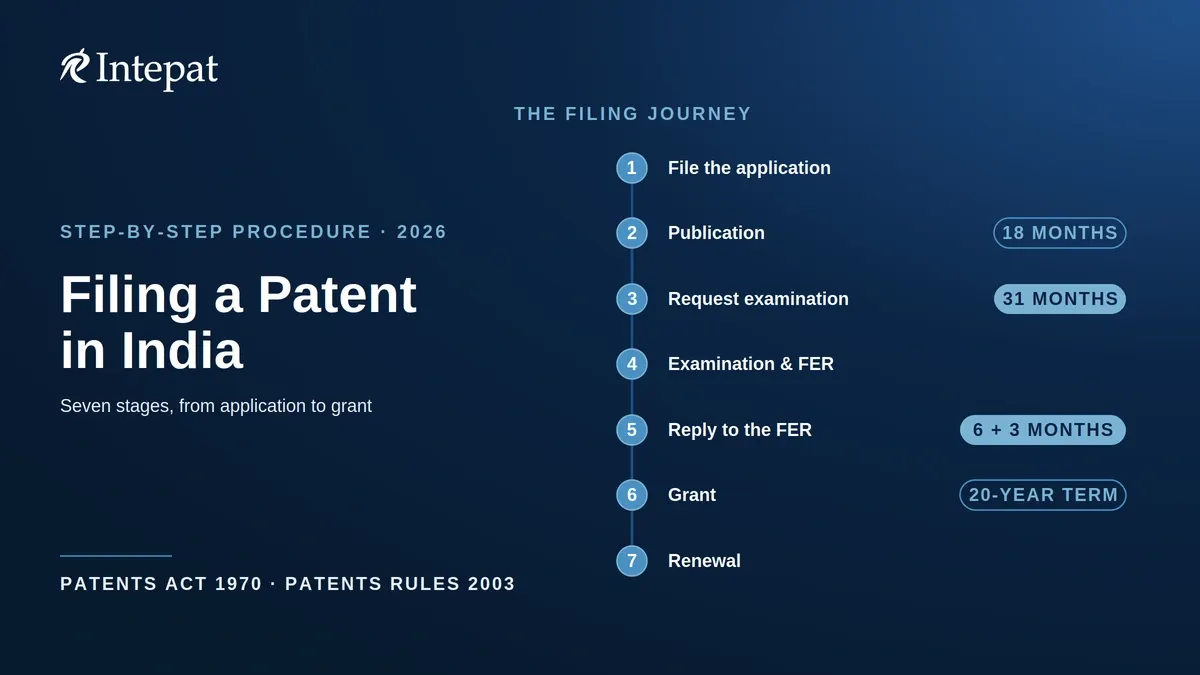
The patent filing procedure in India, step by step
Once the application is on file, it moves through a defined sequence. The patent office calls this the patent process in India, or prosecution. Here is what happens, and what each stage asks of you.
Step 1: File the application
Filing starts the clock and secures your filing date, which determines who got there first. India follows a first-to-file approach, so between two people with similar inventions, the earlier filing date generally wins, which is why filing promptly matters even before the invention is fully polished. At this point you choose between two kinds of specification. A provisional specification suits an invention still under development; it gives you a filing date while you keep refining the idea. A complete specification suits an invention that is fully worked out, with claims that define the legal scope of protection. If you file provisionally, you must file the complete specification within twelve months, or the application is treated as abandoned.
Step 2: Publication
The patent office publishes your application in the official patent journal eighteen months after your filing or priority date, whichever is earlier. Publication is automatic; you do nothing to trigger it. From the date of publication until grant, you enjoy rights similar to a granted patent, although you cannot actually sue for infringement until the patent is granted. If you want protection on the public record sooner, you can request early publication using Form 9, and the office ordinarily publishes within about a month.
Step 3: Request examination
This is the step applicants most often get wrong. A patent application in India is not examined unless you ask for it. You request examination by filing Form 18, and you must do so within 31 months of your priority or filing date, whichever is earlier. This deadline was reduced from 48 months by the Patents (Amendment) Rules 2024 for applications filed on or after 15 March 2024; older applications keep the previous 48-month period.
If you miss the window, the application is treated as withdrawn, and there is no general route to revive it. Our dedicated guide to the request for examination covers the timing in full. Startups and small entities in a hurry can instead pay for expedited examination on Form 18A.
Step 4: Examination and the First Examination Report
After your request, the Controller refers the application to an examiner, who checks whether the invention is new, involves an inventive step, and otherwise meets the Act. The examiner also looks at whether the subject matter is something the Act allows to be patented at all, which matters for software and business-method inventions in particular, where the bar is higher; our guide on software patents in India explains where the line falls. The examiner’s findings are issued to you as the First Examination Report, usually called the FER. The FER lists any objections, often with cited prior-art documents on novelty and inventive step, along with formal requirements about the specification, drawings, and claims. These reports now arrive by email in most cases.
Step 5: Respond to the FER
The FER starts a strict clock. You have six months from the date the report is issued to put the application in order by answering every objection. You can amend the claims to overcome an objection, and you can argue against objections you disagree with. If you need more time, you can request a three-month extension on Form 4, which takes the maximum to nine months. Since the 2024 amendment, that extension request can be made even after the first six months have passed, as long as it is filed before the extension period itself runs out. A late or incomplete response is the second common way applications are lost, so each objection should be addressed squarely. Where deadlines are genuinely tight, read our guide on extension of time for patent deadlines to see what can and cannot be saved.
Step 6: Grant
Once every objection is resolved and the application is found to be in order, the patent office grants the patent, seals it, enters the date in the register, and publishes the grant. The Act requires this to happen as expeditiously as possible. A grant certificate then issues to you, in current practice by email. From grant, your enforceable patent rights begin, and the patent runs for twenty years from the filing date. If you entered India through the PCT route, that twenty years is counted from the international filing date.
Step 7: Keep the patent in force
A granted patent only stays alive if you pay renewal fees. Renewal becomes payable from before the end of the second year, for the third year and each year after that, with the amounts rising over the life of the patent. Let a renewal lapse and the patent can fall away. The full schedule and the limited restoration route are set out in our guide to patent renewal in India.
What patent filing costs in India
Official fees depend on who you are and how you file. The Patents Rules give a lower fee band to natural persons, startups, small entities, and educational institutions, and a higher band to everyone else (large entities). Online filing is cheaper than physical filing. The figures below are the official fees for the main stages, verified as of June 2026.
| Stage | Form | Natural person / startup / small entity (e-filing) | Other applicants / large entity (e-filing) |
| Filing the application | Form 1 | Rs 1,600 | Rs 8,000 |
| Request for examination | Form 18 | Rs 4,000 | Rs 20,000 |
| Expedited examination | Form 18A | Rs 8,000 | Rs 60,000 |
| Early publication (optional) | Form 9 | Rs 2,500 | Rs 12,500 |
Two points keep applicants from under-budgeting. First, the filing fee covers a specification of up to 30 pages and up to 10 claims; beyond that, you pay per extra page and per extra claim, which adds up quickly for detailed inventions. Second, ordinary publication at 18 months is free, so the Form 9 fee above applies only if you choose to publish early. Physical filing costs slightly more than the e-filing figures shown. To model your own total, use our patent fees calculator or read the detailed breakdown in patent fees and cost in India.
Provisional vs complete application: which to file first
The choice between a provisional and a complete first filing is the earliest real decision you make, and it turns on how finished your invention is.
| Provisional application | Complete application | |
| Best when | the idea still needs development | the invention is fully worked out |
| What it contains | a description of the invention | full specification with claims |
| Filing date | secures an early date while you refine | secures the date with final scope |
| Key deadline | complete specification due within 12 months | none, it is the complete filing |
A provisional filing buys you up to a year to develop and test the invention while holding an early date, which is valuable in fast-moving fields. The trade-off is the firm twelve-month deadline to follow up with a complete specification. File complete from the start when the invention and its claims are settled.
Opposition: how others can challenge your patent
Your application can be challenged by third parties, and it helps to know this exists even though most applicants never face it. Before grant, any person can file a pre-grant opposition once the application is published. After grant, a person interested, typically a competitor in the same field, can file a post-grant opposition within twelve months of the grant being published.
Pre-grant opposition is decided by the Controller, who first checks whether there is a prima facie case before taking it further; a pending pre-grant opposition can hold up your grant until it is resolved. Post-grant opposition is referred to an Opposition Board, which examines it and recommends to the Controller, who then decides after hearing both sides. Both routes now carry official fees, and a well-drafted application that gives opponents little to attack is the best defence. The detail is in our guide to patent opposition proceedings in India.
Filing your patent without missing a deadline
Most patents are won or lost not on the strength of the invention but on three dates. If you file provisionally, the complete specification is due within twelve months. The request for examination is due within 31 months, and missing it is fatal to the application. After the FER, you have six months, plus a possible three, to respond.
Diary these from day one. The official position on each stage, including the consequence of missing the examination request, is set out in the Patents Act 1970 itself. If you would rather not carry that risk alone, a registered patent agent can prepare the specification, file the right forms, and hold the deadlines for you.
Frequently asked questions
How long does it take to get a patent in India?
Timelines vary with the patent office’s workload and the complexity of your invention. After you request examination, an examiner is assigned and issues the First Examination Report, then you respond, and grant follows once objections are resolved. The whole process commonly takes a few years, though expedited examination can shorten it significantly.
How much does it cost to file a patent in India?
For a startup or small entity filing online, the official fee is about Rs 1,600 to file the application plus Rs 4,000 to request examination, before any excess-page or excess-claim fees. Large entities pay considerably more. These are government fees only and do not include patent agent charges.
Do I need a patent agent to file a patent in India?
You can file your own patent application in India. In practice, drafting the specification and claims, choosing the right route, and responding to examination objections are technical tasks where errors are costly and often irreversible. Many applicants engage a registered patent agent for exactly these reasons.
What is the 31-month deadline in patent filing?
It is the period within which you must file the request for examination (Form 18) for your application to be examined. The Patents (Amendment) Rules 2024 reduced it from 48 months to 31 months from the priority or filing date for applications filed on or after 15 March 2024. Missing it means the application is treated as withdrawn, with no ordinary route to revive it.
Is publication of my patent application mandatory?
Yes. Your application is published automatically in the patent journal at 18 months from the filing or priority date, and you take no action to make this happen. You may optionally request early publication on Form 9 for an additional fee if you want your application on the public record sooner.
Can I file a patent without a complete specification?
Yes, by filing a provisional specification first. This secures an early filing date while your invention is still being developed. You must then file the complete specification, with claims, within twelve months, or the application is treated as abandoned.
Can I file a patent after I have publicly disclosed my invention?
It is risky. A public disclosure before you file can destroy the novelty of your invention and make it unpatentable, because novelty is judged against what is already in the public domain. Only narrow exceptions exist. The safe rule is simple: file first, disclose later.
Can my company file a patent if the inventor is an employee or founder?
Yes. The company files as the assignee of the inventor. You need proof of the right to apply, usually an assignment from the inventor to the company, and this should go in with the application or be furnished within six months of filing.
This guide explains the general patent filing procedure in India and is current as of June 2026. Official fees, forms, and timelines are set by the patent office and can change, and the route that fits your invention depends on its facts. This is general information, not legal advice. For advice on a specific application, consult a registered patent agent.