




インドにおける商標権侵害訴訟は、地方裁判所以上の裁判所に提起しなければなりません。1999年商標法第134条(2)項では、登録商標権者は自身の営業所所在地で訴訟を提起できますが、これは登録商標に関する請求に限られます。純粋な不正競争訴訟は、1908年民事訴訟法第20条に従って提起されます。
本稿では、インドにおける商標権侵害訴訟の管轄権について解説する。対象となるのは、インドの裁判所に提起された民事訴訟である。商標法第103条および第104条に基づく刑事告訴は、別途の裁判管轄規則に従うため、本稿では取り上げない。
ファイリング戦略の要点
・登録商標侵害訴訟は、地方裁判所レベル以下の裁判所には提起できない(第134条(1))。
・登録所有者または登録利用者は、1908年民事訴訟法第20条で定められた裁判所に加えて、実際に自発的に居住し、事業を営み、または個人的に営利目的で働いている場所で訴訟を起こすことができる(第134条(2))。
• この原告に有利なフォーラムは、登録商標紛争を対象とする第134条(1)項(a)および(b)にのみ適用されます。純粋な不正競争の訴えは(c)項に該当し、民事訴訟法第20条に基づいて提起する必要があります。
• 訴訟原因が原告の主たる事務所で発生した場合、原告は別の都市にある従属事務所に依拠して、その従属事務所で第134条(2)を援用することはできない(IPRS v. Sanjay Dalia (2015) 10 SCC 161)。
• 訴訟対象物の指定価値が少なくとも 3 万ルピーの場合、訴訟は 2015 年商事裁判所法に基づいて指定された商事裁判所に提起されます。第 12A 条に基づく訴訟提起前の調停は、訴状が緊急の暫定的救済を真に想定している場合を除き、義務付けられています (Yamini Manohar 対 TKD Keerthi、2023 年)。
| あなたのシナリオ | どこに提出すればいいですか? |
| 登録商標、原告は事務所を1つしか持っていない | 民事訴訟法第134条(2)に基づく原告の事務所、または同法第20条に基づく裁判所 |
| 登録商標であり、原告は本社および支店を所有している。 | 以下に説明するUltra Homeの4つのシナリオフレームワークを適用してください。 |
| 純粋な不正競争行為(登録商標または未登録商標) | 民事訴訟法第20条のみ。第134条(2)は適用されない。 |
| 最低30万ルピーの指定価格 | 地区レベルの指定商事裁判所、または関連する高等裁判所の商事部 |
| 訴状は真に緊急な暫定的救済を求めている | 直接申請。第12A条に基づく訴訟提起前の調停は省略可能。 |
商標法第134条が実際に要求していること
Section 134(1) of the Trade Marks Act 1999 prohibits the institution of three categories of suit in any court inferior to a District Court: (a) a suit for infringement of a registered trade mark, (b) a suit relating to any right in a registered trade mark, and (c) a suit for passing off arising out of the defendant’s use of a trade mark identical with or deceptively similar to the plaintiff’s mark, whether registered or unregistered. The District Court is therefore the statutory floor. A Civil Judge (Junior Division) or equivalent subordinate court has no jurisdiction to hear these matters.
Section 134(2) then expands the set of District Courts that count as a “District Court having jurisdiction.” Notwithstanding the Code of Civil Procedure 1908 or any other law in force, the term includes a District Court within whose local limits the person instituting the suit actually and voluntarily resides, carries on business, or personally works for gain, at the time the suit is instituted. The Explanation to Section 134(2) clarifies that “person” for this purpose includes the registered proprietor and the registered user.
This wording does two things at once: it carves out an additional forum, the plaintiff’s own place of business, that is not available in ordinary civil litigation, and it does so notwithstanding the Code of Civil Procedure. The full text of Section 134 is on the India Code repository for the Trade Marks Act 1999.
When the plaintiff can sue at its own place of business
The plaintiff-residence forum under Section 134(2) departs from the conventional civil-litigation rule that the suit follows the defendant. Section 20 of the Code of Civil Procedure 1908 lets a plaintiff file where the defendant resides or carries on business (clause (a)), where any one of multiple defendants resides subject to leave of the court or acquiescence (clause (b)), or where the cause of action arises wholly or in part (clause (c)). The Explanation to Section 20 treats a corporation as carrying on business at its sole or principal office in India, or, in respect of any cause of action arising at a place where it has also a subordinate office, at that subordinate office.
Section 134(2) layers a further forum on top of Section 20: for clauses (a) and (b) of Section 134(1), the District Court where the plaintiff resides, carries on business, or personally works for gain is also a District Court “having jurisdiction.” The provision was introduced to ease the logistical burden on proprietors whose marks are infringed in cities far from their commercial base, allowing the proprietor to sue at home, subject to the narrowing reading of Sanjay Dalia discussed below.
The expression “carries on business” is read functionally rather than formally. It does not require a registered office or a fixed branch; an established commercial presence at a place, with goods or services actually offered or supplied there, can satisfy the test. The expression “personally works for gain” covers an individual proprietor who works at a place, even without a formal office. Both formulations are factual inquiries; an isolated transaction or a passive online presence will not ordinarily meet them.
Why a pure passing off suit cannot use this forum
The plaintiff-residence forum under Section 134(2) is, on the face of the statute, narrower than it is sometimes assumed to be. The provision applies “for the purpose of clauses (a) and (b) of sub-section (1).” It does not extend to clause (c), the passing off limb.
The consequence is practical. A pure passing off suit, whether by an unregistered proprietor or by a plaintiff bringing a passing off claim disconnected from a registered-mark infringement claim, must satisfy Section 20 of the Code of Civil Procedure 1908 in the conventional way. The plaintiff cannot sue at its own place of business merely because Section 134(2) appears to allow it; the additional forum is unavailable for the passing off cause of action.
In practice, infringement plaints are commonly framed to combine a Section 29 infringement claim with a passing off claim arising on the same facts. Where the plaint is so framed and the court is satisfied that jurisdiction exists for the infringement claim under Section 134(2), the same court ordinarily proceeds to hear the joined passing off claim. The Delhi High Court took this approach in Burger King Corporation v. Techchand Shewakramani, CS (COMM) 919/2016, decided on 27 August 2018, holding that where the plaintiff invokes both Section 134 of the Trade Marks Act and Section 20 of the Code of Civil Procedure, and territorial jurisdiction is supported under either, the court is not deprived of jurisdiction. A suit framed solely as passing off, by contrast, has no recourse to Section 134(2). For the underlying doctrine on a passing off action in the domain name context, see our note on passing off in domain name disputes.
How the Supreme Court narrowed Section 134(2) in Sanjay Dalia
The narrowing of the plaintiff-residence forum was settled by the Supreme Court in Indian Performing Rights Society Ltd v. Sanjay Dalia & Anr, (2015) 10 SCC 161, decided on 1 July 2015. The Court considered Section 62(2) of the Copyright Act 1957 and Section 134(2) of the Trade Marks Act 1999, which are materially identical in language.
The Supreme Court held that Section 134(2) is an additional forum to those available under Section 20 of the Code of Civil Procedure, not an unfettered right to choose any branch office. The Court read the provision purposively to prevent a mischief: a plaintiff cannot file at a city where it has only a subordinate office and where neither the cause of action arose nor the principal office sits, since that would drag the defendant to a forum unconnected with the dispute.
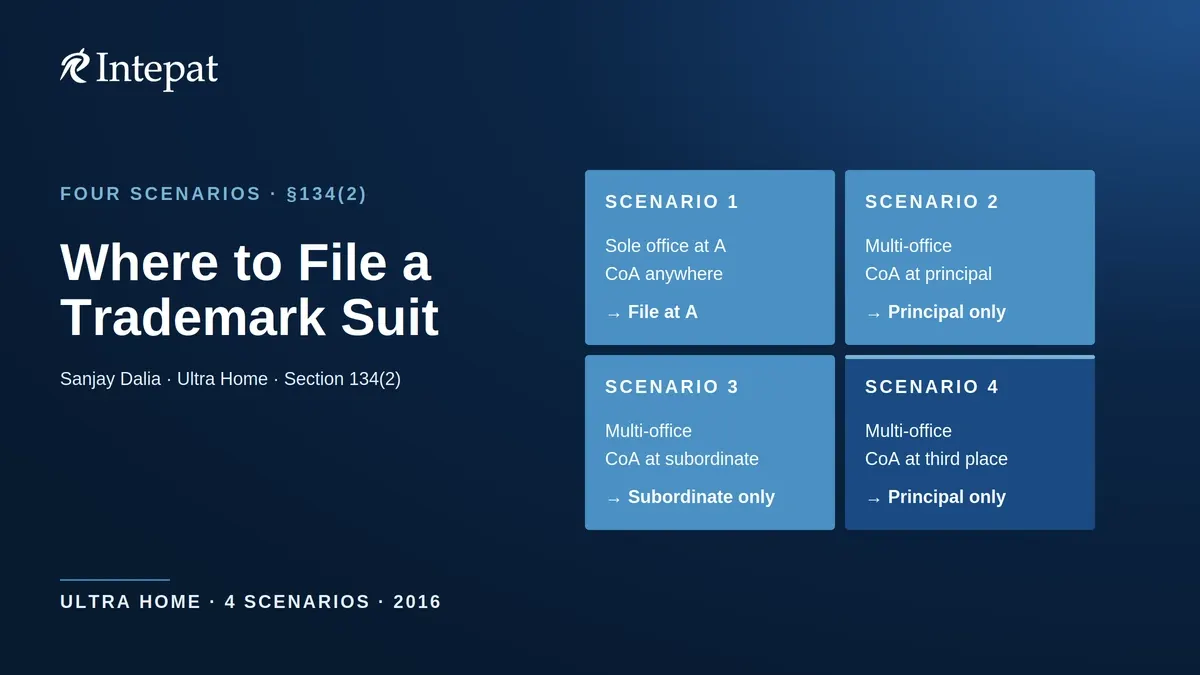
The Delhi High Court Division Bench in Ultra Home Construction Pvt Ltd v. Purushottam Kumar Chaubey, FAO (OS) 494/2015, decided on 20 January 2016, applied Sanjay Dalia to set out four scenarios for a corporate plaintiff:
| Plaintiff’s offices | Where cause of action arose | Section 134(2) forum |
| Sole office at A | Anywhere | A |
| Principal at A, subordinate at B | At A (the principal office place) | A only; the plaintiff cannot rely on B |
| Principal at A, subordinate at B | At B (the subordinate office place) | B only; the plaintiff cannot rely on A |
| Principal at A, subordinate at B | At a third place C | A only; B is barred under Section 134(2) |
Two worked examples illustrate the framework.
Example 1: single-office plaintiff. A company has its sole registered office at Hyderabad. Infringement is being committed by a retailer based at Bengaluru. The plaintiff may sue at Hyderabad under Section 134(2), or at Bengaluru under Section 20 of the Code of Civil Procedure. Both forums are open; the plaintiff chooses.
Example 2: multi-office plaintiff, third-place cause of action. A consumer goods company has its head office at Mumbai and a branch office at Delhi. Infringement is being committed at Bengaluru, where the plaintiff has no office. The plaintiff may sue at Mumbai (principal office, under Section 134(2)) or at Bengaluru (place of the cause of action, under Section 20 of the Code of Civil Procedure). The plaintiff cannot sue at Delhi merely because of the branch office, because Delhi is neither the principal office nor the place where the cause of action arose. This is the Scenario 4 case in the Ultra Home framework.
When the Commercial Courts Act 2015 changes who hears the suit
A District Court having jurisdiction under Section 134 is not, in many cases, the regular District Judge’s bench. The Commercial Courts Act 2015 sits across the trademark statute and controls which court within the hierarchy actually hears a substantial IP suit.
Section 2(1)(c)(xvii) of the Commercial Courts Act lists disputes relating to intellectual property rights, including trademark disputes, as a “commercial dispute.” The 2018 amendment reduced the specified value threshold from Rs 1 crore to Rs 3 lakh. Where the specified value of the subject matter is at least Rs 3 lakh, the suit must be instituted before a Commercial Court designated under Section 3, or, where applicable, before the Commercial Division of a High Court that exercises ordinary original civil jurisdiction (Delhi, Bombay, Calcutta, Madras). Routing within the original-side hierarchy turns on territorial nexus, valuation, the Commercial Division rules, and (where notified) the Intellectual Property Division rules of the relevant High Court; current local practice should be confirmed before filing.
The interplay with Section 134 is not fully settled. Section 21 of the Commercial Courts Act gives the Act overriding effect over inconsistent provisions in other laws. A question has arisen whether, where a state has notified Commercial Courts at the Civil Judge (Senior Division) level under Section 3, such courts can hear suits under Section 134 in light of the District Court floor in Section 134(1). The Jharkhand High Court in Khemka Food Products Pvt Ltd v. ISDS Pvt Ltd, Commercial Appeal No. 14 of 2024, decided on 8 August 2024, held that a Civil Judge (Senior Division) acting as a Commercial Court can entertain such suits, reading the Commercial Courts Act as overriding the floor. The Supreme Court has issued notice on the special leave petition; the position at the apex level is awaiting determination. Counsel should check the state notification, the specified value of the suit, and the applicable High Court practice before deciding the forum.
Section 12A of the Commercial Courts Act adds a procedural threshold. A commercial suit that does not contemplate any urgent interim relief cannot be instituted without first exhausting pre-institution mediation. The Supreme Court in Yamini Manohar v. T.K.D. Keerthi, 2023 SCC OnLine SC 1382, decided on 13 October 2023, treated this requirement as mandatory and clarified that an IP suit which genuinely seeks urgent interim relief, typically an injunction, an Anton Piller order, or an asset preservation order, is exempt. The Supreme Court added that the prayer for urgent interim relief must not be a disguise to wriggle out of Section 12A; the commercial court must examine the plaint, the documents, and the prayer to confirm the urgency is real.
Online trademark infringement jurisdiction in India
Where the alleged infringement plays out on the internet, the territorial question becomes harder. Most websites are accessible everywhere; a rule that mere accessibility confers jurisdiction would put every plaintiff at the global maximum, which the Indian courts have rejected.
Two threshold points orient the analysis. First, in a registered-mark infringement suit, Section 134(2) may independently support the plaintiff’s forum on the basis of the plaintiff’s own place of business, subject to the Sanjay Dalia and Ultra Home discipline; the Banyan Tree purposeful-availment inquiry is not strictly required to establish that forum. Second, where the plaintiff relies on online activity to show that a part of the cause of action arose in the forum, particularly under Section 20 of the Code of Civil Procedure or in pure passing off matters, the Banyan Tree test becomes determinative.
The Delhi High Court Division Bench in Banyan Tree Holding (P) Ltd v. A. Murali Krishna Reddy, 2010 (42) PTC 361 (Del), decided on 23 November 2009, settled the test. The Bench held that mere accessibility of the defendant’s website in the forum state does not confer jurisdiction on the forum court. The plaintiff must show two further elements: that the defendant purposefully availed itself of the jurisdiction of the forum by specifically targeting customers in the forum, and that this targeting resulted in commercial transactions or injury within the forum.
A passive website with no interactivity directed at the forum state will not pass the test. An interactive website that allows users in the forum to transact, supported by evidence that the defendant solicited or completed such transactions in the forum, ordinarily does. The Bench expressly displaced the earlier broader view that mere accessibility of an infringing site in the forum was sufficient.
Burger King Corporation v. Techchand Shewakramani, decided in 2018, applied a related principle under Section 20 of the Code of Civil Procedure. The court treated the defendant’s franchise-related solicitations directed at Delhi, including digital outreach and applications for approvals, as use of the mark “in relation to” goods or services in Delhi, giving the Delhi High Court territorial jurisdiction. For practical purposes, a plaintiff alleging online infringement must plead the targeting and the commercial nexus, not merely the existence of an infringing webpage accessible in the forum. The broader cross-border setting is covered in our note on cross-border trademark infringement.
A practical sequence for choosing the forum
Forum choice in a trademark infringement matter is sequential. Each step screens out forums that are not open before the next is considered. A misstep at any step risks an early dismissal under Order VII Rule 11 of the Code of Civil Procedure on grounds of jurisdiction or non-compliance with Section 12A, and the loss of valuable time in the limitation window.
- Classify the claim. Is it a registered-mark infringement claim under Section 29 (Section 134(1)(a) or (b)), a pure passing off claim (Section 134(1)(c)), or a combined claim? The classification controls whether Section 134(2) is available.
- Identify the cause of action. 侵害行為、販売、勧誘はどこで行われたか?被告はどこで取引を行ったか?オンライン上の事案については、バニヤンツリー判例の意図的な利用と商業取引の基準を適用する。
- 第20条CPCフォーラムの一覧を記載してください。 各被告はどこに居住または事業を行っているのか?訴訟原因は全部または一部がどこで発生したのか?これらの裁判所は、不正競争訴訟を含むあらゆる訴訟に対応可能です。
- 該当する場合は、第134条(2)項のフォーラムを追加してください。 登録商標に関する訴訟の場合、原告が居住している、事業を行っている、または個人的に営利目的で働いている地方裁判所を列挙してください。サンジャイ・ダリア判例およびウルトラホーム判例の原則を適用してください。訴訟原因が原告の主たる事務所所在地で発生した場合は、従属事務所の選択肢は除外してください。
- 商事裁判所法フィルターを適用してください。 商業裁判所法第12条に基づき、訴訟対象物の価値を評価する。指定された価値が30万ルピー以上の場合、訴訟の対象となる裁判所を、指定された商業裁判所、および該当する場合は、関連する高等裁判所の商業部に限定する。
- 第12A条に基づく訴訟前調停を実施するかどうかを決定する。 訴状が真に緊急の暫定的救済を求めている場合は、直接訴訟を提起することができる。そうでない場合は、訴訟提起前に事前調停を完了しなければならない。
裁判管轄の決定は、法令遵守だけでなく戦略的な側面も重要です。例えば、高等裁判所商事部と地方商事裁判所のどちらを選択するかによって、訴訟期間、暫定救済のペース、控訴手続きに影響が生じる可能性があります。私たちは、訴訟原因の証拠と求められる救済内容に基づいて利用可能な裁判管轄を洗い出し、訴状に署名する前に依頼者と選択内容を確認します。この裁判管轄分析に関連する実体的な責任の根拠については、以下の注記を参照してください。 インドにおける間接的な商標権侵害 そして 商標権侵害に対する救済措置。
訴訟提起先が決定したら、原告は訴訟提起時に以下のものを準備しておく必要があります。
- 商標登録証明書および区分詳細(更新状況を含む)
- 原告の主たる事務所および従属事務所の証明
- 被告の事業所または営業所の証拠
- 販売請求書、マーケットプレイスの出品情報、梱包写真、配送記録の侵害
- 提案されたフォーラムにおけるオンラインターゲティングの証拠(管轄権の根拠として依拠される場合)
- 商事裁判所法第12条に基づく特定価値の計算、およびそれを裏付ける評価資料
- 一方的な暫定差止命令の申し立ておよび第12A条の免除を裏付ける緊急資料
よくある質問
登録商標の侵害訴訟は、民事裁判官の法廷に提起できますか?
いいえ。1999年商標法第134条(1)項は、地方裁判所より下位の裁判所での侵害訴訟の提起を禁じています。州が2015年商事裁判所法に基づき、地方裁判所判事以上のレベルの商事裁判所を指定している場合、指定された金額が30万ルピーを超える訴訟は、その指定裁判所で審理されます。
不正競争の原告は、第134条(2)項を利用して、自身の事業所で訴訟を起こすことができるか?
いいえ。第134条(2)項は、登録商標に関する訴訟を対象とする第134条(1)項(a)号および(b)号の「目的のため」にのみ適用されます。(c)号に基づく純粋な不正競争訴訟は、拡大された管轄区域外であり、1908年民事訴訟法第20条に基づき管轄権を有する裁判所に提起しなければなりません。
サンジェイ・ダリア事件の後、原告は支店で訴訟を起こすことができるのか?
訴訟原因が同じ場所で発生した場合に限ります。最高裁判所は、IPRS v. Sanjay Dalia (2015) において、訴訟原因が原告の主たる事務所で発生した場合、原告は第 134 条 (2) に基づいて別の都市にある下位事務所に訴訟を提起するために、その下位事務所に依拠することはできないと判示しました。
2015年商事裁判所法は、すべての商標権侵害訴訟に適用されるのか?
これは、2018年の改正で基準額が1,000万ルピーから30万ルピーに引き下げられた後、指定された値が少なくとも30万ルピーの場合に適用されます。それ以下では、デリー高等裁判所の二審法廷が Pankaj Ravjibhai Patel v. SSS Pharmachem (2023) において、知的財産訴訟は自動的に商事裁判所に送られるわけではなく、管轄裁判所が人為的な評価を精査できると判断しました。
第12A条に基づく訴訟提起前の調停は、訴訟提起前に必ず必要な手続きですか?
いいえ。最高裁判所は、Yamini Manohar 対 TKD Keerthi 事件 (2023 年) において、商事裁判所法第 12A 条に基づく訴訟提起前の調停は、訴訟が真に緊急の暫定的救済を求めている場合を除き、義務であると判示しました。商事裁判所は、訴状と請求内容を精査し、緊急性が真実であり、調停を回避するための手段ではないことを確認しなければなりません。
商標権侵害と不正競争の訴えを同一の訴訟で同時に提起することは可能ですか?
はい。インドの裁判所は、同一の事実に基づいて、商標法第29条に基づく侵害請求と不正競争請求を併合した訴状を日常的に受理しています。デリー高等裁判所は、Burger King v. Techchand (2018) 事件において、商標法第134条(2)または民事訴訟法第20条に基づき管轄権が存在する場合、併合された請求は有効であると確認しました。
純粋にオンラインで事業を行っている企業は、第134条(2)項に基づく「事業を営んでいる」という要件を満たすでしょうか?
受動的なオンラインプレゼンスでは通常、認められません。裁判所は「事業を営む」とは、その場所に確立された商業拠点があり、実際に商品やサービスがそこで提供または供給されていることを意味すると解釈します。フルフィルメント、マーケティング、顧客契約など、その場所と運営上のつながりを持つeコマース事業は、第134条(2)項の適用を受けるためのより強力な主張権を有します。
免責事項
本記事は一般的な情報提供のみを目的としており、法的助言を構成するものではありません。商標権侵害訴訟における裁判管轄の選択は、登録内容、訴訟原因、対象物の特定価額、当事者の立場など、個々の事案の具体的な事実関係によって決まります。読者は訴訟提起前に、資格を有する弁護士に相談してください。本稿で述べた立場は2026年6月時点のものであり、1999年商標法、1908年民事訴訟法、改正後の2015年商事裁判所法、および引用されている判例を反映したものです。