




インドの著作権法は、オリジナルの文学作品、演劇作品、音楽作品、美術作品、映画作品、録音物を保護します。 1957年著作権法. 著作物が有形物として創作された瞬間に、著作権は自動的に保護されます。登録は任意ですが、所有権の明白な証拠となり、権利行使を強化します。
このガイドは、法律が実際に何を保護しているのか、誰が権利を所有しているのか、保護期間はどのくらいなのか、そして自分の作品がコピーされた場合にどうすればよいのかを理解したいクリエイターや小規模事業者(作家、ミュージシャン、デザイナー、写真家、ソフトウェア開発者、コンテンツクリエイターなど)向けに書かれています。参照されているのは、インドで現在施行されている1957年著作権法および2013年著作権規則です。
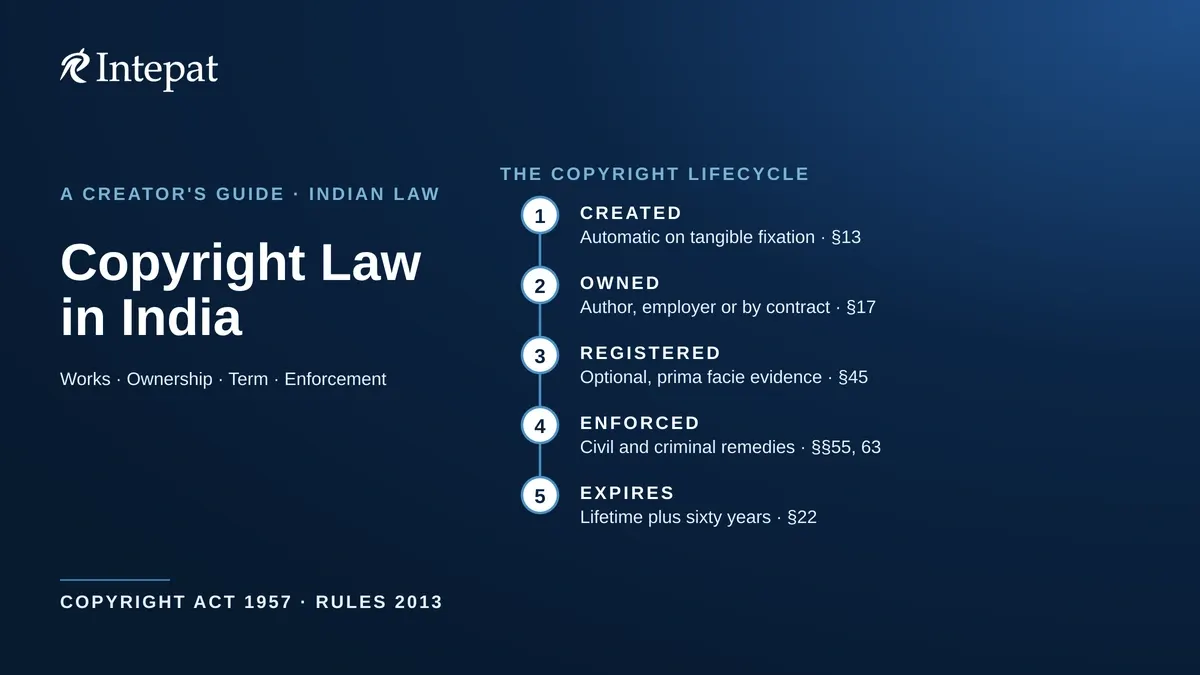
| 簡単な回答:インドにおける著作権法(60秒で解説) |
| 著作権は、アイデアそのものではなく、アイデアが有形的な形で表現されたものを保護するものである。 |
| 保護は作成時に自動的に付与されます。シンボル、登録、通知は一切不要です。 |
| 通常は著者が最初の所有者ですが、雇用、委託、契約によって状況が変わる場合があります。署名する内容をよく読んでください。 |
| 文学作品、演劇作品、音楽作品、美術作品の著作権保護期間は、著者の死後60年とする。映画および録音作品の著作権保護期間は、初版発行から60年とする。 |
| 登録は任意ですが、一応の証拠となり、商業的に価値のある作品の場合は登録する価値があります。 |
| 執行手段としては、プラットフォームの閉鎖、民事訴訟、輸入に対する税関措置、商業規模の事件における刑事告訴などが挙げられる。 |
インドの著作権法は実際には何を保護しているのでしょうか?
1957年著作権法第13条(1)項は、著作権が成立する作品の3つのカテゴリーを規定しています。オリジナルの文学作品、演劇作品、音楽作品、美術作品、映画作品、録音物です。著作権は、インドで利用可能な4つの知的財産制度の1つです。著作権、商標、意匠、特許のどれがあなたの作品の適切な保護であるか不明な場合は、当社のガイドを参照してください。 商標、著作権、特許の違い それぞれがどのような場面で適用されるかを説明します。
2つの考え方を詳しく見ていく必要があります。まず、「オリジナル」とは、宇宙的な意味で斬新またはユニークという意味ではありません。インドの裁判所は、 独創 作者に最低限の技能、労力、判断力が求められるのであって、絶対的な斬新さは求められない。旅行記、携帯電話で録音した歌、紙にスケッチしたロゴなど、作者自身の作品であり、他からコピーしたものでなければ、すべて対象となる。基準は確かに存在するが、高くはない。
第二に、著作権は 表現 アイデアそのものではなく、アイデアの著作権です。コーヒーミーティングで共有されたストーリーの概要には著作権はありません。その概要に基づいて書かれた小説には著作権があります。 アイデアと表現の二分法 これはインドにおける確立された司法原則であり、自分のアイデアが「盗まれた」と感じるクリエイターの間で最もよく混乱を招く原因となっている。法的救済手段は、アイデアが具体的な形で固定された後にのみ存在する。
第2条の定義は、各カテゴリーの範囲を拡大する。「文学作品」には、コンピュータプログラム、表、およびコンピュータデータベースを含む編集物が含まれる(第2条(o))。「美術作品」には、絵画、彫刻、図面(図表、地図、チャートを含む)、版画、写真、建築作品、およびその他の美術工芸品が含まれ、それらが芸術的品質を有するか否かは問わない(第2条(c))。「それらが芸術的品質を有するか否か」という限定条件は意図的なものであり、本法は作品が優れた芸術であるかどうかを問うのではなく、それが認められたカテゴリーに該当するかどうかのみを問うている。
著作権の対象外となる作品も存在します。著作権法第15条(1)項によれば、2000年意匠法に基づいて登録された意匠には、著作権は発生しません。意匠法に基づいて登録可能な意匠であっても登録されていない場合、第15条(2)項では、原本となる物品が工業的プロセスによって50回以上複製された時点で、その意匠の著作権は消滅すると規定されています。したがって、製品デザイナーは大量生産される意匠について、著作権のみに頼ることはできません。このカテゴリーにおいては、意匠登録が適切な手段となります。
あなたの作品の著作権は誰が所有していますか?
第17条に基づくデフォルトルールは、 著者 著作物の所有者は、その著作物の最初の所有者である。ただし、同法は、商取引において重要な例外規定を設けている。
著作者が雇用契約または徒弟契約に基づいて雇用されている過程で著作物を作成した場合、別段の合意がない限り、雇用主が最初の所有者となる(第17条(c))。ジャーナリストには別の例外規定が適用される。著作者が新聞社または雑誌社に雇用されている過程で、そこで出版する目的で文学作品、演劇作品、または美術作品を作成した場合、その出版物に関しては所有者が最初の所有者となり、著作者はその他の用途に関する権利を保持する(第17条(a))。
「雇用契約」と「業務委託契約」の区別は、契約書に記載されている名称によって決まるものではありません。インドの裁判所は、業務の遂行方法の管理、依頼者の事業への統合、道具の所有権、財務リスクの負担者など、業務内容の実質を精査します。単一のプロジェクトのために雇用されたフリーランサーは、契約書に明示的に所有権の移転が規定されていない限り、通常は所有権を保持します。
第17条(b)項は、依頼を受けて制作された作品のうち、写真、絵画、肖像画、版画、映画フィルムなど、より限定された範囲の作品を対象としています。これらの作品については、契約書に別段の定めがない限り、依頼者が最初の所有者となります。したがって、結婚式の撮影を依頼された写真家は、当然には写真の所有権を持たず、依頼した家族が所有権を持ちます。一方、一般的な依頼を受けて制作されたロゴやグラフィックデザイン作品は、依頼者が代金を支払ったという理由だけで自動的に依頼者に譲渡されるわけではありません。ただし、それが第17条(b)項に規定される特定のカテゴリー(例えば、手描きの美術作品)に該当する場合、または依頼契約書に所有権が明示的に記載されている場合は除きます。
共同執筆 第2条(z)項では、2名以上の著者の共同作業によって作成された著作物であって、そのうちの1名の貢献が他の著者の貢献と区別できないものについて規定している。各共同著者は著作物全体に対する権利を有し、商業利用には通常、全員の同意が必要となる。
事業主にとっての重要な教訓は、契約が重要であるということです。従業員、フリーランサー、代理店、または請負業者によって作成された作品の著作権を所有することが事業の基盤となっている場合、業務委託契約書には、所有権について明確に書面で明記し、両当事者が署名する必要があります。第17条はデフォルトの規定を定めていますが、契約書はそれを覆します。
フリーランサーや代理店を雇う前に
- 作業開始前に所有権について書面で合意してください。第17条は、商業的な意図と一致しない可能性のあるデフォルト設定を定めています。
- 依頼を受けて制作された写真や絵画については、第17条(b)項に基づき、依頼者が原則として所有権を有します。その他のほとんどの種類の作品(ソフトウェア、イラスト、コピーライティング、およびほとんどのロゴ制作を含む)については、契約書に別段の定めがない限り、フリーランサーが所有権を有します。
- 有効な譲渡契約書には、作品を特定し、譲渡される権利、譲渡期間、地域、および支払われるロイヤリティを記載しなければならない(第19条)。
- 「すべての権利、永久、全世界」という表現は、ライセンスではなく譲渡を意味します。意図する関係性に応じて適切な言葉を使用してください。
- 期間が明記されていない場合、法律上は5年間とみなされる。地域が明記されていない場合は、インドのみとみなされる。両方とも明記すること。
インドにおける著作権の有効期間はどれくらいですか?
保護期間は作品の種類によって異なります。法律第5章にその規定が定められています。以下の表は、創作者にとって最も重要なカテゴリーにおける保護期間をまとめたものです。
| 仕事の種類 | 学期 | ソース |
| 文学作品、演劇作品、音楽作品、美術作品(著者の生前に出版されたもの) | 著者の存命期間に、著者の死後翌年の暦年から60年を加えた期間 | 第22条 |
| 映画フィルム | 初版発行年の翌年から60年後 | 第26条 |
| 音声録音 | 初版発行年の翌年から60年後 | 第27条 |
| 匿名および偽名作品 | 出版から60年(または、期間内に著者の身元が公表された場合は、著者の死亡から60年) | 第23条 |
| 遺作 | 初版発行の翌年から60年後 | 第24条 |
| Government works | Sixty years from the calendar year following first publication | Section 28 |
For a work of joint authorship in the literary, dramatic, musical, or artistic categories, the sixty-year clock runs from the death of the author who dies last (Section 22, Explanation).
Once the term expires, the work enters the public domain. Anyone is free to reproduce, adapt, or perform it, subject to any moral rights that continue to apply under Section 57, which the authors legal representatives may exercise.
Should you register your copyright?
Registration is optional. Under Indian law, copyright arises automatically the moment a work is created in tangible form, and Section 45 makes registration permissive (‘may,’ not ‘shall’). A work is protected whether or not it sits on the Register of Copyrights.
That said, registration provides three real advantages.
First, evidence. Section 48 makes entries in the Register of Copyrights prima facie evidence of the particulars recorded, and certified extracts are admissible in court without further proof. This is a useful evidentiary advantage in an infringement suit, although it is not conclusive: the presumption is rebuttable on contrary proof.
Second, deterrence. A registration certificate is a tangible document a creator can show to a publisher, a licensee, or a counterparty considering misappropriation.
Third, customs and platform takedowns. Section 53 enables a copyright owner to give the Commissioner of Customs notice to treat infringing imports as prohibited goods. Online platforms accustomed to acting on copyright notices also tend to act faster on properly documented claims.
The copyright registration procedure in India is governed by Rule 70 of the Copyright Rules 2013. The application is filed on Form XIV, one work per application, signed by the applicant. Filing is in person, by post, or online through the Copyright Office portal at copyright.gov.in. The supporting documents depend on the type of work:
| Filing scenario | Key supporting document |
| Literary, dramatic, musical, or artistic work | A copy of the work |
| Unpublished work | Two copies of the work |
| Computer programme (software) | The first ten and last ten pages of source code, or the entire source code if it runs to less than twenty pages, with no blocked-out or redacted portions |
| Artistic work used or capable of use in relation to goods or services | A search certificate from the Trade Marks Registry confirming no identical or deceptively similar trade mark is registered or applied for by a different person |
| Application by an owner who is not the author | A No Objection Certificate from the author |
After filing, the Registrar gives notice to anyone with a claim or interest in the work. If no objection arrives within thirty days and the Registrar is satisfied with the particulars, the entry is made on the Register. Where objections do come in, the Registrar may hold an inquiry. Rule 70(13) makes clear that registration is complete only when a copy of the entries is signed and issued by the Registrar of Copyrights or a Deputy Registrar.
Government fees as specified in the Second Schedule to the Copyright Rules 2013 (verified as of May 2026):
| Work | Government fee per work |
| Literary, dramatic, musical, or artistic work | Rs 500 |
| Artistic work used or capable of use in relation to goods or services | Rs 2,000 |
| Cinematograph film | Rs 5,000 |
| Sound recording | Rs 2,000 |
These are statutory filing fees only; the cost of copyright registration in India varies where professional assistance is engaged.
Fair dealing: when others can use your work without permission
Section 52 carves out a long list of acts that do not amount to infringement. The core category is ‘fair dealing.’ Indian law uses ‘fair dealing,’ a more circumscribed concept than the American ‘fair use’ doctrine, but the underlying purpose is similar: not every unauthorised use of a copyrighted work is an infringement.
Under Section 52(1)(a), fair dealing with any work (other than a computer programme) is permitted for: private or personal use, including research; criticism or review of that work or of any other work; and the reporting of current events and current affairs, including the reporting of a lecture delivered in public.
Other Section 52 carve-outs that creators encounter often include:
- Reproduction of a work in a judicial proceeding or in a report of one (Section 52(1)(d))
- Reading or recitation in public of reasonable extracts from a published literary or dramatic work (Section 52(1)(g))
- Reproduction by a teacher or pupil in the course of instruction, or as part of an examination (Section 52(1)(i))
- Performance of a literary, dramatic, or musical work in the course of activities of an educational institution with a limited audience of staff, students, and connected persons (Section 52(1)(j))
- Making not more than three copies of a book by a non-commercial public library where the book is not available for sale in India (Section 52(1)(o))
‘Fair’ is not a fixed quantity. Indian courts assess each case on its facts, looking at indicators such as the purpose and character of the use, the nature of the original work, the amount and substantiality of what was taken, and the effect on the potential market for the original. These are judicially relevant factors, not a mechanically applied statutory four-factor test of the kind found in United States fair use law. A creator using a thirty-second clip of a film for genuine critical review stands on stronger ground than one using the same clip as background ambience in a monetised video.
Computer programmes have their own carve-outs in Section 52(1)(aa) through (ad), permitting backup copies, study of functioning to determine the underlying ideas and principles, and adaptation of a legally obtained copy for non-commercial personal use.
What counts as infringement, and the remedies available
Section 51 sets out when copyright is infringed. The two limbs that matter for most creators are:
- A person doing anything that only the copyright owner has the exclusive right to do, without licence (Section 51(a)(i))
- A person, by way of trade, making, selling, distributing, exhibiting in public, or importing infringing copies (Section 51(b))
Both civil and criminal remedies are available, and the two routes are often pursued in parallel.
Civil remedies (Section 55). A copyright owner can sue for an injunction, damages, accounts of profits, and delivery up of infringing copies. Section 62 permits the suit to be filed in a district court within whose jurisdiction the plaintiff actually and voluntarily resides, carries on business, or personally works for gain, a notable departure from ordinary civil procedure. This special forum, however, is not unlimited. In Indian Performing Rights Society Ltd. v. Sanjay Dalia, (2015) 10 SCC 161, the Supreme Court held that where the plaintiff has a principal office and a subordinate office, and the cause of action arose at or near the subordinate office, Section 62 does not allow the plaintiff to drag the defendant to a forum near the principal office. Section 62 provides an additional forum; it does not authorise forum shopping. Where the defendant proves they were not aware and had no reasonable ground for believing that copyright subsisted in the work, the plaintiff cannot recover damages beyond the defendants profits on the infringing sales; injunctive relief remains available.
Criminal remedies (Section 63). Knowing infringement of copyright, or abetment of such infringement, is punishable with imprisonment for a term of not less than six months which may extend to three years, and with a fine of not less than fifty thousand rupees which may extend to two lakh rupees. The court may impose a lower sentence only where the infringement was not made for gain in the course of trade or business and adequate and special reasons are recorded in the judgment.
Section 63A applies enhanced penalties for second and subsequent convictions: imprisonment of one to three years and fine of one to two lakh rupees. Section 63B covers the specific case of knowingly using an infringing copy of a computer programme on a computer, with imprisonment from seven days to three years and a fine from fifty thousand to two lakh rupees, and a discretion to impose no jail term where the use was not commercial.
A police officer not below the rank of sub-inspector may seize infringing copies without warrant under Section 64 where satisfied that a Section 63 offence has been, is being, or is likely to be committed.
Two further provisions are worth knowing. Section 65A penalises the circumvention of effective technological measures applied to protect copyrighted works. Section 65B penalises tampering with rights management information. Together, these form Indias anti-circumvention regime and broadly align Indian copyright law with the WIPO Internet Treaties.
If someone copies your work online
- Document the infringement. Screenshots with the URL and date, downloaded copies of the infringing content, and the platforms reference number for any complaint.
- Send a take-down notice to the platform. Most major platforms (Meta, Google, YouTube, Amazon) have copyright-claim forms.
- A cease-and-desist letter to the infringer, served on a legally identifiable address, often stops ongoing infringement before litigation.
- For substantial commercial infringement, consider a civil suit under Section 55 seeking injunction, damages or accounts of profits, and delivery up. Add a criminal complaint under Section 63 where the infringement is knowing and on a commercial scale.
- Customs action under Section 53 requires a notice to the Commissioner of Customs treating infringing imports as prohibited goods.
Assignment and licensing of copyright
Copyright is freely transferable. The owner can assign the copyright outright under Section 18 or grant a licence permitting specified uses under Section 30. Both transactions have statutory form requirements that creators routinely overlook.
Under Section 19 (see also our guide on the copyright assignment agreement in India), an assignment is valid only if:
- It is in writing and signed by the assignor or a duly authorised agent
- It identifies the work
- It specifies the rights assigned, the duration of the assignment, and its territorial extent
- It specifies the amount of royalty and any other consideration payable
Three default rules fill gaps in poorly drafted assignments. If duration is not stated, the assignment is deemed to last five years from its date (Section 19(5)). If territory is not specified, it is presumed to extend within India only (Section 19(6)). If the assignee does not exercise the rights within one year from the date of assignment, the assignment is deemed to have lapsed in respect of those rights unless the contract specifies otherwise (Section 19(4)).
A licence differs from an assignment in that it permits use without transferring ownership. The same Section 19 framework applies to licences through Section 30A. An exclusive licence (defined in Section 2(j)) confers a right to the exclusion of all other persons, including the copyright owner. A non-exclusive licence leaves the owner free to grant similar rights to others.
クリエイターが出版社、アグリゲーター、プラットフォームに作品を提供する際、実用的なアドバイスは簡潔です。契約書をよく読んでください。「すべての権利を永久に世界中で譲渡する」という条項は、ライセンスではなく譲渡です。関係を限定する場合(インドでの出版は5年間、音声権と商品化権は保持するなど)、契約書にその旨を明記する必要があります。
| 事前情報:映画および音楽制作者 |
| 2012年著作権(改正)法は、映画および録音物の原作者の著作者に対する重要な保護を導入しました。第19条(9)項および第10条は、映画に含まれる文学作品または音楽作品、あるいは映画の一部ではない録音物の著作者は、映画館での映画上映以外のあらゆる形態で作品を利用する場合、使用料の均等な分配を請求する権利を保持すると規定しています。この使用料は、著作者の法定相続人または著作権管理団体への徴収および分配を除き、譲渡または放棄することはできません。これに反する合意は無効です。作詞家、作曲家、脚本家は、映画または録音契約の文言に関わらず、この保護が適用されることを認識しておく必要があります。 |
よくある質問
いいえ。1957年著作権法は、©マークやその他の表示を義務付けていません。著作権は、有形のオリジナル作品が創作された時点で自動的に発生します。このマークを使用することは権利を示すための良い慣習ですが、法的な前提条件ではありません。
いいえ。インドの著作権は、アイデアそのものではなく、アイデアが具体的な形で表現された後に保護されるものです。企画案、コンセプト、概要などは、書かれたり、録音されたり、描かれたり、その他の方法で表現されるまでは著作権の対象になりません。アイデアと表現の区別は、確立された判例法です。
はい。ロゴは著作権法第2条(c)項に基づき美術作品として認められ、創作時から著作権保護の対象となります。ロゴがブランド識別子としても機能する場合、1999年商標法に基づく商標登録により、別途補完的な保護が提供されます。したがって、商業的に使用されるロゴは通常、両方の制度によって保護されます。
はい。コンピュータプログラムは、著作権法第2条(o)項に規定される「著作物」であり、コンピュータプログラム、表、およびコンピュータデータベースを含むコンパイルが明示的に含まれます。ソフトウェアの著作権は、ソースコードとオブジェクトコードを保護するものであり、その根底にある機能やアイデアを保護するものではありません。アルゴリズムおよび機能の保護は、可能な場合、特許法によって規定されます。
出版された文学作品の場合、著作権は第22条に基づき、著者の生存期間に加え、著者の死亡年の翌年から60年間存続する。共同著作物の場合、著作権の存続期間は最後に死亡した著者の死亡日から起算される。
いいえ。第45条は著作権登録を任意としています。保護は創作の瞬間から存在します。登録は第48条に基づく一応の証拠となり、紛争解決に役立ちますが、保護を受けるための前提条件でも、侵害訴訟を提起するための前提条件でもありません。
複数の手段を並行して講じることが可能です。プラットフォームへの削除要請、侵害者への停止命令書、第55条に基づく差止命令および損害賠償請求訴訟、そして侵害が故意かつ商業的なものである場合には、第63条に基づく刑事告訴などが考えられます。最適な手段の組み合わせは、侵害行為の規模と侵害者の身元によって異なります。
インドはベルヌ条約およびTRIPS協定の加盟国である。加盟国はインドの著作物を内国民待遇で承認しており、インド法は国際著作権法第40条に基づき、条約加盟国の国民の著作物に対しても同様の承認を与えている。ただし、国境を越えた権利行使には、侵害行為が発生した国での措置が必要となる。
本稿は、2026年5月時点における1957年著作権法および2013年著作権規則(2026年Jan Vishwas(規定改正)法を含む)に基づく立場を反映したものです。Jan Vishwas法は、上記で説明した侵害、譲渡、または登録に関する中核的な規定に影響を与えることなく、著作権法の周辺規定(特に登録簿への虚偽記載に関する第67条)の一部を非犯罪化しました。本ガイドは一般的な情報を提供するものであり、法的助言ではありません。個々の状況については、個別の評価が必要です。ご自身の著作物、登録、または紛争に関する助言については、資格を有する知的財産専門家にご相談ください。インドの公式著作権ポータルはcopyright.gov.inにあり、法令全文はindiacode.nic.inで入手できます。