




インド国内段階に移行したすべてのPCT出願は、1970年特許法第8条に基づき、継続的な開示義務を負います。出願人は、国内段階移行後6か月以内に様式3を提出し、最初の審査報告書が発行された時点で様式3を更新し、特許庁長官の指示に対して2か月以内に回答しなければなりません。これらの義務を履行しない場合は、特許法第64条(1)(m)に基づき、特許が取り消される可能性があります。
| 簡単な回答 |
| インドで国内段階出願を実際に提出した日から6ヶ月以内に、様式3(手数料無料)を提出してください。最初の異議申立書が発行された日から3ヶ月以内に、審査官に最新情報を報告してください。様式3の提出期限を過ぎた場合は、3ヶ月の延長期間が終了する前に、様式4の猶予申請書を提出してください。. |
簡単に言うと、様式3は、インドがあなたが同じ発明を他にどこに出願しているか、そしてそれらの特許庁でどのような状況にあるかを尋ねるためのものです。PCT国内段階出願の場合、これは任意の書類ではありません。特許明細書、翻訳、出願料、およびFER応答とは別に追跡しなければならない、法定開示義務です。
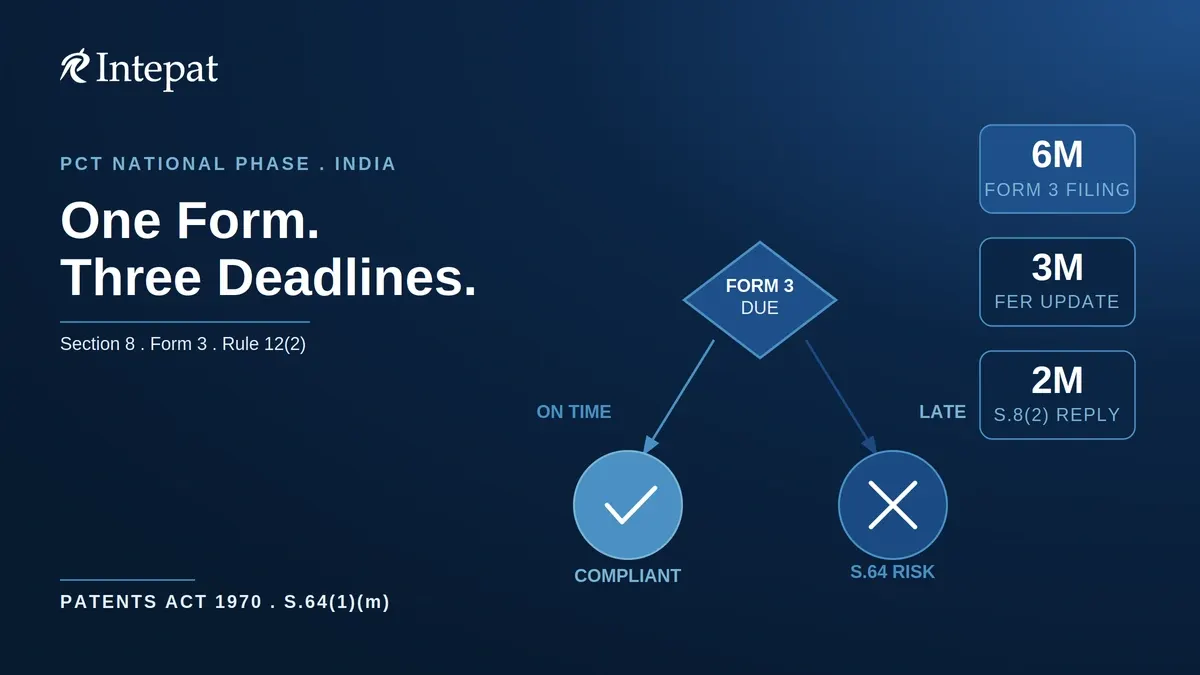
インドにおけるPCT出願人に対する第8条の要求事項
1970年特許法第8条 インド国外の国において、同一または実質的に同一の発明について出願手続きを行っている、または出願手続きを行っている人物を知っている出願人に対し、2つの異なる義務を課す。
第8条(1)(a)項に基づく最初の義務は、国名、出願番号、出願日、その他規定される事項を記載した陳述書を提出することです。第8条(1)(b)項に基づく2番目の義務は、インドにおける特許付与日まで、その後のすべての対応する外国出願について、特許庁長官に通知することを約束することです。
PCT国内段階出願の場合、両方の義務は、対応する国内段階出願がインドで実際に提出された日から適用されます。第8条の義務は、2003年特許規則第20条に基づく国内段階移行要件と並行して適用されます。国内手数料の支払いと必要な翻訳の提出は、様式3の代替ではなく、別々の手続きです。
第8条(2)項はまた、出願から特許付与までのいつでも行使できる独立した権限を特許庁長官に与え、出願人に対し、異議申し立て、補正、および認められた請求項を含む、対応する外国出願がどのように処理されているかの詳細を提供するよう指示する権限を与えている。
PCT国内段階におけるフォーム3の提出期限:6ヶ月間のカウントダウンはどのように進むのか
Rule 12 of the Patents Rules 2003 sets the Form 3 deadline at six months from the date of filing the application. For a PCT national phase application, the six-month period is reckoned from the actual date on which the corresponding application is filed in India, not from the PCT international filing date and not from the priority date.
This distinction matters in practice. A PCT application designating India has a 31-month national phase entry window running from the priority date under Rule 20(4)(i). An applicant who enters the Indian national phase early gets six months from that early entry date; an applicant who waits until month 30 gets six months from that later date. In both cases the clock starts at the actual Indian filing.
Form 3 carries no fee when filed within the prescribed period. The First Schedule to the Patents Rules 2003 sets the fee for filing a statement and undertaking under Section 8 as nil for all applicant categories, whether filed electronically or physically (verified as of July 2026). The form requires the applicant to list every application for the same or substantially the same invention filed outside India as at the date of filing, with application numbers, filing dates, and current status.
Foreign counsel filing across multiple offices should note that the Section 8 obligation in India is broader than the duty to disclose prior art that applies in some other jurisdictions. It extends to all corresponding foreign applications, not only those that have generated search reports or office actions. An applicant who has entered the national phase in the US, EP, and Japan, as well as India, must list all three in Form 3 and keep the Indian Controller updated on each of them.
The continuing duty: when you must update Form 3 after the FER
The Section 8(1)(b) undertaking does not expire on filing Form 3. It requires the applicant to keep the Controller informed of every subsequent corresponding foreign application until the date of grant in India.
Rule 12(2) (as amended by the Patents (Amendment) Rules, 2024) sets a specific trigger for this update obligation: the applicant must keep the Controller informed of details in respect of other applications filed in any country within three months from the date of issuance of the first statement of objections under Rule 24B(3) or Rule 24C(8). When the first examination report is issued on the Indian national phase application, the applicant has three months from that date to update the particulars of corresponding foreign applications filed up to that point, covering application numbers, countries, filing dates, and current status.
This Rule 12(2) update covers application-level particulars. It is distinct from a direction the Controller may separately issue under Section 8(2), which can require the applicant to furnish prosecution details such as search and examination reports, objections raised, amendments made, and claims allowed or refused in corresponding foreign applications. A Section 8(2) direction, if issued, must be responded to within two months from the date of the Controllers communication.
This three-month update window is shorter than the six-month window to put the application in order under Rule 24B. Applicants managing parallel prosecution in multiple jurisdictions should diarise the Form 3 update obligation as a separate action item alongside the FER response, not as a step within it.
Where the Indian Patent Office can access documents through the WIPO Centralized Access to Search and Examination (WIPO CASE) system, it may not require the applicant to physically resubmit documents that are available there, provided the applicant has filed a statement confirming availability. Per section 09.03.06 of the Manual of Patent Office Practice and Procedure, examiners are guided to check WIPO CASE before requiring further information under Section 8(2). This reduces the document burden in practice, but does not waive the Form 3 filing obligation or its deadline.
What happens if you miss the Form 3 deadline
The condonation and extension provision in Rule 12 of the Patents Rules 2003 permits the Controller to condone the delay or extend the time for filing Form 3 by up to three months, on a petition made in Form 4. The fee for this Form 4 request is prescribed in the First Schedule to the Patents Rules 2003: Rs 2,000 per month for natural persons, startups, small entities, and educational institutions filing electronically; Rs 10,000 per month for other applicants filing electronically; Rs 2,200 per month for natural persons, startups, small entities, and educational institutions filing physically; and Rs 11,000 per month for other applicants filing physically (verified as of July 2026).
The three-month condonation window is the only relief mechanism the Rules provide for a missed Form 3 deadline. Rule 137(2) of the Patents Rules 2003 expressly excludes the general extension mechanism under Rule 138 from applying to this condonation. There is no provision for a further extension after the three-month window closes. An applicant who misses the six-month period without filing a Form 4 petition within three months has left the delay unresolved.
The consequence of non-compliance is serious. Section 64(1)(m) of the Patents Act 1970 provides that a patent may be revoked on a petition of any person interested or of the Central Government, or on a counter-claim in a suit for infringement, where the applicant has failed to disclose to the Controller the information required by Section 8 or has furnished information which in any material particular was false to his knowledge.
Indian courts have interpreted this ground with some nuance. The revocation remedy under Section 64(1)(m) is discretionary: the word “may” in Section 64 means a court is not obliged to revoke solely and automatically on proof of non-compliance. Courts have considered whether the non-disclosure was deliberate or wilful and whether the undisclosed information was material to the grant.
These court decisions are defences against revocation after the event, not a substitute for timely filing. A granted patent carrying an unresolved Section 8 defect remains exposed to challenge at any point before expiry. Foreign applicants should not rely on the discretionary element of the revocation provision as a reason to treat the Section 8 timeline loosely.
Filing Form 3: what the form covers and how to submit it
Form 3 is a two-part document. The first part is the statement required under Section 8(1)(a): a list of every corresponding foreign application, with application number, country, filing date, and current status. The second part is the undertaking required under Section 8(1)(b): a commitment to keep the Controller informed of future corresponding applications until the date of grant in India.
For PCT national phase applications, the form is filed through the Indian Patent Office e-filing portal under the national phase application number. The form can be submitted along with the Form 1 national phase application at entry, or as a standalone filing within the six-month window. Where the PCT international application is the earliest application and there are no other corresponding national filings as at entry, the form is completed with the international application details alone; the undertaking then covers any subsequent national or regional entries.
Subsequent updates required under Rule 12(2) are filed as a fresh Form 3 submission under the same application number. No additional fee applies to timely subsequent filings. Applicants relying on WIPO CASE or WIPO DAS availability should include a statement in their Form 3 identifying the documents accessible through those systems and the relevant access codes.
For the full national phase entry procedure in India, including the 31-month deadline and the fee structure at entry, those articles cover the entry requirements alongside which the Form 3 obligation runs. The PCT overview covers the international phase in full.
What to include in Form 3: a PCT filing reference
Before filing or updating Form 3 for a PCT national phase application in India, confirm the following details are available:
- PCT国際出願番号および国際出願日。
- 優先権出願の詳細(国、出願番号、出願日)。
- 既に提出済みのすべての国別または地域別の段階申請について、申請番号、国または管轄機関、申請日、および現在のステータスを記載します。
- 該当する出願の公開日および廃棄日(入手可能な場合)。
- 規則12(2)に基づいて更新する場合、インドで最初の検査報告書が発行された日付。
- 統制官が第8条(2)項に基づき、訴追の詳細を要求する別の指示を出したかどうか。
- フォーム3の提出期限である6ヶ月が経過しており、フォーム4による期限延長申請が必要かどうか。
よくある質問
はい、実際にはその通りです。インドにおけるPCT国内段階出願の場合、様式3には、PCT国際出願の詳細、および出願時に判明している対応する外国、国内、または地域出願を開示する必要があります。個別の国内または地域出願がまだ存在しない場合でも、誓約書は提出し、後日対応する出願が行われた際には更新する必要があります。
2003年特許規則第12条(1A)に基づき、期限はインドにおける対応する国内段階出願の実際の提出日から6か月です。この期間は、PCT国際出願日または優先日からではなく、インドでの出願日から起算されます。
期限内に提出された様式3には手数料は規定されていません。2003年特許規則の第一付則では、すべての申請者区分において手数料は無料とされています。手数料は様式4による猶予申請にのみ適用され、個人、スタートアップ企業、小規模事業体、教育機関(電子申請)の場合は月額2,000ルピー、その他の申請者(電子申請)の場合は月額10,000ルピーとなります。
2003年特許規則第12条(2)では、出願人は、規則24B(3)または規則24C(8)に基づく最初の異議申立書の発行日から3か月以内に、特許庁長官に通知しなければならないと規定されている。通知の発端は、インド出願に関する最初の審査報告書の発行であり、3か月の期間はその日から起算される。
いいえ。WIPO CASEは、インド特許庁が対応する外国出願の調査および審査書類にアクセスすることを可能にし、第8条(2)項に基づき同庁が要求する事項を軽減する可能性があります。ただし、規則12に基づく様式3の提出期限、または第8条(1)項に基づく最初の陳述書および誓約書の提出義務を免除または延長するものではありません。
1970年特許法第64条(1)(m)項に基づき、第8条で要求される情報の開示を怠った場合、特許取消事由となる。救済措置は裁量によるものであり、インドの裁判所は故意性と重要性が考慮されると判断している。第8条の不備が未解決のまま付与された特許は、利害関係者または中央政府による異議申し立ての対象となる。
2003年特許規則第12条では、特許庁長官は、様式4による申立てに基づき、様式3の提出期限を最大3か月まで延長または遅延を容認することを認めている。この期間が終了すると、それ以上の延長は認められない。期限を過ぎてしまった出願人は、この3か月以内に速やかに様式4による申立てを提出しなければならない。
本記事は、2026年7月時点のインドにおけるPCT国内段階出願に関する第8条開示および様式3の規定を説明するものであり、一般的な情報提供のみを目的としています。法的助言ではありません。政府の手数料、様式、手続きは変更される可能性がありますので、出願前にインド特許庁で最新の情報をご確認ください。個々の出願に関する助言については、登録特許代理人にご相談ください。この分野の期限は厳格であり、期限を過ぎると権利を失う可能性があります。ここに記載されている数値と期間は目安であり、変更される可能性がありますので、最新の情報を確認せずに特定の出願に利用しないでください。
CMSへの注記:免除規定に関する規則12の細則番号は、公表前に官報で確認する必要があります。第一付則は細則(4)を参照しており、規則137(2)は細則(5)を参照しています。官報で確認されるまでは、記述による引用とします。